By Ramachandran Rajeev Kumar — 2026-01-08
Bharath Manthan - Episode 10
By Ramachandran Rajeev Kumar
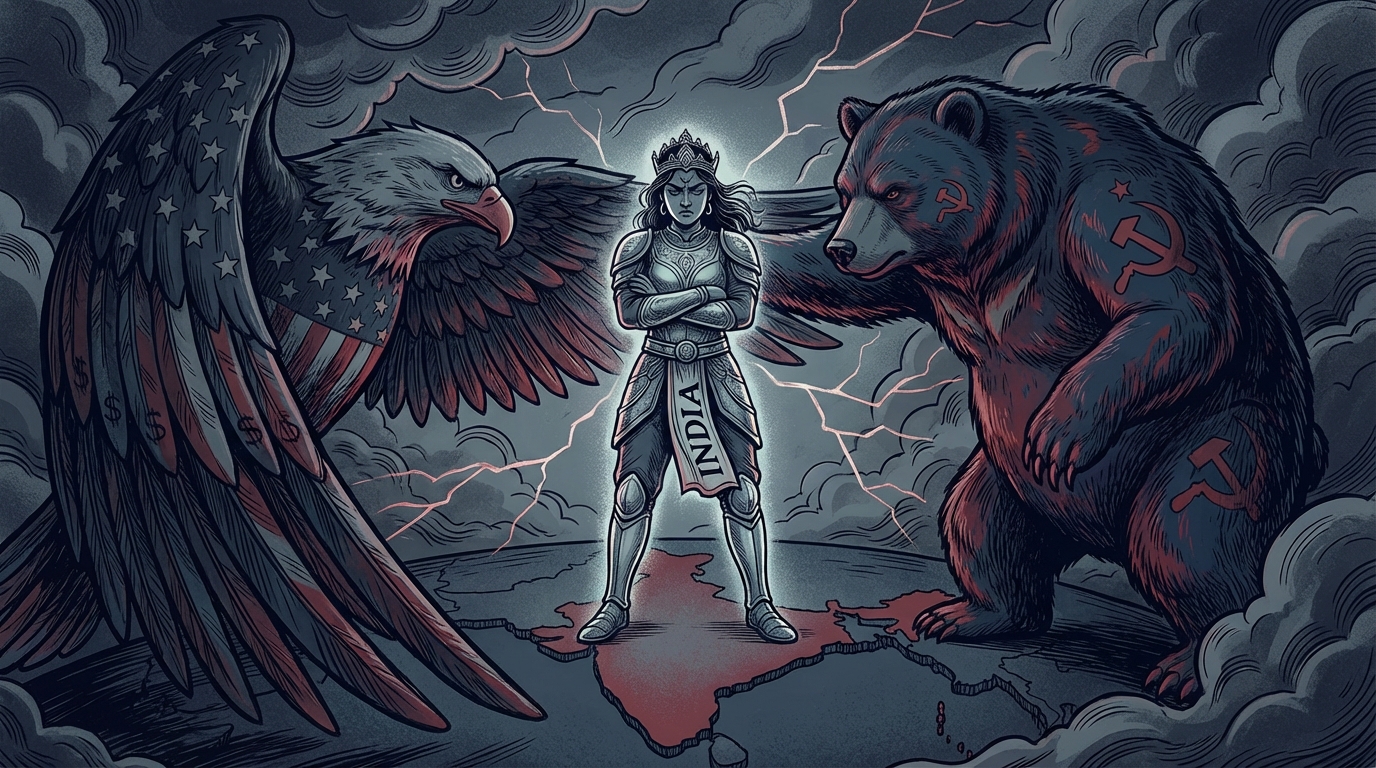
The Trump Tax: Strategic Autonomy Under Fire
When both superpowers squeeze, what remains of independence?
In the mythology of Indian foreign policy, there is a sacred phrase: strategic autonomy.
It means India charts its own course. It means we buy weapons from Russia while conducting naval exercises with America. It means we join the Quad while chairing BRICS. It means we refuse to be anyone's junior partner, anyone's satellite, anyone's pawn.
For seven decades, this doctrine has served India well. Through the Cold War, through the unipolar moment, through the rise of China - India maintained its independence by playing all sides, committing to none.
But in January 2026, strategic autonomy faces its greatest test since Nehru first articulated non-alignment.
The bill has come due. And it is denominated in dollars.
The Three Hammers
In the first week of 2026, three blows fell in quick succession.
First, the tariffs. Since August 2025, Indian exports to the United States have faced a 50% tariff wall. Not targeted tariffs on specific goods. Not retaliatory tariffs for specific grievances. A blanket tax on Indian commerce - the "Trump Tax" - imposed because America's president believes trade deficits are theft and tariffs are the cure.
The United States is India's largest trading partner. In fiscal year 2025, we exported $77 billion worth of goods to America - pharmaceuticals, IT services, textiles, gems, machinery. Every one of those dollars now costs 50% more for American buyers.
The impact has been brutal. Indian textile exports to the US fell 23% in the fourth quarter of 2025. Pharmaceutical margins have been squeezed to breaking point. IT services companies are relocating operations to Mexico and Eastern Europe. The rupee, which had been strengthening against the dollar, reversed course and breached 87.
Second, the sanctions threat. On January 8th, President Trump endorsed a bipartisan Senate bill to impose sanctions on any country purchasing Russian oil above a price cap. Senator Lindsey Graham announced that Trump had "greenlit" the legislation.
India currently imports 38% of Russia's crude oil exports. We are, by some measures, Moscow's largest oil customer. This discounted Russian crude - purchased at $20-30 below market rates - has saved India an estimated $15 billion since 2022. It has kept inflation in check, subsidized our fuel prices, and given our refineries feedstock at prices China and Europe can only envy.
If the sanctions bill passes, every Indian refinery processing Russian crude becomes a target. Every bank financing those purchases becomes a target. Every shipping company carrying those barrels becomes a target.
Third, the visa squeeze. The H-1B visa program - the golden ticket that has sent 400,000 Indian professionals to America - is under renewed assault. Processing delays have doubled. Denial rates have tripled. The rhetoric from Washington speaks of "America First" and "protecting American jobs."
The IT services industry that built Bangalore, that turned India into the world's back office, that created a middle class from nothing - that industry depends on the ability to send engineers to client sites. Without H-1B visas, without L-1 transfers, without B-1 business travel, the model breaks.
Three hammers. Tariffs on goods. Sanctions on energy. Restrictions on people.
This is the Trump Tax on strategic autonomy.
The Illusion of Multi-Alignment
For years, India's foreign policy establishment has congratulated itself on a clever doctrine: multi-alignment.
The theory goes like this: In a multipolar world, India need not choose sides. We can maintain strategic partnerships with America AND Russia AND Europe AND the Gulf AND Southeast Asia. We can buy S-400 missiles from Moscow while purchasing MQ-9 Reaper drones from Washington. We can join the Quad to contain China while participating in BRICS alongside China. We can have our cake and eat it too.
This was always a pleasant fiction.
Multi-alignment works when the great powers are not actively competing. When America is distracted by the Middle East and Russia is content with its sphere, India can quietly build relationships with both. When China is focused on economic growth rather than territorial expansion, India can trade with Beijing while preparing for conflict.
But we do not live in such a world.
We live in a world where America demands loyalty. Where Russia demands solidarity. Where China demands submission. Where every major power is actively pressuring middle powers to choose sides.
Multi-alignment in this environment is not sophisticated diplomacy. It is wishful thinking.
The Trump administration has made this explicit. You are with us or against us. Buy Russian oil? Face sanctions. Trade with Iran? Face penalties. Maintain ties with China? Face suspicion. There is no neutral ground.
India's response has been to invoke strategic autonomy as if it were a magic spell - as if saying the words loud enough would make the pressure disappear.
It will not.
The Historical Parallel
This is not the first time India has faced pressure to choose sides.
In 1971, during the Bangladesh Liberation War, the United States sent the USS Enterprise carrier group into the Bay of Bengal to intimidate India. Nixon and Kissinger, tilting toward Pakistan, wanted to signal that America would not tolerate Indian intervention.
India did not blink. With Soviet backing, we proceeded with military operations. Bangladesh was born. The carrier group withdrew.
The lesson Indian strategists drew from this episode was that great power pressure can be resisted if you have an alternative patron. The Soviet Union balanced America. India could afford to defy Washington because Moscow had our back.
But here is what that lesson misses: India in 1971 was not economically integrated with America.
We were a closed economy. We traded little with the West. American sanctions would have hurt, but they would not have been catastrophic. Our economy was insulated by its very poverty.
Today, the United States is our largest export market. American technology powers our IT industry. American universities train our elite. American investors fund our startups. American pharmaceutical regulations determine what drugs we can sell globally.
The Soviet Union in 1971 could offer India weapons and diplomatic cover. Russia in 2026 can offer India discounted oil and some military hardware. It cannot offer India an alternative market for $77 billion in exports. It cannot offer India an alternative technology ecosystem. It cannot offer India an alternative to the dollar-based financial system.
The 1971 playbook does not work when your economy is entangled with the very power pressuring you.
The Real Cost of Russian Oil
Let us do the arithmetic on Russian crude.
India imports approximately 1.5 million barrels per day of Russian oil. At a discount of $25 per barrel below market rates, this saves India roughly $37 million per day, or $13.5 billion per year.
This is real money. It has kept petrol prices from rising. It has reduced our current account deficit. It has given Indian refineries - particularly Reliance and Nayara Energy - fat margins on processing cheap crude and selling refined products at market prices.
But what is the cost?
Cost #1: Secondary sanctions risk. The European Union has already sanctioned two ships owned by Gatik Ship Management, an Indian company, for transporting Russian oil. Nayara Energy, partly owned by Rosneft, faces EU-UK sanctions exposure. If the US sanctions bill passes, every Indian entity in the Russian oil trade becomes a target.
Cost #2: Technology denial. India desperately needs American technology - semiconductor fabrication, advanced materials, AI chips, aerospace components. Every day we remain Russia's largest oil customer, we give Washington a reason to slow-walk technology transfers, to add conditions to defense deals, to treat us as an unreliable partner.
Cost #3: Diplomatic isolation. India's abstentions on UN votes regarding Ukraine have cost us goodwill in Europe. Our continued Russian oil purchases cost us goodwill in Washington. We are seen as free-riders - enjoying the benefits of the Western security order while refusing to contribute to its defense.
Cost #4: The precedent. If India can ignore Western pressure on Russia, what message does that send about future pressure campaigns? When China invades Taiwan, will India again claim neutrality while trading with the aggressor?
The $13.5 billion we save on Russian oil is not free money. It is a loan against our strategic credibility, compounding interest daily.
What Strategic Autonomy Actually Requires
Here is the uncomfortable truth that Indian foreign policy refuses to confront: strategic autonomy is not a right. It is a capability.
You do not get to be independent because you declare yourself independent. You get to be independent because you have the economic, technological, and military capacity to resist pressure.
America can impose 50% tariffs on India because we need access to American markets more than America needs access to Indian markets. Our exports to the US represent 18% of our total exports. American exports to India represent less than 2% of American exports. The leverage is asymmetric.
America can threaten sanctions on Russian oil purchases because India depends on the dollar-based financial system. Our banks clear transactions through American correspondent banks. Our companies raise capital in dollar-denominated markets. Our foreign exchange reserves are held primarily in US Treasury securities. We are inside the dollar system, and the dollar system has an owner.
America can restrict H-1B visas because India produces more IT talent than its domestic economy can absorb. We need the American job market. America can source talent from anywhere - China, Eastern Europe, Latin America. The dependency runs one way.
Strategic autonomy requires changing these equations. It requires:
Economic diversification. India cannot be strategically autonomous while 18% of our exports go to a single market. We need trade agreements with Europe, with ASEAN, with the Gulf, with Africa. We need to reduce American market share to a level where their tariffs hurt us but do not cripple us.
Technological sovereignty. India cannot be strategically autonomous while we depend on American semiconductors, American software, American AI. The chip fabrication plants we are building with Western help are a start. But we need indigenous capacity - not because foreign technology is bad, but because dependency is dangerous.
Financial alternatives. India cannot be strategically autonomous while trapped inside the dollar system. The rupee internationalization initiative is a step. BRICS currency discussions are a step. But we are years away from a financial architecture that gives us genuine alternatives to SWIFT and dollar clearing.
Military self-reliance. India cannot be strategically autonomous while we depend on Russian engines for our fighters and American components for our warships. The Tejas program, the Dhruv helicopter, the indigenous aircraft carrier - these are the building blocks. But we remain decades behind the frontier.
Strategic autonomy is not a slogan. It is a multi-generational project. And we are still in the early chapters.
The Path Forward
So what should India do in January 2026, facing 50% tariffs and sanctions threats?
First, negotiate without illusions. A trade deal with the United States is worth pursuing. Market access matters. But we should not surrender strategic flexibility for the promise of tariff relief that can be revoked by the next presidential tweet. Any deal must be durable, enforceable, and balanced.
Second, accelerate diversification. The EU Free Trade Agreement under negotiation is more important than ever. The India-UK FTA matters. The CPTPP (Comprehensive and Progressive Agreement for Trans-Pacific Partnership) deserves serious consideration, despite our traditional FTA skepticism. We need multiple large markets, not dependency on one.
Third, build domestic capacity relentlessly. Every rupee spent on semiconductor fabs, on defense manufacturing, on renewable energy, on AI research - that is investment in future autonomy. The Atmanirbhar Bharat slogan has been mocked as protectionism. But the core insight is correct: a nation that cannot make things cannot be free.
Fourth, manage the Russian relationship carefully. The oil imports should continue - but at volumes that are defensible, with payment mechanisms that minimize sanctions exposure, and with a clear timeline for gradual reduction as alternative sources come online. We need not abandon Russia. But we need not be Moscow's largest customer either.
Fifth, strengthen the alternative poles. India chairs BRICS in 2026. Use that platform to build genuine alternatives to Western-dominated institutions - not as an "anti-Western" bloc, but as a "non-Western" option. The more alternatives exist, the less leverage any single power has.
Sixth, accept that autonomy has costs. The Trump Tax is real. We will pay higher prices for American market access. We will face restrictions on technology transfer. We will be pressured to make choices we would prefer to avoid. This is the price of independence. The question is not whether to pay it, but whether to pay it consciously and strategically.
The Lesson
The churning this episode reveals is uncomfortable: India's strategic autonomy has been, in part, a bluff.
We have enjoyed the rhetoric of independence while benefiting from the structures of American hegemony. We have proclaimed non-alignment while free-riding on the security provided by Western naval supremacy in the Indian Ocean. We have claimed the right to trade with everyone while depending on access to American markets and American technology.
The Trump Tax is a wake-up call. The bluff has been called.
This does not mean India should abandon strategic autonomy. The doctrine remains correct. A nation of 1.4 billion people, with the world's fourth-largest economy and third-largest military, should not be a satellite of any power.
But strategic autonomy must be earned, not declared. It must be built on capability, not aspiration. It requires hard choices, sustained investment, and the willingness to pay costs in the short term for freedom in the long term.
Nehru's non-alignment was possible because India was poor and irrelevant - not worth pressuring. Modi's multi-alignment was possible because the great powers were distracted. Neither condition holds today.
India is too important to ignore and too integrated to isolate. We are caught in the middle, which means we must be strong in the middle.
The Trump Tax is not an aberration. It is the new normal. American pressure will continue regardless of who sits in the White House. Chinese pressure will intensify as their power grows. Russian demands will persist as their isolation deepens.
Strategic autonomy in this environment requires something India has rarely demonstrated: strategic patience combined with strategic investment.
We must build the capabilities that make us genuinely independent - not in five years, but in twenty. We must accept short-term costs for long-term freedom. We must resist the temptation to declare victory before the battle is won.
The churning has begun. The poison and the nectar will both emerge.
The question is whether we have the wisdom to tell them apart.
Next Episode: The BRICS Gambit - India's 2026 Chairmanship and the Future of the Non-Western World
Previous Episodes:
- Episode 9: The Handshake and the Missile
- Episode 8: Does India Need to Be Vishwa Guru?
- Episode 7: The Soft Power Paradox
- Episode 6: The Education Emergency
- Episode 5: The Sanctuary Civilization
- Episode 4: The Caste Calculus
- Episode 3: The Innovation Gap
- Episode 2: One Billion Indians, One Identity
- Episode 1: The Thousand Year Mirror
The author is Founder & Editor-in-Chief of BarathVector.