By Ramachandran Rajeev Kumar — 2025-12-25
The Sanctuary Civilization: How India Became Home to the World's Persecuted
Bharath Manthan - Episode 5
By Ramachandran Rajeev Kumar
In the year 1492, Spain expelled every Jew from its territory. Those who refused to convert faced death. Thousands fled - to Portugal (which expelled them four years later), to North Africa, to the Ottoman Empire.
That same century, the Spanish Inquisition burned thousands of "heretics" at the stake. Protestants slaughtered Catholics. Catholics slaughtered Protestants. The Thirty Years' War would eventually kill eight million Europeans - roughly one-third of Germany's population - over questions of religious doctrine.
Meanwhile, in a land to the east, something extraordinary had been happening for over a thousand years.
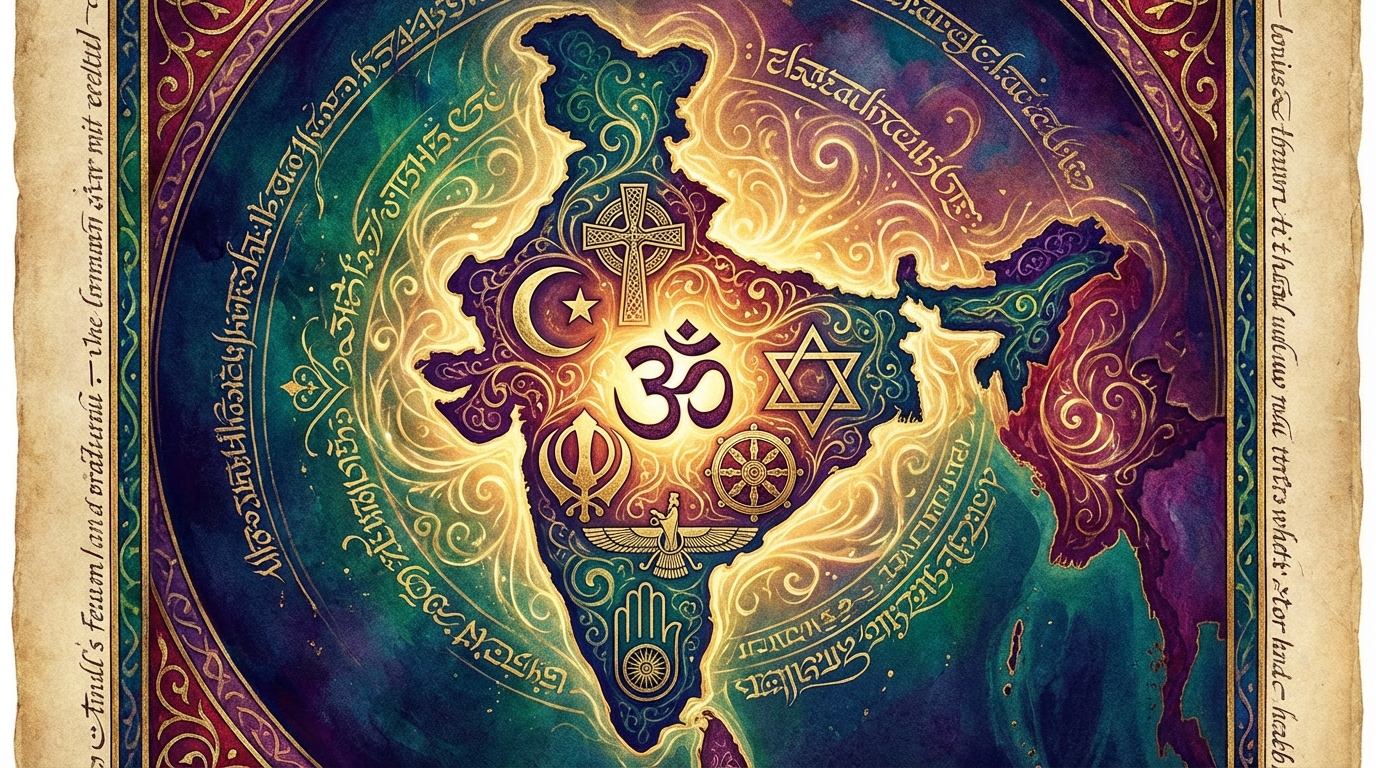
Jews had been living peacefully in Kerala since before the destruction of the Second Temple. Zoroastrians had fled Islamic Persia and been welcomed by Hindu kings. Christians traced their presence to the Apostle Thomas himself. Arab Muslim traders had built mosques with royal blessing. Buddhists and Jains had thrived alongside Hindus for millennia. And from within the tradition, Sikhism had emerged with the revolutionary declaration: "There is no Hindu, there is no Muslim."
India was not just tolerant. India was a sanctuary.
This is the story of how one civilization became home to the world's persecuted - and what that means for who we are today.
The Bowl of Milk
Let us begin with a story that every Indian child should know.
Sometime between the 8th and 10th centuries CE, a group of refugees arrived on the coast of Gujarat. They were Zoroastrians - followers of the ancient Persian prophet Zarathustra - fleeing the Islamic conquest of their homeland. Their fire temples had been destroyed. Their priests had been killed. Their children faced forced conversion.
They landed at Sanjan, a small port town, and requested an audience with the local Hindu king, Jadi Rana.
The king was skeptical. His land was already full. His people had their own customs, their own gods, their own way of life. How could he accommodate these strangers with their foreign religion?
He sent the refugees a message in the form of a bowl filled to the brim with milk. The meaning was clear: there is no room.
The Zoroastrian priests did not argue. They did not threaten. They did not demand.
Instead, they dissolved a spoonful of sugar into the milk and sent the bowl back.
The milk did not overflow. It became sweeter.
Message received.
Jadi Rana welcomed them. He gave them land. He permitted them to build their fire temples. He asked only that they explain their religion to him, adopt the local language (Gujarati), dress in local attire (the women would wear saris), conduct their rituals discreetly, and refrain from proselytizing.
The Zoroastrians agreed. They called themselves Parsis - people from Pars (Persia) - and they kept their word.
For over a thousand years.
The Parsi Miracle
What happened next is one of history's most remarkable stories of immigrant success.
The Parsis integrated without assimilating. They adopted Gujarati but preserved their scriptures. They wore saris but maintained their religious identity. They built fire temples but respected local customs.
They never tried to convert Hindus. Hindus never tried to convert them.
And they thrived.
Today, despite numbering fewer than 60,000 in India, Parsis have produced:
- The Tata family (India's largest industrial conglomerate)
- The Godrej family (consumer goods empire)
- Homi Bhabha (father of India's nuclear program)
- Sam Manekshaw (India's greatest military commander)
- Zubin Mehta (legendary conductor)
- Freddie Mercury (Queen's frontman - born Farrokh Bulsara in Zanzibar to Parsi parents)
A community that constitutes 0.006% of India's population has shaped the nation's industry, science, military, and culture beyond all proportion.
This is what happens when refugees are welcomed, not feared.
The Parsis enriched India without disrupting it - exactly as they promised with that spoonful of sugar thirteen centuries ago.
The Jews Who Never Knew Antisemitism
Now consider an even more extraordinary case.
The Cochin Jews of Kerala claim to have arrived in India as early as 562 BCE - centuries before the destruction of the Second Temple in 70 CE. Even by conservative estimates, Jews have lived continuously in Kerala for at least 2,000 years.
Two thousand years.
During this time, Jews in Europe faced:
- Expulsion from England (1290)
- Expulsion from France (1306, 1394)
- Massacres during the Black Death (1348-1351)
- Expulsion from Spain (1492)
- Pogroms in Russia (1881-1921)
- The Holocaust (1941-1945)
During this same period, Jews in India faced: nothing.
No pogroms. No expulsions. No forced conversions. No ghettos. No yellow badges. No blood libel accusations. No synagogue burnings.
The Cochin Jews received copper plates from Hindu kings granting them land, autonomy, and trading privileges. They built synagogues freely. They practiced their religion openly. They prospered as merchants and spice traders.
When asked about their experience, Cochin Jews consistently express bewilderment at European Jewish history. The concept of antisemitism was simply foreign to their experience.
As one community elder put it: "We never knew what it meant to be persecuted for being Jewish until we learned about it from books."
This is not because Indians were ignorant of Judaism. Jews lived openly, built prominent synagogues, and engaged in commerce with their Hindu and later Muslim neighbors. The tolerance was not passive ignorance - it was active acceptance.
Today, only 26 Jews remain in Kerala - most emigrated to Israel after 1948. But the synagogues still stand. The history is preserved. And the lesson endures: it was possible, for two millennia, for Jews to live without persecution.
India proved it.
The Apostle's Children
Christianity arrived in India not through colonialism, but through apostleship.
According to tradition, Thomas the Apostle - one of Jesus's twelve disciples - landed on the Malabar Coast in 52 CE. That's barely two decades after the crucifixion. Before Christianity reached most of Europe. Before the Gospels were fully compiled.
Thomas reportedly converted several high-caste Brahmin families and established seven churches along the Kerala coast. These converts became known as Syrian Christians or Nasranis - one of the oldest Christian communities in the world outside the Levant.
Did the Hindu majority persecute these early Christians? Force them to recant? Burn their churches?
No.
The Syrian Christians were integrated into the caste system at a high level. They were granted social status equivalent to Nairs (the martial aristocracy of Kerala). They owned land. They engaged in trade. They built churches with architectural elements borrowed from Hindu temples.
For 1,500 years - until the Portuguese arrived with their Inquisition in the 16th century - Indian Christians practiced their faith freely, without Roman interference, without persecution from their Hindu neighbors.
The Portuguese were shocked to find Christians in India. They were even more shocked that these Christians didn't recognize Papal authority. They attempted to "correct" Indian Christianity - with predictably violent results.
The persecution of Christians in India came from European Christians, not from Hindus.
Islam Before the Invasions
Here is a historical fact that complicates simplistic narratives: Islam arrived in India peacefully, through trade, long before any military conquest.
The Cheraman Juma Masjid in Kodungallur, Kerala, is believed to have been built in 628 CE - during the lifetime of Prophet Muhammad. If this dating is accurate, it is one of the oldest mosques in the world outside the Arabian Peninsula.
How did a mosque come to be built in Hindu-ruled Kerala in the 7th century?
Arab traders had been visiting the Malabar Coast for centuries, drawn by spices, teak, and precious stones. When some of these traders converted to Islam, they continued their commerce. They sought permission from local Hindu rulers to build mosques. Permission was granted.
According to legend, a Chera king named Cheraman Perumal witnessed a miraculous splitting of the moon, traveled to Arabia, met the Prophet, converted to Islam, and died on the journey home. His companions returned with letters requesting that the Kerala rulers permit mosque construction.
Whether or not the legend is literally true, the historical reality is clear: Hindu kings permitted and protected the earliest Islamic presence in India.
The Cheraman Juma Masjid still stands. It features traditional Kerala temple architecture - not domes and minarets. An eternal oil lamp has burned there for over a thousand years, maintained not just by Muslims but by Hindus and Christians as well.
This is what indigenous religious interaction looked like - before conquest, before communalism, before politicians learned to weaponize faith.
The Faiths That Grew Within
India didn't just welcome foreign religions. It incubated new ones.
Buddhism emerged from Hinduism in the 5th century BCE. The Buddha was born a Hindu prince. He never claimed to be founding a new religion - he was reforming existing practice. His followers built monasteries, universities (Nalanda, Vikramashila, Taxila), and spread across Asia.
Did Hindus persecute Buddhists? There were occasional conflicts - particularly between Buddhist monasteries and Brahmanical establishments competing for royal patronage. But wholesale persecution? No. Buddhism flourished in India for over a millennium before declining - primarily due to loss of royal support and absorption back into Hindu practice, not to violent suppression.
Jainism emerged around the same time as Buddhism, also from within the Hindu tradition. Jains built temples next to Hindu temples. Jain merchants prospered. Jain philosophy influenced Hindu thought. The relationship was competitive but coexistent.
Sikhism emerged in the 15th century, in the Punjab, from the teachings of Guru Nanak. His message was radical: "There is no Hindu, there is no Muslim." His first and most devoted companion, Mardana, was a Muslim who traveled with him for decades and is buried with honor in Sikh tradition.
The Guru Granth Sahib, Sikhism's holy scripture, includes verses from Hindu and Muslim saints alongside the Sikh Gurus. When Guru Nanak died, legend says his Hindu followers wanted to cremate him and his Muslim followers wanted to bury him. He told both groups to place fresh flowers beside him. In the morning, both sets of flowers were blooming and his body had vanished - unity preserved even in death.
The Conflicts We Must Acknowledge
Honest history requires acknowledging that India was not a utopia of permanent harmony.
Vaishnavites and Shaivites - followers of Vishnu and Shiva respectively - engaged in sometimes violent sectarian conflicts in medieval South India. Temples were destroyed. Priests were killed. Kings took sides.
Yet even this internal conflict eventually resolved into synthesis. The concept of Harihara - a deity who is half Vishnu, half Shiva - emerged. The Skanda Purana declares: "He who is Shiva is Vishnu, he who is Vishnu is Sadashiva." Major temples were built accommodating both traditions. Most Hindu households today worship both deities without a sense of contradiction.
The pattern was friction, followed by synthesis.
We must also acknowledge that later Islamic invasions were not peaceful. The raids of Mahmud of Ghazni, the conquests of the Delhi Sultanate, the campaigns of Aurangzeb - these involved temple destructions, forced conversions, and religious persecution. The peaceful Islam of Kerala's Arab traders was not the same as the political Islam of Turkic and Mughal conquerors.
But even here, the Indian pattern reasserted itself. Over time, Mughal emperors like Akbar embraced religious syncretism. Sufi saints became beloved by Hindus and Muslims alike. The rigid boundaries imported by conquest softened under the influence of indigenous tolerance.
India absorbed and transformed even those who came as conquerors.
Sarva Dharma Sama Bhava
In the 20th century, Mahatma Gandhi codified what had been Indian practice for millennia into a principle: Sarva Dharma Sama Bhava - equal respect for all religions.
This was not Western secularism, which separates church and state. This was something distinctly Indian: the state embraces all religions equally, rather than favoring one or rejecting all.
Gandhi's eleven vows included Sarva-Dharma-Samanatva as a moral imperative. He saw it as essential to India's integrity as a multi-religious nation.
This principle is enshrined in India's Constitution. India has no state religion. Citizens of all faiths have equal rights. Religious minorities are protected. Personal laws for different communities are respected.
At the United Nations, India's representatives have articulated this vision: "At the heart of this ethos is our principle of Sarva Dharma Sama Bhava... affirming the inherent goodness of all religions, each deserving of equal respect. Whether Zoroastrians, Buddhists, Jews, or adherents of any other belief, they have consistently found in India a sanctuary free from persecution or discrimination."
This is not nationalism. This is civilizational DNA.
The Colonial Corruption
If India had such a strong tradition of religious tolerance, why is communal violence a persistent problem today?
Part of the answer lies in colonial manipulation.
The British systematically categorized Indians by religion, conducted censuses that hardened fluid identities, and practiced "divide and rule" as explicit policy. They elevated religious difference into political identity. They created separate electorates for Hindus and Muslims. They encouraged communal organizations while suppressing unified nationalist movements.
Partition was the catastrophic result - a million dead, twelve million displaced, wounds that still bleed.
The communalism that plagues modern India is not ancient. It is surprisingly recent.
Pre-colonial India had religious conflicts, but not the systematic, politically organized communalism of the 19th and 20th centuries. That was manufactured - first by colonial administrators, then by communal politicians who found religious division more useful than national unity.
The Choice Before Us
India today stands at a crossroads.
One path leads backward - to the colonial-era politics of religious division, to the weaponization of faith for electoral gain, to defining Indian identity by exclusion rather than inclusion.
The other path leads forward - to reclaiming the civilizational inheritance of Sarva Dharma Sama Bhava, to recognizing that India's strength has always been its capacity to welcome, absorb, and synthesize.
The Parsis added sugar to the milk. The Jews found a home without persecution. The Christians of Thomas thrived for millennia. The early Muslims built mosques with Hindu royal blessing. Buddhism and Jainism and Sikhism emerged and flourished.
This is who we were. This is who we can be again.
The sanctuary civilization is not a myth. It is documented history. The question is whether we honor that inheritance or betray it.
The Lesson
Bharath Manthan churns the past for lessons applicable to the present. Here is what this history teaches:
1. Tolerance is strength, not weakness. The civilizations that welcomed diversity - India, the Ottoman Empire, medieval Spain under the Caliphate - flourished. Those that demanded uniformity - Inquisition Spain, Nazi Germany - ultimately destroyed themselves.
2. Integration without assimilation is possible. The Parsis kept their religion while adopting Indian language and dress. They remained Zoroastrian and became Indian. These identities were not contradictory.
3. Religious conflict is often political, not theological. The Vaishnavite-Shaivite conflicts were about royal patronage and institutional power, not genuine doctrinal irreconcilability. Modern communalism is about votes and power, not about gods and scriptures.
4. The indigenous pattern can reassert itself. Even after conquest and colonialism, India's tolerance tradition resurfaced. It is resilient. It can be recovered.
5. We have a choice. The sanctuary civilization is not automatic. It requires conscious commitment. Every generation must choose whether to honor or abandon it.
The Inheritance
When Zoroastrians fled Persia, they could have gone anywhere. They chose India.
When Jews faced persecution everywhere else, India was different. They stayed for two thousand years.
When the Apostle Thomas sought to spread the Gospel, he came to India. His spiritual descendants still worship here.
When Arab traders brought Islam, Hindu kings gave them land for mosques.
When the Buddha and Mahavira sought to reform religion, India gave them space to teach.
When Guru Nanak declared the unity of all faiths, India gave birth to Sikhism.
India was the sanctuary. India can be the sanctuary again.
But only if we choose to be.
"There is no Hindu, there is no Muslim." - Guru Nanak
"He who is Shiva is Vishnu." - Skanda Purana
"All religions are the same." - Gandhi's Sarva Dharma Sama Bhava
"We dissolved sugar in the milk." - The Parsis
Previous Episode: The Caste Calculus - Why India Must Abandon Caste-Based Policy
Next Episode: Coming Soon - The Education Emergency
Series Home: Bharath Manthan - Churning the Indian Pot
Ramachandran Rajeev Kumar is the founder of BarathVector. The sanctuary civilization is not just history - it is a choice we make every day.