By Ramachandran Rajeev Kumar — 2025-12-24
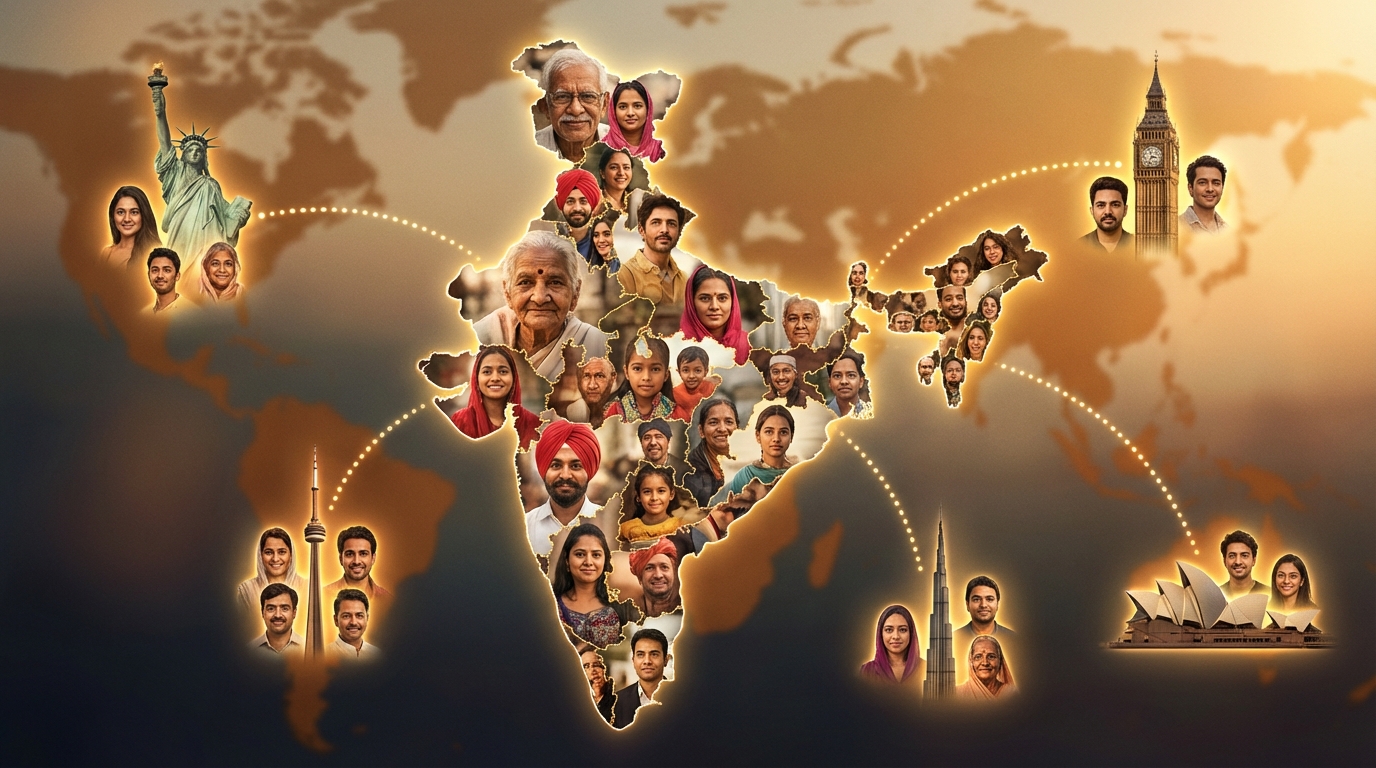
One Billion Indians, One Identity: United We Rise, Divided We Fall
Bharath Manthan - Episode 2
By Ramachandran Rajeev Kumar
There's a question that every Indian living abroad eventually faces. Sometimes it comes from a curious colleague. Sometimes from an immigration officer. Sometimes from their own children, born on foreign soil.
"Where are you from?"
The answer is never simple. We hold American passports and celebrate Diwali. We speak Tamil at home and English at work. We build Silicon Valley's future while our hearts ache for Chennai's filter coffee. We are permanent residents of countries that view us as perpetual foreigners, while the homeland sometimes questions our commitment because we left.
So where are we from?
We are from India. That has never changed. Passports are documents. Green cards are permits. Citizenship is legal status. But identity - the deep, irreducible sense of who you are - that comes from somewhere else. It comes from the civilization that shaped your ancestors for five thousand years. It comes from the values your grandmother taught you. It comes from the inexplicable lump in your throat when you hear "Vande Mataram" played in a foreign airport.
In a world carved into nation-states, where every human must belong to one flag or another, our primary identity - whether we pray in temples, mosques, churches, or gurudwaras, whether we hold Indian passports or foreign ones - is Indian.
This is not jingoism. This is recognition of reality. And understanding this reality is essential for navigating what comes next.
The Success They Cannot Ignore
Let's start with the numbers, because the numbers are extraordinary.
Indian Americans - not Asian Americans broadly, but specifically Indians - have achieved the highest median household income of any ethnic group in the United States: $151,200 per year. This is 43% higher than the Asian American average and more than double the national median.
The poverty rate among Indian Americans is 5.4% - among the lowest of any group. The homeownership rate is 68%, exceeding both Asian American and national averages.
But income is just the beginning. Look at institutional influence.
Sundar Pichai runs Google. Satya Nadella runs Microsoft. Arvind Krishna runs IBM. Shantanu Narayen runs Adobe. Parag Agrawal ran Twitter. Ajay Banga runs the World Bank. Vivek Murthy served as US Surgeon General. Rishi Sunak served as Prime Minister of the United Kingdom.
In the UK, British Indians are the largest ethnic minority with the highest average hourly pay and the lowest poverty rate. They are overrepresented in medicine, law, finance, and entrepreneurship. They control significant portions of the pharmaceutical, steel, and hospitality industries.
In Australia, Indians are the most educated migrant group - 54.6% hold bachelor's degrees or higher, compared to the national average of 17.2%. They were the largest source of new permanent migrants in recent years.
In Canada, Indo-Canadians are the second-largest non-European ethnic group and among the fastest-growing communities. They dominate in engineering, IT, medicine, finance, and accounting.
Globally, the Indian diaspora numbers over 32 million people - roughly 2% of India's domestic population. Yet their combined wealth is estimated at approximately $1 trillion, with annual earnings of around $364 billion.
This is not luck. This is not accident. This is the product of cultural values that prioritize education, family stability, delayed gratification, and relentless work ethic. These values survived colonization, partition, poverty, and discrimination to produce, in a single generation, some of the most successful immigrant communities in human history.
And that success is now becoming a liability.
The Backlash Pattern
In December 2024 and January 2025, something shifted.
The appointment of Sriram Krishnan as the White House's senior policy adviser on artificial intelligence triggered a wave of anti-Indian rhetoric from segments of the American right. His support for H-1B visas and removing country-cap quotas on green cards became a lightning rod.
The numbers tell the story. According to the Stop AAPI Hate Report, more than 75% of anti-Asian slurs during this period targeted South Asians specifically. Moonshot, which tracks online extremism, found over 44,000 anti-Indian slurs in extremist spaces during May and June 2025 alone. A separate analysis found 680 high-engagement anti-Indian posts on X (formerly Twitter), generating nearly 190 million views - with 65% originating from US-based accounts.
Conservative commentator Ann Coulter stated publicly that despite admiring Vivek Ramaswamy's ideas, she would not vote for him because he was Indian. Charlie Kirk declared that "America does not need more visas for people from India." Ron DeSantis called the H-1B program a "total scam" designed to "replace Americans with cheaper labour."
The workplace is changing too. A growing wave of skepticism toward H-1B visa holders is now influencing hiring decisions, team dynamics, and workplace culture. What was once confined to immigration policy debates has become personal.
This pattern is not new. We've seen it before - just not directed at us.
The Jewish Parallel
For most of the 20th century, Jewish Americans occupied the position Indians occupy today: the high-achieving minority whose success inspired both admiration and resentment.
When economies prospered, their contributions were celebrated. When economies soured, they became scapegoats. The most successful ethnic groups are always the most convenient targets when populism needs someone to blame for the failures of others.
This is not a prediction of pogroms. This is recognition of a pattern that repeats across cultures and centuries. High-achieving minorities thrive in stable, prosperous societies with strong institutions and rule of law. They become vulnerable when those conditions erode.
The Jewish community learned this lesson through catastrophic experience. They responded by building institutions, maintaining communal solidarity across ideological divides, supporting Israel as a homeland regardless of whether they lived there, and developing sophisticated advocacy networks.
Indians abroad face a choice. We can assume our achievements will protect us. Or we can recognize that success without solidarity is precarious.
There is one crucial difference between our situation and the historical Jewish experience: we have India.
Strong India, Respected Indians
Consider how American citizens are treated abroad.
When an American is detained in a foreign country, the State Department intervenes. When American businesses face discrimination, trade negotiations address it. When American lives are threatened, the implicit backing of the world's most powerful military provides a shield that no individual wealth can purchase.
The respect accorded to American citizens is not primarily about the citizens themselves. It's about the country behind them.
This is the calculation that every diaspora Indian must understand: our treatment abroad is directly linked to India's strength at home.
When India was a poor, struggling nation dependent on foreign aid, Indians abroad were pitied or ignored. As India has risen - fifth-largest economy, space program, nuclear capability, global diplomatic influence - the treatment of Indians abroad has improved correspondingly. Not because diaspora Indians changed, but because the country backing them changed.
The implication is clear. Every Indian abroad has a stake in India's success, regardless of their citizenship status. The engineer in California and the doctor in London benefit when India sends a rover to the Moon's south pole. They benefit when Indian pharmaceutical companies supply the world's vaccines. They benefit when Indian diplomacy commands respect in international forums.
A strong India is not just good for Indians in India. It is essential protection for Indians everywhere.
The Secret Sauce: Unity in Diversity
India's survival as a coherent civilization - let alone its emergence as a rising power - defies conventional political science.
A country with 22 official languages and hundreds of dialects. A country with Hindus, Muslims, Christians, Sikhs, Buddhists, Jains, and countless other faiths. A country with caste hierarchies millennia old and modern egalitarian aspirations in constant tension. A country where states have populations larger than most European nations and cultural identities stronger than many independent countries.
By every academic theory of nation-building, India should have fractured into a dozen states after independence. Yugoslavia broke apart with far less diversity. The Soviet Union dissolved with stronger institutional cohesion. Most post-colonial multi-ethnic states devolved into civil war or authoritarianism.
India did neither.
Yes, there have been communal riots, separatist movements, emergency rule, and democratic backsliding. India's journey has been far from perfect. But the fundamental achievement - holding together 1.4 billion people of staggering diversity under a democratic framework for nearly 80 years - is without historical parallel.
How?
The Constitution helps. The framework of federalism helps. The shared experience of colonialism and freedom struggle helps.
But the deepest answer lies in something harder to quantify: cultural tolerance that seeps through the fabric of society, and strong family bonds that prioritize peace and prosperity over ideological strife.
Visit any Indian family - Hindu, Muslim, Christian, Sikh - and you'll find the same core values. Education for children. Respect for elders. Hard work. Saving for the future. Taking care of your own. These values don't come from government programs or policy papers. They come from thousands of years of civilizational continuity, passed down through families that maintained their traditions through every invasion and occupation.
The Indian family is the basic unit of Indian resilience. When institutions fail, the family provides. When the state retreats, the family advances. This is why India survived - not because of its governments, which have ranged from excellent to disastrous, but because of its families, which have been remarkably consistent.
Unity in diversity is not a slogan. It is a survival strategy refined over millennia.
The Enemy's Playbook: Exploiting Every Fissure
Our adversaries understand Indian unity better than many Indians do. They know they cannot defeat India militarily or economically in direct confrontation. So they pursue a different strategy: amplify every division until the whole structure cracks.
Religion is the most obvious pressure point. Hindu-Muslim tensions can be inflamed with a single incident, real or manufactured. But religion is not the only fault line. Caste divides. Language divides. Regional identity divides. Economic class divides. Insider-outsider distinctions divide.
The playbook is simple:
- Identify any existing friction within Indian society
- Amplify it through media, social networks, and proxies
- Fund organizations that deepen the divide
- Wait for Indians to tear themselves apart
This is not paranoia. This is documented strategy. Foreign intelligence agencies, hostile neighbours, and global competitors all have interests in a divided, distracted India. The investment required to sow discord is trivial compared to the cost of direct confrontation.
The defence is equally simple: refuse to be divided.
This does not mean pretending differences don't exist. Friction within any group of people is inevitable. Disagreements are healthy. Debate is necessary. The question is not whether Indians will disagree - we always will - but whether we allow those disagreements to be weaponized against us.
When someone benefits from Hindu-Muslim conflict, ask: who benefits?
When someone amplifies caste resentments beyond addressing legitimate grievances, ask: who benefits?
When someone stokes regional chauvinism to the point of separatism, ask: who benefits?
The answer is never ordinary Indians of any community. The answer is always someone who wants India weak.
The Chest-Thumping Trap
There is a peculiar disease afflicting modern Indian discourse: the substitution of rhetoric for action.
We speak of ancient glory while our education system ranks among the world's worst in learning outcomes. We boast of Vedic mathematics while importing chips for our smartphones. We celebrate the wisdom of our ancestors while failing to implement the lessons they left us.
Chest-thumping achieves nothing.
"We invented zero!" means nothing if we can't build a semiconductor fab.
"Aryabhata discovered heliocentrism!" means nothing if our universities produce unemployable graduates.
"We had the world's largest economy for 1,500 years!" means nothing if we can't secure our borders.
History is not a trophy case. It is a laboratory. The past is valuable not because it makes us feel good, but because it contains operational lessons for the present.
The question is not "Were our ancestors great?" The answer is obviously yes. The question is "What did they do right, what did they do wrong, and what can we learn from both?"
Action is the only answer. Quiet competence that builds capability. Institutions that function regardless of which party rules. Education that teaches thinking instead of memorizing. Technology that we create instead of just consume. Defence that deters instead of merely reacts.
The ancestors left us their example. Some achieved extraordinary things. Others made catastrophic mistakes. Both are equally valuable as instruction.
Education: The Root of Everything
You cannot fix India's challenges without fixing Indian education.
The statistics are damning. According to ASER 2024, only 23.4% of Class 3 students in government schools can read a Class 2-level text. The World Bank's Learning Poverty Index shows India's learning poverty rate at 70%. Student suicides exceeded 13,000 in 2021, driven largely by academic pressure that produces credentials without capability.
And here is the most devastating number: the unemployment rate for Indian graduates is 29.1% - nine times higher than the 3.4% unemployment rate for illiterates. Our education system is producing people less employable than those who never attended school.
This is the British legacy in its purest form. Macaulay designed Indian education to produce clerks - people who could follow instructions, fill forms, and maintain records, but never innovate, question, or lead. We have had nearly 80 years of independence, and the fundamental structure remains intact.
What does Indian education teach?
- Memorize formulas, not understand principles
- Recite definitions, not apply concepts
- Score on standardized tests, not solve novel problems
- Compete against peers, not collaborate on solutions
- Obey authority, not question assumptions
This is not education. This is training for subservience.
The National Education Policy 2020 acknowledges these problems. It emphasizes critical thinking, multidisciplinary learning, and competency-based assessment. Implementation, as always, lags far behind intention.
But the change must go deeper than policy. It must reach the culture of education itself - the tiger parents who measure success only in engineering and medical seats, the teachers who punish questions rather than rewarding them, the employers who filter by credentials rather than capability.
Every pattern of Indian defeat we examined in Part One traces back to failures of thinking. Not failures of courage or capability, but failures to adapt, to anticipate, to learn. Education is where thinking is formed or deformed.
Fix the education, and everything else becomes possible.
The Babu Raj Continues
Let us be honest about something: the British left, but the system they created remained.
Visit any government office in India. Observe the hierarchy of deference, the multiple levels of signature required for trivial decisions, the culture of fear that pervades interactions between officials and citizens. The IAS officer sits where the ICS officer sat. The inspector wields power the constable under the Raj wielded. The citizen approaches the state as a supplicant, not as the sovereign whose taxes pay official salaries.
The babus changed their masters from British to elected, but they did not change their essential nature.
This is not an attack on individual civil servants, many of whom are talented and dedicated. It is an observation about a system designed for colonial extraction that was never redesigned for democratic service.
When an ordinary Indian sees a policeman, the instinct is fear, not trust. When a small business owner faces a tax inspector, the instinct is bribery, not compliance. When a citizen needs a permit, the instinct is to find a connection, not to follow the process.
These instincts were trained into us over generations. They will take generations to untrain.
The good news is that change is happening, unevenly but perceptibly. Digital systems are reducing human discretion and therefore corruption opportunities. Young officers are more exposed to global standards of service delivery. Public expectations are rising with education and awareness.
But the pace is too slow. India does not have generations to wait for evolutionary change. The competition - whether from China, from global economic pressures, or from internal demographic challenges - will not wait.
The colonial hangover must end. Not through chest-thumping nationalism that merely changes who wields the colonial apparatus, but through fundamental reimagining of the relationship between citizen and state.
What Ordinary Indians Have Achieved
Consider for a moment what ordinary Indians have accomplished despite all these obstacles.
They built one of the world's largest pharmaceutical industries starting from almost nothing, now supplying 60% of global vaccines.
They created a $230+ billion IT services industry that the world depends on.
They sent missions to Mars and landed on the Moon's south pole - achievements that eluded far wealthier nations.
They built infrastructure across the most challenging terrain on Earth - the Himalayas, the deserts, the flood plains - connecting a nation that was designed by colonial powers to be ungovernable.
They maintain the world's largest democracy despite poverty levels that should have produced authoritarianism generations ago.
They achieved diaspora success that puts them at the top of almost every country they've settled in.
All of this with an education system designed to produce clerks. With a bureaucracy designed to control rather than enable. With infrastructure that only recently began catching up. With capital markets that still favour connections over merit.
Imagine what Indians could achieve with the right arsenal.
With education that teaches thinking. With institutions that function on merit. With infrastructure that doesn't create friction. With capital that flows to competence. With government that serves rather than extracts.
The potential is not hypothetical. We see it every time an Indian succeeds abroad, freed from the constraints that hobble achievement at home. We see it in the diaspora numbers - $151,200 median income in America from the same human capital that produces far less in India.
The difference is the system. Change the system, and the same people produce different results.
The Call: United We Rise
Let me speak directly now.
To the Indian abroad: You carry India with you wherever you go. Your success reflects on all of us. Your failures are weaponized against all of us. You cannot escape your identity - and you should not want to. A strong India is your shield. Support it not from obligation, but from self-interest clearly understood.
To the Indian at home: The diaspora is not separate from you. They are your cousins, your classmates, your fellow travellers in the project of Indian civilization. Their achievements abroad prove what Indian talent can accomplish. Their challenges abroad remind us why India's strength matters beyond its borders.
To all Indians: The fractures that divide us - religion, caste, language, region, class - are real. But they are also exploitable. Every time we allow these divisions to supersede our common identity, we weaken ourselves and strengthen those who wish us harm.
This is not a call to uniformity. We will never agree on everything. Hindus and Muslims will have different religious practices. Tamilians and Punjabis will celebrate different cultures. Left and right will propose different policies. This diversity is not a weakness - it is the source of Indian resilience and creativity.
The call is for unity, not uniformity. The recognition that whatever our differences, we share a civilizational identity that transcends them. That a strong India benefits all Indians regardless of their particular community. That our ancestors - despite their many failures - left us a civilization worth preserving and improving.
The Path Forward
What would it take?
Education reform that prioritizes thinking over memorizing, application over regurgitation, questioning over obedience. This is the foundation without which nothing else is sustainable.
Institutional strengthening that reduces dependence on individual leaders and creates systems that function regardless of who holds power. The resilience that Hemu's army lacked must be built into every Indian institution.
Technology self-reliance that reduces strategic dependencies. Semiconductors, defence manufacturing, pharmaceutical APIs, artificial intelligence - the areas where dependency equals vulnerability.
Diaspora integration that treats Indians abroad as assets rather than defectors. Policy frameworks that make it easy to contribute to India without abandoning lives built elsewhere.
Cultural confidence that draws from tradition without being trapped by it. Pride in civilizational achievement without the chest-thumping that substitutes rhetoric for action.
Strategic clarity that recognizes threats and responds proportionately. Neither the naive gentlemanliness of Prithviraj nor the paranoid aggression that creates unnecessary enemies - but clear-eyed assessment of who wishes us well and who does not.
Democratic deepening that moves beyond the mechanics of elections to the substance of accountable governance. The colonial apparatus serving elected masters is still a colonial apparatus.
None of this is easy. All of it is necessary. And all of it is possible - if we choose.
The Concluding Hope
I began this essay by asking where we're from. Let me end with where we're going.
The challenges are real. The colonial legacy is not fully overcome. The education system fails too many. The babu raj persists. The fractures are exploitable. The backlash against diaspora success is growing. The patterns that defeated our ancestors remain visible in modern form.
And yet.
A civilization that survived Alexander, the Sultans, the Mughals, the British, partition, poverty, and Cold War neglect is not easily extinguished. A people who achieved the world's highest diaspora income despite every obstacle are not easily dismissed. A democracy that has held together 1.4 billion people of impossible diversity for eight decades is not easily replicated.
The potential is staggering. The trajectory, despite setbacks, is upward. The human capital - educated, ambitious, hardworking - is the best in our history.
What we lack is not capability but unity. Not intelligence but institutions. Not courage but strategic clarity.
These are fixable problems. They require only that we learn from our past instead of merely celebrating or lamenting it. That we build systems instead of hoping for heroes. That we act instead of merely talk.
The thousand-year mirror shows us patterns, not fate. The patterns can be broken.
Imagine an India where education produces thinkers instead of clerks. Where institutions function regardless of who leads them. Where technology is created instead of imported. Where citizens trust their state and the state serves its citizens. Where the diaspora and the homeland see themselves as one family with different addresses.
This India is not fantasy. It is potential waiting to be realized.
The ancestors showed us what can go wrong. Our task is to show our descendants what can go right.
United, Indians have achieved extraordinary things against extraordinary odds. Divided, we have fallen to enemies a fraction of our strength.
The choice, as always, is ours.
United we rise. Divided we fall.
Choose wisely.
This is Episode 2 of Bharath Manthan. Previous: Episode 1 - The Thousand Year Mirror. Next: Episode 3 - The Innovation Gap.