By Ramachandran Rajeev Kumar — 2025-12-26
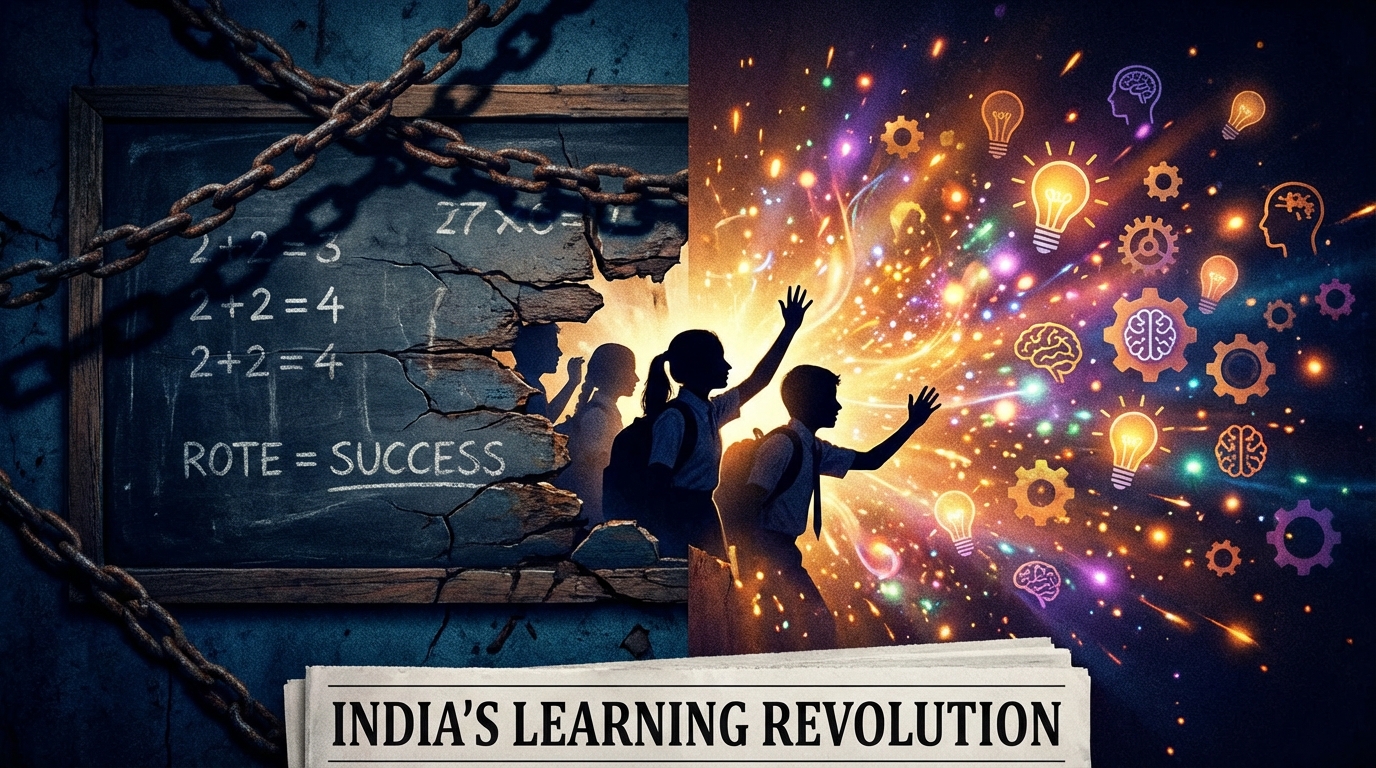
The Education Emergency: From Clerks to Creators
Bharath Manthan - Episode 7
By Ramachandran Rajeev Kumar
Watch on YouTube: https://youtu.be/Z5qs-Gavx6c
India produces more engineers than any country on Earth.
We graduate 1.5 million engineers every year. We have the third-largest scientific workforce in the world. Our students top universities from MIT to Oxford. Indians lead Google, Microsoft, IBM, and Adobe.
Yet India designs very little that the world uses.
No Indian smartphone. No Indian search engine. No Indian social network. No Indian electric vehicle that competes globally. No Indian semiconductor. No Indian AI model that matters.
We produce the talent that builds Silicon Valley's future. We struggle to build our own.
Why?
The answer lies not in our DNA, our culture, or our lack of ambition. It lies in a system designed 190 years ago by a British bureaucrat who never intended us to think - only to obey.
This is the story of India's education emergency.
The Architect of Obedience
In 1835, a 34-year-old British politician named Thomas Babington Macaulay sat in Calcutta and wrote a memo that would shape Indian minds for two centuries.
His "Minute on Indian Education" was explicit about its purpose:
"We must at present do our best to form a class who may be interpreters between us and the millions whom we govern; a class of persons, Indian in blood and colour, but English in taste, in opinions, in morals, and in intellect."
Read that again. The goal was never education. The goal was colonization of the mind.
Macaulay dismissed thousands of years of Indian learning - the mathematics of Aryabhata, the grammar of Panini, the philosophy of the Upanishads - as worthless. "A single shelf of a good European library," he wrote, "is worth the whole native literature of India and Arabia."
The system he designed had specific features:
- Rote memorization over understanding
- English medium to disconnect Indians from their own knowledge traditions
- Fixed curriculum serving administrative needs
- Examinations as gatekeeping - not skill assessment, but filtering
- Hierarchy and obedience as core values
The purpose was to produce clerks. Functionaries. People who could file papers, maintain records, and follow orders.
Not thinkers. Not creators. Not leaders.
And 190 years later, this system still runs India's schools.
The Lie on Macaulay's Shelf
Let us examine that claim: "A single shelf of a good European library is worth the whole native literature of India and Arabia."
Every computer you use, every smartphone in your pocket, every satellite orbiting Earth, every digital transaction, every line of code - all of it runs on a foundation that came from the very civilization Macaulay dismissed as worthless.
The Numbers That Run the World
The numerals you call "Arabic" are Indian.
The Hindu-Arabic numeral system - the 0, 1, 2, 3, 4, 5, 6, 7, 8, 9 that power all modern mathematics - originated in India. The Brahmi numerals, developed around 300 BCE, evolved through the Gupta period into the system we use today. Arab traders and scholars encountered this system, recognized its brilliance, and transmitted it to Europe. Medieval Arab mathematicians called it al-hisab al-hindi - "Indian arithmetic."
When Al-Khwarizmi wrote his treatise On the Calculation with Hindu Numerals in 825 CE, he wasn't inventing - he was translating Indian knowledge for the Arabic world. Europe received these numerals around the 10th century and eventually, through historical amnesia, started calling them "Arabic numerals."
The entire digital age runs on Indian mathematics.
Zero: The Number That Made Everything Possible
Before India, zero didn't exist as a number.
Other civilizations had placeholder concepts, but it was Indian mathematicians who transformed shunya (emptiness, void) from a philosophical concept into a mathematical reality. Aryabhata used positional notation with zero as placeholder in the 5th century. Brahmagupta, in 628 CE, wrote the first rules for arithmetic operations with zero - addition, subtraction, multiplication.
The oldest recorded zero as a number appears on the wall of the Chaturbhuj temple in Gwalior, India - a circle inscribed in the 9th century that changed the world.
Without zero, there is no binary. Without binary, there are no computers. Without computers, there is no modern civilization.
Every computer chip in the world owes its existence to Indian mathematics.
The Binary Code Before Computers
Two thousand years before Leibniz "invented" binary, an Indian scholar named Pingala had already mapped it.
Pingala (3rd-2nd century BCE) was analyzing Sanskrit poetry meters in his work Chandahshastra. He used a system of short syllables (laghu) and long syllables (guru) - essentially 0s and 1s - to describe all possible metrical patterns. He created algorithms to convert between this binary representation and decimal numbers. He developed what we now call Pascal's Triangle (which Indians knew as Meru Prastara) and touched on Fibonacci sequences.
This is not metaphor. This is not reinterpretation. Pingala's binary mathematics predates European discovery by nearly two millennia.
The foundation of every computer, every smartphone, every digital system - conceptualized in India before Christ was born.
When Physicists Found the Vedas
Here is what Macaulay could not have imagined: the greatest physicists of the 20th century would turn to Indian texts for insight.
Erwin Schrödinger, Nobel laureate and father of wave mechanics, was deeply influenced by the Upanishads. He wrote: "The unity and continuity of Vedanta are reflected in the unity and continuity of wave mechanics." He named his dog "Atman" and reportedly ended lectures with the equation "Atman = Brahman."
Werner Heisenberg, architect of quantum mechanics, visited India and spent time with Tagore discussing philosophy. He later said: "Quantum theory will not look ridiculous to people who have read Vedanta."
Niels Bohr, Nobel laureate and pioneer of atomic structure, famously said: "I go into the Upanishads to ask questions."
Robert Oppenheimer learned Sanskrit specifically to read the Bhagavad Gita in original. When the first atomic bomb exploded at Trinity, he quoted the Gita: "Now I am become Death, the destroyer of worlds." He called access to the Vedas "the greatest privilege of this century."
These weren't mystics seeking spiritual comfort. These were rigorous scientists who found in Indian philosophy conceptual frameworks that aligned with their most radical discoveries - the interconnectedness of all matter, the role of the observer in determining reality, the illusory nature of apparent multiplicity.
The texts Macaulay dismissed as worthless were guiding the greatest scientific minds of the modern age.
What We Might Have Been
Consider the counterfactual.
India had the mathematics, the philosophical frameworks, the tradition of inquiry. We had Nalanda and Takshashila. We had scholars who thought freely about infinity, zero, atomic theory (Vaisheshika), consciousness, and the nature of reality.
What if there had been no invasions? No destruction of universities? No colonial suppression of indigenous knowledge?
Would India have developed the computer? The theory of relativity? Quantum mechanics?
We cannot know. But we know this: the raw intellectual material was there. The freedom to think was there. The tradition of abstract reasoning that makes theoretical physics possible - it was there, embedded in the Upanishads, the mathematical texts, the philosophical schools.
India didn't lack creativity. India was interrupted.
The Shelf That Matters
Macaulay's European shelf contained knowledge that Europeans had developed - much of it built on mathematics they received from India and the Arab world, philosophy influenced by Greek thinkers who may have learned from Indian sources, science that would later find its conceptual mirrors in Vedantic thought.
That shelf was valuable. But it was not superior.
The Indian shelf that Macaulay dismissed contained:
- The numerical system that runs all modern computation
- The concept of zero that makes mathematics possible
- Binary logic two millennia before computers
- Philosophical frameworks that quantum physicists would seek out
- Medical knowledge (Ayurveda, Sushruta's surgery) that predated European medicine
- Grammatical analysis (Panini) so sophisticated that it influenced modern linguistics and computer science
- Astronomical calculations (Aryabhata) that were accurate to minutes
A single verse of Brahmagupta's Brahmasphutasiddhanta - defining zero and negative numbers - is worth entire libraries of Roman numeral arithmetic.
Reclaiming the Inheritance
This is not about chest-thumping nationalism. This is about truth.
We were told our knowledge was worthless. We believed it. We abandoned our own traditions of inquiry and adopted a system designed to produce clerks.
The irony is complete: Indian mathematical concepts power the very computers on which colonial narratives are now written.
It is time to reclaim the inheritance. Not to live in the past, but to build the future. Not to reject Western knowledge, but to integrate it with our own. Not to claim superiority, but to recognize that India's tradition of free, abstract, creative thinking was as powerful as any civilization has produced.
We were not inferior. We were conquered.
We were not uncreative. We were interrupted.
We can still become what we might have been.
What We Lost: The Gurukul Genius
Before Macaulay, India had a different idea of education.
Nalanda University (5th-12th century CE) hosted 10,000 students from across Asia, taught by 2,000 teachers. Subjects included philosophy, logic, medicine, grammar, astronomy, and metaphysics. Students came from China, Korea, Japan, Tibet, Mongolia, Turkey, and Persia.
Takshashila (6th century BCE - 5th century CE) was among the world's earliest universities. Its alumni included Chanakya (who wrote the Arthashastra), Charaka (father of medicine), and Panini (whose grammar rules still define Sanskrit).
What made these institutions remarkable wasn't their size. It was their philosophy.
The Gurukul Principles
1. Aptitude-based streaming
Teachers observed students closely and guided them toward fields matching their natural abilities. Not everyone studied the same curriculum. The warrior learned warfare. The healer learned medicine. The mathematician learned astronomy. The philosopher learned logic.
2. Holistic development
Education integrated physical, mental, and spiritual growth. A student wasn't just a brain to be filled - they were a complete person to be developed.
3. Learning by doing
Knowledge was applied, not just memorized. The doctor treated patients. The architect built structures. The administrator governed.
4. Mentorship over mass instruction
Small groups or one-on-one teaching allowed personalization. The teacher knew each student's strengths, weaknesses, and potential.
5. Mastery over marks
There were no standardized examinations. Competence was demonstrated through application. You weren't evaluated by how well you remembered - you were evaluated by how well you performed.
The scholars this system produced - Aryabhata, Brahmagupta, Varahamihira, Sushruta, Charaka - made contributions that shaped global knowledge for centuries.
Then the British came. And we forgot.
The Misfit Gallery
Here is an uncomfortable truth that our education system cannot explain:
Almost every person who changed the world was a misfit in formal education.
Let me introduce you to the failures.
Srinivasa Ramanujan (1887-1920)
A poor Brahmin boy from Tamil Nadu who failed college. Twice.
Ramanujan was so obsessed with mathematics that he neglected every other subject. He flunked out because he couldn't pass English, physiology, or Sanskrit. No degree. No credentials. No formal training.
He taught himself from a single borrowed textbook - Carr's Synopsis of Elementary Results in Pure Mathematics. By age 15, he had independently discovered theorems that took European mathematicians decades to prove.
When he wrote to Cambridge mathematician G.H. Hardy, two professors returned his papers without comment. Hardy almost threw the letter away. Then he looked at the theorems.
"They must be true," Hardy said, "because, if they were not true, no one would have the imagination to invent them."
Ramanujan went to Cambridge, became one of the youngest Fellows of the Royal Society, and revolutionized number theory - all without ever passing a college examination.
The education system saw a failure. History saw a genius.
Rabindranath Tagore (1861-1941)
At age seven, Rabindranath Tagore made a decision: he would never go to school.
He had attended for one month. He hated it. The punishment, the rote learning, the stifling of curiosity. He refused to return.
His family tried multiple schools - Calcutta Academy, Oriental Seminary, St. Xavier's. He dropped out of each one. He was sent to England to study law. He dropped out there too. He never passed the matriculation examination.
This dropout went on to write Gitanjali, become the first non-European to win the Nobel Prize in Literature, compose the national anthems of two countries (India and Bangladesh), and found Visva-Bharati University - where, ironically, teaching happens under trees rather than in classrooms.
The system that expelled him couldn't produce a single mind of his caliber.
Albert Einstein (1879-1955)
The myth says Einstein failed math. That's false - he excelled at mathematics.
But Einstein hated school. He despised the rote memorization, the rigid discipline, the suppression of curiosity. At 15, he dropped out of his Munich school. When he took the entrance exam for ETH Zurich, he failed (passing math but failing botany, zoology, and languages).
His teachers considered him a problem student. One professor told him he would "never amount to anything."
This problem student developed the special and general theories of relativity, won the Nobel Prize, and became the symbol of genius itself.
What did his teachers see? A troublemaker. What was he? A revolutionary.
Thomas Edison (1847-1931)
Edison attended school for a total of twelve weeks.
His teacher called him "addled" - unable to think clearly. His mother pulled him out and taught him at home. He educated himself through voracious reading at the public library.
This "addled" child went on to hold 1,093 patents. He invented the phonograph, the motion picture camera, and practical electric lighting. He created industries that employed millions.
The school saw a lost cause. He became America's greatest inventor.
Steve Jobs, Bill Gates, Mark Zuckerberg
Jobs dropped out of Reed College after one semester because his working-class parents couldn't afford it. He created Apple, Pixar, and transformed computing, music, and mobile phones.
Gates dropped out of Harvard to start Microsoft. He became the world's richest person and revolutionized personal computing.
Zuckerberg left Harvard to build Facebook. He created a platform that now connects three billion humans.
Three dropouts. Trillions of dollars in value created. The education system takes no credit.
Richard Branson
Dyslexic. ADHD. Dropped out at 16.
His headmaster's prediction: "You'll either end up in prison or become a millionaire."
Branson founded Virgin Group - over 400 companies spanning music, airlines, telecommunications, and space travel. He was knighted for "services to entrepreneurship." Net worth: $3 billion.
The system saw a disabled delinquent. He saw possibilities it couldn't imagine.
Jack Ma
Failed his primary school exam. Twice.
Failed his middle school exam. Three times.
Failed the Chinese college entrance exam. Twice. (On his first attempt, he scored 1 out of 120 in mathematics.)
Applied to 30 jobs after college. Rejected by all of them. KFC interviewed 24 people - hired 23, rejected only Jack Ma.
Applied to Harvard. Ten times. Rejected every time.
This serial failure founded Alibaba, built China's largest e-commerce empire, and is worth $27 billion.
Every system he touched rejected him. He built systems that serve billions.
The Uncomfortable Research
These stories aren't anomalies. Research proves they're the pattern.
Dr. Karen Arnold of Boston College conducted the first longitudinal study of high school valedictorians - the students our system celebrates as its greatest successes. She tracked 81 valedictorians and salutatorians from 1981 for over fourteen years.
Her findings should terrify every education minister in India.
The Valedictorian Study
Academic performance:
- 95% went to college
- Average college GPA: 3.6
- 60% earned graduate degrees
Career outcomes:
- 90% became professionals
- 40% reached top-tier positions
- Good salaries, stable lives, respectable careers
Visionary impact:
- Zero.
Not one valedictorian in the study became a standout success. Not one changed an industry. Not one founded a transformative company. Not one made a breakthrough discovery.
Arnold's conclusion is devastating:
"Valedictorians aren't likely to be the future's visionaries. They typically settle into the system instead of shaking it up."
Why Toppers Don't Change the World
The traits that create academic success - compliance, rule-following, risk-aversion, conscientiousness - are precisely the traits that prevent breakthrough innovation.
Toppers optimize within the system. Innovators break the system.
Toppers fear failure. Innovators embrace it.
Toppers seek approval. Innovators seek truth.
The average GPA of American millionaires? 2.9.
In the Forbes 400 list of America's richest people, 12% are college dropouts. Among world billionaires, 16% lack a bachelor's degree.
Our education system rewards the wrong things.
The Indian Emergency
Now look at what this system has done to India.
The Numbers
Graduate employability rate: 42.6% (India Skills Report 2024)
More than half of India's graduates are unemployable by industry standards. They have degrees. They have marks. They cannot do the jobs.
Graduate unemployment: 29.1% (National Sample Survey)
Nearly one in three graduates is unemployed - higher than the overall unemployment rate. Education is supposed to increase employment. In India, it may be decreasing it.
Youth unemployment (15-29): 45.4% (ILO India Employment Report 2024)
Nearly half of India's young people have no work. This isn't an education system - it's a unemployment generation machine.
The Brain Drain
36% of IIT's top scorers leave India within five years.
73% of AI researchers educated in India work abroad.
India spends an estimated Rs. 3 lakh crore ($36 billion) educating people who leave to build other countries' futures.
We're not developing talent. We're exporting it.
The Learning Crisis
The ASER 2024 report reveals the foundation is crumbling:
50% of Class 5 students cannot read Class 2 level texts.
We're producing graduates who cannot read. Engineers who cannot think. Professionals who cannot perform.
The emergency is not coming. It is here.
The Return to Wisdom
What would education look like if we learned from both our ancient wisdom and modern research?
From Gurukul: Aptitude-Based Streaming
Identify each child's natural abilities early. Not everyone needs to study the same subjects to the same depth. The future artist doesn't need calculus. The future engineer doesn't need to analyze poetry for board exams.
Match curriculum to aptitude. Stop forcing square pegs into round holes.
From Research: Celebrate Different Intelligence
Howard Gardner identified eight types of intelligence - linguistic, logical-mathematical, spatial, musical, bodily-kinesthetic, interpersonal, intrapersonal, and naturalistic.
Our system recognizes exactly two: linguistic and logical-mathematical. We call children who excel in others "not academic."
Ramanujan had mathematical intelligence so profound he didn't need the others. We would have failed him.
From Technology: AI-Powered Personalization
57% of Indian institutions are now prioritizing AI in education. Adaptive learning platforms can customize pace, content, and method for each student.
We finally have the technology to return to Gurukul principles at scale - individualized instruction for millions, not just the privileged few.
The question is whether we have the will.
From Policy: NEP 2020
The National Education Policy 2020 acknowledges many of these problems:
- 5+3+3+4 structure replacing the rigid 10+2
- Vocational exposure from Class 6
- Multiple entry and exit points
- Credit bank system
- Emphasis on critical thinking over rote learning
But implementation is slow, uneven, and often superficial. Changing policy is easy. Changing mindsets is hard.
The Choice
India stands at a crossroads.
One path continues the colonial legacy - mass-producing clerks for an economy that no longer needs clerks. Celebrating marks over mastery. Filtering out the Ramanujans, the Tagores, the potential that doesn't fit standardized tests.
The other path reclaims our civilizational wisdom - recognizing that education should develop human potential, not suppress it. That aptitude matters more than uniformity. That the misfits might be our greatest assets.
Macaulay designed a system to produce servants for empire. The empire is gone. The system remains.
Every year, we crush millions of young minds into a mold created by colonizers. We celebrate those who conform. We discard those who don't.
And then we wonder why India consumes but doesn't create.
The Misfits' Message
The great achievers who failed in formal education aren't exceptions to be dismissed. They're evidence to be studied.
They're telling us something important:
The system is measuring the wrong things.
The system is rewarding the wrong traits.
The system is crushing the very creativity it claims to develop.
Ramanujan failed college - and revolutionized mathematics.
Tagore never passed matriculation - and won the Nobel Prize.
Edison was called "addled" - and lit up the world.
Jobs, Gates, and Zuckerberg dropped out - and created the digital age.
What are we measuring? What are we missing?
The Way Forward
The education emergency demands urgent action:
1. Early aptitude identification Invest in assessments that identify strengths, not just weaknesses. Guide children toward fields where they can excel, not just fields that have "scope."
2. Multiple pathways to success Vocational training, technical education, creative arts, entrepreneurship - all should be respected pathways, not consolation prizes for those who "couldn't" do academics.
3. Teacher transformation Teachers must become mentors, not supervisors. Facilitators, not lecturers. This requires training, respect, and resources they currently lack.
4. Assessment revolution Move beyond marks to competency. Can the student do the thing? Not just remember the theory, but apply it? Project-based assessment. Portfolio-based evaluation. Continuous feedback, not annual judgment.
5. Celebrate the misfits Tell children about Ramanujan, not just Rankers. About Tagore, not just Toppers. Show them that different minds succeed in different ways.
6. Implement NEP 2020 - seriously The policy exists. The implementation lags. Every year of delay is another generation lost to the colonial mold.
The Close
In 1835, Macaulay looked at India and saw raw material for empire - minds to be shaped into servants.
In 2025, we should look at India and see something different - minds to be liberated into creators.
We have the talent. We always did. Ramanujan proved it. Tagore proved it. The Indians running Silicon Valley prove it every day.
What we lack is a system that nurtures talent instead of filtering it. That develops creativity instead of crushing it. That prepares children for a world of change instead of a world of compliance.
From clerks to creators.
That's not just a slogan. It's a survival strategy.
The world is being reshaped by artificial intelligence, biotechnology, renewable energy, and innovations we can't yet imagine. The countries that will lead are the countries that can create - not just consume.
India has the numbers. India has the raw talent. India has the civilizational heritage of Nalanda and Takshashila.
What India needs is an education system worthy of its potential.
The emergency is real. The solution is known. The only question is whether we have the courage to act.
Macaulay built a machine to produce clerks.
It's time to build something else.
"I never let my schooling interfere with my education." - Mark Twain
"Everybody is a genius. But if you judge a fish by its ability to climb a tree, it will live its whole life believing that it is stupid." - Attributed to Albert Einstein
"The principal goal of education is to create men who are capable of doing new things, not simply of repeating what other generations have done." - Jean Piaget
Previous Episode: The Sanctuary Civilization - How India Became Home to the World's Persecuted
Next Episode: Coming Soon - Does India Need to Be Vishwa Guru?
Series Home: Bharath Manthan - Churning the Indian Pot
Ramachandran Rajeev Kumar is the founder of BarathVector. The education emergency is not a future crisis - it is a present one. Every day we wait, another generation is processed through a system designed for servitude.