By Ramachandran Rajeev Kumar — 2026-01-02
The Handshake and the Missile: India-Pakistan's Eternal Dance
Bharath Manthan - Episode 9
By Ramachandran Rajeev Kumar
On January 1, 2026, India and Pakistan exchanged lists of their nuclear installations - the 35th consecutive year of this ritual. The agreement, signed in 1988, ensures neither nation targets the other's nuclear facilities. It is perhaps the only confidence-building measure that has survived every crisis, every war, every atrocity.
Four months earlier, in September 2025, Indian cricketers refused to shake hands with their Pakistani counterparts at the Asia Cup. Captain Suryakumar Yadav cited "alignment with the government and BCCI" - a deliberate protest over the Pahalgam attack.
And on New Year's Eve, in a waiting room in Dhaka, India's External Affairs Minister Subrahmanyam Jaishankar walked up to Pakistan's National Assembly Speaker Sardar Ayaz Sadiq and extended his hand.
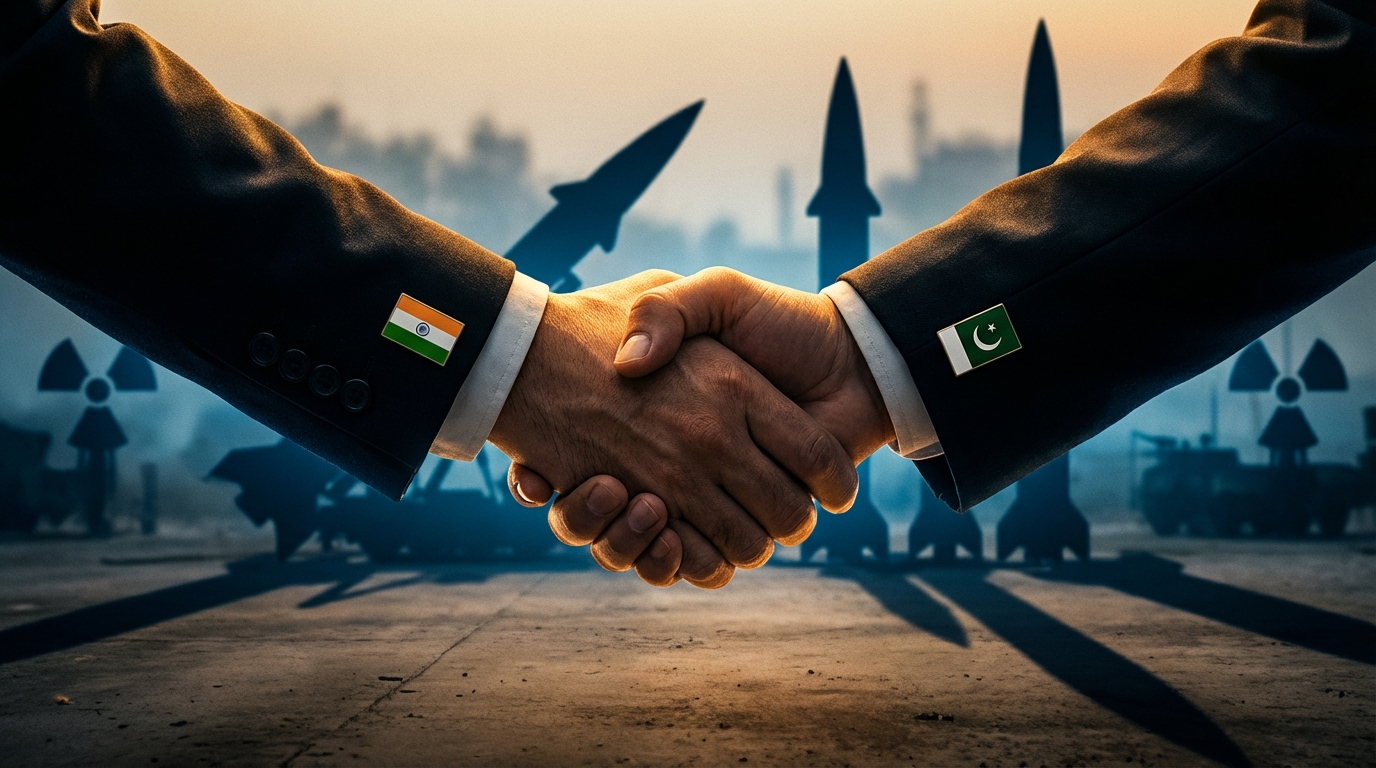
This is the paradox of India and Pakistan: two nations that exchange nuclear target lists because they must, refuse cricket handshakes because they can, and offer diplomatic courtesies because protocol demands it.
Seventy-seven years after Partition. Four wars. Countless skirmishes. One near-nuclear confrontation. And still, no resolution.
Today, we churn this oldest and deepest wound.
The Dhaka Moment
The setting was Khaleda Zia's funeral. The former Bangladesh Prime Minister, who had navigated that country's turbulent politics for decades, died on December 30, 2025. World leaders gathered in Dhaka to pay respects.
In a waiting room at Bangladesh's Parliament, Jaishankar approached Sadiq. According to Pakistani accounts, the Indian minister remarked that he was "familiar with Speaker Ayaz Sadiq's personality." They shook hands. A photograph was taken. Dr. Muhammad Yunus's office shared it.
And then came the interpretations.
Pakistan's National Assembly Secretariat issued a statement emphasizing Sadiq's "consistent emphasis on dialogue, restraint and cooperative measures." Pakistani media portrayed the handshake as a potential breakthrough - India softening its position, an opening for dialogue.
India's reaction was cooler. Former diplomats dismissed it as routine courtesy inflated by a "desperate" Pakistan. One noted that Pakistani ministers "practically stalk" Indian leaders at multilateral forums, hoping for photo opportunities they can spin domestically.
The divergence is instructive. For Pakistan, any engagement with India is a victory - proof of relevance, of parity, of the possibility of dialogue. For India, the handshake was diplomatic necessity, nothing more.
The asymmetry reveals everything about where these two nations stand in January 2026.
The Blood of Pahalgam
To understand why India is unmoved by handshakes, one must return to April 22, 2025.
Baisaran Valley, seven kilometers from Pahalgam in Kashmir's Anantnag district. Tourists - pilgrims, families, ordinary Indians seeking the beauty of the mountains - were separated by religion. Hindus and a Christian on one side. Muslims on the other.
Then the shooting began.
Twenty-six civilians were executed. The attackers used M4 carbines and AK-47 rifles. The Resistance Front, a proxy of Lashkar-e-Taiba, claimed responsibility. It was the deadliest civilian attack since Mumbai 2008.
The timing was not coincidental. Pakistan's Army Chief, General Asim Munir, had recently called Kashmir Pakistan's "jugular vein" - reviving rhetoric India thought buried with Musharraf.
India's response was not strategic restraint. It was not diplomatic protest. It was not the familiar cycle of outrage followed by quiet return to status quo.
It was Operation Sindoor.
The New Doctrine
On May 7, 2025, Indian missiles and aircraft struck nine terrorist camps - not just in Pakistan-occupied Kashmir, but in settled Pakistan itself. Muridke, headquarters of Lashkar-e-Taiba. Bahawalpur, home of Jaish-e-Mohammed. For the first time since 1971, Indian munitions fell on Pakistani soil proper.
Pakistan retaliated. Operation Bunyan-un-Marsoos launched drone and missile strikes on Indian airbases at Srinagar, Pathankot, and Ambala. Artillery shells fell on Poonch and Rajouri. Religious sites were targeted - a calculated provocation.
For 88 hours, two nuclear-armed nations exchanged fire. The first large-scale drone warfare between them. Indian carrier battle groups deployed to the Arabian Sea, effectively blockading the Pakistani Navy.
Then, on May 10, Pakistan's Director General of Military Operations called his Indian counterpart on the hotline. The request: ceasefire.
India had lost five soldiers. Pakistan, according to Lieutenant General Rajiv Ghai's October 2025 statement, lost over a hundred - a figure corroborated by Pakistan's own gallantry awards list issued on Independence Day.
Operation Sindoor established a new doctrine. Strategic restraint - the policy that governed Indian responses from the Parliament attack in 2001 through Mumbai 2008 through Pulwama 2019 - was replaced by punitive retaliation.
The message was clear: attack India, and India will strike back. Not proportionally. Not symbolically. Devastatingly.
Water as Weapon
One day after Pahalgam, India placed the Indus Waters Treaty in "abeyance."
The treaty, signed in 1960, had survived four wars. It governed how the rivers flowing from India into Pakistan would be shared. For sixty-five years, it had functioned - imperfectly, contentiously, but it had functioned.
No more.
"Blood and water cannot flow together," declared the government. The Permanent Indus Commission's meetings were suspended. Hydrological data sharing - river flows, flood forecasts, drought warnings - stopped. Upstream projects accelerated without Pakistani objections.
Pakistan called it an "act of war" and threatened force if water were diverted. The World Bank, nominal facilitator of the treaty, declined to intervene.
For Pakistan, whose agriculture depends on Indus waters, this is existential pressure. The abeyance is not a tap turned off overnight - it is the slow tightening of a vice, forcing Pakistan into a legal grey zone with no clear path out.
India has discovered a weapon more potent than missiles: water.
The Nuclear Thread
And yet, through all of this, the nuclear installation lists were exchanged on January 1.
Why?
Because both nations understand what nuclear war means. Because the 1988 agreement - negotiated when India had tested one device and Pakistan was racing to match it - represents the bare minimum of sanity between neighbors who possess the means to annihilate each other.
The exchange is not trust. It is not friendship. It is not even diplomacy in any meaningful sense.
It is two neighbors who despise each other acknowledging that they both know where the gas mains are buried.
This thin thread - this annual ritual of listing targets neither side will strike - may be all that prevents catastrophe. It continues because the alternative is unthinkable.
Everything else can freeze. Cricket handshakes can be refused. Trade can stop. Diplomats can be expelled. Cultural exchanges can end.
But the nuclear lists must be exchanged. Because if they are not, the next crisis might not end with a phone call.
The Cricket Mirror
In September 2025, at the Asia Cup in the UAE, Indian captain Suryakumar Yadav refused to shake hands with Pakistan's captain Salman Ali Agha. Not at the toss. Not after the match. The Indian team bypassed customary post-match pleasantries entirely.
When asked, Yadav said the team was "aligned with the government and the Board of Control for Cricket in India." The statement was explicit: this was not personal. It was policy.
Pakistan protested to the ICC. The match referee received complaints. Nothing changed.
Cricket, once the last arena of India-Pakistan engagement, has become another front in the cold war. The sport that gave us Tendulkar versus Wasim, Kohli versus Amir, shared joy and shared heartbreak - now reflects the broader estrangement.
And yet, in Dhaka, ministers shake hands.
The contradiction is the point. Diplomatic courtesy is costless. Cricket handshakes are public, watched by millions, laden with symbolic weight. One can be extended without consequence. The other cannot.
Pakistan amplifies the diplomatic handshake because it has nothing else. India dismisses it for the same reason.
Seventy-Seven Years of Pattern
The historian sees cycles. Attack. Outrage. Mobilization. Perhaps limited strikes. International pressure. Gradual de-escalation. Quiet return to status quo. Then, years later, another attack.
2001: Parliament attack. Operation Parakram mobilizes a million troops. No shots fired. De-escalation.
2008: Mumbai massacre. 166 dead. Strategic restraint. Diplomatic pressure. Nothing changes on the ground.
2016: Uri attack. "Surgical strikes" across the Line of Control. First acknowledged cross-border action.
2019: Pulwama bombing. Balakot airstrikes. Pakistan retaliates. Brief aerial engagement. De-escalation.
Each cycle raised the threshold slightly. Each Indian response grew bolder. But the pattern held: India absorbs attack, responds within limits, accepts de-escalation, waits for the next attack.
2025 broke the pattern.
Operation Sindoor struck Pakistani soil - not just PoK. The Indus Waters Treaty was suspended. Cultural and sporting ties were severed. Diplomatic engagement reduced to bare necessity.
India did not return to status quo. India changed the status quo.
The Lesson of Asymmetry
Pakistan's desperation for dialogue is not diplomatic preference. It is strategic necessity.
The economy is "in tatters" - the phrase used by Pakistani analysts themselves. The IMF bailout comes with conditions that strangle sovereignty. The Indus Waters abeyance threatens agriculture. International isolation deepens.
India, meanwhile, grows. Fourth-largest economy. Growing military capability. Expanding global partnerships. A seat at tables Pakistan cannot access.
The asymmetry is now too large to ignore. In 1947, Partition created two nations of roughly comparable size and development. In 2026, India's GDP is ten times Pakistan's. Its military budget is eight times larger. Its diplomatic reach incomparably greater.
Pakistan needs dialogue to arrest this divergence. India has no such need.
This is why a handshake in Dhaka is proclaimed as breakthrough by Islamabad and dismissed as courtesy by Delhi. Pakistan must believe engagement is possible. India knows it can afford to wait.
The Hard Questions
Bharath Manthan churns uncomfortable truths. Here are the questions India must ask itself:
Can we afford permanent estrangement?
Strategically, yes. India can maintain the current freeze indefinitely. Pakistan has no leverage to force dialogue. The costs to India are minimal.
But strategically optimal is not the same as morally right or practically wise. A failed state on our border - which is where Pakistan's trajectory leads - creates different problems: refugee flows, nuclear security, terrorist safe havens beyond anyone's control.
Should we normalize after Pahalgam?
The victims of Pahalgam deserve justice. That justice requires Pakistan to dismantle the terror infrastructure it has built over decades - Lashkar, Jaish, the ISI's jihadi networks.
Nothing suggests Pakistan is willing to do this. Normalization without this would reward terror. It would signal that enough diplomatic pressure can wash away the blood of 26 civilians.
India is right to demand "verifiable and irreversible action" before engagement resumes.
What do we want from Pakistan?
This is the question India has never clearly answered.
Do we want a Pakistan that accepts the Line of Control as permanent border? A Pakistan that dismantles terror groups? A Pakistan that becomes a normal neighbor - trading, traveling, occasionally cooperating?
Or do we want a Pakistan that slowly fails, weakens, fragments - becoming less of a threat through collapse rather than transformation?
The first requires engagement. The second requires only patience.
India has chosen patience. Whether that is wisdom or abdication remains to be seen.
The Thin Line
In nuclear strategy, there is a concept called "the stability-instability paradox." Nuclear weapons make total war unthinkable - but precisely because total war is unthinkable, smaller conflicts become possible. Each side knows the other won't escalate to annihilation, so both take risks they otherwise wouldn't.
India and Pakistan live this paradox every day.
Operation Sindoor was possible because India calculated - correctly - that Pakistan would not go nuclear over conventional strikes. Pakistan's drone attacks were possible because Pakistan calculated - correctly - that India would not go nuclear in response.
But calculations can be wrong. Escalation can spiral. Accidents happen. Leaders miscalculate.
The nuclear lists exchanged on January 1 are a reminder: we dance on the edge of an abyss. The handshake and the missile are not contradictions. They are two aspects of the same terrifying reality.
The Verdict
The Dhaka handshake changes nothing.
It was diplomatic courtesy at a funeral, inflated by a desperate Pakistan and dismissed by a confident India. It will not lead to dialogue. It will not resolve Kashmir. It will not bring justice for Pahalgam.
What it reveals is the strange suspended animation of India-Pakistan relations in 2026: frozen in hostility, bound by nuclear necessity, unable to move forward, unwilling to risk moving backward.
India has made its choice. Strategic patience backed by punitive capability. Let time and asymmetry do their work. Engage only if Pakistan transforms - which Pakistan shows no sign of doing.
Pakistan has made its choice too, though less consciously. Continue the jihadi infrastructure. Hope diplomatic handshakes create openings. Pray the economy survives long enough for something to change.
Neither choice leads to peace. Both lead to continued estrangement, punctuated by crises, held back from catastrophe only by the thin thread of nuclear sanity.
Seventy-seven years after Partition, this is where we are: exchanging target lists because we must, refusing handshakes where we can, and shaking hands where protocol demands.
The dance continues. The music never stops. And the abyss remains, patient and eternal, waiting for someone to miss a step.
The churning continues. The previous episode examined The Soft Power Paradox.
The author is Founder & Editor-in-Chief of BarathVector.