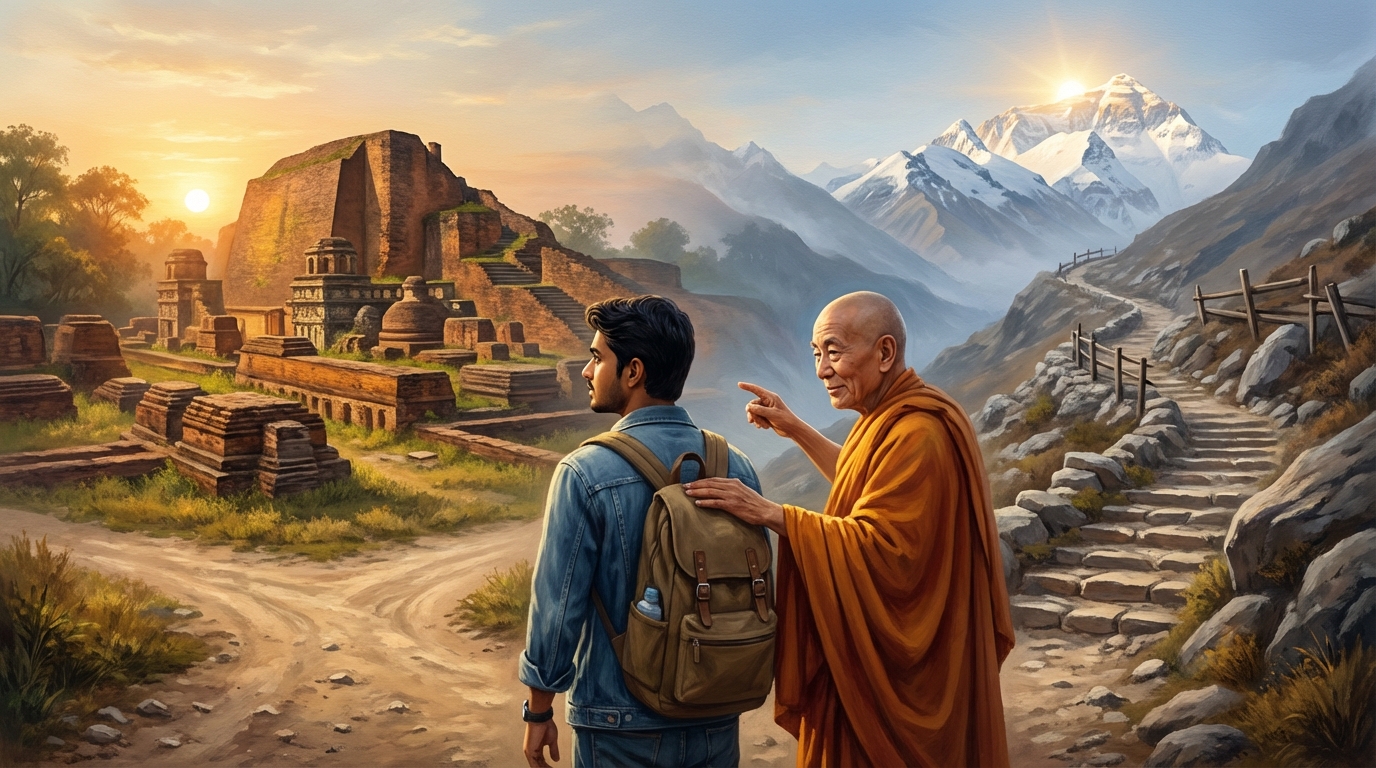
By Ramachandran Rajeev Kumar — 2025-12-27
Does India Need to Be Vishwa Guru?
Bharath Manthan - Episode 6
By Ramachandran Rajeev Kumar
The Fable: The Elder Who Taught While His House Burned
In a village at the edge of the forest, there lived an elder named Vidyasagar. He was learned in the scriptures, knew the movements of stars, and could recite verses that made grown men weep with their beauty.
Every morning, Vidyasagar would walk to the neighboring villages. He would sit under their banyan trees and teach their children about dharma, about the cosmic order, about the ancient wisdom of their ancestors.
The neighbors listened politely. They took notes. They nodded with respect.
But they also noticed things.
They noticed that Vidyasagar's own house had a leaking roof. That his children went to bed hungry. That his courtyard had become a refuse heap. That when it rained, his family slept in puddles.
"Guruji," one neighbor finally asked, "why do you teach us about the stars when your own roof has holes through which the rain pours?"
Vidyasagar drew himself up with wounded dignity. "My ancestors were the greatest teachers this land has ever known. It is my duty to continue their legacy."
"But Guruji," the neighbor pressed gently, "your ancestors also had houses that didn't leak."
Vidyasagar never answered that question. He continued teaching. His house continued crumbling. His children eventually left for other villages where they could learn useful trades.
Years later, when Vidyasagar died, the neighboring villages sent representatives to his funeral. They spoke kind words about his learning. Then they went home to their functional houses, their well-fed children, and their practical wisdom.
And in the village records, someone noted: "Here lived Vidyasagar, who knew everything about the cosmos but nothing about fixing a roof."
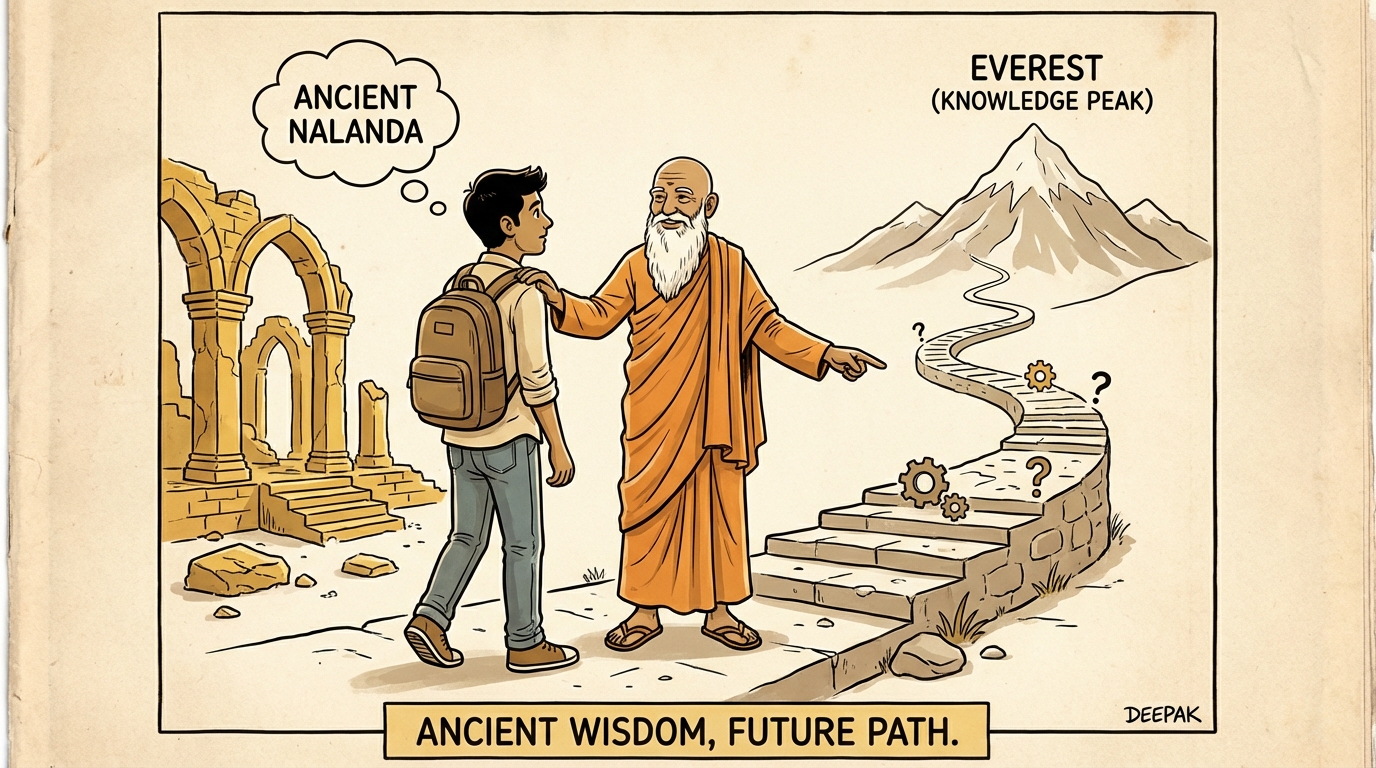 The path forward climbs higher than the pedestal of the past - but only for those willing to learn first
When India Actually Was Vishwa Guru
Before we examine today's rhetoric, let us be honest about history. There was indeed a time when India was the world's teacher. This is not mythology. This is documented fact.
Takshashila, established around 700 BCE in what is now Pakistan, was humanity's first great university. Students from Persia, Greece, China, and Arabia traveled for months to reach its gates. Here, Chanakya wrote the Arthashastra. Here, Panini codified Sanskrit grammar with a precision that modern linguists still marvel at. Here, Charaka and Sushruta developed medical knowledge that would influence healing traditions across Asia.
Nalanda, founded in the 5th century CE, housed 10,000 students and 2,000 teachers at its peak. Its library was so vast that when invaders finally burned it, the manuscripts smoldered for three months. Students from Korea, Japan, China, Tibet, Indonesia, and Persia came to study Buddhist philosophy, logic, mathematics, and astronomy.
Indian mathematicians gave the world zero, the decimal system, and the foundations of algebra. When these ideas reached the Arab world and then Europe, they transformed human civilization. The numbers you use today are called "Arabic numerals," but Arabs themselves called them "Hindu numerals" in acknowledgment of their origin.
Indian philosophy influenced Greek thought through Alexander's campaigns. Indian astronomy shaped calculations across the Islamic world. Indian medicine formed the foundation of healing traditions from Tibet to Indonesia.
This was Vishwa Guru. Not as rhetoric. As reality.
The world came to India because India had something to offer that could not be found elsewhere. No marketing was needed. No government programs. No diplomatic missions promoting "Brand India." The knowledge was so valuable that people risked their lives crossing deserts and mountains to acquire it.
The Colonial Wound
Then came the centuries of decline and conquest.
The destruction of Nalanda by Bakhtiyar Khilji in 1193 CE was not just the burning of a library. It was the symbolic end of India as a knowledge destination. The scholars who survived fled to Tibet, Nepal, and Southeast Asia, taking fragments of learning with them. But the institution, the system, the infrastructure of knowledge creation was gone.
What followed were centuries of foreign rule, culminating in two hundred years of British colonialism that systematically dismantled what remained of Indian educational and economic systems. Macaulay's infamous 1835 Minute explicitly aimed to create "a class of persons Indian in blood and colour, but English in tastes, in opinions, in morals and in intellect."
The colonizers didn't just take wealth. They took confidence.
By the time India gained independence in 1947, generations had internalized the message that Indian knowledge was inferior, Indian systems were primitive, Indian traditions were superstition. The first task of nation-building was psychological as much as economic: convincing Indians that they were capable of governing themselves.
This is the wound that still festers. This is why the "Vishwa Guru" rhetoric resonates so deeply. It promises healing. It promises that the humiliation was temporary, that the greatness was real, that the world will once again look to India for guidance.
The desire is understandable. The question is whether the rhetoric helps or hinders the healing.
The Rhetoric vs Reality
Let us examine where India actually stands today.
Human Development Index 2025: India ranks 130th out of 193 countries. We are in the "medium human development" category. Our neighbors Sri Lanka (89th) and China (78th) are in "high human development." Bangladesh, which we helped liberate in 1971, now matches our rank.
Literacy: India's literacy rate is approximately 81%. China's is 97%. We have nearly 290 million adults who cannot read.
Diplomatic Presence: India has 194 diplomatic posts worldwide, ranking 11th globally. China has 274. The United States has 271. We have no diplomatic presence in 53 countries.
Research Output: Despite having the world's second-largest population, India produces a fraction of the research output of the United States, China, or even smaller nations like the United Kingdom and Germany.
Brain Drain: Our best minds are teaching in foreign universities, running foreign companies, winning Nobel Prizes while holding foreign passports. The very people who could make India a knowledge destination have themselves become knowledge exports.
Here is the uncomfortable question: Would you take advice from someone in this condition?
If a person came to your village claiming to be a great teacher, but you noticed that his house was falling apart, his children were illiterate, and his most talented family members had all left to work elsewhere, would you sit at his feet for wisdom?
This is how the world sees India's Vishwa Guru claims. Not with hostility, but with polite bemusement.
What Would We Actually Teach?
Let us conduct an honest inventory.
Yoga and Spirituality: Yes, India has genuine gifts to offer here. The world has embraced yoga. Meditation practices rooted in Indian traditions are now mainstream in the West. This is real soft power.
But here's the problem: the most successful yoga teachers and meditation gurus are increasingly non-Indian. The West has taken Indian practices, systematized them, and now teaches them back to us. Headspace, Calm, and other meditation apps were created by Western entrepreneurs. The global yoga industry is dominated by Western brands.
Democracy: India is the world's largest democracy, and this is genuinely remarkable. For 75 years, a nation of 1.4 billion people across 22 official languages and every major religion has conducted peaceful transfers of power through the ballot box. Elections are vibrant, participation is massive, and the system, while imperfect, functions. This is no small achievement in a world where democracies are struggling.
There is always room for improvement, as in any democracy. But India's democratic credentials are real and hard-won. This is perhaps our strongest card to play.
Economic Development: India has lifted hundreds of millions out of poverty. This is a genuine achievement. But so have China, Vietnam, and Bangladesh. Our growth story is impressive but not unique. And our per capita income remains low.
Technology: Indian engineers are prized globally. But they build technology for American and Chinese companies. The platforms that shape the world, the AI that will transform the future, the chips that power everything, these are not made in India.
Ancient Wisdom: Yes, the Vedas, the Upanishads, the great philosophical traditions contain genuine insight. But how many Indians have actually read them? How many can engage with these texts in their original languages? We claim inheritance of wisdom we ourselves no longer study.
The Shift from Vishwa Guru to Vishwa Mitra
Interestingly, the government itself seems to have recognized the problem. Since 2023, official rhetoric has quietly shifted from "Vishwa Guru" (world teacher) to "Vishwa Mitra" (world friend).
This is a significant recalibration. A teacher claims authority over students. A friend claims equality with peers. The shift suggests an understanding that the world does not respond well to a poor country claiming to be everyone's teacher.
As former National Security Advisor Shivshankar Menon noted, India is not now, or anywhere near, being a net exporter of knowledge and ideas. The Vishwa Guru label, with its teacher-student hierarchy, "inadvertently reinforces hierarchies" that alienate rather than attract international partners.
The Vishwa Mitra framing is more honest and more effective. It acknowledges that India has things to learn as well as things to teach. It positions India as a collaborative partner rather than a condescending instructor.
Perhaps this shift should be embraced more explicitly.
The Path to Genuine Leadership
RSS chief Mohan Bhagwat said something important recently: economic and strategic power alone is not enough. India must offer "moral, intellectual, and civilisational guidance" to the world. This combines "material progress with values, knowledge, and responsibility."
The key word is "responsibility."
Ancient India became Vishwa Guru not through rhetoric but through responsibility. The scholars of Nalanda didn't advertise. They built an institution so excellent that the world came to them. The mathematicians who developed zero didn't promote "Brand India." They solved problems that humanity needed solved.
Genuine leadership is earned, not claimed.
Here is what genuine path to knowledge leadership would look like:
Fix Education First: When Indian universities rank among the world's best, not 200th or 500th, we will have something to teach. When our literacy rate reaches 99%, when every Indian child has access to quality education, we will have credibility.
Become a Research Destination: Instead of exporting our best minds, create conditions that attract the world's best minds to India. This requires research funding, academic freedom, and institutions that value original thinking over rote learning.
Solve Global Problems: India faces challenges that the whole world faces: climate change, sustainable development, managing diversity, providing healthcare at scale. If we solve these problems at home, the world will come to learn from us without any marketing.
Practice Before Preaching: Every piece of ancient Indian wisdom emphasizes this. The guru earns the right to teach through demonstrated mastery, not through claims of ancient lineage. Be the change. Show the results. The teaching will follow naturally.
First Fix, Then Preach
India does not need to be Vishwa Guru.
India needs to be Vishwa Vidyarthi first. The world's student. Humble enough to learn from anyone who has something to teach. Disciplined enough to execute what we learn. Patient enough to earn respect through results, not rhetoric.
The truly wise, in any tradition, do not proclaim their wisdom. They demonstrate it through action. They solve problems. They build things that work. They create institutions that outlast them.
When Nalanda was at its height, no Indian king gave speeches about being Vishwa Guru. The scholars simply did their work. The world noticed. The students came.
That is the Vishwa Guru India should aspire to become. Not one that claims the title, but one that earns it.
Not one that markets ancient glory, but one that creates present excellence.
Not one that lectures the world, but one that fixes its own house so beautifully that the neighbors come asking for advice.
The elder in our fable taught while his house burned. Let us not be that elder.
Let us first fix the roof. Feed the children. Clean the courtyard. Build something worth seeing.
Then, if the neighbors want to learn how we did it, we will have something real to teach them.
Bharath Manthan continues. Some truths are bitter. But the churning must bring up both poison and nectar if we are ever to taste the amrita of genuine national greatness.
The question is not whether India was once great. It was. The question is not whether India can be great again. It can. The question is whether we have the honesty to admit where we are, and the humility to do the work required to get where we want to be.
Vishwa Guru? Perhaps someday.
But first, Vishwa Vidyarthi.
Read the previous episode: Episode 5: The Sanctuary Civilization
Read the next episode: Episode 7: The Education Emergency