By Ramachandran Rajeev Kumar — 2025-12-24
The Thousand Year Mirror: What Our Ancestors' Defeats Teach Us About Tomorrow
Bharath Manthan - Episode 1
By Ramachandran Rajeev Kumar
There is a peculiar discomfort that settles over Indians when we discuss our defeats. We celebrate Chandragupta, Ashoka, the Cholas, and the Marathas with vigour. But ask about Tarain, Panipat, or Plassey, and watch the conversation shift to "circumstances," "betrayal," or the ever-convenient "what-ifs."
This discomfort is understandable. No civilization enjoys examining its wounds. But here's the uncomfortable truth: those who refuse to study their defeats are condemned to repeat them.
This is not an exercise in self-flagellation. This is a strategic autopsy - a forensic examination of patterns that destroyed empires and enslaved a subcontinent. Because the patterns haven't disappeared. They've merely changed costumes.
When Alexander Turned Back: India at Its Martial Peak
Let us begin with a victory so complete that history barely registers it as one.
In 326 BCE, Alexander of Macedon - the man who had conquered Persia, Egypt, and everything in between - stood at the banks of the Beas River in Punjab. Behind him lay eight years of unbroken conquest. Before him lay the Gangetic plains and the Nanda Empire.
He never crossed.
Why? Because his battle-hardened veterans - men who had marched from Greece to India - refused to face what lay ahead.
The Greek historian Plutarch records their fear: the Nanda Empire commanded 200,000 infantry, 80,000 cavalry, 8,000 war chariots, and 6,000 war elephants. These weren't exaggerated numbers whispered by frightened scouts. This was military intelligence that made Alexander's 40,000 veterans conclude that further advance meant annihilation.
Consider what this tells us. In the 4th century BCE, the Indian subcontinent was formidable enough to make history's greatest conqueror turn back. Not through diplomacy. Not through bribery. Through sheer military credibility.
This was India at its martial peak. Remember this baseline. Everything that follows is a descent from it.
The Ashokan Pivot: When Compassion Became Policy
Fast forward sixty-five years. Within four years of Alexander's retreat, Chandragupta Maurya had overthrown the very Nanda dynasty whose military strength had terrified the Macedonian veterans. He founded the Mauryan Empire in 322 BCE - inheriting and expanding the martial tradition that had stopped Alexander.
Two generations later, Chandragupta's grandson Ashoka brought this empire to its territorial zenith. In 261 BCE, he conquers Kalinga in what historians describe as one of the bloodiest wars in Indian history. An estimated 250,000 people perished.
What followed changed everything.
Ashoka, surveying the carnage, experienced what he called "profound remorse." He converted to Buddhism, renounced military conquest, and spent the rest of his reign spreading dharma rather than dominion.
This transformation is rightly celebrated as a moral awakening. Ashoka's edicts on non-violence, religious tolerance, and ethical governance were millennia ahead of their time. His legacy influenced Buddhism's spread across Asia, touching billions of lives.
But we must also ask an uncomfortable question: What were the strategic consequences?
The Mauryan Empire's aggressive military expansion ended permanently. Within fifty years of Ashoka's death, the empire fragmented. The institutional military apparatus that had made India unconquerable began to atrophy.
More critically, a cultural shift took root. The Kshatriya warrior ethos - the tradition that had produced armies capable of stopping Alexander - began its long subordination to Brahmanical spiritual ideals and Buddhist pacifism.
I am not arguing that Ashoka was wrong. I am observing that civilizational choices have civilizational consequences. The same philosophical depth that gave India its spiritual leadership also gradually softened its martial edge. By the time the first waves of Central Asian invaders arrived, the will to fight had changed.
Prithviraj and Ghori: The Cost of Misplaced Honour
If there is one story that crystallizes India's strategic failures, it is the tragedy of Prithviraj Chauhan.
In 1191 CE, Muhammad Ghori invaded India with a formidable army. The Rajput Confederacy, led by Prithviraj Chauhan, met him at Tarain (modern Haryana). The battle was decisive - the Rajputs annihilated the invading force. Ghori himself was captured.
What happened next defines a millennium.
Prithviraj's ministers counselled execution. Ghori was a threat who would return if released. But Prithviraj, bound by the Rajput code of honour - which forbade killing a surrendered enemy - let him go.
The gentleman followed his code. The pragmatist noted his enemy's weakness.
One year later, Ghori returned with reinforcements. Same battlefield. Opposite result. Prithviraj was captured, humiliated, and eventually executed. The Delhi Sultanate was born. Eight hundred years of foreign rule had begun.
What was the lesson?
When Ghori begged for mercy, he was not operating within the same moral framework as Prithviraj. The Rajput king assumed shared rules of warfare - conventions of honour that bound both parties. Ghori recognized no such constraints. He exploited his enemy's nobility as efficiently as he would have exploited a military weakness.
Do we see echoes of this today? When India releases captured combatants as goodwill gestures, when we parley endlessly with neighbours who operate in bad faith, when we assume our adversaries share our commitment to civilized conduct - are we not playing Prithviraj to their Ghori?
The honourable warrior who assumes his enemy shares his values is not noble. He is naive. And naivety in geopolitics is not a virtue - it's a vulnerability.
Panipat 1526: When Technology Was Ignored
Consider the mathematics of Babur's conquest.
At the First Battle of Panipat in 1526, Babur commanded approximately 12,000 troops. Ibrahim Lodi, the Sultan of Delhi, brought anywhere from 50,000 to 100,000 soldiers and 1,000 war elephants.
The result? Babur won. Ibrahim Lodi died on the battlefield along with 20,000 of his men. The Mughal Empire was born.
How does an army outnumbered 5:1 achieve total victory?
The answer had been available for over a century: gunpowder.
Babur had studied Ottoman artillery tactics. He brought 20-24 field cannons - small by later standards, but revolutionary on the Indian battlefield. His Turkish gunners knew how to use them. His mobile cavalry knew how to exploit the chaos artillery created.
Ibrahim Lodi's army had no field artillery. None. Despite gunpowder being known in India for generations. Despite the writing on the wall being visible across the Islamic world. The greatest military innovation since the stirrup, and the Delhi Sultanate faced it with tactics their great-great-grandfathers would have recognized.
The elephants - traditional symbols of Indian military might - panicked at the cannon fire and trampled their own infantry.
This is the technology gap in its starkest form. Not a gap of intelligence or courage, but of adaptation. The Indians knew about gunpowder. They simply didn't prioritize incorporating it into their military doctrine. The old ways had always worked. Until they didn't.
Is this pattern extinct? When we depend on foreign nations for semiconductor chips, when our defence manufacturing lags decades behind our adversaries, when we consume technology but struggle to produce it - are we not the spiritual descendants of Ibrahim Lodi, facing the next Panipat with the weapons of the previous war?
Hemu at Second Panipat: When the Hero Falls, Everything Falls
Thirty years after Babur, another Panipat. Another lesson.
Hemu Vikramaditya was a Hindu commoner who had risen to become Prime Minister and commander-in-chief of the Sur Dynasty's forces. He had won 22 consecutive battles. He had just conquered Delhi and Agra, crowning himself emperor. A restoration of "Sanskritic monarchical tradition" - Hindu rule in North India after centuries - seemed imminent.
At Second Panipat in 1556, Hemu faced the Mughals under the 13-year-old Akbar (really his regent, Bairam Khan). Hemu had 30,000 experienced cavalry and 1,500 war elephants. The Mughals had perhaps 20,000.
The battle was going Hemu's way. Both Mughal flanks had been driven back. Victory was within reach.
Then a stray arrow struck Hemu in the eye.
He collapsed unconscious on his elephant. And his army - 30,000 battle-hardened warriors, 1,500 elephants, 22 victories of momentum - broke formation and fled.
The man who would have restored Hindu rule was captured unconscious and beheaded. The Mughal Empire was secured.
What does this tell us about Indian military organization?
Everything depended on one man. No chain of command. No empowered subordinates. No institutional resilience. When the leader fell, there was no system to continue the fight. Twenty-two victories meant nothing because they were Hemu's victories, not his army's victories.
This is the problem with hero worship in place of institution building. We celebrate individual genius - Chandragupta, Shivaji, Hemu - but we never built systems that could function without the genius. The Mughals had systems. We had personalities.
Look at modern India's political landscape, its corporate structures, its institutions. How many function because of systems versus how many depend on the singular vision of one leader? When that leader retires, falls ill, or is removed - what remains?
The Sycophancy Trap: When Courts Became Echo Chambers
Why didn't Siraj ud-Daulah know his own commander-in-chief was plotting against him?
Why didn't Ibrahim Lodi know he needed artillery?
Why didn't Prithviraj know Ghori was preparing to return?
Because they were surrounded by people who told them what they wanted to hear.
The pattern is grimly consistent across Indian defeats: courts filled with sycophants who filtered reality to please the king. Advisors who understood that honest counsel meant loss of favour. A culture that rewarded flattery over truth.
When Siraj ud-Daulah marched to Plassey, his commander-in-chief (Mir Jafar), his chief banker (Jagat Seth), and multiple nobles were in secret contact with the British. The entire power structure was compromised. Yet the young Nawab apparently suspected nothing.
How? Because no one in his court was incentivized to deliver bad news. The sycophants had created an echo chamber where the ruler heard only confirmation of his brilliance, his invincibility, his inevitable victory.
This is not ancient history. Every Indian who has worked in a hierarchical organization - government, corporate, or family business - recognizes this pattern. The culture of telling superiors what they want to hear is alive and well. The modern-day chamcha is the direct descendant of the Mughal-era courtier who whispered flattery while the empire crumbled.
The 125 Merchants: How We Lost India to a Trading Company
And now we arrive at the most humiliating chapter: how a small band of merchants became masters of a subcontinent.
In 1600, 125 English businessmen pooled £72,000 and received a royal charter to trade in the East Indies. That's it. No army. No territory. No grand imperial design. Just commerce.
When the East India Company landed in Surat in 1608, the Mughal Empire commanded over 4 million soldiers. The Company's officials knew - absolutely knew - that any military confrontation meant instant annihilation. So they traded. They built relationships. They waited.
And they watched.
They watched as Aurangzeb's religious policies fractured the empire. They watched as Sikhs, Afghans, Marathas, and regional powers tore at the carcass. They watched as Indian rulers squabbled over territory while ignoring the quiet Englishmen building fortified trading posts along the coast.
Then came Plassey. June 23, 1757.
Robert Clive: 3,000 soldiers (including 2,100 Indian sepoys). Siraj ud-Daulah: 50,000 soldiers, 50 cannons, 10 war elephants.
The ratio was 17:1 in India's favour. The result? 22 British dead, 500+ Indian dead, and the birth of Company rule.
How?
Because the battle was decided before the first shot. Mir Jafar - commanding 16,000 cavalry - had been bribed months earlier. The Jagat Seth bankers had financed the conspiracy. Multiple nobles were in British pay. When the fighting started, Mir Jafar's cavalry simply stood aside. They watched their Nawab lose, then collected their reward.
A commercial corporation leveraged intrigue and a small force to capture the fiscal heart of India. Not through superior capability, but through exploiting our divisions, our greed, our inability to identify traitors among us.
Plassey wasn't a military defeat. It was a civilizational failure.
And then the same pattern repeated in Mysore. Tipu Sultan - the "Tiger of Mysore," the one ruler who genuinely threatened British dominance - was betrayed at Srirangapatna in 1799 by his own minister, Mir Sadiq, who withdrew troops at the critical moment. Tipu died fighting. The public mutilated Sadiq's corpse for two weeks.
The poet Muhammad Iqbal captured it perfectly: "Jafar of Bengal and Sadiq of the Deccan: A stigma on humanity, on religion, and the country."
The British Legacy: Designed to Diminish
When the British finally left in 1947, what did they leave behind?
An education system designed to produce clerks, not thinkers. "We must create a class of persons, Indian in blood and colour, but English in taste, in opinions, in morals, and in intellect," wrote Thomas Babington Macaulay in 1835. Mission accomplished.
An administrative system designed to control, not serve. The ICS officer was trained to maintain order, not to innovate. The police existed to instil fear in the population, not to protect them. The babu was a willing instrument of colonial extraction.
A psychology of subservience. Generations learned to fear the white officer, to defer to foreign expertise, to assume that anything indigenous was inferior.
The wealth extraction was staggering - estimates range from $45 trillion drained from India over two centuries. But the psychological damage may have been worse. We were taught to doubt ourselves, to look westward for validation, to assume our own traditions were backward.
And yet.
The Miracle We Don't Celebrate Enough
And yet, India survived.
After everything - the invasions, the colonization, the partition, the poverty - the civilization endured. The culture that absorbed Greeks, Kushans, Mughals, and British is still here. Still practicing the same festivals, still worshipping the same gods, still speaking languages older than most Western nations.
Consider what the British left us: a shattered economy, minimal industrialization, literacy below 20%, life expectancy of 32 years, an education system designed for subservience, and an administrative apparatus that viewed citizens as subjects to be managed.
Now consider where we are, less than 80 years later.
The largest democracy in human history - 1.4 billion people voting, however imperfectly. A space program that lands on the Moon's south pole, where even superpowers haven't reached. The world's fifth-largest economy, soon to be third. A pharmaceutical industry that supplies 60% of the world's vaccines. A diaspora that leads global technology companies and achieves the highest income of any ethnic group in America.
This wasn't inevitable. This was earned. Earned by ordinary Indians who, despite every institutional disadvantage, built lives, businesses, and futures. Earned by first-generation college graduates who became engineers. By villagers who sent their daughters to school. By entrepreneurs who built companies in a system designed to strangle them.
The babus and diwans are still here - they've simply changed their titles. The fear of authority persists - watch how an ordinary Indian reacts when a policeman approaches. The education system still prioritizes rote memorization over critical thinking. The colonial mindset hasn't fully died.
And yet, despite all this, look how far we've come.
Imagine what we could do if we fixed these things.
Teaching History to Think, Not to Memorize
Here is the final failure: how we teach history itself.
Ask an Indian schoolchild about the Battle of Plassey and they will tell you: "1757, Robert Clive defeated Siraj ud-Daulah."
Ask them why 50,000 lost to 3,000, and you'll get blank stares.
We teach dates. We don't teach causation. We teach names. We don't teach patterns. We teach history as a graveyard of facts to be memorized for exams, not as a laboratory of strategic lessons.
What if, instead of memorizing "First Battle of Panipat - 1526," we asked students: "Why didn't India adopt gunpowder technology despite knowing about it for generations?"
What if, instead of memorizing "Mir Jafar betrayed Siraj ud-Daulah," we asked: "What systems would have prevented or detected such betrayal?"
What if we studied defeats not to wallow in them, but to extract the operational lessons that prevent their recurrence?
The ancestors left us their life stories. Their victories are inspiration. Their defeats are instruction. We dishonour both when we reduce them to dates for board exams.
The Mirror Speaks
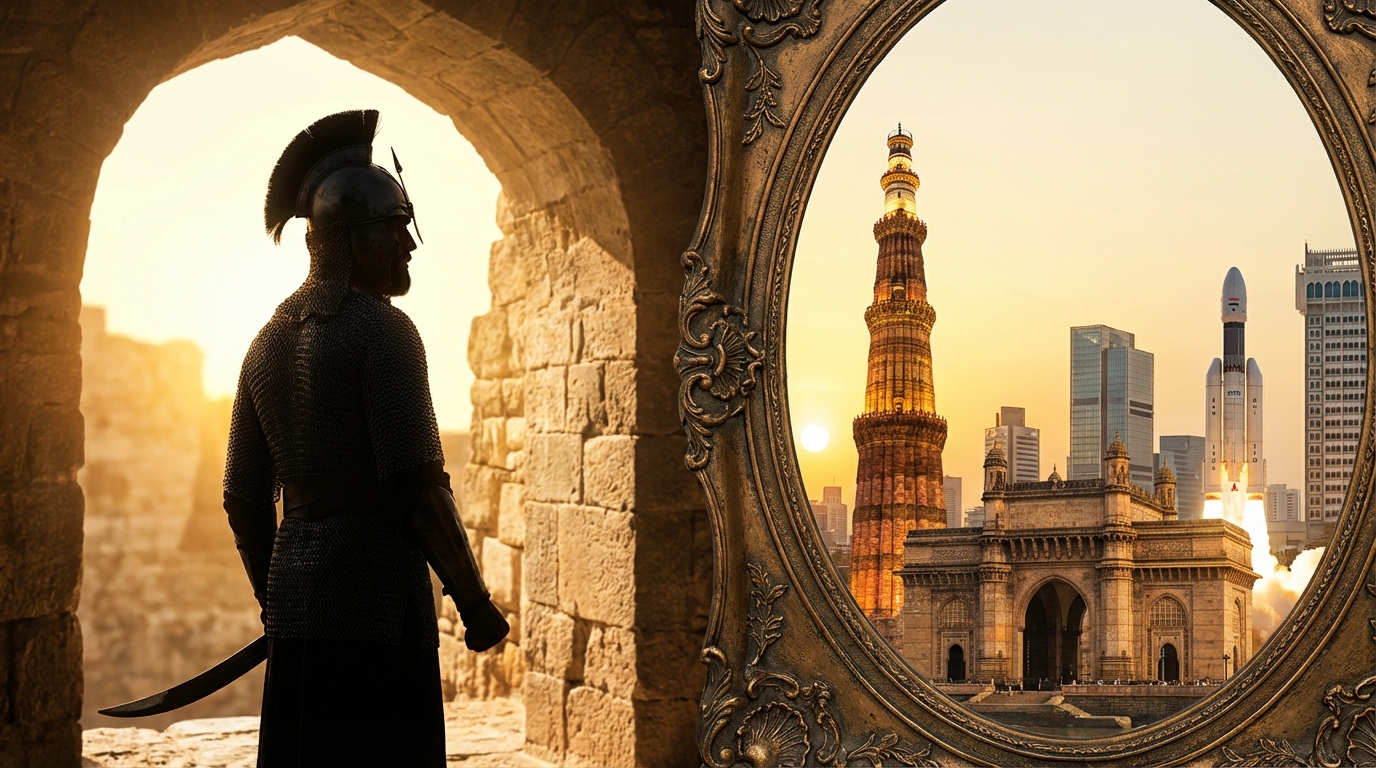
The thousand-year mirror shows us patterns, not fate.
Pattern 1: Unity is non-negotiable. Every major defeat - Tarain, Panipat, Plassey - was enabled by division. Jaichand against Prithviraj. Lodi's nobles against their sultan. Mir Jafar against his Nawab. Our enemies have always known that the way to defeat India is not through superior force, but through exploiting our fractures.
Pattern 2: Technology waits for no one. The gap between Babur's cannon and Lodi's elephants is the gap between victory and annihilation. We ignored gunpowder. We cannot ignore semiconductors, AI, and whatever comes next.
Pattern 3: Systems outlast heroes. Hemu won 22 battles and lost everything to one arrow. We need institutions that function regardless of who leads them - in government, military, business, and civil society.
Pattern 4: Sycophancy is suicide. The ruler who hears only flattery is the ruler who doesn't hear the conspiracy forming in his own court. Truth-tellers must be protected, not punished.
Pattern 5: The gentleman's code requires mutual adherence. Prithviraj's honour only worked if Ghori shared it. He didn't. Playing by rules your opponent doesn't recognize isn't nobility - it's strategic incompetence.
Pattern 6: Action over rhetoric. Chest-thumping about past glory achieves nothing. Quiet competence that builds capability achieves everything.
The mirror doesn't show us our doom. It shows us our choices. Where our ancestors failed, we and our future generations need not - because they left us the most valuable gift possible: the documented story of what went wrong.
The only real defeat is refusing to learn.
This is Episode 1 of Bharath Manthan - a series that churns India's history, identity, and future. Continue to Episode 2: One Billion Indians, One Identity.