By BarathVector Editorial — 2026-05-27
The Quad on Life Support: Rubio Comes to Delhi to Manage a Downgrade
When a secretary of state shows up to a meeting that a president should be hosting, the signalling is in the substitution.
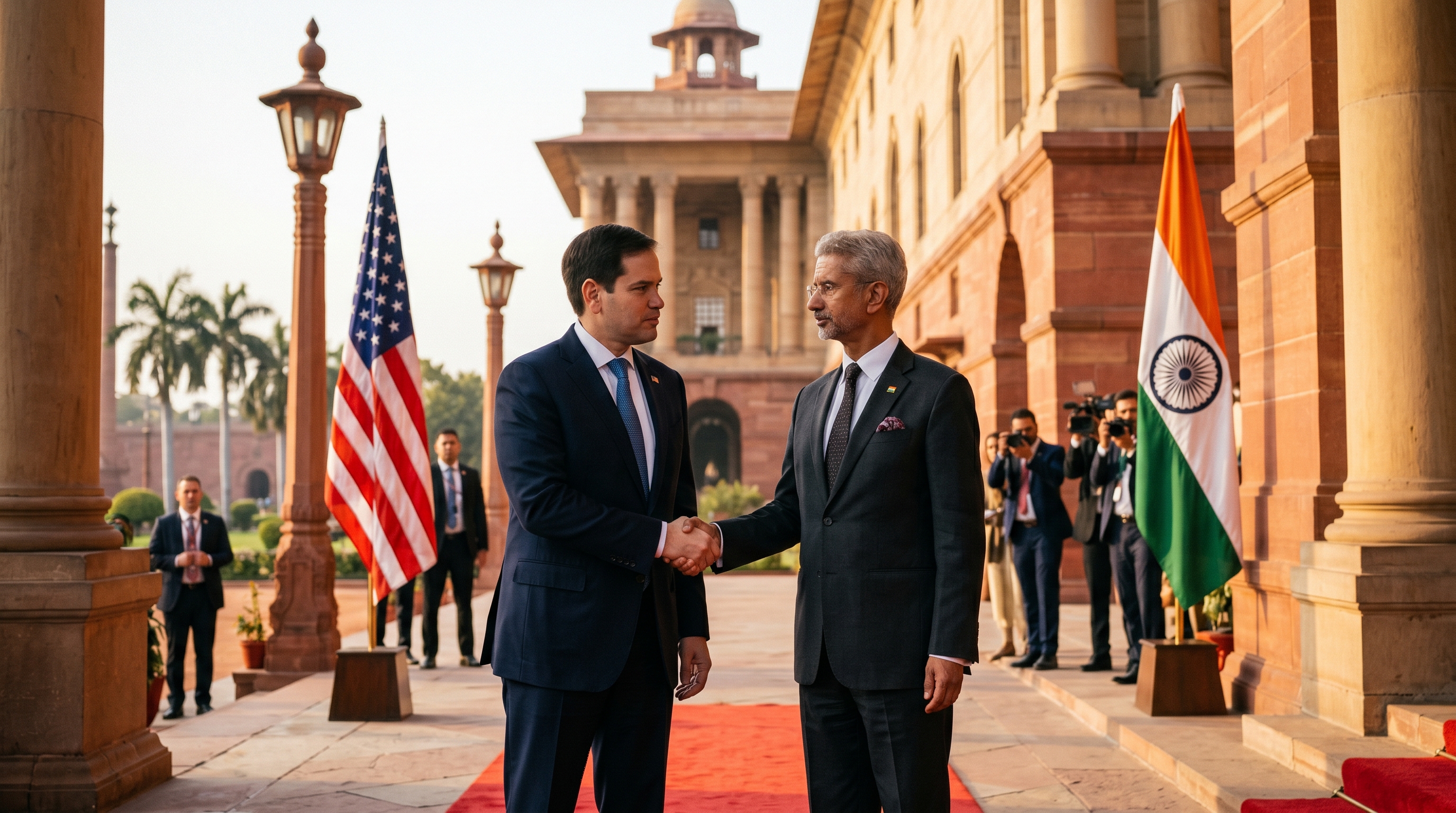
US Secretary of State Marco Rubio landed in India on May 23 for a four-day visit that would conclude, on May 26, with a Quad foreign ministers' meeting in New Delhi — Australia, India, Japan, and the United States around the same table that was supposed, not so long ago, to seat their respective heads of government.
The downgrade is not incidental. It is the story.
The 2025 Quad leaders' summit that India was to host never happened. The reasons are not mysterious: India and the Trump administration were locked in tariff friction, Trump personally resented Modi's studied neutrality after the India-Pakistan four-day war, and the deliverable Washington was demanding — a signed US-India free trade agreement — was still being negotiated. So the summit slipped. It has not recovered.
Foreign Policy, in a piece published on May 22, went further than most in naming the damage: "Why the Quad Was Doomed From the Start." That is probably overstated. But the underlying diagnosis — that the Quad has been drained of its leaders-level strategic ambition — is correct. The agenda for the May 26 meeting has narrowed to critical minerals and supply-chain security. The grand Indo-Pacific vision that animated the grouping's 2021 summit era, the vaccine and infrastructure ambitions that followed — all of it compressed into one working issue, however important that issue is.
What Rubio Actually Came to Discuss
Strip the diplomatic bunting from Rubio's New Delhi visit and what remains is a conversation about minerals.
China's dominance over the processing and refining of rare earth elements — lithium, cobalt, nickel, the full periodic table of inputs that modern defence manufacturing and clean energy infrastructure require — has become the central supply-chain vulnerability for any economy that wants to operate independently of Beijing's goodwill. The Quad's July 2025 foreign ministers' meeting in Washington produced the Critical Minerals Initiative, a coordinated effort to map, develop, and diversify supply chains across the four member nations. The May 26 meeting is meant to advance that work.
This is a legitimate and consequential agenda item. China has demonstrated, repeatedly, that it will weaponise its minerals position when it calculates the benefit outweighs the diplomatic cost. The Quad as a coordinated minerals-and-supply-chain instrument is genuinely useful to India. India needs the technology partnerships, the offtake agreements, and the processing investment that the other three members can help assemble.
But a minerals working group is not a strategic vision. And conflating the two — as some commentary is doing, arguing that a "focused" Quad is a stronger Quad — is a form of institutional denial.
At their joint press availability on May 24, Rubio described the Quad as an "important mechanism" for cooperation, and said the four countries could jointly "influence global events." Jaishankar, characteristically more precise, pointed to the Quad's character as an assembly of maritime democracies and said the grouping's cooperation in the Indo-Pacific would continue to grow. He promised, with a diplomat's confidence, "a good strong story to tell" when the foreign ministers convened two days later.
These are not the words of a grouping in rude health. They are the words of four foreign ministers doing careful maintenance on something that their presidents and prime ministers have not shown up to tend.
The Absent Host
The most telling figure in the Quad's current equation is not Rubio, not Jaishankar, not Australian Foreign Minister Penny Wong. It is Donald Trump — who is not there, and whose absence is the loudest fact in the room.
The Hill recently observed: "The US built the Quad, but now it's letting it fail." The essential point stands. A grouping that depends on consistent American presidential engagement for its legitimacy cannot sustain itself when the president has other preoccupations. Trump's preference is for bilateral deals and burden-sharing, not minilateral architectures requiring sustained diplomatic investment. Australia, as rotating chair for 2026, may yet host a leaders' summit later this year — but whether Trump attends, and whether attendance alone would restore the grouping's strategic coherence, are two separate questions.
The Lowy Institute asked ahead of the New Delhi meeting whether the Quad can keep momentum without a leaders' summit. The answer, bluntly: not the kind that matters for India's strategic planning horizon.
Why This Is Not India's Crisis
Here is where Washington's commentariat and the Indian strategic community part ways — or should.
For the commentariat, the Quad's diminution represents a failure of the free-world coalition, a retreat from the Indo-Pacific. The framing assumes that India's leverage is a function of how tightly it is integrated into a US-led architecture. That assumption has never been accurate, and in 2026 it is demonstrably false.
India's leverage comes from being simultaneously courted by Washington, Moscow, Brussels, Beijing, and Riyadh. Rubio's presence is itself the proof: a US secretary of state does not make a four-day trip — including stops in Kolkata, Agra, and Jaipur — to a country whose cooperation it takes for granted. India is worth visiting precisely because India has not committed itself.
The multi-alignment doctrine that India formalised at Raisina this year requires the opposite of Quad-centrism — no single framework becomes the organising principle of India's international positioning. The Quad, at its most useful, is one instrument among several. At its most constraining, it is a commitment architecture that limits India's room with China, Russia, and the Global South simultaneously.
Even as Rubio sat in Delhi for a minerals conversation, India was reportedly near a separate critical minerals pact with Russia — access to Russian deposits and processing capacity entirely outside the Quad framework. The tariff negotiations that secured India's 18 percent rate — the best in Asia — were bilateral. The framework Lavrov came to discuss under the BRICS chairmanship is outside the Quad's orbit entirely. India's strategic landscape holds all of this simultaneously. That simultaneity is the point.
The Constructive Read: Keep It, Don't Crown It
None of this means India should walk away from the Quad. That would be performative and counterproductive. The grouping's critical minerals work is real, and the supply-chain cooperation it enables — joint mapping, processing investment, offtake agreements across four large economies — is worth having. The maritime domain awareness exercises, the humanitarian assistance frameworks, the technology-sharing elements that have accumulated across Quad working groups are all operational positives.
What India should stop doing is treating the Quad as the anchor of its strategic identity, or allowing Washington's enthusiasm for the grouping's symbolism to drive India's actual posture.
Jaishankar's framing of the Quad as a community of maritime democracies is shrewder than it first appears. It grounds the grouping in something functional — shared interests in open sea lanes, shared resistance to unilateral territorial claims, shared stake in the international maritime order — rather than in the anti-China framing that Western advocates have always wanted to give it. A Quad organised around maritime cooperation and minerals diversification is durable and useful. A Quad organised around being the democratic bulwark against Beijing is a commitment India should not make, both because it would compromise India's China diplomacy and because it would hand China a narrative gift.
The test for the May 26 foreign ministers' meeting is not whether it produces stirring language about the Indo-Pacific. It is whether it produces concrete progress on the Critical Minerals Initiative — specific investments, specific processing agreements, specific commitments on supply-chain mapping. If it does that, the meeting will have been worth holding, regardless of the level at which it was held.
A leaders' summit would be better optics. But India does not govern by optics.
The Structural Truth
A Quad that cannot hold leaders' summits because the American president is uninterested has honestly revealed its structural limits. That clarity is useful. It tells India exactly how much weight to place on the framework — and where to stop.
The alternative — a Quad propped up by manufactured summits and communiqués that paper over fundamental American disengagement — would be worse. Hollow institutions consume diplomatic energy that India should be spending elsewhere.
India's strategic position in 2026 is not defined by the Quad's health. It is defined by the fact that Rubio came to Delhi, that Lavrov came to Delhi, that Brussels negotiators and Gulf capitals make the same journey. The coming-to-Delhi is the measure of Indian leverage. The Quad's ministerial meeting is one item on a calendar that is full, for the right reasons.
Use the instrument. Do not be defined by it.
BarathVector covers India's foreign policy posture and the institutions that shape it. Subscribe for the weekly briefing.