By Ramachandran Rajeev Kumar — 2026-05-01
Lavrov in Delhi: India's BRICS Chair Becomes a Geopolitical Tool
Russia's foreign minister came to set the table for the leaders' summit. India is the host setting the menu.
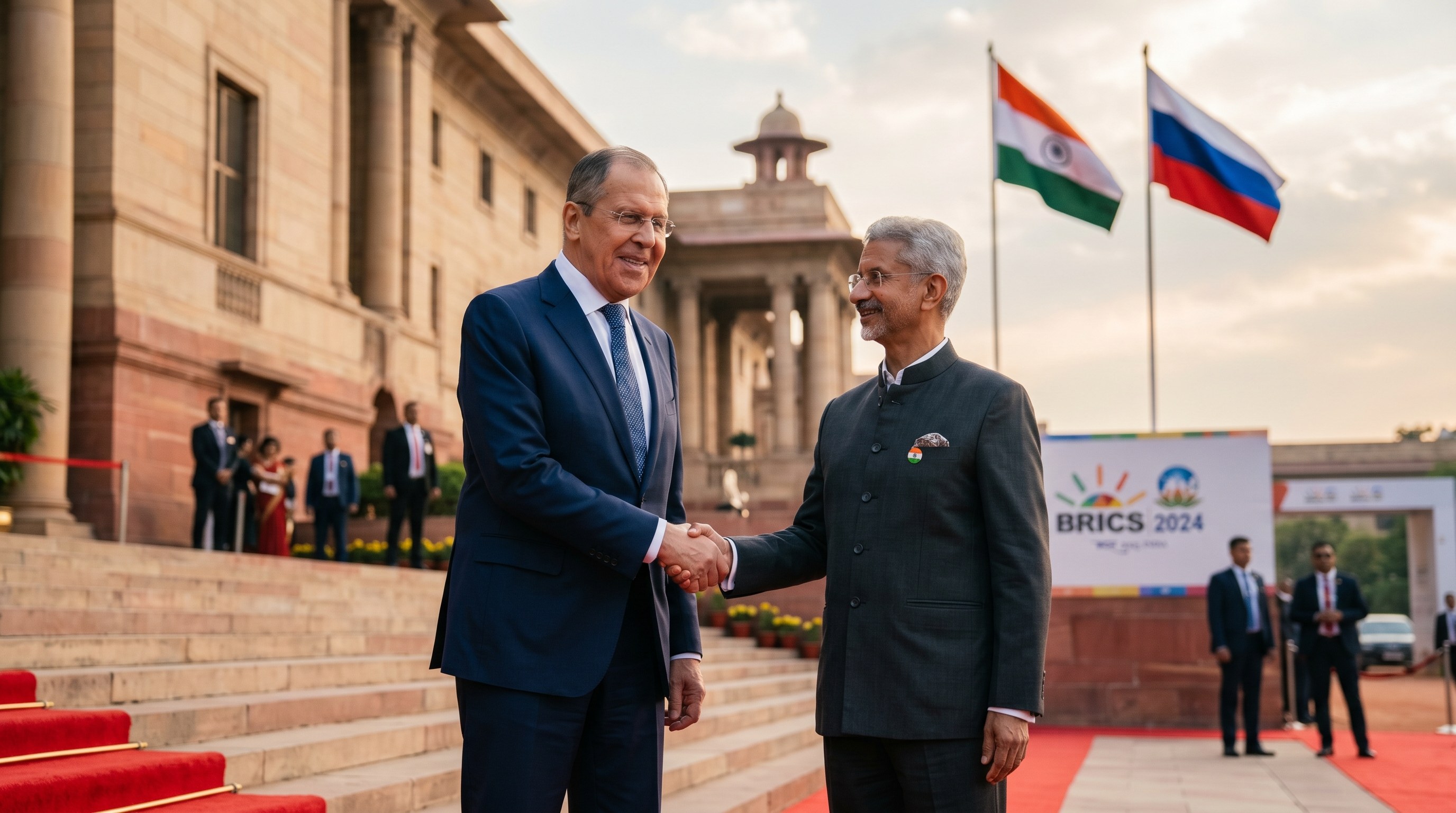
Sergey Lavrov landed in New Delhi on May 1 for a full-format meeting of BRICS foreign ministers. The optics matter. The substance matters more.
India holds the rotating BRICS chairmanship this year. That means the foreign ministers' meeting in Delhi is not a courtesy visit. It is the working session where the agenda for the leaders' summit later in 2026 gets shaped, narrowed, and sequenced. Whoever runs that room runs the year.
S. Jaishankar is running that room.
What Lavrov wants
Russia is in a particular kind of bind. The West has spent four years isolating it through sanctions, asset freezes, and energy decoupling. Moscow has responded by pivoting hard toward what its officials now call the "global majority" — China, India, the Gulf, parts of Africa and Latin America. BRICS is the most legible vehicle for that pivot.
So Lavrov arrives wanting four things from the Delhi meeting:
- A coordinated BRICS line on global governance reform — code for clipping the wings of the dollar-denominated, US-led financial order
- Progress on a BRICS payment-settlement architecture that lets members trade outside SWIFT
- A unified message ahead of the leaders' summit, so Putin does not arrive in any country looking diplomatically alone
- Quiet alignment with India on Ukraine framing, because Indian abstentions at the UN are still the diplomatic shield Russia leans on most
What India wants
India's interest is not to mirror Russia's. It is to use Russia.
Delhi has spent the last three years carefully refusing to choose between the West and Moscow. That refusal has held under pressure — Trump's tariff threats over Russian oil, European complaints, the 2018 S-400 deal that the United States never quite managed to sanction India for. The BRICS chairmanship is the year India turns that refusal into a doctrine.
What Jaishankar's team is pushing for in this meeting:
- A widening of BRICS without diluting it — adding members like Saudi Arabia, the UAE, and Egypt as full participants while keeping the founding five at the centre
- A development bank refresh — the New Development Bank gets fresh capital and an expanded lending mandate, ideally headquartered in a way that gives India operational weight
- A Global South framework on AI governance — separate from the EU's AI Act, separate from US-led standards work, anchored in what India is already calling "AI for All"
- Climate finance language that does not let rich countries off the hook on their pre-2020 unmet commitments
None of this is anti-Western. All of it is non-Western. The distinction matters.
The S-400 backdrop
Lavrov's visit overlaps with another piece of news that is not coincidental: India is set to take delivery of the fourth unit of its S-400 surface-to-air missile system this month. The deal was signed in 2018 — five units for roughly five billion dollars — and has survived three US administrations, two rounds of CAATSA threats, and active pressure from Washington to walk away.
It will not be walked away from. The fourth unit landing in May is a signal Lavrov can carry home: the India–Russia defence relationship still works, even with Indian–Western trade booming.
That is the message Lavrov needs in Moscow. It is the message Delhi is happy to send, because it costs Delhi nothing to send it.
The summit ahead
The BRICS leaders' summit later this year is where the test comes. Modi has signalled in private conversations, according to officials familiar with the prep, that he wants the summit to produce three concrete things:
- A BRICS contingency lending facility that can move money in 72 hours during a balance-of-payments crisis — a real alternative to going to the IMF
- A common technical standard for cross-border digital payments interoperability between member central banks
- A joint declaration on UN Security Council reform that does not let the P5 hide behind procedural fog
If Delhi can land any two of those three at the leaders' summit, India's chairmanship year will be remembered as the one where BRICS stopped being a photo opportunity and started being an institution.
What the West is reading
Western capitals are reading this visit through a narrow lens: are India and Russia coordinating on Ukraine? On energy? On sanctions evasion?
The honest answer is yes, no, and partially. India and Russia coordinate on energy — that is no secret. They do not coordinate on Ukraine framing in any meaningful operational sense; India's position is its own and predates the war. They have not coordinated on sanctions evasion in any way that Western intelligence has been able to substantiate.
But the lens itself is the wrong one. The story Western capitals keep missing is that India is no longer arranging its foreign policy around Western anxieties. It is arranging Western foreign policy around its own priorities. The BRICS chairmanship is the year that reversal becomes visible.
The bottom line
Lavrov came to Delhi to be useful to Russia. He will leave having been useful to India.
That is what hosting feels like, when you know how to do it.
BarathVector tracks India's strategic positioning across multilateral forums. Subscribe for the weekly briefing.