By Ramachandran Rajeev Kumar — 2026-05-01
Raisina 2026: India Stops Apologising for Multi-Alignment
The doctrine that was once a defensive Indian word is now an offensive one.
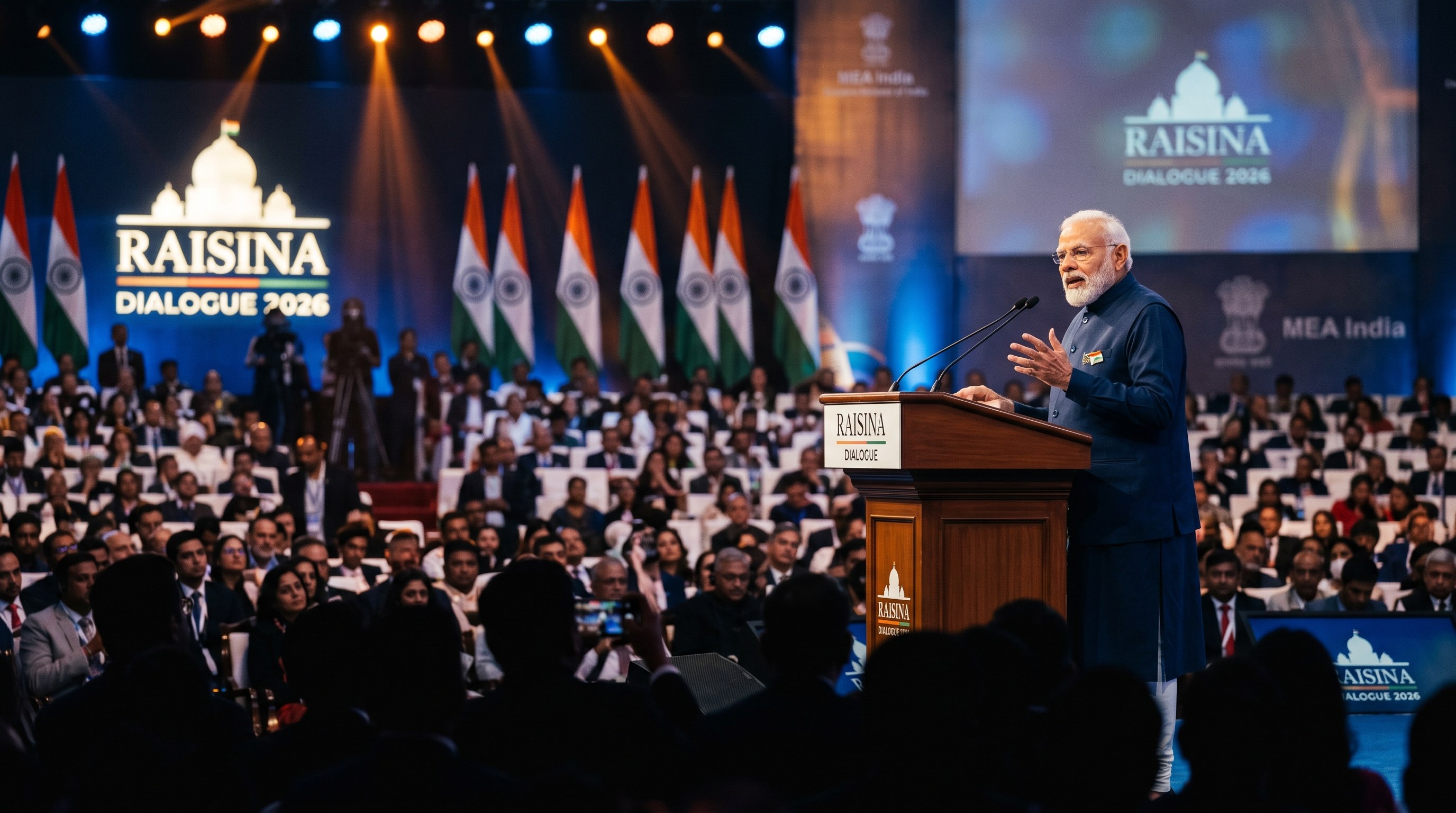
The 11th edition of the Raisina Dialogue, held in New Delhi this spring, was the most consequential edition of the conference yet. Not because of any single announcement. Not because of any specific bilateral breakthrough. Because of a tonal shift that, once you noticed it, was everywhere in the room.
Indian officials, Indian analysts, and Indian ministers stopped apologising for multi-alignment.
For a decade, "multi-alignment" or its slightly older cousin "strategic autonomy" was an Indian term used to explain to Western audiences why Delhi would not pick a side in their preferred binary — Washington versus Moscow, Washington versus Beijing, the West versus the rest. The explanation was usually defensive in posture. India would speak about civilisational logic, the size of its population, the scale of its problems, the importance of strategic patience. The room would listen politely and ask follow-up questions about whether India would eventually pick a side.
That tone is gone.
What changed in the room
This year the language flipped. The Indian speakers — from the Prime Minister down through ministers, ambassadors, and former officials — talked about multi-alignment as a doctrine the rest of the world should be learning from, not as a posture India needed to defend.
Modi's inaugural address framed it most clearly: India is a stabilising force in a destabilising world precisely because it does not subscribe to the binary categories that Western strategic thought has been trying to force on the international system since the early Cold War. The argument went: in a multipolar world, the country that maintains operational relationships with the most poles wins. India has done this work. The rest of the world is starting to.
That is not a defensive position. That is an offensive claim. India is not multi-aligned because it cannot pick. India is multi-aligned because it has correctly read the structure of the international system, and the rest of the world is now catching up.
The Global South pivot
The second tonal shift was about whose voice the conference was foregrounding.
Past editions of Raisina featured a dense lineup of Western analysts, US-based think-tank principals, and European foreign-policy officials. This year, the relative weight shifted noticeably. African ministers, Latin American senior officials, ASEAN representatives, and Gulf strategists were given main-stage billing. The Western contingent was still present, but it was one voice among several rather than the dominant register.
The framing was not anti-Western. It was post-Western. The implicit message: the conversations that matter for the next decade will not be primarily Atlantic conversations. They will be Indo-Pacific, Africa-Asia, Latin-Asia. The Atlantic will be in the room. The Atlantic will not run the room.
This is the editorial choice India has been making for several years through its G20 presidency, its BRICS chairmanship, its Voice of Global South summits. Raisina 2026 was the moment that choice became impossible to misread.
The three doctrinal pillars
Reading across the speeches, three operating principles emerged. They are not new in their components. They are new in their integration.
First, India will engage every major power simultaneously and refuse exclusive arrangements with any of them. This includes the United States, China, Russia, the European Union, Japan, the Gulf monarchies, and the major Global South economies. The engagement is not symmetrical — different relationships have different weights and operational depths — but the principle of engagement is unconditional.
Second, India will lead on issues where Indian leadership is structurally credible: digital public infrastructure, the affordable-medicine supply chain, vaccine production for the developing world, climate finance frameworks for emerging economies, food security architectures, and now AI governance from a Global South lens. These are not aspirational claims. India has the operational track record on all six.
Third, India will not lead on issues where Indian leadership would be empty: hard security guarantees outside its immediate neighbourhood, mediation in conflicts where India does not have direct trust on both sides, and grand normative declarations that India cannot operationally back up. The reticence on these is deliberate, not a weakness.
The combination of the three pillars is the doctrine. It is more disciplined than the rhetoric suggests, and it is more consequential than its critics acknowledge.
The Western reaction
Western reaction at the conference was mixed and instructive.
The American contingent was thoughtful but visibly recalibrating. Senior US analysts privately acknowledged that the Indian doctrine, as articulated, was no longer something Washington could pretend to be merely tolerating. India is no longer in the queue for a US strategic partnership. India is offering its own model and asking the United States to engage on India's terms or accept reduced influence in the consequence.
European reaction was more uncertain. The EU has spent five years trying to convince India to align more closely on China, on Russia, on broader normative questions. The Indian response at Raisina was, in effect: we will work with you, we will not be defined by you, and the difference matters.
The Russian and Chinese contingents were quieter than they would have been at past editions. Both countries understand that India's multi-aligned posture limits how much Russian or Chinese exclusivity Delhi can be drawn into. Both also understand that the alternative — pushing India into a Western-exclusive alignment — would be much worse for them. So they take what they get.
What this means for 2026
Three concrete operational consequences over the next year:
- BRICS chairmanship — India will use the chair to push for the substantive institutional development discussed earlier in this series, rather than treating BRICS as primarily a symbolic forum. The Lavrov visit and the May foreign ministers' meeting are the early signals
- Quad engagement — India will continue to participate, will not allow the Quad to become an anti-China military alliance, and will quietly broaden the Quad's working agenda toward Indo-Pacific public goods rather than military coordination
- Bilateral deals as building blocks — Each India bilateral deal of 2026 will be designed to fit into the multi-aligned architecture rather than to choose sides. The EU FTA, the US trade framework, the Russia defence and energy continuity, the China managed competition — all four will be advanced simultaneously, and the simultaneity is the point
The bottom line
Raisina is, in the end, a conference. Conferences do not make foreign policy. They reveal it.
What Raisina 2026 revealed is that India has stopped explaining itself and started defining the terms. The country that walked into past editions defending its choices walked out of this one offering them as a model.
The shift is real. The room knew it. So did the cameras.
BarathVector covers India's foreign policy posture and the institutions that shape it. Subscribe for the weekly briefing.