By Ramachandran Rajeev Kumar — 2026-01-27
The Deal Is Done: India and EU Close the Mother of All Trade Agreements
By Ramachandran Rajeev Kumar
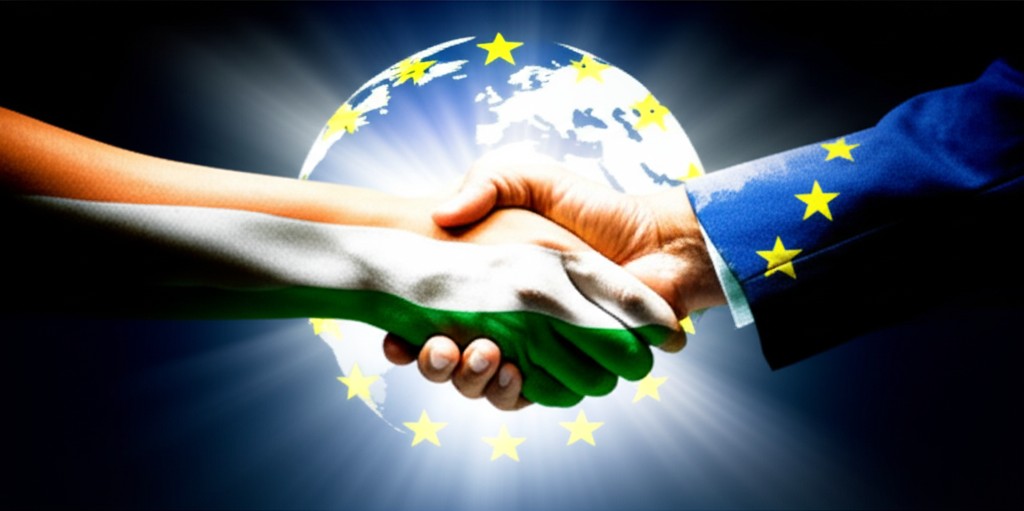
On January 27, 2026, in New Delhi, Prime Minister Narendra Modi, European Commission President Ursula von der Leyen, and European Council President António Costa announced what commerce officials on both sides have been calling "the mother of all deals."
After 18 years of stop-start negotiations, false dawns, and missed deadlines, India and the European Union have concluded the largest free trade agreement in India's history.
The numbers are staggering: two billion people, 25% of global GDP, one-third of world trade. A unified market that, on paper, rivals the combined heft of the United States and China.
The timing is not coincidental. With Washington imposing 50% tariffs on Indian goods and threatening 500% penalties for Russian oil purchases, India has demonstrated what it has always insisted: it has options.
What's in the Deal
Tariff Liberalization: Near-Total Market Access
The headline figures tell the story of ambition:
From the EU to India:
- 99.5% of Indian exports by value will receive preferential access
- 96.8% of tariff lines covered
- Immediate duty elimination on textiles, gems, jewellery, leather, footwear
- Phased reduction on automobiles (to 10% for specified volumes)
From India to the EU:
- 97% of EU exports by value covered
- 92.1% of tariff lines liberalized
- Reduced barriers on machinery, chemicals, pharmaceuticals
- Medical technology and equipment duties slashed
For India's labour-intensive sectors—the industries that employ millions and have struggled under Trump's tariffs—this is transformational. Textiles alone account for 12% of India's manufacturing employment. Duty-free access to a market of 450 million affluent consumers changes the calculus entirely.
Defence Partnership: From Trade Partners to Security Allies
The summit delivered more than trade. India and the EU signed a comprehensive Security and Defence Partnership that elevates bilateral ties to the level the EU maintains with Japan and South Korea.
Key provisions include:
- Intelligence sharing frameworks
- Joint defence industrial cooperation
- Technology transfer in critical sectors
- Space and telecom collaboration
- AI research partnerships
This is significant for two reasons. First, it signals European commitment to the Indo-Pacific at a moment when American attention wavers. Second, it opens European defence markets to Indian manufacturers—a two-way street that could see Indian missiles, ammunition, and components flowing westward.
"Enhance partnerships in sectors such as defence, space, telecom, and AI," Modi urged. Europe appears to have heard.
Mobility Framework: The Professional Pathway
For India's skilled workforce, the mobility provisions may matter most.
The agreement includes:
- Intra-Corporate Transferees (ICT): Simplified movement for employees within multinational companies
- Business Visitors: Streamlined visa processes for commercial travel
- Contractual Service Suppliers (CSS): Access in 37 sectors for Indian service providers
- Independent Professionals (IP): Access in 17 sectors for freelance specialists
- Traditional Medicine Practitioners: Recognition for Ayurveda, Yoga, and other Indian systems
- Social Security Framework: Five-year roadmap for bilateral agreements
The numbers validate the demand. In 2024, Indian citizens received the highest number of EU residence authorizations for study and research. Indians were the largest recipients of EU Blue Cards—the bloc's skilled worker visa—accounting for nearly 21% of all issued.
What's Out: Agriculture Stays Home
Sensitive agriculture was excluded. Period.
Both sides protected their farmers. The EU shielded beef, sugar, and rice. India protected dairy, pulses, and staple crops. This was always the dealbreaker in previous rounds, and negotiators wisely chose progress over perfection.
Agriculture can wait. Market access for 97% of goods cannot.
The CBAM Question: No Exemption, But a Framework
The elephant in the room was CBAM—the Carbon Border Adjustment Mechanism that went live on January 1, 2026, and now levies carbon costs on Indian steel, aluminum, cement, and fertilizer exports.
India wanted exemptions. India didn't get them.
Brussels was clear: CBAM is a horizontal regulation. No country-specific flexibility. No carve-outs. The climate imperative trumps bilateral trade considerations.
But India secured something potentially more valuable: a framework for future relief.
What India Got on CBAM:
1. Most-Favoured Nation Clause Any flexibility the EU grants to any country under CBAM automatically extends to India. If Brussels softens rules for Turkey, or grants transition periods to Morocco, India benefits identically.
2. Technical Cooperation A joint technical group will help Indian companies:
- Get carbon data verified
- Understand EU compliance requirements
- Prepare for integration of India's carbon pricing system
3. Carbon Price Recognition Pathway If India's Carbon Credit Trading Scheme (CCTS) meets EU standards, those domestic carbon costs can be deducted from CBAM bills. The agreement commits both sides to work toward mutual recognition.
4. Financial and Technical Support The EU will provide assistance to help Indian exporters:
- Reduce emissions intensity
- Meet climate-related trade requirements
- Transition to greener production
5. Rebalancing Rights If CBAM measures "impair pact benefits" to Indian firms, the FTA provides mechanisms to restore balance—a pressure valve if carbon costs become trade-distorting.
The Reality Check
Let's be clear: CBAM still hurts. Indian steel faces €55-80 per tonne in additional costs. Exporters may need to cut prices 15-22% to remain competitive. The $2-4 billion annual burden doesn't disappear with today's signing.
But the framework matters. India's CCTS launches in full this year. If carbon prices reach 25% of EU ETS levels, CBAM costs could drop 42%—from €826 million to €480 million annually. That's €346 million kept in India rather than flowing to European treasuries.
The technical cooperation provisions could accelerate this alignment. What looked like a unilateral climate tax three weeks ago now has a bilateral pathway to mitigation.
The Strategic Context: Why Now?
The Trump Factor
The timing speaks loudly.
In August 2025, the Trump administration imposed 50% tariffs on Indian goods—25% as baseline "reciprocal tariffs" and another 25% as punishment for Russian oil purchases. Last week, Trump backed a bill proposing 500% tariffs on countries buying Russian petroleum.
India's exports to the US face collapse. The Global Trade Research Initiative projects a fall from $86.5 billion to $50 billion in 2026 if current policies hold.
Into this chaos walks the EU-India FTA. A message to Washington: India does not depend on American goodwill. The world's largest democracy has other markets, other partners, other options.
The China Contrast
Modi's framing was pointed. India, he noted, operates on "give-and-take"—genuine partnership where both sides benefit. The implicit contrast with China's "give-give-give-but-no-take" approach was unmistakable.
Europe has learned this lesson. The Belt and Road Initiative created debt dependencies. Technology transfer requirements extracted value from European companies. Market access promises proved illusory.
India offers something different: a democratic partner of scale that plays by rules and expects reciprocity. For European businesses burned by Beijing, this matters.
The Climate Alignment
Beyond trade, the FTA positions India and the EU as climate partners.
The agreement includes:
- Green hydrogen cooperation
- Sustainable mobility initiatives
- Circular economy frameworks
- Water management collaboration
- Joint work on small modular reactors
India's 500 GW renewable target by 2030 and the EU's Green Deal find common ground. Climate Trends, the think tank, called the FTA "a climate platform linking trade, hydrogen, and carbon markets."
What Happens Next
Ratification: The Road Ahead
Today's announcement concludes negotiations. It does not conclude the process.
EU Ratification:
- European Parliament approval required
- Council of the EU adoption
- Potentially, all 27 member state parliaments (for comprehensive agreements)
The EU-Canada deal (CETA) took years to fully ratify. Belgium's regional parliament nearly killed it. Similar obstacles could emerge—agricultural lobbies in France, labour concerns in Germany, environmental groups across the continent.
Indian Ratification:
- Cabinet approval (straightforward)
- Parliamentary process (simpler than EU)
- Implementation legislation
Optimistic projections suggest full implementation by late 2027. Realistic assessments suggest 2028 or beyond.
Implementation: The Details Matter
Tariff reductions will phase in over years. The 10% auto duty applies to "specified volumes"—quotas that must be negotiated. Service sector liberalization requires domestic regulatory changes.
The defence partnership needs operational frameworks. Intelligence sharing requires trust-building. Technology transfer demands bureaucratic processes.
Today is the beginning, not the end.
The CBAM Opportunity: India's Carbon Pivot
This section builds on our earlier analysis of CBAM's impact on India and carbon sequestration opportunities.
The FTA creates a framework. What India does with it determines whether CBAM remains a burden or becomes an opportunity.
The Domestic Carbon Market Play
India's Carbon Credit Trading Scheme (CCTS) covers 740 entities across nine sectors—including the steel, aluminum, and cement industries most exposed to CBAM. The EU has committed to work toward recognizing India's carbon pricing.
The arithmetic is compelling:
| India's Carbon Price | CBAM Cost Reduction | Savings |
|---|---|---|
| €0 (current) | 0% | €0 |
| €20/tonne (~25% of EU ETS) | 42% | €346M annually |
| €40/tonne (~50% of EU ETS) | ~70% | €578M annually |
Every rupee India charges its own emitters is a rupee not sent to Europe. Domestic carbon revenue can fund green steel R&D, renewable energy, worker retraining—investments that make Indian industry permanently more competitive.
The Sequestration Opportunity
India's Nationally Determined Contribution commits to 2.5-3 billion tonnes of additional carbon sink by 2030. The EU's 2040 climate target allows up to 3% of emission reductions via international carbon credits.
India could become a primary supplier.
Blue carbon alone offers 702 million tonnes of sequestration potential across mangroves, seagrass, and tidal marshes. Gujarat has signed $266 million in mangrove carbon credit deals. Tamil Nadu achieved India's first Global Carbon Council certification.
The FTA's technical cooperation provisions could fast-track verification of Indian sequestration projects for EU compliance purposes. Instead of fighting CBAM, India sells carbon credits to the world.
What Should Happen Now
1. Accelerate CCTS Implementation The full carbon trading scheme must launch on schedule. Delays mean continued CBAM payments to Europe.
2. Align with EU Standards The technical working group should prioritize mutual recognition of carbon pricing. Every month of alignment saves millions.
3. Scale Sequestration National coordination of state-level carbon projects—Gujarat's mangroves, Tamil Nadu's wind credits, the Sundarbans restoration—into a unified export offering.
4. Create "Green Steel" Export Zones Industrial parks powered by renewables, with carbon capture and sequestration offsets, producing CBAM-compliant steel for European markets.
5. Leverage the FTA Defence Link European defence procurement increasingly incorporates sustainability criteria. Low-carbon Indian manufacturing gains advantage.
The opportunity is real. India can continue paying Europe's carbon tax, or it can build a carbon economy that turns climate compliance into competitive advantage.
The Verdict: Transformational, If Implemented
Eighteen years is a long time. Negotiations that began when George W. Bush was president, when Nokia dominated mobile phones, when climate change was an abstraction rather than a daily reality, have finally concluded.
The deal that emerges is not perfect. Agriculture is excluded. CBAM exemptions were denied. Ratification could take years. Implementation will encounter obstacles.
But the strategic significance is undeniable.
India has demonstrated to Washington that American markets are not irreplaceable. It has demonstrated to Beijing that democratic partnerships based on reciprocity still appeal. It has demonstrated to its own citizens that patient diplomacy eventually delivers.
Two billion people. Twenty-five percent of global GDP. One-third of world trade.
The mother of all deals, finally done.
This article is part of BarathVector's coverage of India-EU relations. See also:
- The Mother of All Deals: What 18 Years of Patience May Finally Deliver India (January 22)
- The Great Realignment: Why the Old Order Is Giving Way (January 23)
- The CBAM Reckoning: Europe's Carbon Tariff Is Climate Policy Dressed as Protectionism (January 15)
- The Carbon Pivot: How India Can Turn CBAM Pain Into Sequestration Profit (January 18)
Related Coverage: