By Ramachandran Rajeev Kumar — 2026-01-22
The Mother of All Deals: What 18 Years of Patience May Finally Deliver India
By Ramachandran Rajeev Kumar
In Davos this week, European Commission President Ursula von der Leyen chose her words with uncharacteristic drama: "the mother of all deals."
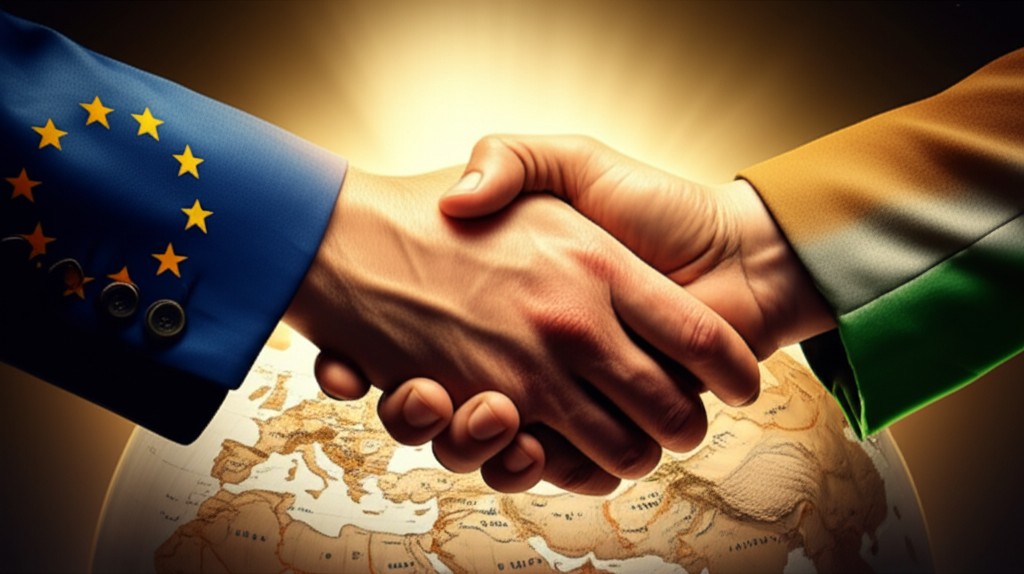
She was describing the India-EU Free Trade Agreement, now reportedly days away from announcement. After 18 years of stop-start negotiations, missed deadlines, and diplomatic frustration, the world's largest democracy and its most ambitious trade bloc are on the verge of creating something remarkable: a unified market of two billion people, accounting for nearly a quarter of global GDP.
The timing is not coincidental. Donald Trump's 50% tariffs on India, imposed last August, did what years of diplomatic entreaties could not: they made this deal urgent.
The Long Road to January 27
The India-EU FTA has a history that reads like a diplomatic epic. Negotiations began in 2007, during the Singh government's economic opening. By 2013, they had collapsed—victims of disagreements over automobiles, wine, intellectual property, and the perennial sticking point of agricultural market access.
Between 2016 and 2020, revival attempts sputtered. India was focused elsewhere: on domestic reform, on China's rise, on managing an increasingly transactional relationship with Washington. Europe, consumed by Brexit and its aftermath, had limited bandwidth for a deal that seemed perpetually out of reach.
The turning point came in June 2022, when both sides formally relaunched negotiations. But even then, progress was incremental. As recently as late 2025, observers expected conclusion only by year's end—at earliest.
Then Trump happened.
The Tariff Accelerant
When the United States imposed 50% tariffs on Indian goods in August 2025, India's trade calculus changed overnight. The American market, while important, was suddenly far more expensive to access. Alternative partnerships became not merely desirable but essential.
The EU, facing its own Trump-induced uncertainties, found a willing partner. Negotiations that had moved at diplomatic speed suddenly shifted to business speed. Over the past three months, what Commerce Secretary Rajesh Agrawal called "the last and most arduous leg" was completed with remarkable efficiency. Twenty of twenty-four chapters have been concluded. The remaining four are expected to close before Tuesday.
There is a certain irony here. Trump's "America First" trade policy, designed to force bilateral concessions from trading partners, has instead accelerated the formation of alternative trading blocs. The EU-India deal is the most significant example, but not the only one.
What's in the Deal
The agreement, as currently structured, represents genuine compromise from both sides.
For the EU:
- Reduced Indian tariffs on automobiles, a long-standing European demand
- Lower barriers to wines and spirits
- Improved access for medical technology and machinery
- Binding sustainability standards in trade
For India:
- Expanded market access for textiles—a labor-intensive sector employing millions
- Duty reductions on electronics, chemicals, and pharmaceuticals
- Enhanced mobility provisions for Indian professionals seeking EU employment
- A security and defence partnership agreement
The mobility provisions deserve particular attention. India has long sought easier visa access for its skilled workforce. Europe, facing demographic decline and skills shortages, needs those workers. The FTA reportedly includes a dedicated mobility pact—a significant concession from Brussels, where immigration remains politically sensitive.
What's Out
Agriculture.
This single word explains why previous negotiations failed and why this one may succeed. India's agricultural sector employs 44% of its workforce. Opening it to European competition would be politically suicidal for any Indian government. The EU, recognizing this reality, has apparently accepted agriculture's exclusion from the final deal.
This is not a small concession. European agricultural producers—particularly dairy, which sees India's massive vegetarian population as an untapped market—have lobbied intensively for access. Their exclusion represents a clear prioritization: Brussels wants this deal more than it wants to satisfy its farming lobby.
The CBAM Complication
One significant tension remains unresolved in the broader relationship, even if it sits outside the FTA proper: the EU's Carbon Border Adjustment Mechanism.
Since January 1, 2026, CBAM has applied to Indian exports of steel, aluminum, and cement. For India—whose heavy industries remain carbon-intensive—this represents a substantial cost burden. Indian negotiators have sought exemptions or transition periods. European negotiators, bound by climate commitments, have limited flexibility.
The FTA reportedly does not resolve CBAM. Instead, it creates frameworks for ongoing dialogue. This is diplomatic language for "we'll fight about this later." The fight will come. India's steel exports to Europe are too significant, and Europe's climate ambitions too central to its identity, for this issue to remain dormant.
The Strategic Dimension
Trade agreements are never purely about trade. The EU-India FTA carries strategic weight that extends far beyond tariff schedules.
For India, the deal represents diversification—a hedge against American unpredictability. With Trump imposing 50% tariffs while offering Pakistan just 19%, New Delhi has received a clear message about Washington's priorities. Europe offers an alternative anchor: large, wealthy, democratic, and—crucially—not engaged in zero-sum competition with India over regional influence.
For Europe, India represents something equally valuable: a democratic partner of scale in Asia that genuinely shares its commitment to rules-based international order. This is not rhetoric. India has demonstrated this commitment through action: signing up for Rafale fighter jets from France, negotiating submarine deals with Germany, participating in multilateral institutions even when they disadvantage Indian interests in the short term. China's market may be larger, but China operates in give-give-give-but-no-take mode—extracting concessions while offering little reciprocity. India, by contrast, understands partnership as mutual benefit. In a fragmenting world, that difference matters enormously.
The security and defence partnership included in the FTA package may prove as significant as the trade provisions themselves. Europe and India have never been natural military partners—geography and history placed them in different spheres. But the relationship is maturing rapidly. India buys European fighter jets and submarines. Europe, in turn, can source missiles, ammunition, and defense equipment from India at a fraction of what American contractors charge. This is genuine win-win: European defense industries gain a massive market, Indian manufacturers gain technology transfer and scale, and both sides reduce dependence on an increasingly unreliable Washington.
The Russia Question
Any honest assessment of EU-India strategic alignment must address the elephant in the room: Russia.
India's continued engagement with Moscow—on energy, on defense, on diplomacy—frustrates European policymakers who see Russia as an existential threat. But Europe would do well to understand and respect Russian security concerns rather than dismiss them. Russia, while economically weakened, remains a military superpower. Pushing Moscow further into isolation achieves nothing except strengthening the China-Russia axis—an axis that is not natural. China and Russia are not organic partners; they are being forced together by European and American policy choices.
As Canadian Prime Minister Mark Carney articulated recently, middle powers must think carefully about which conflicts serve their interests and which merely exhaust them. De-escalation with Russia is not appeasement—it is strategic wisdom. Without Russian involvement in a global conflagration, a third world war lacks the fuel to ignite. China, for all its assertiveness, is not historically or culturally inclined toward sustained warfare—it prefers economic domination and growth, even at others' expense, working through proxies rather than direct confrontation.
The real disruption to global order has come from an unexpected quarter: Washington itself. Recent American actions—the tariff chaos, the transactional abandonment of allies, the retreat from multilateral frameworks—represent a betrayal of the free market principles that democracies once considered sacred. This American decoupling from progressive global action may prove temporary, but the damage to American long-term interests is undeniable. Canada has openly staked its claim to independence from American leadership. Europe is following. India, for its part, maintained strategic distance all along and is emerging stronger from this turbulence.
The EU-India FTA is one step in what will be decades of reshaping the global order. Human endeavor and endurance for positivity will always create new amalgamations and unions, irrespective of occasional disruptions. The FTA does not resolve the Russia tension. But it creates space for the conversation to evolve—and demonstrates that democracies can build partnerships that transcend the crises of the moment.
For a deeper exploration of these geopolitical shifts, see our analysis: The Great Realignment: Why the Old Order Is Giving Way.
Republic Day Symbolism
The timing of the announcement carries its own significance. EU leaders Ursula von der Leyen and Antonio Costa will attend India's Republic Day celebrations on January 26 as chief guests—the first time EU institutional heads have received this honor.
The following day, January 27, they will co-chair the 16th India-EU Summit, where the FTA announcement is expected. The sequencing is deliberate: first the symbolism of partnership, then the substance.
For Modi, European leaders on Rajpath (now Kartavya Path) sends a message to multiple audiences. To domestic observers, it signals India's growing global stature. To Washington, it demonstrates that India has options. To Beijing, it shows that democracies can cooperate at scale.
What Remains Uncertain
Even with announcement imminent, significant uncertainties remain.
Ratification: EU trade agreements require approval from the European Parliament and, for comprehensive deals, from all 27 member state parliaments. This process has derailed agreements before—most notably the EU-Canada deal, which faced years of delays. India's parliamentary process is simpler but not automatic.
Implementation: A signed agreement is not a functioning agreement. Regulatory harmonization, customs procedures, and dispute resolution mechanisms must all be operationalized. This takes years, not months.
CBAM: As noted, the carbon border adjustment mechanism remains contentious. If European steel prices make Indian exports uncompetitive, the FTA's benefits will be substantially reduced for one of India's most important industrial sectors.
Political durability: Both India and Europe face electoral cycles. A future Indian government less committed to trade liberalization, or a future European Commission less enthusiastic about Asian partnerships, could slow implementation or seek renegotiation.
The Larger Picture
The EU-India FTA, if concluded as expected, will be the European Union's largest trade agreement by population covered. It will create the world's most significant democratic trading bloc. And it will represent a clear statement about how major economies intend to navigate an era of American retreat from multilateral trade.
None of this was inevitable. For 18 years, this deal seemed destined to join the long list of promising initiatives that never quite materialized. What changed was context: Trump's tariffs, China's assertiveness, Europe's post-Brexit search for new partnerships, India's need for export diversification.
Sometimes the mother of all deals needs the father of all disruptions to finally get done.
The India-EU Summit convenes January 27 in New Delhi. BarathVector will provide full coverage of the FTA announcement and its implications.
Related Coverage: