By Ramachandran Rajeev Kumar — 2026-02-10
Bharath Manthan - Episode 5
By Ramachandran Rajeev Kumar
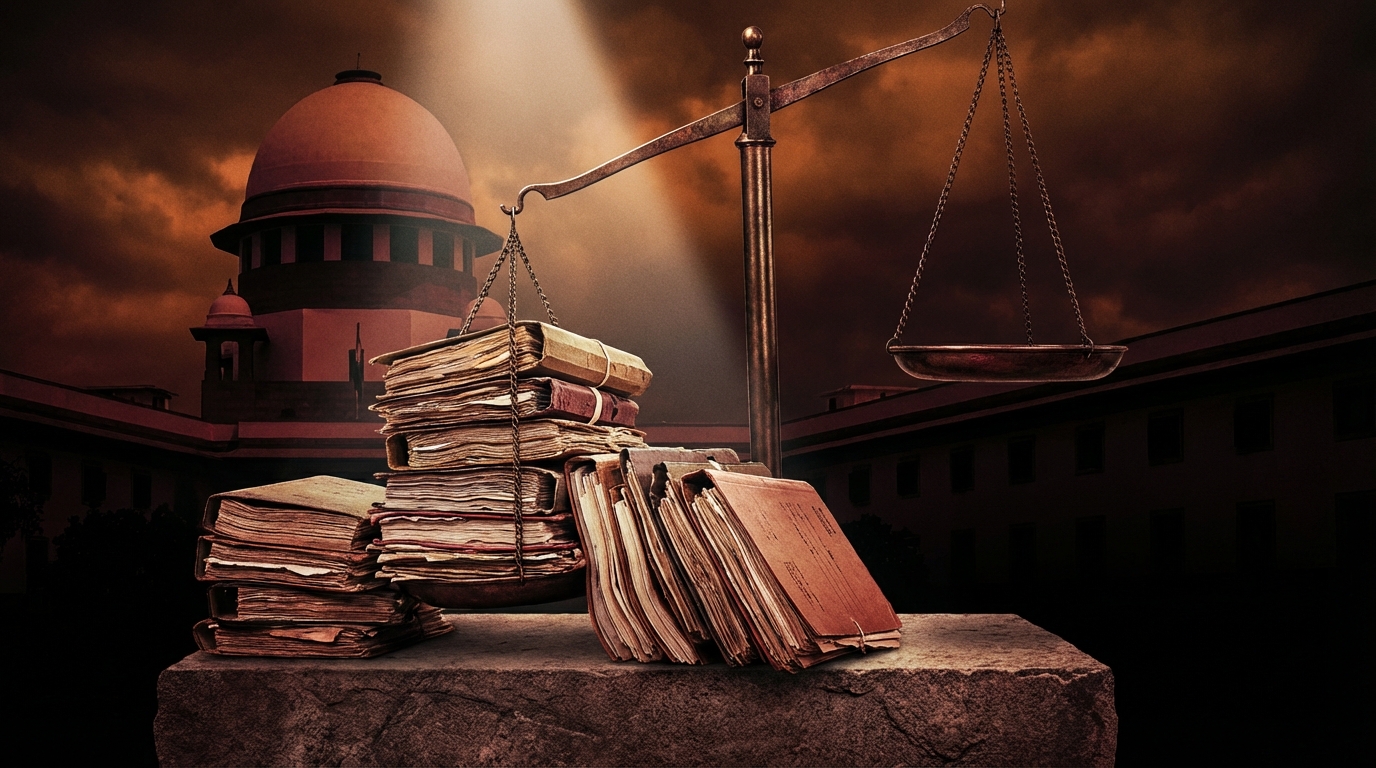
The Judiciary Question: Justice Delayed, Democracy Denied
India modernised its military. It digitised its tax system. It built a biometric identity infrastructure that covers 1.4 billion people. It launched spacecraft to the Moon and Mars. It connected 97 crore citizens to the internet. In sector after sector, institution after institution, India has demonstrated the ability to transform legacy systems into functional modern machinery.
Except one.
The Indian judiciary operates, in its essential structure, much as it did when the British designed it -- not to deliver justice efficiently, but to administer a colonial territory where delay served the interests of the ruling power. Independent India inherited this system in 1947 and has spent the subsequent eight decades adding cases to it without fundamentally reforming how it processes them.
The result is a number that should haunt every citizen: 5.3 crore pending cases across all levels of the Indian judiciary. More than 70,000 in the Supreme Court. 60 lakh in the High Courts. 4.6 crore in district and subordinate courts. If no new case were filed from today, a NITI Aayog analysis estimates it would take 324 years to clear the existing backlog.
Three hundred and twenty-four years. The British ruled India for less time than that.
The Anatomy of Delay
The numbers are staggering, but they obscure the human reality. Behind every pending case is a person -- a farmer waiting for a land dispute resolution, a woman waiting for a domestic violence protection order, a small business owner waiting for a contract enforcement ruling, an undertrial prisoner waiting for a trial that may never come.
India's prison population tells the starkest version of this story. Of the country's 5.7 lakh prisoners, 76% are undertrials -- people who have not been convicted of any crime but remain incarcerated because the system that is supposed to determine their guilt or innocence cannot process their cases in a reasonable timeframe. These are not hardened criminals awaiting sentencing. Many are poor, illiterate, and unrepresented. They are in prison because the court calendar is full.
More than 180,000 cases have been pending for over 30 years. A child born on the day a case was filed could now be a parent, and the case would still be listed for the next hearing date. This is not a system experiencing delay. It is a system that has structurally substituted delay for function.
Why Reform Has Failed
India has not been unaware of the problem. Since independence, multiple commissions, committees, and reports have diagnosed the judiciary's ailments and prescribed remedies. The Law Commission has issued over 270 reports. The Supreme Court has established e-Courts, Lok Adalats, mediation centres, and fast-track courts. The National Mission for Justice Delivery has been operational for over a decade.
And yet the backlog has increased by 30% since 2020.
The reasons are structural, not incidental.
Judicial vacancies remain chronic. India has approximately 21 judges per million citizens, compared to 50 in the United Kingdom and over 100 in the United States. Despite repeated recommendations to increase judicial strength, vacancies persist across all court levels. As of 2025, roughly 30% of High Court positions and 20% of district court positions remained unfilled. The collegium system for judicial appointments -- opaque, slow, and prone to institutional deadlock -- ensures that vacancies take years to fill.
Procedural culture rewards delay. The Indian legal system allows for extensive adjournments, repeated interlocutory applications, and a culture of postponement that benefits litigants with resources and patience. Lawyers have financial incentives to extend proceedings rather than resolve them. Judges, overburdened with existing caseloads, routinely grant adjournments rather than insist on proceeding. The system does not punish delay; it normalises it.
Infrastructure is inadequate. Many district courts operate from dilapidated buildings with insufficient courtrooms, unreliable power supply, and inadequate digital infrastructure. The e-Courts project has made progress in digitising case records and enabling electronic filing, but the physical infrastructure of the lower judiciary remains a constraint on throughput.
Legislative output exceeds judicial capacity. India's Parliament and state legislatures continuously enact new laws and regulations, each of which generates litigation. The judiciary's capacity to process cases has not kept pace with the expanding scope of justiciable matters. Every new consumer protection law, environmental regulation, or digital governance framework adds to the queue.
The Constitutional Paradox
India's Constitution guarantees the right to life and personal liberty under Article 21. The Supreme Court has interpreted this to include the right to a speedy trial. In Hussainara Khatoon v. State of Bihar (1979), the Court held that prolonged detention without trial violates fundamental rights.
Yet the system that the Constitution creates -- an independent judiciary with the power to enforce fundamental rights -- is the same system that cannot process its caseload. The guarantor of justice is the primary obstacle to its delivery. This is not a paradox that can be resolved by judicial pronouncements alone. It requires structural intervention of the kind that India has applied to other institutional challenges.
What Reform Looks Like
The solutions are not mysterious. They have been identified, costed, and endorsed by virtually every serious analysis of the Indian judiciary. The question has never been what to do. It has been who will do it.
Fill vacancies aggressively. India needs to at least double its judge-to-population ratio within a decade. This requires reforming the appointment process, expanding the pool of eligible candidates, and treating judicial recruitment with the same urgency that the government applies to military recruitment.
Limit adjournments ruthlessly. Courts must enforce strict timelines for case progression, with adjournments granted only in genuinely exceptional circumstances. Case management systems -- already available through the e-Courts platform -- should automatically flag cases that exceed normative timelines and escalate them for administrative review.
Invest in infrastructure at scale. The Budget 2026-27 has been criticised for fiscal restraint on judiciary spending. This is precisely the wrong signal. India needs a national judicial infrastructure programme comparable in ambition and funding to the highway expansion or digital connectivity programmes. Courtrooms, judges' residences, digital infrastructure, and support staff all need massive expansion.
Embrace technology beyond digitisation. AI-driven case management, automated bench allocation, predictive analytics for case duration, and virtual hearings for procedural matters can dramatically increase judicial throughput without compromising quality. India's own technological capabilities -- demonstrated in Aadhaar, UPI, and CoWIN -- suggest that building such systems is within reach.
Reform procedural law. The Civil Procedure Code and Criminal Procedure Code contain provisions that actively incentivise delay. Mandatory pre-litigation mediation, limits on interlocutory applications, and expedited procedures for categories of cases with clear factual matrices would reduce the inflow of new cases while accelerating the processing of existing ones.
The Democracy Argument
Judicial reform is typically framed as an efficiency problem -- a matter of clearing backlogs and reducing wait times. This framing is accurate but insufficient.
An independent and functional judiciary is the foundational institution of a constitutional democracy. It is the mechanism through which the powerful are held accountable, the rights of minorities are protected, and the rule of law is given practical meaning. When the judiciary cannot function -- when it takes decades to resolve disputes, when undertrial prisoners outnumber convicts, when the poor cannot access the courts at all -- the entire constitutional project is compromised.
India has modernised every other pillar of its governance architecture. The executive has been digitised. The legislature has been televised. The military has been recapitalised. The economy has been reformatised.
The judiciary alone remains substantially as the British left it -- slow, hierarchical, paper-heavy, and inaccessible to the majority of citizens it is supposed to serve.
The Question
Bharath Manthan asks the hard questions that churning a nation's history demands.
Here is this episode's question: Can India sustain its democratic ambitions with a judicial system that denies effective justice to the majority of its citizens?
The answer should be obvious. The action required to address it is known. The political will to execute it remains the missing ingredient -- not because reform is unpopular, but because the judiciary's dysfunction is diffuse. It does not create a single crisis that forces action. Instead, it creates 5.3 crore small crises, each borne individually by people who lack the power to demand systemic change.
324 years is a number. Behind it are millions of lives suspended in legal limbo -- waiting for a system that was never designed to serve them to finally, belatedly, deliver what the Constitution promised.
Justice delayed is not merely justice denied. In a democracy that defines itself by the rule of law, justice delayed is democracy denied.
The question is not whether India can reform its judiciary. It is whether India can afford not to.
Previous episodes: Episode 1: The Thousand Year Mirror | Episode 2: One Billion Indians, One Identity | Episode 3: The Innovation Gap | Episode 4: The Caste Calculus
Next episode: Coming soon
The author is Founder & Editor-in-Chief of BarathVector.