By Ramachandran Rajeev Kumar — 2026-05-30
The Quad Has Finally Found a Real Job
For years, the Quad has suffered from a strange disease: too much strategic language, too little strategic plumbing.
Every meeting produced the right phrases. Free and open Indo-Pacific. Rules-based order. Freedom of navigation. Resilient supply chains. Regional stability. China was rarely named directly, but everyone knew who sat behind the curtain. The problem was not that the language was wrong. The problem was that language does not secure a sea lane, refine lithium, protect an undersea cable, build a port or detect a militia vessel.
The New Delhi foreign ministers' meeting on May 26 matters because it finally moved the Quad closer to its natural purpose.
Not alliance theatre. Not moral sermon. Infrastructure.
This was the eleventh meeting of Quad foreign ministers. A grouping that has now outlasted changes of government in all four capitals is no longer an experiment in search of a rationale. The only question left is what, concretely, it is for.
The Quad is useful to India only when it helps build capacity India actually needs: maritime surveillance in the Indian Ocean, diversified critical minerals supply chains, port and cable resilience across the Indo-Pacific, energy security, logistics coordination and technology standards that reduce single-vendor dependence. If the Quad becomes that, it is valuable. If it returns to communique diplomacy, it becomes another premium seminar in a region already over-supplied with seminars.
India's test is simple: use the Quad as a capacity multiplier without renting its strategic mind.
The Old Quad Problem
The Quad was always easiest to describe as an answer to China. That was also its weakness.
For Washington, the Quad could sound like one more instrument in a grand contest with Beijing. For Tokyo and Canberra, it carried maritime and supply-chain urgency. For New Delhi, it was more complicated. India wanted a stronger Indo-Pacific balance, but not a treaty alliance. It wanted cooperation with the United States, Japan and Australia, but not a posture that made Indian strategy look like American subcontracting. It wanted pressure on Chinese coercion, but also space to manage its own border, its own trade exposure and its own continental vulnerabilities.
That is why the most useful Quad has never been the loudest Quad.
India does not need a club that merely denounces China. India needs arrangements that reduce the costs China can impose. That means awareness at sea, alternatives in minerals, redundancy in cables, resilience in ports, and optionality in technology. A country does not become secure because its partners agree with its adjectives. It becomes secure when its systems can continue functioning under pressure.
The May 26 statement suggests the Quad may finally be internalizing this.
Maritime Surveillance Is Not Symbolism
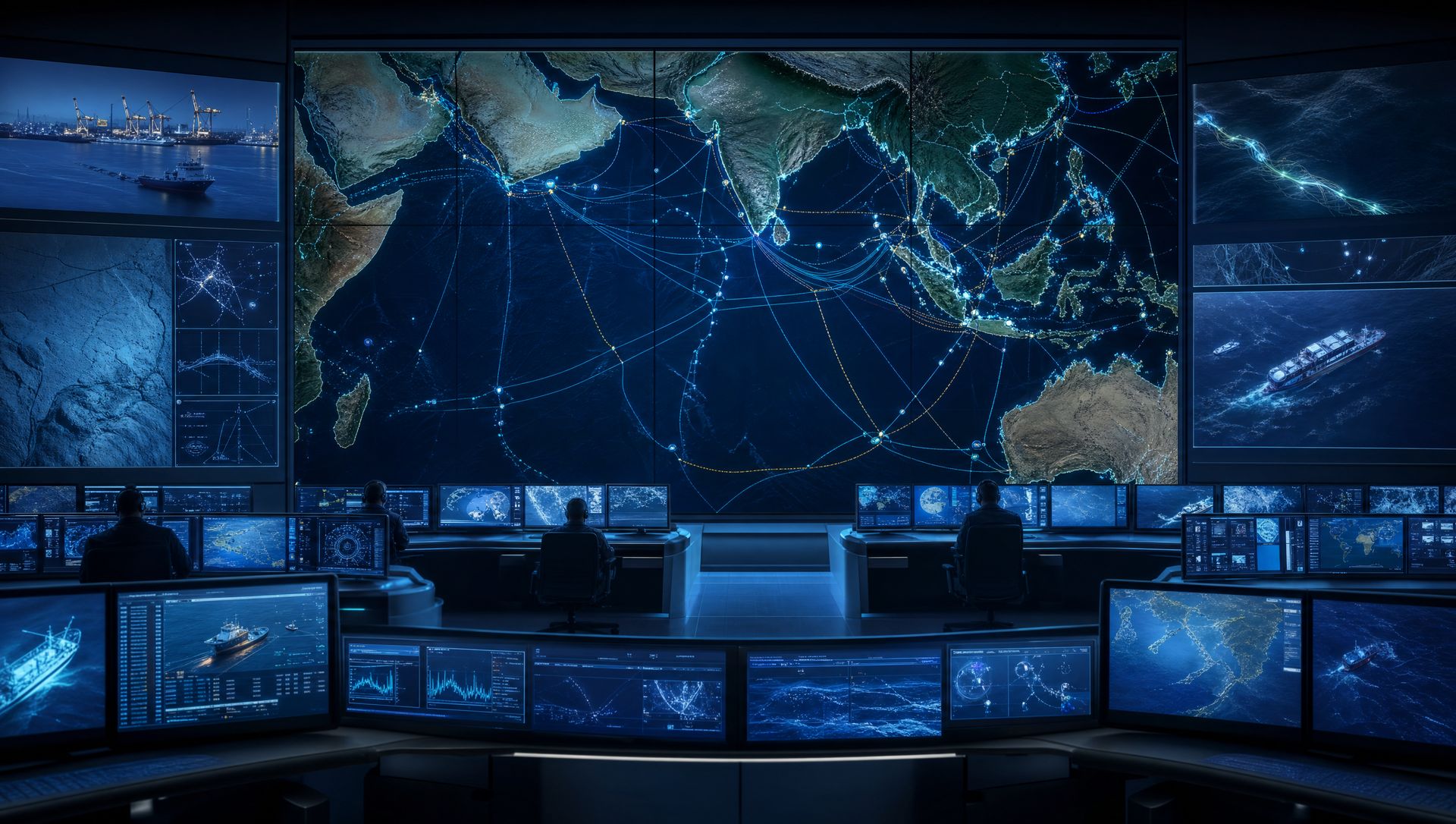
The most important Quad announcement was not the most glamorous one. It was the move to strengthen maritime domain awareness.
The joint statement welcomed India's operationalization of the Indian Ocean Region programme of the Quad Indo-Pacific Partnership for Maritime Domain Awareness through the Information Fusion Centre - Indian Ocean Region in Gurugram. It also announced the Indo-Pacific Maritime Surveillance Collaboration, initially in the Indian Ocean Region, to improve coordination and real-time information sharing.
Translated out of diplomatic grammar, this is about seeing the water.
That matters because grey-zone conflict at sea thrives on ambiguity. Fishing fleets that are not only fishing fleets. Coast guard vessels that are not only coast guard vessels. Research ships that are not only research ships. Militia assets that probe, crowd, block and test response thresholds. The South China Sea has taught the region that coercion does not always arrive as a naval battle. Often it arrives as a map slowly enforced by small vessels, administrative claims and fatigue.
India's Indian Ocean challenge is different from Southeast Asia's, but the lesson is the same. You cannot deter what you cannot track. You cannot protect shipping, ports, seabed infrastructure or exclusive economic interests if the maritime picture is fragmented across navies, coast guards, commercial operators and friendly governments.
For India, the value of the Quad is not that an American or Australian system watches the Indian Ocean for us. The value is that shared awareness raises the cost of covert coercion and gives India more decision time. Strategic autonomy is not isolation. It is the ability to make your own decisions from a stronger information base.
Critical Minerals Are The New Chokepoint
The Quad Critical Minerals Initiative Framework is the second serious move.
The official statement frames the problem carefully: economic coercion, arbitrary export restrictions, price manipulation and supply-chain disruption, especially in critical minerals. The real-world translation is clear. China dominates processing capacity for several inputs that modern industry cannot do without. Electric vehicles, batteries, semiconductors, defence electronics, renewable energy, telecom networks and AI infrastructure all run through mineral supply chains that are more concentrated than polite commentary admits.
Business Standard reported that the Quad initiative aims to mobilize up to $20 billion in government and private sector support for mining, processing and recycling. The exact number matters less than the architecture. Mining alone is not security. A country can own ore and still remain dependent if processing, refining, magnet production, cell manufacturing and recycling sit elsewhere.
This is where India must be precise.
India should not treat the Quad as a foreign supply guarantee. That would only replace one dependency with another. The point is to use the Quad to build a wider non-coercive ecosystem: Australian and Indian resources, Japanese processing discipline, American finance and technology, Indian demand, recycling capacity, standards and industrial policy aligned to actual factories.
The compute sovereignty argument applies here too. If India wants semiconductor fabs, grid-scale storage, defence electronics and AI infrastructure, it cannot outsource the mineral base of that future. Minerals are not a mining story. They are an industrial sovereignty story.
Ports, Cables And The Boring Things That Decide Power
The Fiji port announcement may look peripheral from Delhi. It is not.
The Quad countries said they would work with Fiji to advance port infrastructure. They also emphasized the resilience of undersea cable systems and support for Pacific Island connectivity. This is where the Quad begins to look less like a debate platform and more like a regional operating system.
Ports decide trade routes. Cables decide digital routes. Energy corridors decide inflation routes. Maritime surveillance decides whether coercion remains deniable. These are not supporting details of strategy. They are strategy.
China understood this earlier than most democracies. It built roads, ports, industrial parks, telecom networks and financing channels, then allowed the politics to follow the infrastructure. Democracies spent too long answering with speeches. The correct democratic answer is not to imitate predatory lending or opaque leverage. It is to build trusted infrastructure faster, cleaner and with less drama.
India has a special interest in this. The Indian Ocean is not a backdrop to India's rise. It is the operating environment of India's trade, energy imports, diaspora links, naval reach and island diplomacy. If India wants to be a leading power, it cannot outsource the region's connective tissue to any single country.
The Quad's job is to make the alternative visible and usable.
Energy Security Is Back
The Quad Initiative on Indo-Pacific Energy Security also deserves attention.
Energy security is often treated as old economy, as though serious countries can leap directly from strategic ambition to clean-tech brochures. They cannot. Fuel, fertilizer and shipping disruptions still move inflation, food prices and political stability across the Indo-Pacific. The official statement connects maritime transport and supply chains to fuel, food and fertilizer security for a reason.
For India, this is not abstract. West Asian disruption, Russian oil exposure, dollar pressure, refinery dependence and fertilizer imports all sit inside the same strategic ledger. The Russian crude question and the Strait of Hormuz question are not separate from the Quad's Indo-Pacific agenda. Sea lanes join them.
An energy-security Quad should not become a cartel of anxiety. It should help build redundancy: strategic petroleum coordination, resilient fuel logistics, clean-fuel partnerships, grid technology, emergency supply mapping and fertilizer-chain stability. In a world where shipping disruptions quickly become household inflation, energy security is social stability by another name.
The India Rule: Use The Quad, Do Not Become The Quad
India's temptation after every Quad meeting is to over-explain itself.
One camp wants India to speak louder against China, as if national strength were measured in press-conference adjectives. Another camp fears every Quad initiative as a slide toward alliance dependency. Both positions are lazy.
India should be clear-eyed. The Quad is not NATO. It is not a mutual defence pact. It is not a substitute for Indian naval power, Indian manufacturing, Indian diplomacy or Indian technological capacity. It is a platform. Platforms are useful when they help you build.
India's operating rule should be: cooperate where capacity rises, refuse where autonomy shrinks.
Maritime information sharing raises capacity. Critical minerals coordination raises capacity. Undersea cable resilience raises capacity. Port infrastructure raises capacity. Standards cooperation in 5G, 6G, AI and digital identity can raise capacity if India shapes the rules instead of merely receiving them. Humanitarian logistics can raise capacity. But any pressure to turn India into a predictable vote in someone else's contest should be resisted.
This is not fence-sitting. This is adulthood.
What India Should Ask For Next
The New Delhi meeting gives India an opening. It should not waste it on applause.
First, India should push the maritime surveillance initiative into operational routine. Shared pictures, regular exercises, clear data protocols, and usable feeds for partner states in the Indian Ocean matter more than another summit paragraph.
Second, India should demand critical minerals outcomes that touch Indian soil: processing, refining, recycling, battery materials, magnets, research facilities and offtake agreements for Indian manufacturers. A minerals framework that leaves India only as a market is not enough.
Third, India should connect the Quad's undersea cable work to domestic cable landing, cybersecurity, repair capacity and data-centre resilience. Connectivity without control is vulnerability dressed as progress.
Fourth, India should use the Fiji port model to think harder about Indian Ocean infrastructure. Small island states do not need lectures about rules. They need ports, power, disaster response, hospitals, connectivity and finance that does not trap them.
Fifth, India should keep the Quad practical. The moment the platform becomes mostly performative, its usefulness falls.
The best Quad is one that can be measured in vessels tracked, cables protected, minerals processed, ports built, supply shocks absorbed and partners helped.
Finally, A Job Description
The Quad has spent years looking for a stable identity. New Delhi may have offered one.
It is not an Asian NATO. It is not an anti-China slogan. It is not a diplomatic ornament. It is a practical coalition for reducing coercive dependence across the Indo-Pacific.
That is a real job.
For India, the opportunity is not to join a chorus. It is to build capacity with countries that have complementary strengths. Australia has minerals and Pacific reach. Japan has industrial discipline, finance and infrastructure credibility. The United States has technology, capital, naval reach and market power. India has scale, location, demand, diplomatic access and the largest stake in the Indian Ocean's future.
The Quad works when those strengths become assets in the field, not paragraphs in a statement.
If it helps India see the seas, secure minerals, protect cables, stabilize energy routes and build trusted infrastructure, it deserves attention. If it only helps everyone say "free and open Indo-Pacific" in a more synchronized voice, it deserves boredom.
The New Delhi meeting suggests the Quad understands the difference.
Now India should make sure it does.
BarathVector covers India's strategic posture and geopolitical positioning. Subscribe for the weekly briefing.