By Ramachandran Rajeev Kumar — 2026-05-27
Own the Compute, or Rent the Future: India's Real AI-Jobs Answer
The IT-services escalator that lifted a generation of Indian engineers into the middle class is running in reverse. TCS shed roughly 23,000 employees going "AI-first" in a single year. The top five IT firms added a collective net of fewer than twenty employees across nine months of FY26 — against a sector that once absorbed a hundred thousand fresh graduates annually. Junior-developer job postings are down roughly sixty percent since 2022. GitHub Copilot writes nearly half the code its users produce.
Around 1.5 million engineers graduate each year in India. Only about ten percent land a job that uses what they studied. Graduate unemployment for the fifteen-to-twenty-five cohort sits at roughly forty percent. NITI Aayog puts up to two million IT jobs at risk by 2031 — or four million new AI-enabled roles if India acts. That fork is real. What India does in the next three years will determine which path it takes.
The question is: what does "acting" actually mean?
The Shallow Answer
Every policy document since 2023 says some version of the same thing: reskill the youth. Online courses. AI literacy. Bootcamps. FutureSkills Prime, the flagship initiative, has reached approximately 13,500 scholars — against 1.5 million graduates a year. That is not a programme. It is a pilot that has not noticed it is still a pilot.
Reskilling is necessary. It is nowhere near sufficient. You cannot produce AI researchers and infrastructure engineers by putting them in front of slide decks. AI is an empirical discipline. You learn it by training models, breaking them, debugging at three in the morning — and every hour of that work requires compute.
Access to compute is the binding constraint. India is not treating it that way.
The Real Lever
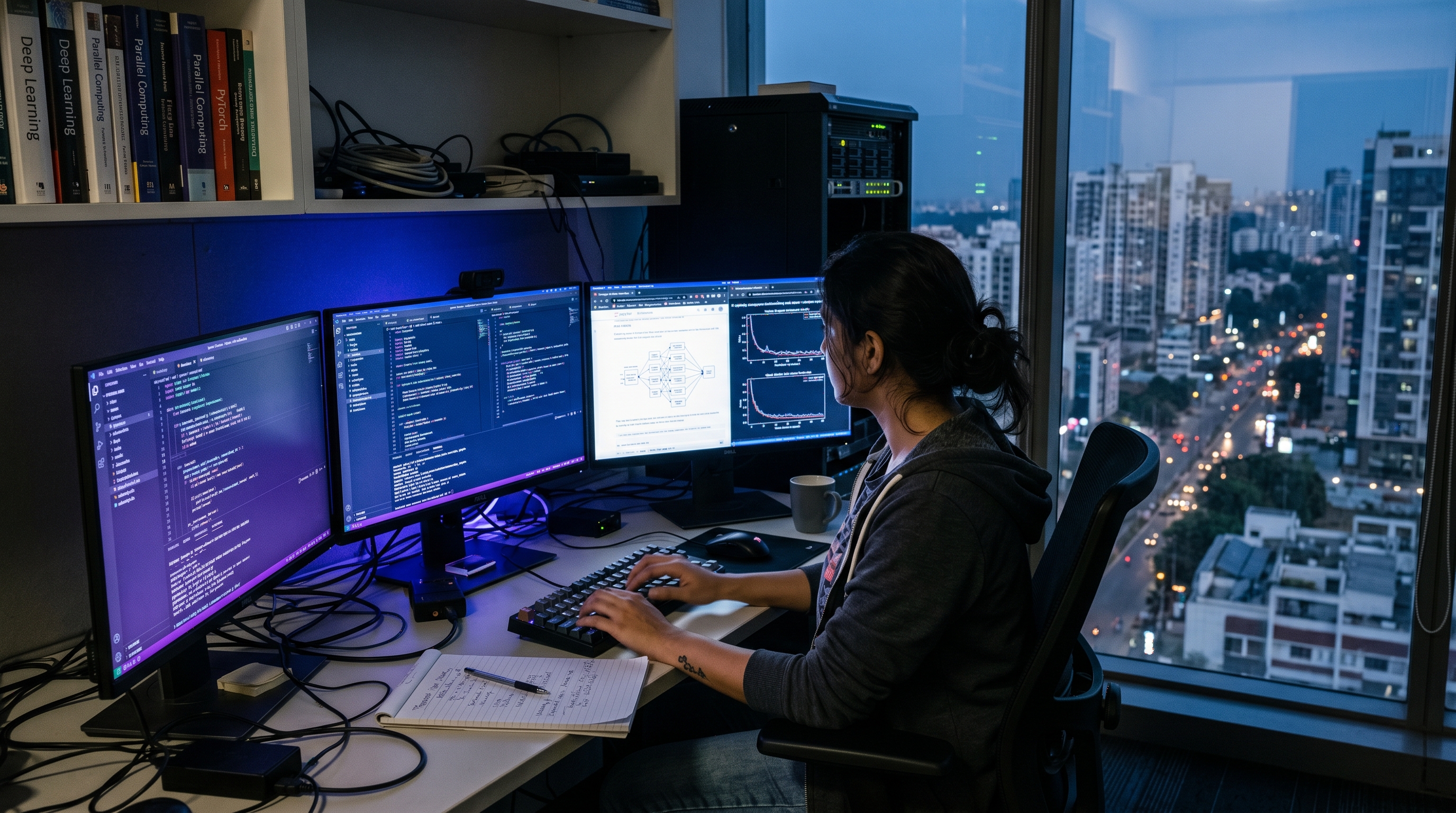
Think about what a 22-year-old aspiring AI researcher in Coimbatore or Patna actually needs. Not a certificate. A GPU — preferably several — running for weeks while a model trains. The resource separating someone who understands transformers in theory from someone who has built one is not intelligence or ambition. It is compute time.
India currently fields roughly 38,000 GPUs through the IndiaAI Mission at approximately Rs 65 per GPU-hour — five to nine times cheaper than global cloud rack rates. That is the most important infrastructure fact in Indian technology policy right now. It is also woefully small against the scale of the problem.
The ambition is to scale toward 100,000 GPUs. Even at that number, the maths is punishing: under 500,000 AI-skilled professionals against a target of one million by end-2026, only sixteen percent of the IT workforce carrying meaningful AI skills. A hundred thousand GPUs rationed across institutions, startups, and research labs is not sovereignty. It is a queue.
What India has built is a foundation. The structure needs to be raised on ground India actually owns.
The NVIDIA Chokepoint
Here is the awkward arithmetic at the centre of India's compute build-out. The dominant GPU supplier for serious AI training workloads is NVIDIA. H100s and H200s run the bulk of the world's model training. India needs a lot of them. And the United States government has formally decided how many India can have.
Under the AI chip diffusion framework that came into force in May 2025, India is classified as a Tier 2 country. The hard ceiling: approximately 50,000 H100-equivalent GPUs through 2027 — a national quota covering research institutions and private data centres alike. That ceiling can double via a bilateral agreement aligning India's technology-security posture with Washington's. The key phrase is can theoretically. The quota is American. The allocation control is American. The pricing power is NVIDIA's.
NVIDIA's data-centre gross margins have run above seventy percent. Blackwell-series chips carry their own allocation constraints for non-Tier-1 buyers. The dependency is structural: India's AI ambitions run on a vendor whose pricing, allocation, and geopolitical exposure lie entirely beyond Indian control.
This is not an anti-NVIDIA argument. It is a supply-chain-risk argument — the same logic applied to any single-source dependency in critical infrastructure. Strategic autonomy in hardware, as this desk has argued in the context of India's air defence doctrine, means maintaining options, not loyalty. Locking national AI capacity to one vendor and one country's export-control framework is a subscription that can be repriced, throttled, or revoked.
The Hedge That Is Already Running
The good news is that the alternative is not theoretical. It is deployed.
The IndiaAI Mission's compute fleet already includes 1,050 Google Trillium TPUs alongside its NVIDIA GPU allocation. That was not an accident — it was the first concrete expression of compute diversification in Indian AI policy, and it deserves to be a template, not a footnote. Google's seventh-generation TPU, Ironwood, is now generally available with more than four times the performance per chip over Trillium. AMD's MI300X accelerators also appear in the IndiaAI portal's catalogue. The pieces of a diversified stack exist.
What is missing is the strategic framing that treats diversification as mandatory rather than incidental. Every GPU added to the national fleet should prompt the question: are we reducing single-vendor concentration, or deepening it? France is spending €109 billion on AI infrastructure. South Korea has committed to deploying more than 260,000 GPUs across sovereign clouds. The EU runs public AI Factories that give startups and universities access to serious compute at reduced cost. The pattern is global and unambiguous: nations serious about AI are treating compute as critical national infrastructure.
India should apply the same self-reliance logic it has built into its defence posture to its compute stack. Build it. Own it. Hedge it.
The Indigenous Horizon — and What It Is Not Yet
No honest argument for compute sovereignty can skip where India's indigenous AI chip capability actually stands.
It is early. The National Supercomputing Mission has initiated processor and GPU-class accelerator design under the RISC-V instruction set. Startups — Fermionic Design, Mindgrove Technologies, 3rdiTech — have taped out chips on 28nm processes and are targeting production-grade designs in 2026. Tata Electronics is building a fabrication facility in Dholera with Taiwan's Powerchip — but at 28nm, a node suited to automotive applications, not frontier AI training.
There is no Indian-designed, Indian-manufactured GPU-class AI accelerator in production today. Anyone claiming otherwise is selling aspirations, not silicon.
India in 2026 sits at roughly the stage China occupied in the mid-2010s before its accelerated semiconductor push — promising research, early designs, government-backed ambition, not yet manufacturing at the frontier. The implication is not to wait. Build the compute hubs now, diversify the vendor stack aggressively, and fund the indigenous accelerator programme as a decade-long project. Sovereignty in compute, like sovereignty in defence, is built over time.
Mass Access, Not Managed Scarcity
The deepest problem with India's compute policy is not the vendor mix. It is the distribution model.
FutureSkills has reached 13,500 scholars against 1.5 million graduates a year. The IndiaAI portal exists — but access is concentrated among approved institutions and a narrow band of funded startups. The Rs 65/GPU-hour subsidy is genuinely competitive. What is missing is distribution at scale.
The model that would move the needle for a 22-year-old in Nagpur or Madurai is not a portal that a handful of IITs can access. It is compute pushed — in meaningful, workable allocations — across the five hundred universities the government has nominally committed to equipping. GPU credits for individual researchers, not just institutional quotas. Compute allocated by merit, not by proximity to a government-backed lab.
The EU's AI Factories model is the reference point: public supercomputing nodes accessible to any qualifying startup or researcher, explicitly designed to break the advantage large cloud incumbents hold. India's equivalent — call it an AI Commons — would be sovereign compute infrastructure, vendor-diversified, subsidy-accessible to any young researcher who can demonstrate a serious project. The kid in Coimbatore training her first language model should not be running it on borrowed AWS credits. She should be running it on Indian compute, at Indian prices, on infrastructure India controls. That is what makes her an AI builder rather than a consumer — and it is the difference, at scale, between a generation that shapes the technology and a generation that deploys someone else's.
The Prescription
Compute sovereignty is not a hardware memo. It is a youth-employment policy.
India has the foundation: 38,000 GPUs, a live TPU deployment that proves the hedge works, a subsidy rate that makes access affordable, and a semiconductor design ecosystem that is promising if not yet mature. What it needs is the political will to treat compute infrastructure with the strategic seriousness it applies to air defence — own it, diversify it, and push it into the hands of every young researcher who can use it. Building it at scale also demands the investment conditions India keeps deferring — compute hubs, fabs, and data centres are capital-intensive, and as the companion argument sets out, capital still has to be made welcome.
The alternative is to keep renting — at prices set in Santa Clara, under tiers set in Washington, on infrastructure that can be repriced when demand spikes or simply not allocated when a larger customer needs the rack. A nation that rents its compute rents its AI future.
NITI Aayog puts four million AI-enabled jobs within reach. Those jobs will not materialise through curriculum reform. They will materialise when the 22-year-old in Patna has the same access to serious compute that her counterpart at MIT has — on infrastructure India has chosen to own.
Own the compute. Own the future. The alternative is not neutrality. It is permanent dependency dressed as a subscription plan.
BarathVector covers India's technology policy, strategic economy, and the national stakes of the AI transition. Subscribe for the weekly briefing.