By BarathVector Editorial — 2026-05-27
"Waiver or No Waiver": India's Russian-Crude Defiance and the Dependency It Won't Name
Delhi told Washington it would keep buying. Washington blinked. Now India needs to be honest about what it has built.
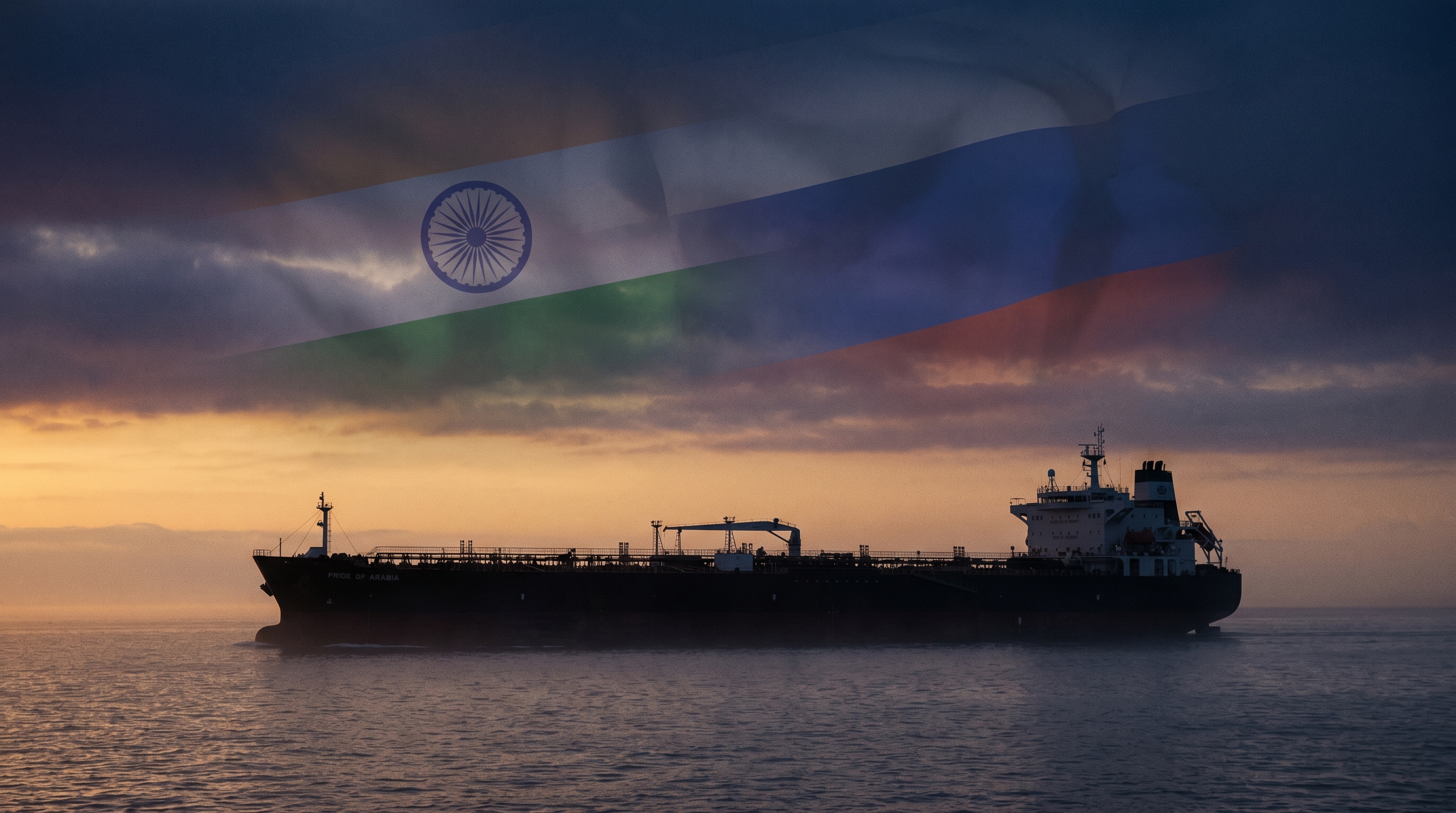
In mid-May 2026, India's petroleum ministry delivered one of the more striking statements in recent diplomatic memory. It would keep purchasing Russian crude to meet its energy needs — "waiver or no waiver." The phrase was deliberate, unhurried, and addressed to an audience in Washington that had been making noise about sanctions enforcement for months.
Within hours, US Treasury Secretary Scott Bessent announced a fresh 30-day waiver allowing India to continue buying Russian seaborne oil without triggering secondary sanctions. The sequence — Indian defiance, American capitulation, same business day — was almost too clean to be accidental.
It was not accidental. It was the logical endpoint of a pattern India has been executing since 2022: hold the line, absorb the pressure, wait for Washington to calculate that the cost of enforcement exceeds the cost of accommodation. The S-400 precedent proved this works on hardware. The crude-oil episode proves it works on energy.
The defiance is real. It is also earned. But India is letting the theatre of the moment obscure a structural question it has declined to answer in public: what does it mean that roughly 35-40% of the world's third-largest crude importer's supply now flows from a single sanctioned supplier, through a logistics architecture built for opacity — and that the price advantage that justified the arrangement has largely evaporated?
How the waiver cycle works
The story of the waiver has a rhythm. The US initially granted a temporary exemption from Russian oil sanctions in March 2026, as supply markets convulsed following the Iran war and pressure on the Strait of Hormuz. That waiver was renewed on April 16. The April waiver expired April 18 — a gap of two days that, according to reporting by BusinessToday and The Week, produced a brief moment of studied ambiguity from Washington before the May 18 renewal came through.
The ambiguity was not an accident. In the April cycle, Bessent publicly signalled the waiver would not be renewed, then reversed within days — preserving diplomatic leverage while avoiding the crisis that enforcement would trigger with a country Washington needs for its China strategy.
India understands this perfectly. The petroleum ministry's "waiver or no waiver" remark was not bravado — it was an accurate reading of the cost-benefit matrix in Washington, applied by a government that has run this calculation before and been right before.
Indian refiners, for their part, acted on the same reading. Ahead of each waiver expiry, state-owned refineries front-loaded purchases aggressively. Russian crude into India ran at approximately 1.9 million barrels per day in May 2026, with some estimates suggesting the rate was approaching 2.3 million bpd as the waiver deadline loomed, according to OilPrice.com's coverage of refiner behaviour.
The discount that disappeared
Here is the detail that makes the current moment genuinely different from 2022 or 2023, and that India's official framing — purchases driven by "commercial considerations and supply availability" — does not fully address.
The commercial argument for Russian crude rested on a discount. After the February 2022 invasion and the subsequent G7 price cap on Russian exports, Indian refiners were buying Urals-grade crude at discounts of $13 to $15 per barrel against Brent. That was real money. India's refining margin improved. Fuel prices faced less upward pressure. The economics were straightforward enough that even critics of the Russia relationship could not argue with the arithmetic.
That arithmetic has changed. Through the first months of 2026 the discount narrowed relentlessly — from the low-$20s per barrel in February toward single digits by April. By late March, Urals cargoes delivered to Indian ports had briefly flipped to a premium of four to eight dollars over Brent, as the Iran war tightened supply and Chinese and Indian refiners competed for the same flow (The Moscow Times; Sunday Guardian). May spreads have stayed volatile — some reporting a partial reversion toward a $10-15 discount — but the through-line is unmistakable: the deep, dependable discount that justified the arrangement in 2022 is gone. Urals has traded above $110 a barrel in May 2026, its highest since 2013. BusinessToday's verdict was blunt: "No discounts — Russian crude oil back on tap for India, but at a higher price."
India is still buying Russian oil. It is no longer buying it cheap. The official framing of "commercial considerations" made clean sense when the commercial consideration was a $13 discount. It requires more explanation when the discount is $4, and requires a different explanation altogether when Urals is at par or above — supply security, geopolitical signalling, logistics inertia, or some combination. None of those are invalid reasons. But they are different reasons, and India has not publicly updated its rationale to match its actual situation.
The dependency no one names
The more important question is structural. Russia's share of India's total crude imports peaked at close to 40% during 2024-2025 — a figure that has oscillated since. It fell below 25% in January 2026, rebounded sharply when state-owned refineries increased volumes by 148% month-on-month in March 2026, and has rebounded toward the high-30s in recent months, according to trade data tracked by The Print and energy analytics firms.
Whatever the precise number in any given month, the structural reality is this: India has built a significant portion of its energy supply chain around a supplier that operates under international sanctions, whose exports move partly through a shadow fleet of approximately 1,400 opaque tankers (per Lloyd's Shadow Fleet Tracker), and whose reliability is contingent on the political durability of a relationship that no formal treaty governs.
Strategic autonomy hawks in Delhi spend considerable energy warning about concentration risk in Chinese supply chains — critical minerals, electronics, pharmaceuticals. The logic is sound. A country that depends on a single foreign supplier for a critical input, especially one that operates outside normalised trade frameworks, has handed that supplier leverage. The argument applies with equal force to energy sourced from a sanctioned state through informal logistics.
This is not the same as saying India should stop buying Russian oil. The sovereign hedging logic that drives the RBI's gold accumulation applies to energy too — diversification of supply sources reduces the leverage any single partner holds. But diversification is the point. India is not diversifying. It is concentrating. A 40% single-supplier share, in any procurement context, triggers risk management protocols. In energy, it is the kind of exposure that makes strategic planners nervous — and should.
What the defiance earns, and what it costs
The "waiver or no waiver" moment earned India something real. It demonstrated that Delhi will not reorganise its energy supply chain on American instructions, and reinforced the message to every other potential partner that India cannot be coerced by threat of secondary sanctions. That credibility is part of the same body of leverage India used in the S-400 negotiations and in the February 2026 trade framework that capped Indian tariff exposure at eighteen percent.
What it costs is harder to name but equally real. A country that publicly commits to a single supplier — "waiver or no waiver" — narrows its own room for manoeuvre. The statement was designed to signal to Washington that India cannot be moved. It also signals to Moscow that India will absorb whatever terms Moscow sets, because the alternative is a public reversal of a high-profile position. That is leverage flowing the wrong direction.
The individual-level consequences are direct. Fuel prices in India are downstream of crude costs. When the Urals discount was $13, Indian refineries passed some of that saving through. When Urals is at par, or at premium, the cushion disappears — and the political logic of cheaper Russian oil as a rationale for absorbing diplomatic friction weakens proportionally. The citizen filling a tank in Chennai or Jaipur is exposed to the same global crude price as everyone else, while the country's supply chain depends on a logistics architecture that operates in the grey zone of international commerce.
The honest off-ramp
The constructive version of this argument is not that India should pivot away from Russian oil. It is that India needs an energy security strategy that matches the sophistication of its geopolitical posture.
That means three things. First, genuine diversification — not away from Russia, but toward a portfolio where no single supplier crosses 25% of total imports. Second, strategic petroleum reserves large enough that front-loading ahead of a waiver deadline is no longer the primary hedge. Third, an honest public accounting of what Russian crude now costs — not the 2022 economics, but the 2026 economics — so the policy debate is grounded in current reality.
Strategic autonomy, at its best, means India chooses its own suppliers on its own terms. What it cannot mean, if the doctrine is to hold, is that the choice calcifies into a dependency as deep as the one it was designed to avoid.
The "waiver or no waiver" declaration was a genuine expression of sovereignty. The next step is making sure that sovereignty has an honest balance sheet behind it.
BarathVector covers India's energy policy, strategic posture, and geopolitical positioning. Subscribe for the weekly briefing.