By Ramachandran Rajeev Kumar — 2026-01-22
US-Iran: The Great Game Returns
A BarathVector Geopolitical Analysis
The USS Abraham Lincoln, accompanied by three destroyers, has passed through the Strait of Malacca heading west. Iran has preemptively shut its airspace. Two leaders are exchanging threats that would have triggered immediate war in any previous century.
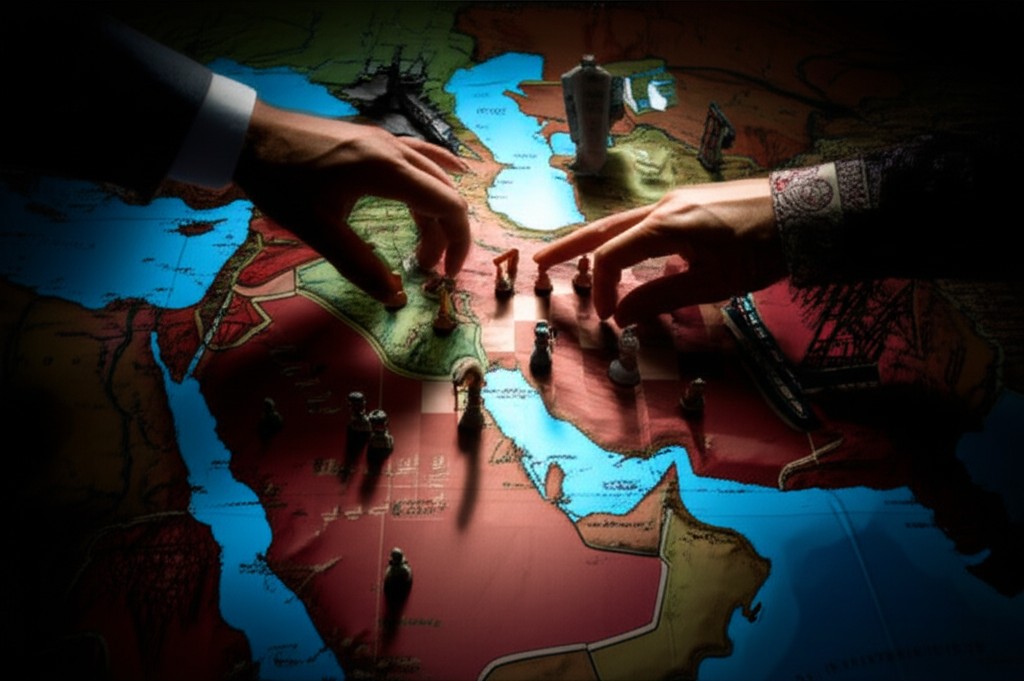
Welcome to January 2026, where the Persian chessboard is set for what could be the most consequential Middle East confrontation since the Iraq War.
The Opening: Protests as Catalyst
The current crisis did not emerge from nuclear negotiations or proxy wars. It began, almost prosaically, with the collapse of Iran's rial currency in late December 2025. Economic desperation drove Iranians into the streets, and what started as bread riots has metastasized into something far more dangerous for Tehran's clerical establishment.
The human cost has been staggering. Over 3,600 protesters have been killed in the crackdown, according to the US-based Human Rights Activists News Agency. More than 26,000 have been arrested. The violence peaked on January 8 and 9, when security forces killed an estimated 12,000 people over two nights.
These are not statistics. They are the kindling for what comes next.
The American Position: Red Lines and Carrier Groups
President Trump has drawn two explicit red lines in the sand:
- No mass executions of protesters
- No killing of peaceful demonstrators
The first red line has likely already been crossed. The second is being violated daily. Yet the American response remains calibrated — for now.
Trump's rhetoric, however, suggests the calibration may not last. "Wiped off the face of this earth," he threatened, should Iran succeed in assassinating American leadership. His description of Ayatollah Khamenei as "a sick man who should run his country properly and stop killing people" was followed by a call for "new leadership in Iran."
The military pieces are moving accordingly. The Abraham Lincoln carrier strike group's westward transit is not a training exercise. When aircraft carriers change course, strategists pay attention.
The Iranian Counter-Game
Tehran's response reveals both defiance and fear in equal measure.
Foreign Minister Abbas Araghchi published an extraordinary op-ed in the Wall Street Journal — choosing America's premier business publication to deliver his message. "Firing back with everything we have if we come under renewed attack," he warned, referencing last year's 12-day Israeli operation against Iranian nuclear facilities.
General Abolfazl Shekarchi, spokesman for Iran's armed forces, went further: "If any hand of aggression is extended toward our leader, we not only cut that hand but also we will set fire to their world."
Supreme Leader Khamenei himself invoked historical precedent, comparing Trump to fallen tyrants: "Pharaoh, Nimrod, Reza Shah and Mohammad Reza were brought down at the peak of their arrogance. He too will be brought down."
The rhetoric is maximalist. But rhetoric from Tehran has always been maximalist. What matters more is the airspace closure — a defensive preparation that suggests Iran believes an attack may be imminent.
The Strategic Calculus
This is where the chess analogy becomes instructive.
American advantages:
- Overwhelming air and naval superiority
- Regional allies (Saudi Arabia, UAE, Israel) aligned against Tehran
- Iranian military already degraded by last year's Israeli strikes
- Domestic Iranian opposition providing potential internal pressure
Iranian advantages:
- Asymmetric warfare capabilities (Hezbollah, Houthis, Iraqi militias)
- Ability to close the Strait of Hormuz (20% of global oil transit)
- Missile arsenal capable of reaching regional US bases
- Russian and Chinese diplomatic cover (though not military support)
The critical unknown: Would Iran actually attempt to assassinate Trump? The threat has been made before, but acting on it would be regime suicide. Yet regimes facing extinction sometimes choose mutual destruction.
What to Watch
Three indicators will signal whether this remains a war of words or becomes something else:
The Abraham Lincoln's destination. If it enters the Persian Gulf or Arabian Sea, the chess pieces are in attack position.
Iran's proxy networks. Any major Hezbollah or Houthi action against American assets would suggest Tehran is preparing the battlefield.
Trump's next statement. The President's communication style is deliberately unpredictable. A shift from threats to ultimatums would mark a phase change.
The Endgame Problem
Every chess match has an endgame. The problem with US-Iran tensions is that neither side can articulate a sustainable end state.
America's implicit goal — regime change in Tehran — is not achievable through airstrikes alone. Iran's explicit goal — American withdrawal from the Middle East — is not achievable without a war Tehran cannot win.
This leaves both players in a perpetual middle game, trading threats and positioning pieces, waiting for the other to make a decisive mistake.
The protests have scrambled this calculation. For the first time since 1979, the Iranian regime faces genuine internal existential threat. A wounded and desperate regime is unpredictable.
And unpredictability is the enemy of strategic stability.
The coming weeks will determine whether this remains a diplomatic crisis or becomes the defining military confrontation of the decade. BarathVector will continue tracking developments as the great game unfolds.
Related Coverage: