By Ramachandran Rajeev Kumar — 2026-02-11
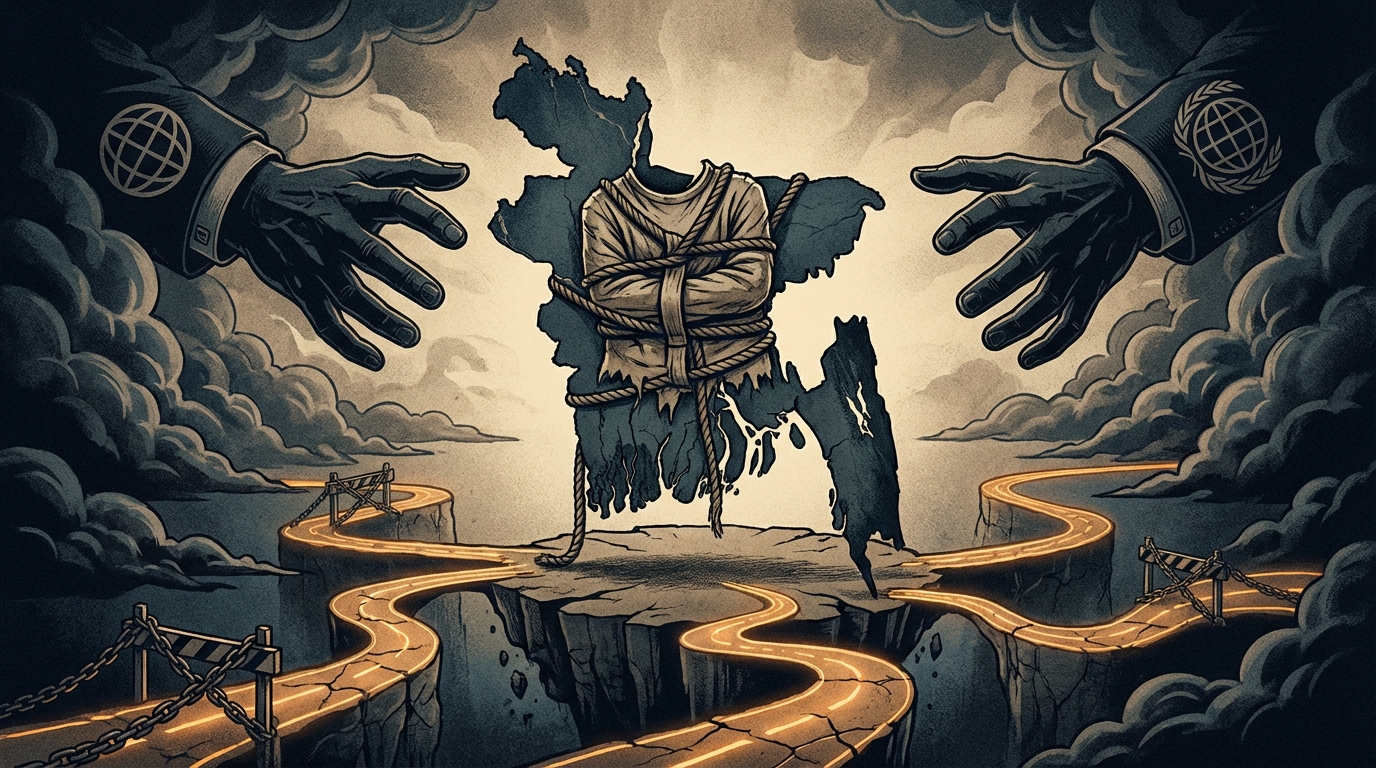
The Yunus Straitjacket: How an Unelected Leader Boxed In Bangladesh
By Ramachandran Rajeev Kumar
This article follows up on our previous coverage from February 1.
When we last wrote about Bangladesh on the eve of its pivotal election cycle, the question was whether India could balance hosting Sheikh Hasina while courting her successors. Ten days later, the picture has shifted -- not because India made a move, but because Muhammad Yunus made one for everyone.
On February 9, three days before Bangladesh goes to the polls, the interim government signed a trade framework with the United States. The deal, negotiated without electoral mandate and rushed past what any democratic convention would consider appropriate, tells us less about US-Bangladesh relations and more about one man's desperation to secure a legacy before voters make him irrelevant.
A Deal Without a Country's Consent
Let us be clear about what happened. An unelected caretaker administration, installed after a popular uprising against Sheikh Hasina, signed a binding trade agreement with the world's most powerful economy -- 72 hours before the people of Bangladesh get to choose who represents them.
This is not governance. It is pre-emption. Yunus, the Nobel laureate turned accidental administrator, has made a strategic calculation: lock Bangladesh into a US-centric trade framework before a potentially more China-friendly or India-friendly government takes charge. Whether this serves Bangladesh's interests is, to him, apparently secondary.
The timing alone should disqualify the deal's legitimacy. Caretaker governments exist to maintain continuity, not to forge strategic alignments. What Yunus has done is the diplomatic equivalent of a departing tenant signing a decade-long lease on behalf of the next occupant.
The Cotton Illusion
The headline concession -- zero tariff on Bangladeshi garments entering the US -- sounds transformative for a nation where textiles account for over 80% of export earnings. But examine the fine print and the picture unravels.
The zero-tariff provision applies exclusively to garments manufactured using American cotton. Bangladesh must import this cotton from the United States, ship it across the Pacific at significant freight cost, process it domestically, and export the finished product back to America.
The arithmetic is unforgiving. Bangladesh's garment competitiveness rests on low labour costs and proximity to regional cotton suppliers. Force American cotton into that equation, and the shipping cost alone -- approximately $1,200 per container from US Gulf ports to Chittagong versus $400 from Indian ports -- eviscerates the tariff advantage. The deal looks generous on paper. In the factory, it is a constraint dressed as a gift.
India's own textile sector, which sources cotton domestically at lower logistics costs, faces no competitive threat from this arrangement. If anything, it reinforces India's structural advantage.
Anti-India Rhetoric: Bangladesh's Self-Inflicted Wound
Since Hasina's departure, a strain of anti-India sentiment has percolated through Bangladesh's political discourse. Temples have been vandalised. Hindu-owned businesses have faced intimidation. The rhetoric has occasionally reached ministerial levels under Yunus's watch.
This is not India's problem. It is Bangladesh's.
India remains Bangladesh's most important regional partner. The Padma Bridge, the power grid interconnections, the transit agreements that allow Bangladeshi goods to reach Nepal and Bhutan through Indian territory -- these are infrastructure realities that no amount of political posturing can undo. Every anti-India headline in Dhaka weakens not Delhi's position, but Dhaka's own negotiating leverage with the partner it needs most.
Pakistan's Empty Hand
Islamabad has been quick to insert itself into Bangladesh's political transition, offering the usual cocktail of diplomatic solidarity and strategic partnership rhetoric. Pakistan's Foreign Minister visited Dhaka twice in four months, and intelligence-sharing arrangements have reportedly been proposed.
But what can Pakistan actually deliver? Its own economy is under IMF supervision. Its currency has depreciated over 40% in two years. Its power sector is in crisis. Pakistan can export ideology and intolerance -- it has decades of practice -- but it cannot export economic stability, industrial capacity, or infrastructure investment. Bangladesh, which fought a war of independence from Pakistan in 1971, would do well to remember that solidarity without substance is just sentiment.
The BNP Factor
If the February 12 elections are free and fair -- and early indications suggest the Election Commission has made genuine efforts toward transparency -- the Bangladesh Nationalist Party under Tarique Rahman's direction is widely expected to form the next government.
This, paradoxically, could be the reset that India-Bangladesh relations need. The BNP, despite its historical scepticism of India, is a pragmatic party that understands the economics of the bilateral relationship. External Affairs Minister Jaishankar's recent meeting with Tarique Rahman signalled that India is ready for this transition.
But a BNP government will inherit the Yunus straitjacket -- a US trade deal it did not negotiate and may not want. Its China relationships will be constrained. Its options for balancing between major powers will be limited. Yunus, in his haste to be consequential, may have handed the incoming government the worst possible starting position: committed to Washington, alienated from Delhi, and unable to pivot to Beijing.
India's Position: Stronger Than It Looks
For all the commentary about India "losing" Bangladesh, the fundamentals remain sound. India's cost of production in textiles, agriculture, and light manufacturing is competitive on its own terms. The US-Bangladesh garment deal does not threaten Indian textile exports -- it constrains Bangladesh's.
India's energy supply to Bangladesh continues uninterrupted. India's transit facilities remain essential for Bangladeshi trade connectivity. India's market remains the most cost-effective destination for Bangladeshi goods.
The straitjacket is on Bangladesh, not India. And the key to removing it may well be the election that Yunus tried so desperately to pre-empt.
This article follows up on our previous coverage of the India-Bangladesh diplomatic tightrope.