By Ramachandran Rajeev Kumar — 2026-02-01
India's Bangladesh Dilemma: Hosting an Exile While Building New Bridges
As Dhaka prepares for elections, New Delhi walks a diplomatic tightrope
On February 12, Bangladesh goes to the polls in its first general election since Sheikh Hasina's dramatic exit from power. The former Prime Minister, who ruled for 15 years before fleeing to India on August 5, 2024, now watches from New Delhi as her Awami League party stands banned from contesting.
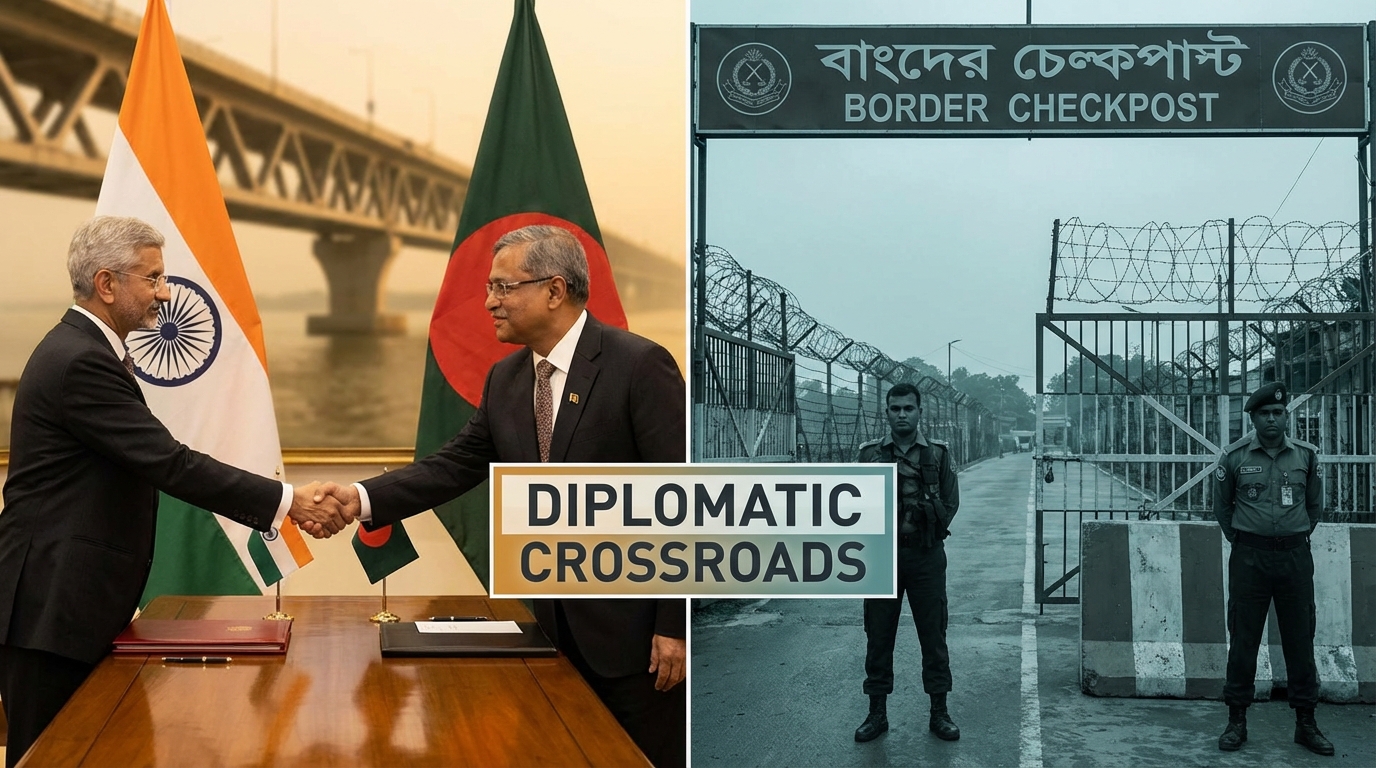
Meanwhile, India's External Affairs Minister S. Jaishankar recently met Tarique Rahman, the man most likely to lead Bangladesh's next government, in what was described as a "very cordial" exchange signalling a "potential new phase" in bilateral relations.
The optics are striking: India simultaneously hosts one leader in exile while courting her successor across the border.
The Hasina Factor
Sheikh Hasina's presence in India has become the single biggest irritant in bilateral relations.
When a student-led uprising ended her rule in August 2024, she fled to neighbouring India—the only country that would take her. What was perhaps expected to be a quiet exile has turned into something far more complicated.
On January 23, 2026, Hasina delivered a virtual address from New Delhi to a packed Foreign Correspondents' Club, with over 100,000 watching online. She called Muhammad Yunus, head of Bangladesh's interim government, a "murderous fascist" and declared that Bangladesh would "never experience free and fair elections" under him.
Bangladesh's response was furious. The Ministry of Foreign Affairs said it was "surprised and shocked" that India allowed the speech, calling it "a clear affront to the people and Government of Bangladesh."
The episode crystallised a difficult reality: Hasina is not content to fade into quiet retirement. She maintains an office in New Delhi, coordinates with Awami League members inside Bangladesh, and continues to position herself as her country's legitimate leader.
For Dhaka, India's refusal to extradite her—despite an existing extradition treaty and a death sentence passed by Bangladeshi courts—is a sore point that overshadows all other diplomatic conversations.
The BNP Pivot
Yet even as Hasina complicates matters, India has been quietly repositioning itself.
The Bangladesh Nationalist Party (BNP), long viewed with suspicion in New Delhi, is now the frontrunner for the February elections. Its leader, Tarique Rahman, returned from 17 years of self-imposed exile in December, shortly after his mother, former Prime Minister Khaleda Zia, passed away.
India's response to Khaleda Zia's death was notably warm. Prime Minister Modi sent a personal condolence letter to Tarique Rahman. Jaishankar attended her funeral in Dhaka. These gestures were not lost on observers.
The BNP of 2026, analysts note, is different from the BNP of the 1980s and 1990s, when relations with India were openly hostile. Tarique Rahman's decision to contest elections without an alliance with Jamaat-e-Islami—the Islamist party that had been BNP's traditional partner—is seen as a deliberate signal to New Delhi.
Whether this pivot will translate into substantive cooperation remains to be seen. Historical mistrust runs deep. The BNP has, at various points, been accused of being closer to Pakistan and China, and of tolerating anti-India sentiment for domestic political gain.
But with Hasina's Awami League banned and the interim government unlikely to last beyond the elections, India appears to have concluded that BNP engagement is not optional—it is necessary.
The Interim Government's Tightrope
Muhammad Yunus, the Nobel laureate economist who took over as Chief Advisor after Hasina's fall, has his own balancing act.
On one hand, his government has sought to reduce Bangladesh's long-standing dependence on India—a hallmark of the Hasina era. Dhaka has pursued talks and agreements with China, Pakistan, Turkey, and South Korea. Yunus has made ASEAN membership a top foreign policy priority, garnering support from Malaysia and Indonesia.
On the other hand, Yunus has tried to keep channels open with India. His economic advisor, Dr. Salehuddin Ahmed, has stressed that the interim government "does not favour confrontation with a major neighbour" and wants "cooperation and stability."
The National Security Advisors of both countries met in New Delhi recently—the highest-level contact since the interim government took office. Both sides appear to recognise that a complete breakdown serves neither country's interests.
Yet the tensions are real. Beyond Hasina's presence, India-Bangladesh relations have been strained by trade restrictions, border confrontations, and the December 2024 attack on Bangladesh's assistant high commission in Agartala by far-right Hindu groups.
What Each Side Wants
Bangladesh's asks are clear:
- Extradite Sheikh Hasina, or at minimum, prevent her from conducting political activity from Indian soil
- End what Dhaka perceives as interference in its domestic affairs
- A more equitable relationship, less defined by India's security concerns
India's priorities are equally apparent:
- Protection of Hindu minorities in Bangladesh, whose situation has deteriorated since Hasina's fall
- Border security and cooperation on insurgent groups
- Maintaining influence in a country that China is actively courting
- Stable trade relations (bilateral trade grew 6% in FY25 despite tensions)
The gap between these positions is not unbridgeable, but neither is it easily closed.
The Structural Challenge
Beyond personalities and politics, India-Bangladesh relations face structural pressures.
The Ganges Water Sharing Treaty, negotiated during the previous period of Awami League-Congress cooperation, is set to expire. Its renewal will require goodwill that currently does not exist in abundance.
Indian elections in the border states of Assam and West Bengal in March-April 2026 could see illegal immigration become a campaign issue, further inflaming sentiments across the border.
And Bangladesh's economic vulnerabilities—debt, remittance dependence, climate exposure—create both opportunities for Indian engagement and risks of resentment if that engagement is perceived as transactional.
No Easy Answers
What is striking about the current moment is the absence of clear heroes or villains.
India is not wrong to seek stability in its neighbourhood, nor is it unreasonable for New Delhi to have concerns about minority protection or border security. The decision to host Hasina, whatever diplomatic costs it has incurred, was not made lightly.
Bangladesh is not wrong to want sovereignty over its political destiny, nor is it unreasonable for Dhaka to object when a leader sentenced by its courts conducts political activities from a neighbouring capital.
The BNP is not wrong to seek international legitimacy before elections, nor is it unreasonable for India to engage with the likely next government.
Muhammad Yunus is not wrong to diversify Bangladesh's foreign relations, nor is it unreasonable for him to seek a relationship with India that is less dependent on any single leader.
What is missing is the framework for managing these competing interests—a mechanism for dialogue that does not depend on personal chemistry between leaders or the alignment of ruling parties.
Looking Ahead
The February 12 elections will clarify some things and complicate others.
If the BNP wins decisively, India will have a clear interlocutor. The early signals suggest both sides are prepared to engage. But Tarique Rahman will face domestic pressure to not appear too close to Delhi, just as Indian leaders will face questions about engaging a party that includes figures historically hostile to India.
If the elections are disputed or produce an unstable government, the situation becomes harder still.
And regardless of the election outcome, Sheikh Hasina will remain in New Delhi—a reminder of an era that both countries are trying to move beyond, but cannot entirely escape.
The India-Bangladesh relationship has survived worse. The 1971 war, the assassination of Hasina's father, the BNP years of the 1980s—all were overcome. But this moment is different because it requires something harder than crisis management: the construction of a new normal, without the benefit of the personal equations that defined the Hasina-Modi era.
Both countries will need to decide how much of the past they are willing to set aside—and what kind of future they are prepared to build together.
Ramachandran Rajeev Kumar is the Founder and Editor-in-Chief of BarathVector.