By Ramachandran Rajeev Kumar — 2026-01-21
This article builds on our previous coverage of the historic EU visit for Republic Day 2026.
When Ursula von der Leyen and António Costa walk down Kartavya Path on January 26th, they will make history. For the first time ever, the Presidents of the European Commission and European Council will attend India's Republic Day parade as chief guests together.
This is not diplomatic courtesy. It is a confession.
Europe has finally understood what India has been saying for decades: strategic autonomy is not a slogan. It is survival.
The Student Becomes the Teacher
For seventy years, Western capitals lectured India on the virtues of alignment. Join the free world, they said. Pick a side. Non-alignment is naive, they insisted, a relic of Nehruvian romanticism unsuited to a world of clear binaries.
India listened politely and continued on its path.
Today, as the Trump administration threatens 500% tariffs on allies, questions Article 5 commitments, and eyes Greenland with the subtlety of a nineteenth-century imperialist, Europe finds itself scrambling to learn what India always knew: dependence on a single power, however friendly, is a strategic liability.
The irony is delicious. The European Union—that cathedral of multilateralism, that temple of rules-based order—never imagined it would need lessons in independence from a former colony. Yet here we are.
India has always pushed for an EU that thinks for itself. Brussels is finally listening.
The Ukraine Wound: A War of Europe's Making
Let us speak plainly about Ukraine.
The tragedy unfolding in Eastern Europe is real. The suffering is genuine. Russia's invasion violated international law. All of this is true.
But so is this: Europe helped create the conditions for this war.
Declassified documents from the National Security Archive reveal that in February 1990, Secretary of State James Baker promised Soviet leaders that NATO would not move "one inch to the east." German Chancellor Helmut Kohl gave similar assurances to Mikhail Gorbachev. Whether these constituted formal treaties or merely what UCLA's Marc Trachtenberg calls "tacit understandings," the message was clear: the Cold War would end without humiliating Russia.
What followed was the opposite.
NATO expanded from 16 members in 1990 to 32 today. The alliance pushed ever eastward—Poland in 1999, the Baltics in 2004, and by 2008, the promise of eventual membership for Ukraine and Georgia. Each expansion was presented as the sovereign choice of free nations. Each expansion was also a strategic provocation that any student of history could have predicted would eventually trigger a response.
The European Union, dancing with earlier US administrations, stretched NATO's boundaries without considering the consequences. It treated Russia not as a diminished power to be integrated, but as a defeated enemy to be contained. In some ways, Europe belittled Russia—celebrating its weakness rather than building a security architecture that included it.
Promises given were promises broken. The result is a land war on European soil, energy chaos, and a refugee crisis that will reshape the continent's politics for generations.
None of this justifies Russia's invasion. But it explains the context that Europe now desperately wishes it could undo.
India, which maintained ties with Moscow throughout, now looks prescient rather than problematic.
The NATO Paradox: Death by Daddy
Here is a truth European leaders whisper but dare not speak aloud: NATO's greatest threat today is not Vladimir Putin.
It is Donald Trump.
At The Hague summit in 2025, allies swallowed a 5% GDP defense spending target—more than double the old 2% benchmark—simply to keep America engaged. Spain's Prime Minister Pedro Sánchez refused and was immediately threatened with tariffs. Estonia, Latvia, and Lithuania, with populations smaller than most Indian cities, are spending 5-6% of GDP on defense to placate Washington.
The transatlantic bargain has become nakedly transactional: unprecedented defense expenditures in exchange for continued American security guarantees. Europe accepted the terms because the alternative—American abandonment—seemed worse.
But Trump's response to questions about Article 5, NATO's sacred mutual defense clause, was chilling in its ambiguity: "Depends on your definition."
Meanwhile, European nations are quietly increasing their military presence in Greenland. Not against Russia. Not against China. Against potential American aggression, after Trump's open threats to annex the Danish territory. NATO allies planning to defend against NATO's leader.
The absurdity would be comic if the stakes were not existential.
Ironically, NATO may soon be history—not because of Russia, but because of Daddy.
Europe: Mother of World Wars
Europe's geography is its curse and its responsibility.
This small peninsula jutting from the Eurasian landmass has birthed two world wars that killed over a hundred million people. The trenches of the Somme, the death camps of Auschwitz, the nuclear shadows of the Cold War—all products of European rivalries and European ideologies exported globally.
The European project—that bold experiment in post-national governance—was designed to make such catastrophe impossible. It worked, for seventy years.
But Europe remains the hinge of global order. The continent that started two world wars potentially holds the key to preventing the third. The Ukraine conflict, if it escalates, could draw NATO directly into war with Russia. A collapse of the Atlantic alliance could create a security vacuum that destabilizes everything from the Balkans to the Baltic.
Europe must defuse the Ukraine situation. Not because Russia deserves absolution, but because Europe cannot afford another continental war. The path forward requires acknowledging uncomfortable truths: that NATO expansion contributed to Russian insecurity, that frozen conflicts can become solutions, that diplomacy sometimes means accepting outcomes short of victory.
India understands this. A destabilized Europe serves no one—not Moscow, not Beijing, and certainly not New Delhi. The world needs Europe as a pole of stability, not a theater of conflict.
This is why the Republic Day invitation matters. It signals that India sees Europe not as a declining power to be humored, but as an essential partner in building a multipolar world—one where middle powers can thrive without superpowers burning everything down.
The Rude Awakening
What has changed?
Both India and Europe have received the same wake-up call, delivered by the same source: Washington's volatility.
For India, the alarm rang in 2025 when the Trump administration imposed 50% tariffs as punishment for Russian oil purchases. The promised trade deal evaporated. The H-1B visa restrictions tightened. The Chabahar port exemption was withdrawn. Every assumption about the "natural partnership" between the world's oldest and largest democracies proved hollow.
Commerce Secretary Howard Lutnick's explanation was insulting in its casualness: the deal didn't happen because "Modi didn't call Trump." India was given "three Fridays" to comply. The superpower's patience, apparently, is measured in weekends.
For Europe, the alarm rang louder. The 500% tariff bill targeting allies. The Article 5 equivocation. The Greenland threats. The demand that allies spend themselves into fiscal crisis to maintain American protection. The dawning realization that the transatlantic relationship—that pillar of the post-war order—had become extortion dressed in alliance language.
Rude awakenings are painful. They are also clarifying.
India underwent this awakening decades ago. In 1971, Nixon sent the USS Enterprise into the Bay of Bengal to intimidate New Delhi during the Bangladesh war. The lesson was clear: American protection comes with American control. The moment you deviate from Washington's preferences, the umbrella closes—or worse, becomes a weapon.
Europe is learning this lesson now, fifty years later. Better late than never.
Similar Dilemmas, Different Histories
India and Europe now face remarkably similar strategic challenges:
The American Problem: Both must manage a superpower that demands loyalty but offers only conditional support. Both are discovering that "ally" is a transactional category in Washington's lexicon.
The China Challenge: Both are executing "de-risking" strategies—reducing critical dependencies on Beijing without complete decoupling. Both worry about technological dependence and supply chain vulnerabilities.
The Russia Question: Here, India and Europe differ fundamentally. Europe sees Russia as an existential threat, an aggressor that has shattered the post-Cold War order. India sees Russia as a historical partner, a reliable arms supplier, and a useful counterweight to Chinese pressure.
These positions are not reconcilable. And that is fine.
The maturity of the India-EU relationship lies precisely in this acceptance of difference. Europe has stopped demanding that India join Western sanctions. India has stopped pretending that European concerns about Ukraine are merely American ventriloquism. Both sides have learned to agree to disagree—without acrimony, without ultimatums, without the passive-aggressive guilt that characterizes India's interactions with Washington.
This is the foundation of genuine partnership. Not shared positions on every issue, but shared interests on enough issues, combined with the wisdom to manage differences without rupture.
The Decade of Convergence
The next ten years could see both India and Europe rise as independent poles of power—or decline as satellites of larger forces.
The ingredients for rise are present.
India's economy, growing at 6-7% annually, will likely become the world's third-largest within this decade. It has already surpassed Japan to become the fourth. The S&P rating upgrade in August 2025—the first in eighteen years—signals growing global confidence.
Europe's combined GDP already rivals America's. The EU remains the world's largest single market, a regulatory superpower whose standards shape global commerce. European technology in green energy, electric vehicles, and advanced manufacturing leads the world in several categories.
What has been missing is strategic imagination—the willingness to see beyond traditional alignments and build something new.
The Republic Day invitation suggests that imagination is finally awakening.
Twenty of twenty-four chapters in the India-EU Free Trade Agreement have been finalized. The 16th India-EU Summit on January 27th could seal the deal. Bilateral trade already exceeds €180 billion. European FDI in India stands at €140 billion, up 70% in just four years.
But the partnership must transcend commerce.
Imagine an India-EU axis that coordinates positions in multilateral forums, from climate negotiations to WTO reform. Imagine joint technology initiatives that reduce dependence on American platforms and Chinese manufacturing. Imagine defense cooperation that helps Europe maintain deterrence without American control and helps India modernize without Russian dependency.
Imagine two democracies—one young and chaotic, one ancient and bureaucratic—demonstrating that the future need not be divided between Washington and Beijing.
Stronger Together, Self-Reliant Apart
The wake-up call, painful as it was, may prove to be a gift.
Both India and Europe are now investing in self-reliance with an urgency that comfortable dependence never permitted. Europe is building defense capabilities it neglected for decades. India is accelerating indigenous manufacturing under Atmanirbhar Bharat. Both are diversifying supply chains, building strategic reserves, and hedging against the volatility of great power politics.
This self-reliance is not isolation. It is the precondition for genuine partnership.
Nations that can walk away from a deal negotiate better deals. Countries that have alternatives are not desperate. Partners who are strong alone are stronger together.
The India-EU relationship is being built on this foundation: two entities that don't need each other to survive, but recognize that cooperation serves both better than competition or indifference.
Mutual benefit without mutual dependence. Alignment without subordination. Partnership without patronage.
This is what strategic autonomy looks like in practice.
The View from Kartavya Path
When the parade begins on January 26th, the symbolism will be unmistakable.
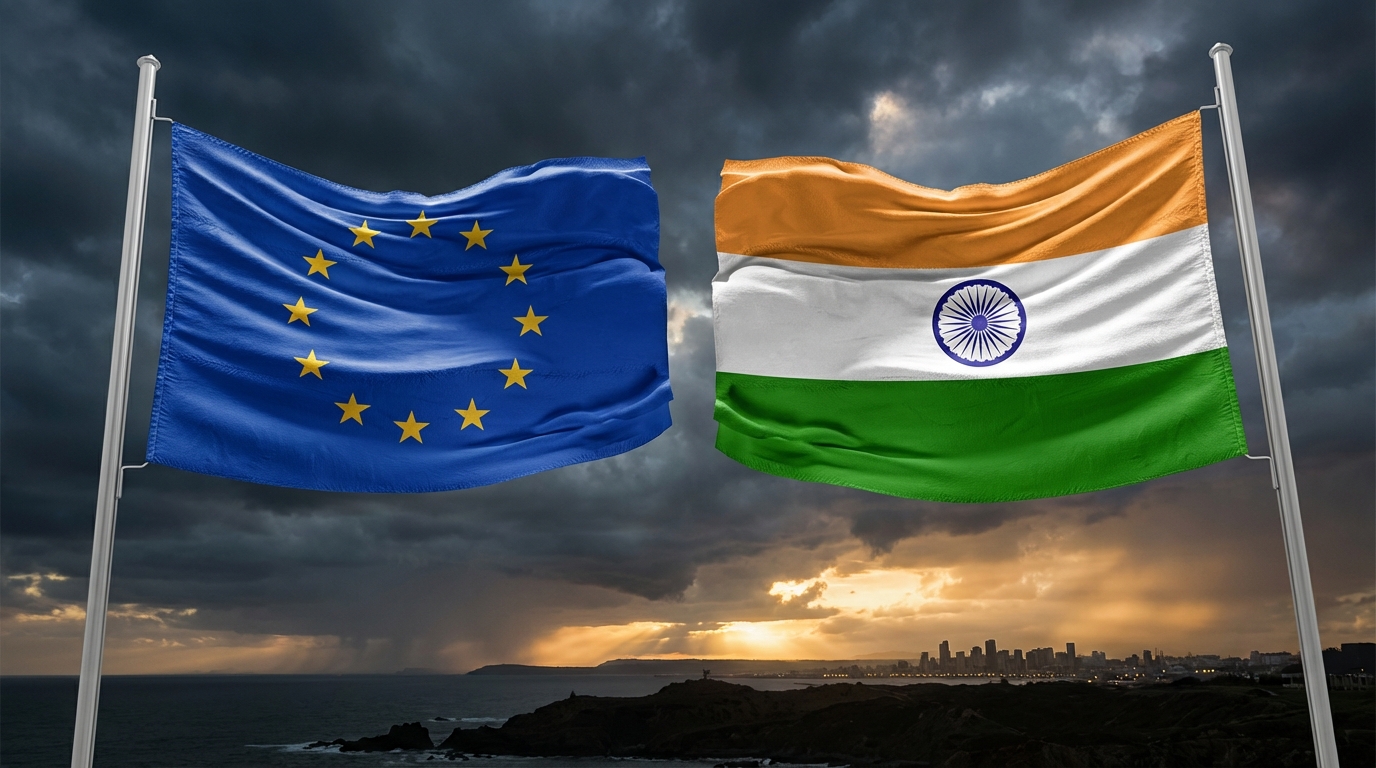
Indian military hardware rolling past European leaders. The tri-color flying beside the circle of stars. Two civilizations that once stood on opposite sides of the colonial divide now standing together as equals.
The theme of this year's parade—150 years of Vande Mataram—celebrates India's freedom struggle. But freedom, as India has learned and Europe is discovering, is not won once and preserved forever. It must be defended continuously, against changing threats, with evolving strategies.
For Europe, Republic Day 2026 is a statement of strategic diversification—a signal that the future lies in multiple partnerships, not American dependency. For India, it is vindication of decades of non-alignment—proof that strategic patience eventually creates strategic options.
For both, it is the beginning of something new.
The rude awakening has happened. The question now is what both powers will build in its aftermath.
If they are wise, they will build a world where middle powers can thrive—not by choosing between superpowers, but by creating alternatives to that choice altogether.
The India-EU Summit convenes on January 27, 2026, one day after Republic Day. The world will be watching—and some in Washington will be worried.