By Ramachandran Rajeev Kumar — 2026-01-10
On January 26, 2026, when India's military might rolls down Kartavya Path and the tri-color unfurls over the Central Vista, two Europeans will occupy the chief guest seats: Ursula von der Leyen, President of the European Commission, and António Costa, President of the European Council.
This is unprecedented. Never before has India invited both heads of the EU to jointly attend its Republic Day celebrations. The symbolism is impossible to miss.
Reading the Invitation
Republic Day chief guests are diplomatic signals disguised as ceremonial protocol. India uses the platform to announce strategic priorities.
When Barack Obama attended in 2015, it marked India's decisive tilt toward Washington under the new Modi government. When Emmanuel Macron attended in 2024, it reaffirmed France's position as India's most trusted European partner. When the entire EU leadership attends in 2026, it announces something larger: India sees Europe as a strategic pole in its multipolar worldview.
External Affairs Minister S. Jaishankar framed it explicitly: "The era of multipolarity - where India seeks neither alignment nor detachment but practical cooperation based on its national interests."
Translation: India won't choose between Washington, Moscow, and Beijing. It will build bridges to Brussels instead.
The Trade Deal Endgame
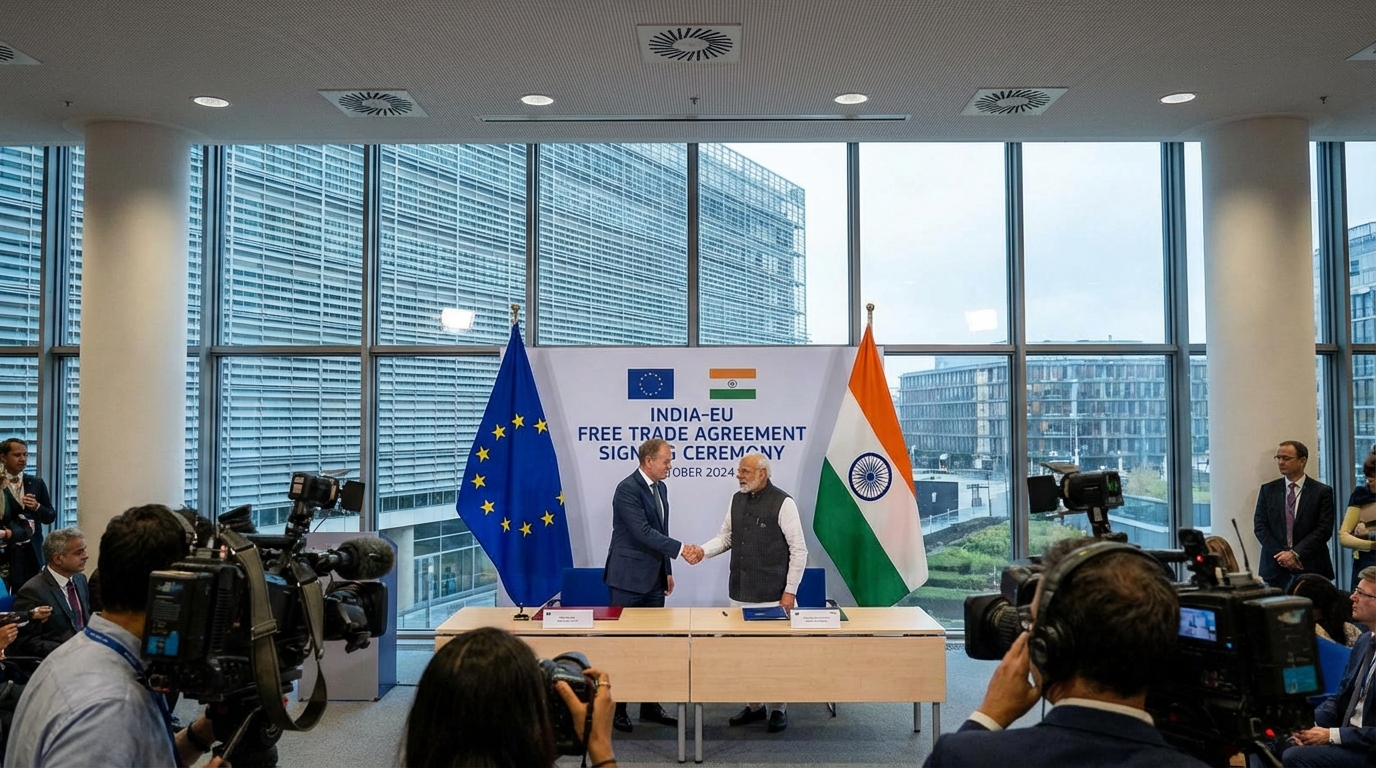
Behind the ceremony lies commerce. India and the EU have been negotiating a Free Trade Agreement for eighteen years - since 2007. Twelve rounds of talks have closed multiple chapters on intellectual property, customs facilitation, and transparency. But sticking points remain.
The EU wants India to cut tariffs on automobiles, wines, and dairy. India wants liberalized access for IT services and professional mobility. And looming over everything is CBAM - the EU's Carbon Border Adjustment Mechanism, which threatens to impose costs on Indian steel and aluminum exports starting February 2027.
Commerce Minister Piyush Goyal has expressed confidence that "political will on both sides" can close the remaining gaps. Government sources suggest "broad contours of the agreement are largely in place."
The Republic Day invitation creates political momentum. Von der Leyen has called a potential EU-India FTA "potentially the largest deal of this kind anywhere in the world." Sealing it during or shortly after her Delhi visit would be a diplomatic triumph for both sides.
Why Europe, Why Now
Three factors explain India's European embrace:
First, Trump's tariffs. The 50% duties Washington has imposed on Indian exports have upended trade calculations. India needs alternative markets. The EU, as India's largest single trading partner ($135 billion in bilateral trade), offers the obvious pivot.
Second, Europe's own pivot. The EU is charting a path toward "strategic autonomy" - reducing dependence on both American security guarantees and Chinese supply chains. India fits perfectly into this vision as a democratic, rule-abiding partner outside the US-China binary.
Third, shared concerns about China. Both India and Europe are executing "de-risking" strategies - reducing critical dependencies on Beijing without complete decoupling. Supply chain diversification serves both. Technology cooperation serves both. A rules-based trading framework serves both.
What India Gets
The potential benefits for India are substantial:
- Market access: 450 million EU consumers, high purchasing power
- Technology transfer: Green tech, electric vehicles, hydrogen - sectors where Europe leads
- Investment flows: EU FDI into manufacturing and services
- Supply chain anchor: Alternative to China-centric production networks
- Climate partnership: Collaboration on renewable energy transitions
- Geopolitical diversification: Reducing vulnerability to any single great power
The EU, meanwhile, gets what it desperately needs: a large, growing, democratic market that isn't China and isn't fully aligned with America.
Historical Pattern
India's chief guest choices reveal strategic priorities across eras:
| Period | Key Guests | Signal |
|---|---|---|
| Cold War | Soviet leaders, Non-Aligned Movement heads | Third-world solidarity |
| 1990s-2000s | Diverse Asian, European leaders | Economic opening |
| 2015 | Barack Obama | US strategic tilt |
| 2018 | ASEAN leaders (all 10) | Act East policy |
| 2024 | Emmanuel Macron | French partnership |
| 2026 | EU dual leadership | European strategic partnership |
The 2026 choice is particularly striking because it elevates the EU as an institution, not just bilateral ties with individual European nations. India is betting that Europe can act as a coherent strategic actor.
Challenges Ahead
The path to deeper EU-India ties isn't obstacle-free.
CBAM friction: The carbon border tax remains contentious. India argues it penalizes developing countries. The EU insists it's necessary for climate goals. Finding compromise will require creative diplomacy.
Agricultural sensitivities: European dairy and wine producers want access. Indian farmers fear being undercut. Both sides have electoral constituencies to protect.
Services mobility: India wants easier visas for IT professionals. European labor markets are politically sensitive. Progress has been slow.
Human rights rhetoric: The EU periodically criticizes India on religious freedom and press freedom. New Delhi bristles at perceived interference. Managing these tensions requires tact on both sides.
The Multipolar Bet
India's European embrace represents a bet on multipolarity - the idea that the 21st century need not be defined by a US-China binary, and that middle powers can carve out independent space.
The EU shares this aspiration. Brussels chafes at Washington's extraterritorial sanctions, worries about becoming a battleground for great power competition, and seeks to assert European interests on European terms.
In this sense, the Republic Day invitation isn't just about trade deals. It's about two large democratic entities signaling that they refuse to be pawns in someone else's game.
Whether this vision of multipolarity can survive American pressure, Chinese competition, and internal European divisions remains to be seen. But for one day in January, on Kartavya Path, India and Europe will celebrate a shared aspiration:
A world where more than two powers matter.
When Von der Leyen and Costa take their seats on Republic Day, they'll witness more than a military parade. They'll witness India's declaration of strategic independence.