By Ramachandran Rajeev Kumar — 2026-02-08
The Sequel
This article follows up on our previous coverage of India's defence pivot from Russian to Western platforms.
Two days ago, in these pages, we wrote the obituary of India's Russian arsenal--the slow, spreadsheet-driven funeral of a seven-decade dependency on Soviet-era military hardware that Moscow can no longer maintain. We described how India's defence transformation was not happening with fanfare but with procurement contracts, supply chain audits, and the grim mathematics of military readiness.
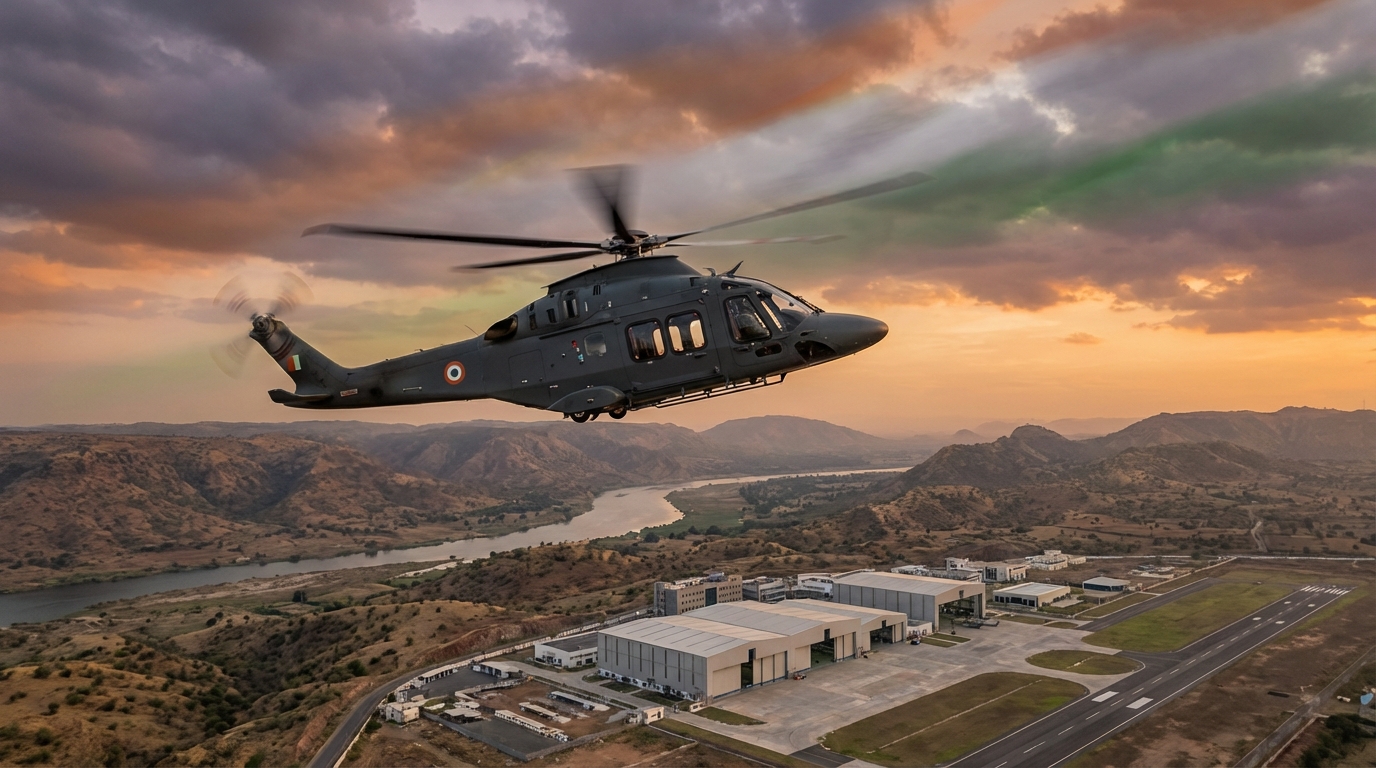
On February 3, the sequel arrived. Adani Defence & Aerospace and Leonardo, the Italian aerospace and defence giant, signed a Memorandum of Understanding to establish a helicopter manufacturing ecosystem in India. The target: more than 1,000 military helicopters that the Indian Armed Forces need over the next decade.
If the "From MiGs to Apaches" story was about what India is leaving behind, this is the story of what it is building in its place.
The Helicopter Crisis Nobody Talks About
India has a helicopter problem. It is not new, it is not secret, and it is not small.
The Indian Army and Air Force currently operate approximately 400 Chetak and Cheetah helicopters--designs that trace their lineage to the French Alouette series from the 1960s. Many of these aircraft are over 30 years old. Their maintenance is a logistical nightmare, their operational capability is limited, and their safety record is a source of quiet anguish within the armed forces. Pilots and crew have been lost in accidents that better machines would have prevented.
The fleet was supposed to have been replaced years ago. The replacement programme has been stuck in the procurement purgatory that is uniquely Indian--a cycle of requirements definition, tender issuance, vendor shortlisting, technical evaluation, price negotiation, and political objection that can consume a decade without producing a single flying helicopter.
Hindustan Aeronautics Limited developed the Light Utility Helicopter--the LUH--as the indigenous solution. The Army has expressed interest in 225 units and is currently in cost negotiations for an initial batch of 126. But the Indian Navy has publicly rejected the LUH, with the Chief of Naval Staff confirming that the platform does not meet maritime standards. The programme has faced technical delays, specification disagreements, and the fundamental challenge of scaling production from prototype to fleet.
Meanwhile, the helicopters that actually need replacing continue to age. Every year that passes without a replacement programme delivering aircraft is a year in which operational readiness degrades, maintenance costs escalate, and risk to aircrew increases.
The armed forces' total helicopter requirement over the next decade exceeds 1,000 units across all roles--utility, reconnaissance, light attack, medium transport, and special operations. No single programme, indigenous or imported, can fill that gap alone.
Enter Adani-Leonardo.
What the Deal Actually Contains
The MoU signed on February 3 centres on two Leonardo helicopter platforms: the AW169M and the AW109 TrekkerM.
The AW109 TrekkerM is a twin-engine, multi-role helicopter designed for the kind of operational environment that defines Indian military aviation. With skid landing gear, a reinforced airframe, and high hot-and-high performance, it is built to operate in conditions ranging from the Rajasthan desert to the Himalayan passes--precisely the terrain that has defeated less capable platforms. Its mission profile covers utility transport, surveillance, light attack, casualty evacuation, and special operations support.
The AW169M is the larger sibling, with a maximum takeoff weight of approximately 4.8 tonnes. Twin FADEC-controlled engines, energy-absorbing landing gear, and crashworthy fuel systems give it modern survivability characteristics. Its modular cabin allows rapid reconfiguration between troop transport, medical evacuation, and mission-specific layouts, while advanced avionics support single-pilot instrument flight and all-weather operations.
Both platforms represent a generation leap over the Chetak and Cheetah fleet they are designed to replace. More importantly, they represent proven designs with global operational track records--not development-stage prototypes requiring years of additional testing.
The Phased Indigenisation Model
The Adani-Leonardo partnership is structured around what the defence industry calls phased indigenisation--a graduated process that begins with assembly and progresses toward full domestic manufacturing.
Phase one involves establishing assembly and integration facilities in India, where Leonardo-supplied kits are assembled into complete aircraft. This is the fastest path to getting helicopters into service while building domestic industrial capability. It is also the phase where Indian workers, engineers, and quality systems learn the discipline of aerospace manufacturing under Italian supervision.
Phase two expands to component manufacturing--progressively replacing imported parts with domestically produced equivalents. This is where the Indian aerospace supply chain develops, where small and medium enterprises acquire the precision engineering capabilities required for flight-critical components, and where the value capture shifts from assembly labour to manufacturing technology.
Phase three--the long-term vision--envisions a vertically integrated rotorcraft ecosystem in India capable of supporting not just domestic military demand but potentially feeding into Leonardo's global supply chain. This is the Aatmanirbhar Bharat proposition in its most ambitious form: India not merely as an end-user of imported technology but as a manufacturing hub for global aerospace production.
The model is not theoretical. It mirrors the trajectory that India has followed with BrahMos (missile systems with Russia), with Tejas (indigenous fighter development leveraging foreign technology), and with C-295 (Airbus transport aircraft now being manufactured by Tata in Vadodara). The precedent exists. The question is execution.
The Italy Connection
The choice of Leonardo as partner is not accidental. Italy has emerged, quietly but unmistakably, as one of India's most important European defence partners--a relationship that has accelerated under the personal chemistry between Prime Minister Modi and Italian Prime Minister Giorgia Meloni.
Leonardo is not a minor player in global aerospace. It is Europe's largest defence company by revenue from a single country, with a helicopter division that is among the top three globally. Its AW series helicopters fly with military and civil operators across more than 150 countries. The AW149 is a contender for India's larger helicopter requirements. The company's naval systems division supplies torpedo systems that India has shown interest in.
The Adani-Leonardo MoU adds a rotary-wing dimension to an Indo-Italian defence relationship that already spans naval systems, electronics, and space. For Italy, India represents both a massive market and a strategic hedge against over-dependence on traditional European customers. For India, Italy offers high-quality defence technology from a partner that is politically uncomplicated--neither carrying the baggage of the US-Pakistan relationship nor the sanctions complications of Russian supply.
The HAL Question
No discussion of Indian helicopter manufacturing is complete without addressing the elephant in the hangar: Hindustan Aeronautics Limited.
HAL has been India's monopoly provider of rotary-wing aircraft for decades. The Dhruv Advanced Light Helicopter, the Prachand Light Combat Helicopter, and the LUH are all HAL programmes. The company is a strategic national asset with irreplaceable expertise in Indian military aviation.
But HAL's production capacity has been a persistent bottleneck. The Dhruv programme took decades from concept to operational service. The Prachand only recently achieved initial operational capability. The LUH programme faces technical and commercial challenges. HAL's order book exceeds its production capacity by years, creating a backlog that delays fleet modernisation across the armed forces.
The Adani-Leonardo partnership does not replace HAL. It supplements it. The 1,000-helicopter requirement is too large for any single manufacturer--indigenous or foreign--to fulfil within the required timeline. India needs HAL building Prachand combat helicopters and Dhruv variants. It simultaneously needs Adani-Leonardo building AW169Ms and AW109s for utility and transport roles. And it may need additional partnerships for medium and heavy helicopter requirements.
This is not a zero-sum competition between private and public sector. It is a recognition that India's helicopter deficit is large enough to require all available manufacturing capacity, from all available sources, operating in parallel.
The Numbers Game
Consider the scale of the problem. India needs 1,000+ helicopters over the next decade. HAL's current helicopter production rate--across all types--is in the low double digits annually. Even with capacity expansion, HAL cannot produce more than 30-40 helicopters per year in the medium term.
At that rate, replacing the current fleet alone would take a decade. Adding new requirements for armed reconnaissance, naval utility, disaster response, and border surveillance extends the timeline further. India's helicopter fleet is not merely aged--it is numerically inadequate for a country of India's geographic scale, border complexity, and disaster vulnerability.
The Adani-Leonardo partnership, if it scales as planned, could add 40-60 helicopters annually to India's production capacity within five to seven years. Combined with HAL's output, this begins to approach the numbers needed to close the fleet gap within a reasonable timeframe.
But these projections assume that the phased indigenisation programme proceeds on schedule, that Indian component suppliers meet aerospace quality standards, that regulatory approvals are processed efficiently, and that the inevitable technical challenges of establishing a new manufacturing line are resolved competently. Each of these assumptions carries risk. Defence manufacturing in India has a documented history of timeline slippage, cost escalation, and quality challenges that must be taken seriously.
The Strategic Calculus
Step back and consider the broader picture. In the span of a single week in early February 2026, India conducted three separate defence-industrial moves that, taken together, describe a coherent strategic trajectory.
The Adani-Leonardo helicopter partnership establishes an Italian manufacturing ecosystem for rotary-wing platforms. The Vayu Shakti 2026 exercise rehearses the air combat doctrine validated in Operation Sindoor. The ongoing US-India defence trade expansion--now reaching 20 billion dollars--deepens interoperability with the world's most advanced military technology base.
Russian hardware is not being replaced by a single alternative. It is being replaced by a diversified portfolio of partnerships--American, European, Israeli, and indigenous--that gives India manufacturing depth, technological breadth, and the strategic flexibility to avoid the single-supplier dependency that Moscow's failures so painfully exposed.
The Adani-Leonardo MoU is one piece of that mosaic. But it is an important piece, because it addresses what may be the most urgent capability gap in India's defence posture: the ageing helicopter fleet that affects every branch of the armed forces, every day, in every operational theatre.
What Happens Next
The MoU is a statement of intent, not a production order. The path from signed memorandum to flying helicopter involves technology transfer negotiations, facility construction, regulatory certification, production trials, military acceptance testing, and the thousand bureaucratic approvals that characterise Indian defence procurement.
History suggests this will take longer than anyone currently projects. The C-295 programme, a comparable foreign-manufacturer-in-India initiative, took years from MoU to first delivery. The Adani-Leonardo timeline will be measured in similar terms.
But the direction is set. India's helicopter future will be manufactured in India, by Indian workers, using technology transferred from a global leader, serving Indian military requirements. The Russian-origin Chetak and Cheetah, like their fixed-wing MiG-21 cousins, are heading for retirement. And unlike the MiG-21 saga--where the replacement arrived decades late--the helicopter replacement has a signed agreement, identified platforms, and a clear industrial pathway.
The obituary was written two days ago. The birth certificate was signed on February 3. The rotor revolution, for all its inevitable delays and challenges, has begun.