By Ramachandran Rajeev Kumar — 2026-02-06
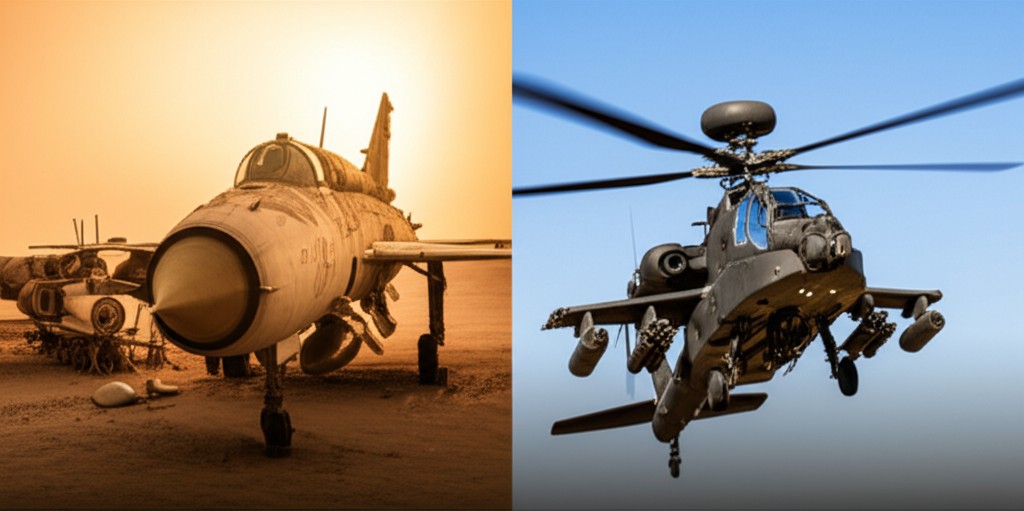
Somewhere in the Thar Desert, scattered across acres of sand-blown tarmac, sit the rusted carcasses of India's once-proud MiG fleet. These aren't museum pieces--they're operational aircraft grounded because Moscow can't supply spare parts. Welcome to the quiet funeral of India's Russian arsenal, a strategic realignment happening not with fanfare but with spreadsheets, supply chain audits, and the grim mathematics of military readiness.
For seven decades, roughly 60-70% of India's military hardware carried Cyrillic maintenance manuals. That era is ending. The recent US-India trade framework isn't just about tariffs and soybeans--it accelerates a defence transformation already underway, one that will fundamentally reshape India's military capabilities, alliance structure, and geopolitical positioning.
This isn't the story of a single weapon system. It's the story of what happens when a military built on Soviet-era infrastructure discovers its primary supplier can no longer deliver.
The Cold War Inheritance: When Moscow Was Delhi's Arsenal
The Indo-Soviet defence relationship wasn't mere commerce--it was quasi-ideological symbiosis. From the 1960s onward, Moscow supplied India with everything from MiG-21 fighters to T-72 tanks, often on concessional terms that Western powers refused to match. The Indian Navy's aircraft carriers, the Air Force's backbone fighters, the Army's main battle tanks--all bore the DNA of Soviet design bureaus.
This arrangement offered India certain advantages. Soviet equipment was robust, designed for conscript armies, and came without the political conditionality that accompanied Western arms sales. Technology transfer, at least nominally, was part of the package. Hindustan Aeronautics Limited assembled MiGs under license; ordnance factories produced Soviet-designed ammunition.
But the relationship also created structural dependency. Indian military doctrine evolved around Soviet platforms. Maintenance ecosystems, training regimes, and tactical frameworks all assumed continuous access to Russian spare parts, upgrades, and technical support.
That assumption is now untenable.
The Ukraine War's Unintended Revelation
When Russian forces stumbled in Ukraine, Western analysts noted the failures: poor logistics, obsolete equipment, compromised C4ISR systems. Indian defence planners noticed something else--Russia could no longer maintain its own military's readiness, much less support export clients.
The spare parts crisis hit first. Russian factories prioritized domestic needs. Delivery timelines stretched from months to years. Critical components for India's Su-30MKI fleet, its Project 75 submarines, its T-90 tank fleet--all faced delays. Some items simply stopped arriving.
Sanctions compounded the problem. Even when parts were theoretically available, payment mechanisms failed. Western financial infrastructure, which Indian defence procurement relies upon, couldn't process transactions with sanctioned Russian entities. India's attempts to use rupee-rouble trade mechanisms proved cumbersome and inadequate for complex military logistics.
The Ukraine war exposed not just Russian military weakness but supply chain fragility. A defence relationship built over decades could potentially collapse within a single procurement cycle.
Enter the Americans: Not Just Hardware, But Interoperability
The shift to US platforms didn't begin with Ukraine--it started in the early 2000s, accelerating through the past two decades. C-130J Super Hercules transports. P-8I maritime patrol aircraft. Apache attack helicopters. Chinook heavy-lift helicopters. MH-60R anti-submarine helicopters. The list keeps growing.
But hardware purchases tell only half the story. The foundational agreements tell the other half.
The Logistics Exchange Memorandum of Agreement (LEMOA), signed in 2016, allows Indian and US forces to use each other's bases for refueling and resupply. The Communications Compatibility and Security Agreement (COMCASA), signed in 2018, enables secure communications interoperability. The Basic Exchange and Cooperation Agreement for Geo-spatial Cooperation (BECA), signed in 2020, provides India access to advanced US geospatial intelligence.
These aren't mere bureaucratic arrangements--they're the infrastructure of alliance architecture. They enable the kind of military-to-military integration that defines NATO-style partnerships. An Indian Navy P-8I can now seamlessly share targeting data with a US Navy destroyer. Indian Army units can coordinate with US forces using encrypted communications protocols.
This is interoperability at the systems level--not just compatible radios, but compatible doctrine.
The QUAD Imperative: Choosing Your Interoperability Partners
India's participation in the Quadrilateral Security Dialogue--alongside the United States, Japan, and Australia--creates operational imperatives that Russian equipment cannot satisfy. QUAD naval exercises require common communication standards. Joint air operations demand compatible identification systems. Combined logistics depend on shared maintenance protocols.
Russian platforms don't integrate with QUAD infrastructure. They can't. Soviet-era design philosophy prioritized self-sufficiency, not coalition warfare. Indian MiG-29s can't datalink with Japanese F-35s. Indian Kilo-class submarines can't coordinate with Australian Collins-class boats using NATO protocols.
The QUAD isn't formally a military alliance, but its implicit security architecture demands interoperability. That interoperability effectively mandates Western--primarily American--hardware.
This creates strategic path dependency. Each US platform India acquires strengthens the argument for the next one. Each foundational agreement signed makes alternative architectures less viable. India isn't just buying weapons--it's buying into an ecosystem.
What Stays: The S-400, BrahMos, and Nuclear Realities
Lest this seem like complete abandonment, Russia still supplies critical capabilities India cannot source elsewhere.
The S-400 air defence system remains in Indian service despite US threats of CAATSA sanctions. No Western equivalent offers comparable range and capability at remotely acceptable cost. India absorbed diplomatic pressure rather than cancel the contract.
The BrahMos cruise missile--a joint Indo-Russian venture--represents rare successful defence collaboration. It combines Russian propulsion technology with Indian guidance systems and has become a genuine export product, with orders from Philippines and potentially others.
Most critically, Russia provides nuclear submarine technology that no Western power will supply. India's nuclear deterrent--particularly its sea-based leg aboard Arihant-class submarines--depends on Russian design assistance and reactor technology.
These aren't minor exceptions. They're strategic anchors preventing complete departure from Russian supply chains. The transition is partial, messy, and will remain incomplete.
The Transition Trap: You Can't Replace an Arsenal Overnight
Here's the problem with defence transformation: militaries don't get downtime. India faces active border tensions with China and Pakistan simultaneously. Its armed forces cannot afford capability gaps during procurement transitions.
Replacing Russian platforms with American equivalents takes decades, not years. Pilot retraining. Maintenance crew certification. Logistics infrastructure reconfiguration. Doctrine revision. This doesn't happen quickly.
Meanwhile, existing Russian equipment ages. A MiG-21 squadron can't suddenly operate F-16s because Delhi signed a purchase agreement. The transition period creates vulnerability--older platforms degrade while newer ones haven't achieved full operational capability.
India currently operates roughly 260 Su-30MKI fighters--the backbone of its air superiority fleet. These aircraft require Russian support for at least the next 15-20 years. There is no realistic scenario where they're replaced wholesale with American alternatives in the near term.
The transition is therefore gradualist. New procurements lean American; existing fleets remain Russian. India operates a hybrid arsenal, attempting to maintain readiness across incompatible ecosystems.
This is logistically nightmarish and strategically precarious.
The Make in India Mirage: Does Technology Transfer Actually Happen?
India's stated goal isn't to swap Russian dependency for American dependency--it's to achieve strategic autonomy through indigenous production. The "Make in India" defence initiative aims for 70% domestic content in military procurement by 2030.
American rhetoric supports this. Defence agreements emphasize technology transfer, co-production, and joint development. In practice, results are mixed at best.
The US has approved licensed production of certain systems--F-16 production was offered as part of a prospective fighter deal. GE supplies jet engines for India's indigenous Tejas fighter, though full technology transfer for the F-414 engine remains contentious.
But advanced technologies--stealth capabilities, AESA radar, turbofan engine cores--remain closely guarded. The US shares interoperability, not intellectual property. India gains access to American systems without gaining the knowledge to independently produce them.
Russia, for all its current failings, historically offered deeper technology transfer. Soviet-era licensing agreements gave Indian engineers actual design documentation. The T-90 tank and Su-30MKI both involve substantial Indian-manufactured content.
Whether American agreements will match that depth remains uncertain. Early indications suggest they won't.
Turkey's Lesson: The Path to Actual Autonomy
Turkey offers an instructive parallel. A NATO member for seven decades, Turkey nonetheless developed substantial indigenous defence capabilities--Bayraktar drones being the most prominent example.
Turkish success stemmed from deliberate policy: requiring technology transfer, investing in domestic R&D, protecting infant defence industries, and accepting short-term capability gaps to achieve long-term autonomy. Turkey's defence exports now exceed $6 billion annually.
India has greater resources, a larger talent pool, and established aerospace and naval shipbuilding sectors. Yet it hasn't achieved comparable autonomy. Why?
Partly because India's threat environment is more acute--Turkey faced no equivalent to China. Capability gaps carry higher risk. But also because Indian policy has historically prioritized immediate procurement over long-term development. Defence PSUs lack competitive pressure. Quality control remains inconsistent. Procurement bureaucracy stifles innovation.
The Russian arsenal's decline forces a choice: use the transition to build genuine indigenous capacity, or simply swap suppliers. The US trade framework offers hardware but doesn't inherently create Indian defence autarky. That requires different policy choices entirely.
Strategic Autonomy or Strategic Alignment?
India's foreign policy establishment clings to the rhetoric of strategic autonomy--the idea that India remains non-aligned, choosing partners issue-by-issue rather than accepting bloc membership.
Defence procurement increasingly undermines this narrative. Interoperability with QUAD partners functionally constrains procurement options. COMCASA and BECA commitments create security interdependencies. Each American platform purchased embeds India deeper into US-led security architecture.
This isn't inherently negative. Alliance structures provide security guarantees, intelligence sharing, and force multipliers. NATO's effectiveness stems from precisely this kind of deep integration.
But it forecloses alternatives. An India fully integrated into American defence ecosystems cannot simultaneously maintain equivalent ties with Russia--or China, or Iran, or any power the US defines as adversarial. Strategic autonomy becomes rhetorical rather than operational.
The MiG-to-Apache transition is therefore more than hardware replacement. It's a choice about which superpower's military DNA India will carry--whose doctrine, whose standards, whose strategic priorities become embedded in Indian military structure.
The Endgame: Indigenous Production or Supplier Swap?
India stands at a junction. The Russian arsenal's decline is irreversible. The question is what replaces it.
Option one: wholesale adoption of American systems, accepting strategic alignment as the price of technological access. This is the path of least resistance--American equipment is available, proven, and offers immediate capability improvements.
Option two: use the transition to genuinely indigenize defence production. Leverage American technology transfer where possible, but prioritize domestic R&D, protect emerging defence companies, accept near-term capability gaps to achieve long-term autonomy.
Current trajectory suggests a muddled middle--partial American procurement, continued Russian dependencies where unavoidable, rhetorical commitment to Make in India without policy structures to achieve it.
The Turkish model demonstrates that middle powers can achieve substantial defence autonomy. It requires decades of consistent policy, industrial protection, and willingness to absorb development costs. It also requires accepting that indigenous systems won't always match cutting-edge foreign equivalents initially.
India has the resources and talent pool to succeed at this. Whether it has the political will and bureaucratic capacity remains uncertain.
The Quiet Funeral Continues
There will be no formal ceremony marking the end of India's Russian arsenal. No treaty termination, no symbolic handover. Just a gradual accumulation of cancelled orders, grounded squadrons, and procurement tenders specifying NATO-compatible systems.
The MiGs will continue flying until they can't. Spare parts will be scavenged from other airframes. Maintenance windows will stretch. Readiness rates will decline. Eventually, the aircraft will be permanently grounded, towed to desert storage, and quietly forgotten.
New helicopters will arrive from Boeing. New maritime patrol aircraft from Lockheed Martin. New howitzers, potentially, from BAE Systems. Each procurement will chip away at Russian legacy systems until they represent historical curiosities rather than operational capabilities.
This transition is neither tragedy nor triumph--it's strategic adaptation to changed circumstances. Russia's inability to supply a modern military apparatus forces India to look elsewhere. American willingness to provide alternatives, combined with QUAD imperatives, makes Washington the logical substitute.
But substitution isn't autonomy. The lesson of the Russian arsenal's decline shouldn't be that India needs a more reliable supplier. It should be that dependence on any external supplier creates vulnerability.
Whether India learns that lesson--whether the funeral of the Russian arsenal marks the birth of genuine indigenous capacity--remains to be seen.
For now, the Apaches are arriving. The MiGs are grounded. And India's military DNA is being rewritten, one procurement contract at a time.
The quiet funeral continues.