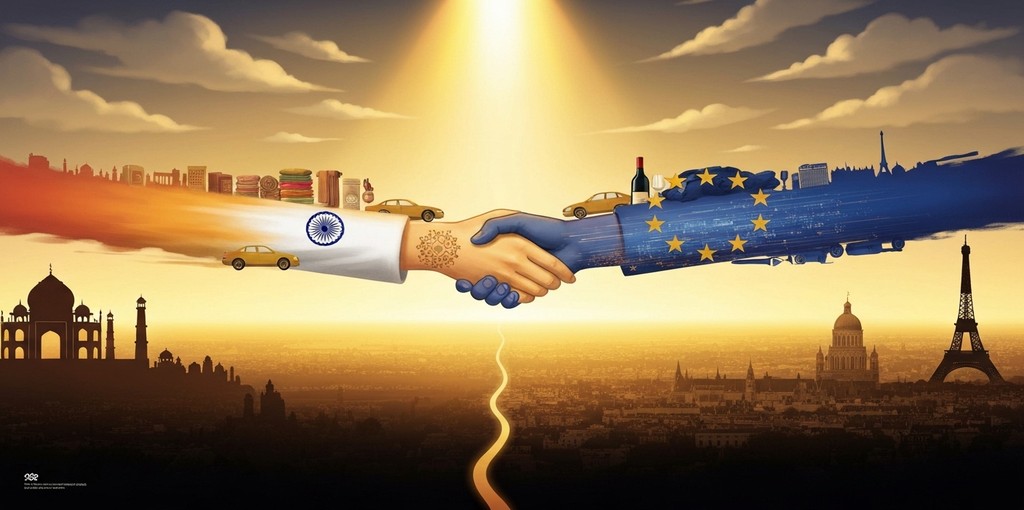
By Ramachandran Rajeev Kumar — 2026-02-15
The Mother of All Deals: How India and Europe Wrote a Trade Agreement Worth Celebrating
By Ramachandran Rajeev Kumar
This article expands on our earlier analysis of India's strategic window in Europe's awakening. That piece examined the geopolitical opportunity; this one covers the trade deal that seized it.
On January 27, at the 16th India-EU Summit at Hyderabad House in New Delhi, Prime Minister Modi, European Commission President Ursula von der Leyen, and European Council President Antonio Costa concluded what Commerce Minister Piyush Goyal had been calling "the mother of all deals" since the final negotiation rounds in mid-January. Von der Leyen adopted the phrase at Davos and again upon arriving in India. That both sides reached for the same superlative tells you something about the scale of what had just been accomplished.
The India-EU Free Trade Agreement covers a combined market of $27 trillion in GDP and over two billion people. India will eliminate tariffs on 96.6% of EU exports. The EU will eliminate tariffs on 99.5% of Indian goods. Annual duty savings are estimated at four billion euros. And 144 EU service subsectors have been opened to Indian professionals and companies.
Negotiations began in 2007. They collapsed in 2013. They restarted in 2022. They concluded in 2026. Nineteen years from inception to handshake. The gestation period of this agreement exceeds the lifespan of some of the governments that attempted it.
The instinct, in an era that rewards speed and punishes patience, is to mock the timeline. But the timeline is the point. This deal was not rushed because the stakes were too high to get wrong. And on January 27, neither side got it wrong.
What India Won
The headline figure for India is $33 billion in projected gains for labour-intensive exports. Textiles, leather goods, processed food, gems and jewellery -- industries that employ tens of millions of Indians, overwhelmingly in small and medium enterprises -- will now enter the European market with tariffs eliminated or dramatically reduced.
This matters more than the number suggests. India's export basket to the EU has historically been dominated by refined petroleum, chemicals, and IT services. These sectors are important but they are not labour-intensive. They do not create jobs in Tirupur's garment factories or Agra's leather workshops or Surat's diamond polishing units. The FTA tilts the playing field towards precisely the industries where India's competitive advantage -- a young, skilled, cost-effective workforce -- is most potent.
The services chapter is equally significant. Indian IT companies, already the largest offshore service providers to European businesses, will now operate under a formalised market access framework. The 144 service subsectors opened by the EU cover everything from engineering and architecture to financial advisory and telecommunications. For India's services sector -- which accounts for over 55% of GDP -- this is not a marginal improvement. It is a structural upgrade in market access.
And then there is the talent mobility provision. Indian professionals will benefit from streamlined visa and work permit processes across EU member states. For a country whose most valuable export has always been its people -- engineers, doctors, researchers, and entrepreneurs who have built careers across every continent -- removing bureaucratic friction in Europe's labour market is worth more than any tariff reduction.
What Europe Won
The EU got what it has wanted from India for two decades: meaningful market access in a $4 trillion economy that has historically guarded its domestic market with the zeal of a dragon sitting on gold.
The numbers are specific and consequential. Automobile tariffs -- the single biggest European demand -- drop from 110% to 10% over five years, with a quota-based system allowing 250,000 EU vehicles annually across price segments. For Volkswagen, BMW, and Stellantis, India's 1.4-billion-person market just went from theoretically interesting to commercially viable. Wine tariffs fall from 130% to 20-30% over seven years, with a floor protecting Indian grape farmers from wines priced below two and a half euros. Machinery, agri-food products, chemicals, and aircraft all receive improved access.
For European industry, the FTA also resolves a strategic anxiety. China was Europe's alternative large market. That relationship has curdled. The EU's de-risking strategy -- reducing dependence on Chinese supply chains without fully decoupling -- requires a credible alternative destination for European exports and investment. India is that alternative. The FTA's rules-of-origin clauses explicitly position India as a trusted sourcing base, with direct implications for electronics, defence, automotive, and chemical supply chains. What began as a trade agreement has become the operational architecture of Europe's China de-risking.
European dairy producers, who have lobbied for Indian market access for over a decade, secured protections for geographical indications -- Champagne remains Champagne, Parmigiano stays Parmigiano. India's concession on GI protections, historically a sticking point, reflects a pragmatic calculation: the value of the overall agreement exceeded the cost of protecting European cheese names.
The Art of the Concession
What makes this agreement remarkable is not what each side won. It is what each side chose to concede -- and the intelligence with which those concessions were structured.
India's tariff elimination at 96.6% rather than 100% preserves protection for sensitive agricultural products. Rice, wheat, and certain pulses remain shielded. The dairy sector gets phased liberalisation rather than overnight exposure. These carve-outs protect the livelihoods of farmers who lack the capital to compete with European agribusiness in the near term, while creating a pathway to gradual adjustment.
Europe's 99.5% tariff elimination leaves room for protections on a handful of Indian products where EU domestic industries lobbied successfully. But the asymmetry in the numbers -- 99.5% versus 96.6% -- reflects the reality that India, as the developing economy in this partnership, needed more policy space. The EU granted it. That is not weakness. It is the kind of calibrated generosity that makes agreements durable.
The intellectual property chapter avoids the maximalist approach that has poisoned other trade agreements. Europe did not demand TRIPS-plus patent extensions that would have restricted Indian pharmaceutical generics. India did not insist on wholesale rejection of EU digital regulations. Both sides found the unglamorous middle ground where commerce can function without ideology.
The Patience Premium
There is a reason this deal took 19 years, and it is not bureaucratic incompetence.
The 2007 negotiations failed because the world was different. India was a $1.2 trillion economy with legitimate fears that European competition would overwhelm its domestic industries. Europe was negotiating from a position of condescension -- offering market access as a favour rather than seeking it as a necessity. Neither side was desperate enough to make the concessions that a balanced agreement required.
By 2026, the calculus had changed fundamentally. India's GDP had quadrupled. Its manufacturing sector had matured. Its services industry had become globally dominant. The fear of being overwhelmed by European competition had given way to confidence that Indian firms could compete -- and win -- in open markets.
And then Donald Trump applied 50% tariffs on Indian goods.
It would be dishonest to discuss this agreement without acknowledging the American elephant in the room. Trump's tariffs -- including 25% reciprocal duties plus additional levies targeting India's Russian oil purchases -- created a pressure that eighteen years of negotiation could not. European leaders have been candid about this: the tariffs stiffened resolve on both sides. India needed market diversification urgently. Europe needed to demonstrate that it could build trade relationships faster than America could destroy them. The deal was concluded on January 27. Six days later, on February 2, Trump cut his own deal with India, reducing US tariffs to 18%. Goyal, with characteristic flair, called the American agreement the "Father of All Deals" -- making January-February 2026 the most productive eight days in Indian trade diplomacy since independence.
Europe, meanwhile, had discovered that the China relationship it had cultivated as its primary Asian economic partnership carried risks that Indian partnership did not. Supply chain disruptions, intellectual property concerns, and geopolitical tensions with Beijing made diversification not just desirable but urgent. India was no longer Europe's second choice. It was, in many sectors, the obvious first.
There is also the RCEP shadow. India walked away from the Regional Comprehensive Economic Partnership in 2019, unwilling to expose its markets to Chinese imports without adequate safeguards. Critics called it isolationist. In hindsight, it was strategic patience. India has since secured bilateral FTAs with every RCEP member except China. The EU deal completes the picture: India now has preferential trade access to markets covering most of the global economy, without the China exposure that RCEP would have mandated.
The 19-year timeline produced an agreement that a hasty negotiation could not have achieved. Both sides arrived at the table with the maturity of their economies, the clarity of their strategic needs, and the willingness to compromise that only comes from having exhausted the alternatives.
What Neither Side Lost
The most important feature of this agreement is what it does not contain: losers.
In an era where trade is increasingly weaponised -- where tariffs are punishments, market access is leverage, and economic agreements are disguised coercion -- the India-EU FTA stands out as a genuinely mutual arrangement. India did not capitulate to European demands. Europe did not surrender to Indian protectionism. Both sides modified their positions to accommodate the other's essential interests.
Indian farmers are not threatened. European manufacturers are not excluded. Indian tech workers gain access. European service providers gain access. The language of the agreement -- the careful phase-in periods, the safeguard mechanisms, the dispute resolution procedures -- reflects a negotiation conducted between equals who intend to remain equals.
This is worth celebrating not because it is perfect -- no 6,000-page trade agreement is perfect -- but because it demonstrates that the alternative to trade wars is not trade surrender. It is trade negotiation conducted with enough patience, intelligence, and mutual respect to produce outcomes that both sides can defend to their domestic constituencies.
The Road from Handshake to Implementation
The agreement must now survive legal scrubbing, translation into all EU languages, and ratification. Goyal has stated it could be implemented within the 2026 calendar year. More realistically, the formal signing is expected when Modi visits Brussels around mid-2026, with the European Council, European Parliament, and India's Union Council of Ministers all needing to approve. Entry into force by early 2027 is the pragmatic estimate.
The implementation phase will test whether the goodwill survives contact with reality. Tariff reductions will be phased over periods ranging from immediate to ten years. Regulatory harmonisation -- the less visible but more consequential element of any trade agreement -- will require sustained bureaucratic cooperation of a kind that neither India nor the EU has historically excelled at.
But the structural incentives for making this work are overwhelming. Four billion euros in annual duty savings create immediate constituencies for implementation. Indian exporters will lobby for timely tariff reductions. European companies will push their governments to remove non-tariff barriers. The commercial interests aligned behind this agreement will, in most cases, overcome the bureaucratic inertia working against it.
A Quiet Triumph of Diplomacy
In a world where strongmen announce deals with exclamation marks and surrender terms dressed as partnerships, the India-EU FTA offers something rarer: a trade agreement where both sides can honestly claim victory because both sides genuinely achieved it.
No one was humiliated. No one was coerced. No one signed under threat of sanctions or the shadow of gunships. Two civilisational powers, representing two of the world's largest economic blocs, sat across a table and -- over nineteen years of intermittent but ultimately productive negotiation -- built something that serves both their peoples.
Von der Leyen called it the mother of all deals. Goyal called it the mother of all deals. They were both right. And the best part is that neither had to pretend the other was wrong.
That, in 2026, may be the most remarkable achievement of all.
The views expressed are those of the author and do not necessarily reflect the editorial position of BarathVector.