By Ramachandran Rajeev Kumar — 2026-02-11
The Pragmatic Pivot: India's Window in Europe's Awakening
By Ramachandran Rajeev Kumar
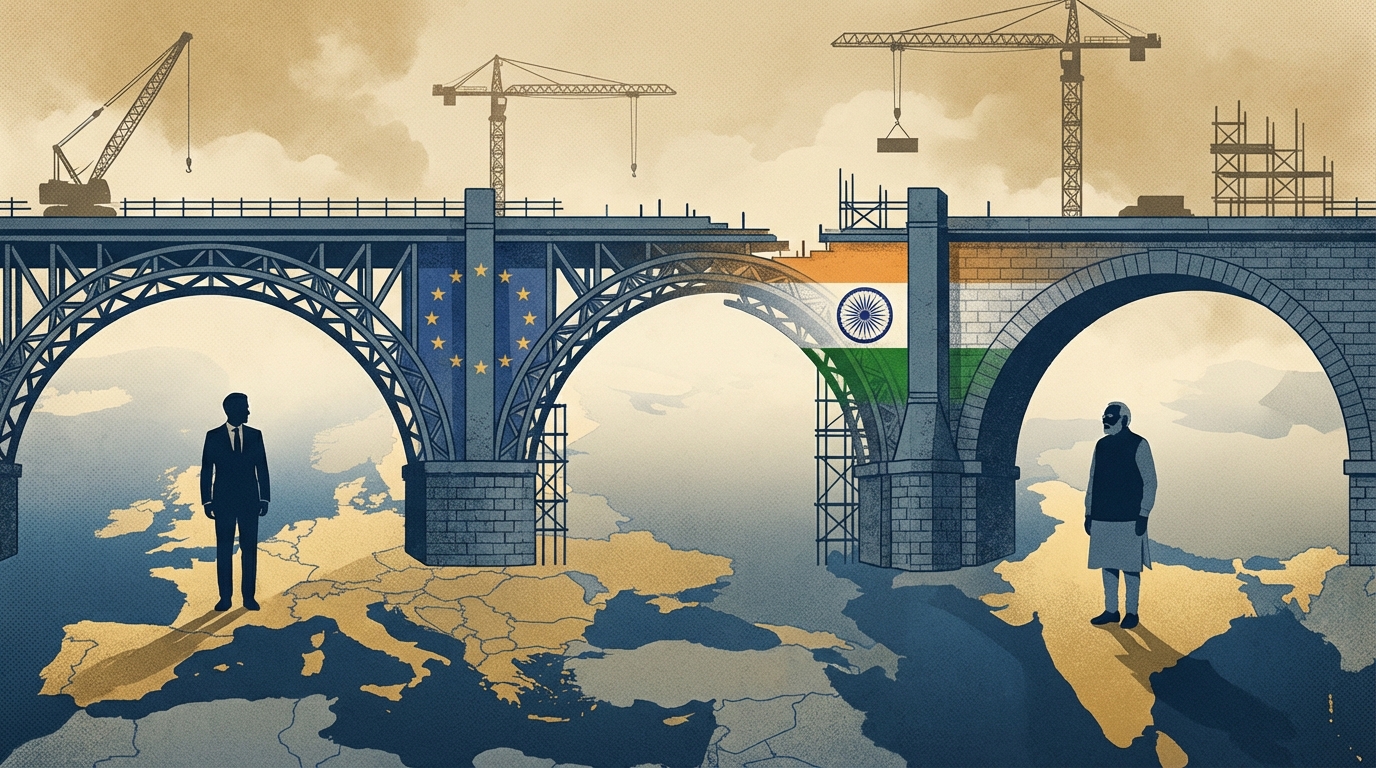
On February 10, Emmanuel Macron sat for coordinated interviews across seven European media outlets -- an unprecedented media operation for a French president -- and delivered a message that diplomats in New Delhi should be reading with highlighters in hand.
"We are not America's vassals," Macron declared, in language that would have been unthinkable from a sitting NATO head of state even six months ago. Europe must build its own defence capacity, its own technology sovereignty, its own strategic autonomy.
The speech was aimed at Europe's capitals. But its most consequential audience may be sitting in South Block.
The Vassals' Revolt
Macron's broadside was not spontaneous. It follows months of escalating US-EU friction: American tariffs on European steel and aluminium, the Inflation Reduction Act's subsidies that lured European green manufacturing to US soil, and Washington's insistence on defence spending increases that several European economies cannot sustain without dismantling social programmes.
The European response has historically been to form committees and issue communiques. But Macron's language marks something genuinely new. The word "vassal" carries historical weight. It implies servitude, dependency, subjugation. A French president using it about the transatlantic relationship is not diplomatic calibration. It is a flare.
For India, this rupture opens doors that years of careful diplomacy alone could not.
India's EU Window
Consider the timing. Macron visits India on February 17-19, carrying with him the $39 billion Rafale Marine deal for India's next-generation aircraft carriers. The deal -- if finalised -- would be France's largest-ever defence export and India's largest-ever European defence procurement.
But the Rafale deal is merely the visible tip. Beneath it lies a structural opportunity: as Europe consciously diversifies away from American technology dependency, Indian industry can position itself as the partner of choice.
The European Union's Digital Markets Act has already constrained Big Tech. The AI Act imposes regulatory requirements that American companies find burdensome. The push for digital sovereignty -- European data on European servers, processed by European-compliant systems -- creates market space that Indian IT companies are uniquely positioned to fill.
The India-EU Free Trade Agreement negotiations, stalled for over a decade, have accelerated in recent months. The political will now exists on both sides. What was once a bureaucratic exercise has become a strategic imperative.
Indian IT Must Gear Up
Infosys, TCS, Wipro, and HCLTech already serve European enterprise clients at scale. But they have largely operated as cost-effective alternatives to American IT firms. The EU-US rift elevates them from alternative to preferred partner.
European governments seeking to reduce dependence on American cloud providers, American AI platforms, and American enterprise software will need someone to build the replacements. Indian IT can be that someone -- but only if it moves now.
Three areas demand immediate attention. First, cloud infrastructure: European enterprises need alternatives to AWS, Azure, and Google Cloud that comply with EU data sovereignty requirements. Indian IT firms should be building EU-hosted, EU-compliant cloud platforms today. Second, AI services: the EU AI Act creates compliance requirements that favour service providers who understand European regulatory culture. Indian IT firms with European operations already have this institutional knowledge -- they must capitalise on it. Third, cybersecurity: as Europe builds its own defence architecture, cyber capabilities become critical infrastructure. Indian cybersecurity firms have a window to establish themselves as trusted European partners before the market consolidates.
The gap that is opening in Europe due to distancing from the US is real and measurable. Indian IT has to gear up to fill it -- or watch East Asian competitors do so instead.
The Tightrope
The temptation for India will be to overplay its hand. This must be resisted.
India cannot afford to be seen as exploiting the EU-US divide. Washington remains India's most important strategic partner on China containment, on defence technology transfers, and on Quad cooperation in the Indo-Pacific. Rupturing that relationship to chase European contracts would be strategic malpractice.
Similarly, India's relationship with Russia -- strained by the Ukraine conflict but sustained by decades of defence dependency and energy trade -- cannot be casually discarded to please either Brussels or Washington.
The correct posture is triangulation without alienation. Strengthen European ties through technology, trade, and defence cooperation. Maintain American ties through strategic alignment and market access. Preserve Russian ties through pragmatic energy and defence maintenance agreements. Be indispensable to all three without being captive to any.
History teaches that over-dependence on any single ally is a vulnerability. Nations that hitched their strategic wagons to one great power -- whether European colonies dependent on Britain, or Eastern Bloc states dependent on the Soviet Union -- discovered this painfully when alignments shifted. India must not repeat that pattern with anyone.
Opportunity With Caution
Macron's visit to India next week will generate headlines about fighter jets and nuclear cooperation. The real story will be in the side agreements -- the technology transfer frameworks, the digital cooperation memoranda, the joint venture structures that convert a political moment into institutional architecture.
India should welcome Europe's awakening to strategic autonomy. It should invest heavily in the EU partnership. But it should do so with the clear-eyed understanding that alliances shift, dependencies backfire, and the only sustainable position is one of pragmatic self-reliance that keeps every door open.
The vassals are revolting. India should be ready -- not to join the revolt, but to walk through the doors it opens.