By Ramachandran Rajeev Kumar — 2026-01-10
The Language of Pragmatism: Why India Must Let Parents Choose
A Companion Editorial
Yesterday, we published a fable about a king who wanted one tongue for his many-tongued kingdom. Today, we make the same argument without the satire—because this issue deserves both the mockery of power and the clarity of reason.
The False Binary
The language debate in India is typically framed as Hindi versus Regional Languages, with English as an awkward colonial hangover that polite society pretends to tolerate while secretly relying upon entirely.
This framing is wrong.
The real question is not which language should dominate. It is whether anyone—any government, any political party, any ideology—should have the power to make this choice for Indian families.
The answer, if we are honest, is no.
Why India Cannot Have a National Language
Let us dispense with the fantasy first.
India has 22 officially recognized languages. It has 19,500 documented dialects. It has four classical languages (Tamil, Sanskrit, Kannada, Telugu) and two more with classical-language movements (Malayalam, Odia). It has scripts that cannot even be transliterated into each other without loss of meaning.
Hindi, despite being the largest plurality, is the mother tongue of only 44% of Indians. In raw numbers, this means 700 million Indians do not speak Hindi at home—more than the entire population of Europe.
Comparisons to other nations fail immediately:
Korea and Japan are ethnically and linguistically homogenous nations smaller than many Indian states. A Korean who moves from Seoul to Busan speaks the same language. An Indian who moves from Chennai to Delhi crosses a civilizational boundary.
China, despite its size, has been historically more homogenous than India, with Mandarin serving as the prestige language of empire for millennia. Even so, Cantonese speakers in Hong Kong and Guangzhou would disagree with Beijing's linguistic confidence. India makes China look monolingual.
European nations fought centuries of wars to establish their linguistic boundaries. France suppressed Breton and Occitan. Spain still struggles with Catalan and Basque. Germany unified dialects into Hochdeutsch through blood and iron. Do we wish to follow this path?
India's diversity is not a bug to be fixed. It is the defining feature of our civilization. Any language policy that begins with "India should have one..." has already failed the assignment.
The English Advantage
Here is the uncomfortable truth that every Indian family understands but few politicians will say aloud:
English proficiency is the single greatest determinant of economic mobility in modern India.
This is not because English is superior. It is not because colonial languages deserve reverence. It is simply because:
Global commerce operates in English. IT services, business process outsourcing, international trade, scientific publishing, legal frameworks—all function primarily in English. An Indian professional fluent in English can work with clients in California, collaborate with researchers in Germany, and negotiate with suppliers in Japan. A professional limited to any single Indian language cannot.
Domestic mobility requires English. An engineer from Tamil Nadu taking a job in Gurugram, a doctor from Kerala practicing in Mumbai, a bureaucrat from Assam posted to Rajasthan—all of them communicate in English. It is the only language that crosses every internal border.
Higher education is English-medium. IITs, IIMs, AIIMS, law schools, central universities—the institutions that create India's professional class teach primarily in English. Medical textbooks are in English. Engineering curricula are in English. Legal precedents are in English.
The internet is English. The overwhelming majority of quality educational content, technical documentation, and professional resources exists in English. A student who cannot read English cannot access MIT OpenCourseWare, cannot follow a GitHub repository, cannot understand a research paper.
None of this is to say English should be India's "national language." It should not. No language should be.
But English, precisely because it is nobody's mother tongue in India, serves as a neutral medium of exchange. It does not privilege Hindi speakers over Tamil speakers or Marathi speakers over Bengali speakers. Everyone must learn it; everyone starts from zero.
The states that recognized this earliest—Tamil Nadu, Karnataka, Kerala, Maharashtra—are today the most globally competitive. The states that resisted English in favor of regional linguistic pride find their children migrating to Bangalore and Hyderabad for opportunity.
Regional Languages: Love Them, Don't Impose Them
Here is where I will lose half my readers from each camp.
Regional languages are treasures. Tamil literature spans two thousand years. Sanskrit is the mother of languages and philosophy. Bengali produced a Nobel laureate. Marathi carries the inheritance of saints. Every regional language contains knowledge, beauty, and identity that humanity would be poorer for losing.
They should be preserved. They should be celebrated. They should be taught.
But they should not be the primary medium of instruction for students who will need to compete in a national and global economy.
A student educated entirely in Tamil can become a Tamil scholar, a Tamil journalist, a Tamil bureaucrat in the Tamil Nadu state government. These are worthy professions.
But that student cannot easily become a software engineer at Google, a researcher at ISRO, a doctor at a multinational hospital, a lawyer arguing before the Supreme Court, or an entrepreneur raising venture capital. The doors are not closed, but they are narrower.
The practical reality: Scientific and technical education in regional languages requires translations that lag years behind, textbooks that are often inadequate, and professional vocabularies that do not exist. No amount of ideological commitment changes the fact that the latest machine learning research is published in English, not Tamil or Hindi.
The mobility reality: Indians move. We are perhaps the most migratory people on earth, circulating between villages and cities, between states and nations. A child educated in Kannada medium in a village in Karnataka may end up working in Dubai, living in Singapore, or building a startup in San Francisco. Education must prepare for this possibility, not assume everyone stays home.
Regional languages should be the second language—learned deeply, loved genuinely, used for culture and community. But the medium of instruction that determines life outcomes should be chosen by parents based on their assessment of their child's likely future, not by politicians based on their assessment of the next election.
The Imposition Trap
Let us be clear about what we oppose:
We oppose Hindi imposition. When Delhi mandates that all central government services must be available in Hindi, when competitive examinations privilege Hindi speakers, when banking and railways conduct business in Hindi alone—this is imposition. It disadvantages 700 million Indians who did not choose to learn Delhi's language.
We also oppose regional language imposition. When states mandate that all education must be in the regional medium, when private schools are forced to teach in languages that limit their students' futures, when ideological commitment to linguistic purity overrides practical preparation for life—this too is imposition.
We oppose Sanskrit imposition. Making Sanskrit mandatory does not preserve it. It creates resentment. Students forced to memorize declensions of a language they will never use do not develop reverence for ancient wisdom; they develop irritation at ancient politicians.
We oppose English imposition. We are not arguing that everyone must learn English. We are arguing that those who wish to learn English should not be prevented by state policy, and those who prefer regional medium education should have that option too.
The common thread: no imposition of any language by any government for any reason.
The Parental Principle
Here is our proposal, radical in its simplicity:
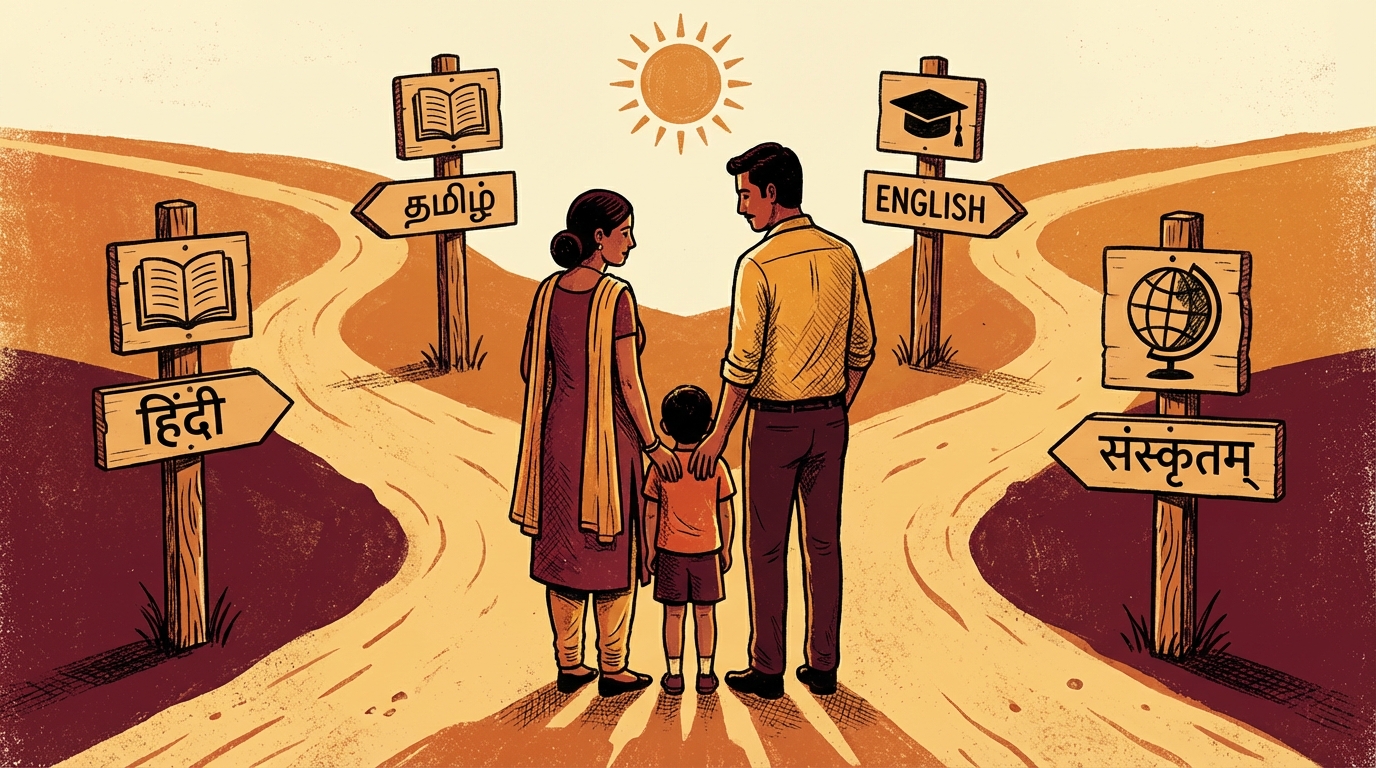
Let parents and students choose.
The government's role should be to:
Provide options. Make quality education available in English medium, Hindi medium, and regional language medium. Let families choose based on their circumstances, their aspirations, and their assessment of their children's futures.
Ensure quality in all tracks. A regional language education should not be second-rate. If a family chooses Tamil medium, their child should receive excellent Tamil medium education—but this should be a choice, not a compulsion.
Require a second language. Every student should learn at least one language beyond their medium of instruction. This could be English, Hindi, or a regional language depending on the primary medium. Bilingualism is the minimum; trilingualism is the goal.
Incentivize, don't mandate, classical languages. Want to preserve Sanskrit and Tamil? Offer scholarships, career pathways, and prestige to those who choose to study them. Create university departments, fund research, celebrate scholars. What you cannot do is force teenagers to memorize paradigms they will never use and expect them to develop love for the language.
Stay out of scientific education. Sciences should be taught in English or another language with adequate technical vocabulary. The political desire to conduct quantum mechanics in regional languages creates students who can discuss physics at a coffee shop but cannot read a journal article. This is not education; it is performance.
The Vote Bank Problem
None of this will happen, of course.
Language policy in India is not about education. It is about politics.
Hindi imposition rallies the BJP's northern base. Regional language assertiveness rallies regional parties. English criticism appeals to anti-colonial sentiment. Sanskrit mandates please traditional constituencies.
No major political party in India has the incentive to tell voters the truth: that their children's economic futures depend on linguistic pragmatism, not linguistic pride.
The families who understand this—the urban middle class, the globally connected diaspora, the upwardly mobile working class—simply buy their way out of the system. They send their children to English-medium private schools, hire tutors, prepare for competitive examinations in English, and leave the language wars to those who cannot afford to escape them.
The poor, as always, bear the burden of ideology.
The Unifying Thread
Here is the final irony that Hindi enthusiasts and Tamil nationalists alike refuse to acknowledge:
English is already India's link language.
When a Punjabi businessman negotiates with a Telugu supplier, they speak English. When a Malayalam nurse works in a Gujarat hospital, she communicates in English. When a Bengali engineer joins a Karnataka startup, the meetings are in English. When an Assamese journalist interviews a Marathi politician, the conversation is in English.
This is not colonialism. This is not cultural surrender. This is practical recognition that in a nation of a thousand tongues, the most useful common language is the one that belongs to nobody.
English allows India to remain united without requiring anyone to abandon their identity. It does not privilege the Hindi speaker over the Tamil speaker or the Marathi speaker over the Bengali speaker. It is neutral ground—imperfect, certainly, but fairer than any alternative.
The choice, ultimately, is between:
- A nation united by a language that belongs to no Indian community (English)
- A nation divided by the imposition of any language (Hindi, Tamil, or otherwise)
We choose unity through neutrality over division through imposition.
The Practical Conclusion
If you are a parent reading this, here is the practical advice that no politician will give you:
Educate your children in English medium if you can afford it and if it is available to you. This is not about abandoning your heritage; it is about maximizing your child's options.
Teach your regional language at home and through supplementary education. Let your children read literature, watch films, understand songs, and connect with their cultural inheritance in the language of their ancestors.
Encourage a third language based on your circumstances. Hindi if you're in the south and anticipate working in the north. A southern language if you're in the north and value cultural breadth. Sanskrit or Tamil if your child shows genuine interest in classical studies.
Ignore politicians who tell you that your child's education should serve their ideology. Your child is not a symbol. Your child is a person who will need to earn a living, raise a family, and navigate a complex world.
Vote for pragmatism. If any politician offers you a language policy that puts children's futures ahead of electoral calculations, support them—regardless of party.
The Final Word
India's linguistic diversity is not a problem to be solved. It is who we are.
But preserving diversity does not require imposing any language on anyone. It requires giving every family the freedom to choose—and ensuring that every choice leads to a quality education.
The king who wanted one tongue for his kingdom misunderstood the nature of unity. Unity does not come from uniformity. It comes from respect—for each other's languages, each other's choices, and each other's futures.
Let parents choose. Let children thrive. Let languages live through love, not law.
The author's mother tongue is Tamil. His education was in English. His children will choose for themselves.