By Ramachandran Rajeev Kumar — 2026-01-10
The King Who Wanted One Tongue: A Fable of Unity and Its Discontents
An Editorial Fable
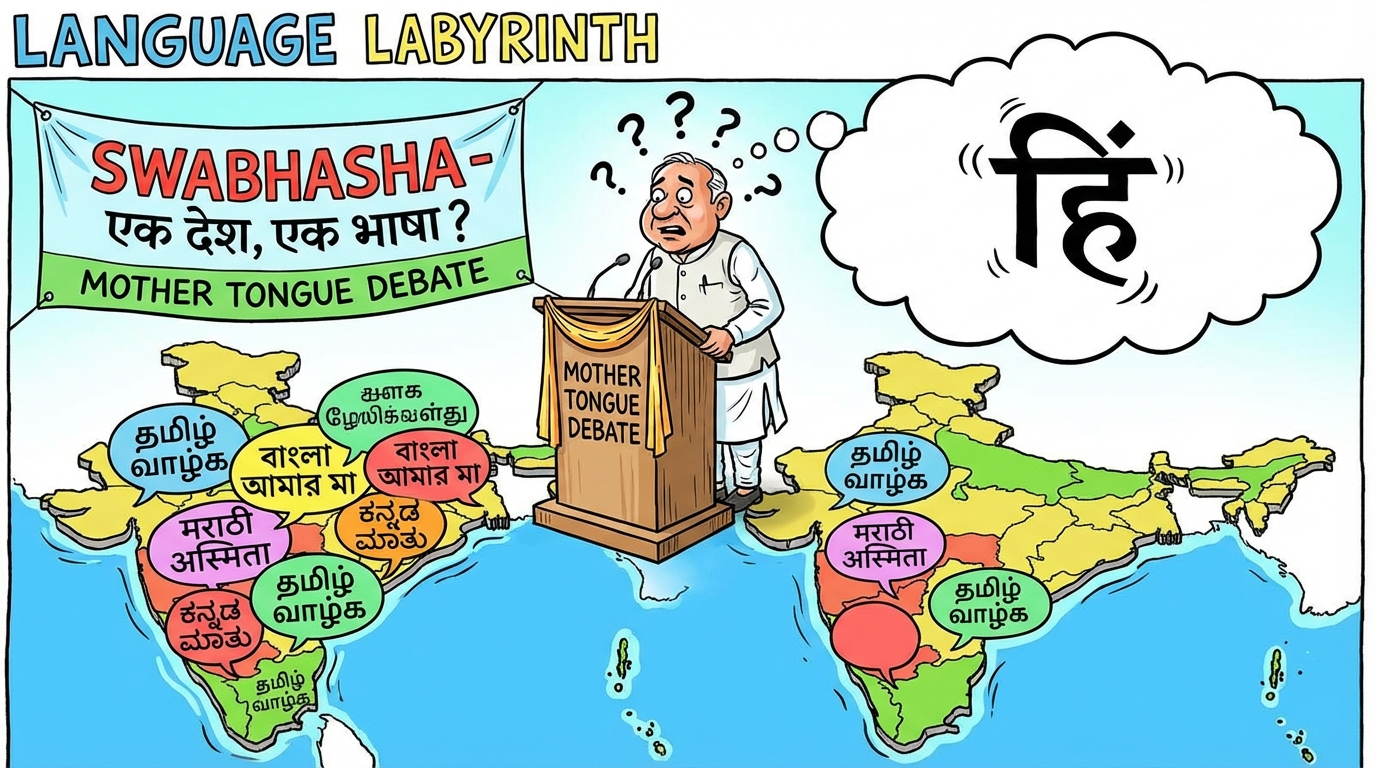
"Speak your mother tongue!" said the King. "Just make sure it's mine."
Once upon a time, in a land of a thousand kingdoms united under one crown, a powerful minister rose in the great assembly.
"My fellow countrymen!" he declared. "We must speak our mother tongue! Only through Swabhasha—our own language—can we achieve true self-reliance!"
The assembly erupted in applause. What a beautiful sentiment! What patriotism! What respect for heritage!
Then the questions began.
The Twenty-Two Tongues
From the southern kingdoms came a scholar who spoke a language older than the minister's own—a classical tongue with two thousand years of unbroken literary tradition.
"Excellent!" said the scholar. "I shall speak Tamil, the language of my mothers and their mothers before them."
The minister's smile flickered.
From the eastern delta came a poet whose language had produced a Nobel laureate, whose songs had become a nation's anthem.
"Wonderful!" said the poet. "I shall speak Bengali, the sweetest of all tongues."
The minister's brow furrowed.
From the western coast came a merchant whose language was the tongue of saints and reformers.
"Perfect!" said the merchant. "I shall speak Marathi, the language of Shivaji himself."
The minister's jaw tightened.
From the hills came voices in Kannada and Telugu, in Malayalam and Odia. From the plains came Gujarati and Punjabi. From the valleys came Kashmiri and Assamese. From ancient seats of learning came Sanskrit scholars.
Twenty-two official languages. Nineteen thousand five hundred dialects. A billion tongues, each one someone's mother.
The minister raised his hand for silence.
"When I said 'mother tongue,'" he clarified, "I meant... the national mother tongue."
"Which one?" asked the assembly, genuinely confused.
"Hindi," said the minister. "Obviously."
And there it was.
The Coded Language of Unity
On January 10, 2026, Union Home Minister Amit Shah urged Indians to "speak only their mother tongue at home" and adopt "Swabhasha" for national self-reliance.
It sounds inclusive. It sounds respectful. It sounds like a celebration of India's linguistic diversity.
It is none of these things.
When the Home Minister—from a government that has consistently pushed Hindi in central institutions, in banking, in railways, in examinations—speaks of "mother tongue," he is not celebrating Tamil or Telugu or Kannada. He is not encouraging Bengalis to read Tagore in the original or Maharashtrians to recite Tukaram.
He is advancing an old project with new vocabulary: the gradual, inexorable imposition of Hindi as India's dominant language.
The tell is in the timing. This statement comes as the National Education Policy's three-language formula faces resistance in non-Hindi states. It comes as southern chief ministers push back against Hindi-only options in competitive examinations. It comes as the linguistic fault lines of Indian federalism grow sharper.
"Swabhasha" is a Sanskrit word. It means "one's own language." But in the mouth of Delhi's power, it means something quite specific: Hindi for you, Hindi for me, Hindi for everyone—whether your mother spoke it or not.
The Inconvenient Mathematics
Let us be clear about the numbers.
Hindi, in all its variants, is the mother tongue of approximately 44% of Indians. This is a plurality, not a majority. It is the largest single group, but it is not "India."
The remaining 56% of Indians—700 million people—speak something else at home. Something their mothers actually taught them.
Tamil alone has more native speakers than French. Telugu has more than Italian. Bengali has more than German. Marathi has more than Spanish in Spain.
These are not dialects. They are not regional variations. They are ancient, sophisticated languages with their own scripts, their own literatures, their own grammars developed over millennia.
When Delhi speaks of "national unity through language," it is asking 700 million people to become second-class citizens in their own country—functional illiterates in the language of power, forever dependent on translation, forever one step behind.
This is not unity. This is subordination with extra steps.
The Hindi Heartland's Hidden Wound
Here is the argument no one in Delhi wants to hear: Hindi imposition hurts Hindi speakers most of all.
Consider the evidence.
India's information technology revolution—the industry that gave us global recognition, that employs millions, that generates billions in exports—is overwhelmingly concentrated in four states: Karnataka, Tamil Nadu, Telangana, and Maharashtra.
Bangalore. Chennai. Hyderabad. Pune.
Not Delhi. Not Lucknow. Not Patna. Not Bhopal.
Why? The answer is uncomfortable but undeniable: English proficiency.
The southern and western states, precisely because they resisted Hindi imposition, invested heavily in English education. They understood that in a globalized economy, the language of opportunity is not the language of Delhi's bureaucracy—it is the language of international commerce, science, and technology.
The Hindi heartland, secure in the knowledge that "their" language would be imposed nationally, grew complacent. Why struggle with English when Hindi would do? Why compete globally when you could dominate locally?
The result? A brain drain of catastrophic proportions.
The brightest students from Uttar Pradesh and Bihar do not stay in Lucknow and Patna. They migrate to Bangalore and Hyderabad—cities where English opens doors that Hindi cannot. They flee the very states that were supposed to benefit most from Hindi's dominance.
Hindi imposition created a Hindi-speaking population that is, paradoxically, less competitive in the Indian economy. The "national language" became a ceiling, not a floor.
The Three-Language Trap
The National Education Policy's three-language formula sounds reasonable: learn your mother tongue, learn Hindi, learn English.
But consider what this means in practice.
For a child in Tamil Nadu: Learn Tamil (mother tongue), learn Hindi (imposed), learn English (essential for employment). Three languages, one of which is genuinely unwanted.
For a child in Uttar Pradesh: Learn Hindi (mother tongue), learn... Hindi again? Learn English. Two languages, with the third slot either wasted on Sanskrit (impressive but impractical) or on a southern language (which they will never use because no Hindi speaker is ever expected to learn Tamil).
The asymmetry is stark. Non-Hindi speakers must become trilingual, while Hindi speakers can remain effectively bilingual. The burden of "national integration" falls entirely on those who are already marginalized.
This is not integration. This is empire with a democratic face.
What the Constitution Actually Says
A small historical correction, since the minister seems to have forgotten.
The Constitution of India does not designate Hindi as the "national language." This is not an oversight. It was a deliberate, fiercely debated decision by the Constituent Assembly.
The Constitution identifies Hindi in Devanagari script as an "official language" of the Union—one of two, alongside English. It was supposed to replace English after fifteen years. That deadline was extended. And extended. And extended again.
Why? Because every time Delhi tried to impose Hindi, the non-Hindi states erupted in protest. The anti-Hindi agitations of 1965 in Tamil Nadu resulted in deaths, immolations, and a political realignment that still shapes southern politics.
The compromise was simple: no imposition. States would determine their own language policies. Hindi would be encouraged but not enforced.
For sixty years, this compromise held. It allowed India to remain united despite its diversity—or rather, because of its diversity.
Now the minister wants to renegotiate.
The Real Meaning of Swabhasha
If the government truly believed in "Swabhasha"—in the power of mother tongues—here is what it would do:
Fund regional language education at the same level as Hindi education in central institutions.
Conduct all competitive examinations in all 22 scheduled languages, with equal validity.
Require Hindi-speaking bureaucrats posted to non-Hindi states to learn the local language—just as non-Hindi bureaucrats are expected to learn Hindi.
Remove Hindi requirements from central government jobs where they serve no practical purpose.
Celebrate linguistic diversity instead of treating non-Hindi languages as obstacles to unity.
But this is not what "Swabhasha" means to Delhi. "Swabhasha" means Hindi for the nation and English for the elite—with everyone else scrambling to keep up.
The Fable's End
Back in the great assembly, the minister was growing frustrated.
"You don't understand," he said. "One language will make us stronger. One language will make us united. One language will make us great."
The Tamil scholar raised his hand. "Whose language made Rome great? Latin. And what happened to all the peoples who spoke Latin but nothing else? They became Italians and Spaniards and French—separate nations with separate identities. The empire that imposed one tongue did not survive. The diversity it crushed did."
The Bengali poet nodded. "And whose language made the British Empire great? English. And when they imposed it on us, what did we do? We used it against them. Tagore wrote in Bengali. Gandhi spoke in Gujarati. Ambedkar argued in Marathi. Our strength was never in one tongue."
The Marathi merchant concluded: "You can build unity through respect or through force. One creates a nation. The other creates resentment. Which are you choosing?"
The minister had no answer.
He returned to Delhi and issued another statement about how much he respected all languages.
In Tamil Nadu, they printed it in Tamil. In Bengal, they printed it in Bengali. In Maharashtra, they printed it in Marathi.
And in every language, it read the same way: a powerful man who wanted one tongue for a land of thousands.
The fable continues.
The Bottom Line
India's linguistic diversity is not a problem to be solved. It is a competitive advantage to be leveraged.
The states that resisted Hindi imposition are today the most globally competitive. The states that accepted Hindi's dominance are today exporting their youth to cities where English opens doors.
When the Home Minister speaks of "Swabhasha," remember what he is not saying: that Hindi speakers should learn Tamil. That UPSC should be conducted equally in all languages. That the burden of "national integration" should fall on everyone, not just the 56% who don't speak the minister's mother tongue.
Unity is not uniformity. A nation of one tongue is not a nation—it is an empire pretending to be a democracy.
India's mothers spoke a thousand languages. Their children should be free to do the same.
The author's mother tongue is Tamil. His second language is English. He sees no reason to add a third simply because it is spoken in Delhi.