By Ramachandran Rajeev Kumar — 2026-01-15
Bharath Manthan - Episode 5
By Ramachandran Rajeev Kumar
The Number That Lies
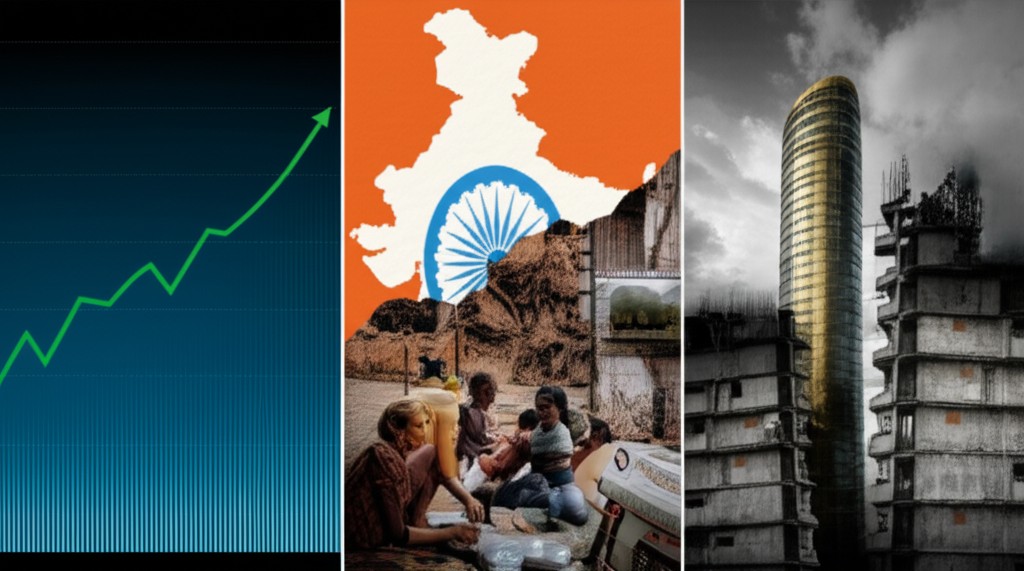
India's GDP crossed $3.9 trillion in 2025. Headlines celebrated. Politicians took credit. Markets rallied.
But here's what the number doesn't tell you:
A car accident that puts three people in the hospital adds to GDP (ambulance fees, hospital bills, insurance claims). A forest razed for a coal mine adds to GDP (extraction value, transport, sale). A mother caring for her children at home adds nothing to GDP (no transaction, no market value). The street vendor who feeds a family of four on ₹300 a day adds nothing to GDP (cash economy, no records).
We've built an entire economic measurement system that rewards destruction and ignores creation. That counts activity but not progress. That sees money changing hands but not lives improving.
And we wonder why India's "growth" feels so hollow.
The Activity Trap: Measuring Churn, Not Progress
What GDP Counts as "Growth"
GDP measures economic activity—any transaction where money changes hands. It doesn't distinguish between:
- Building a hospital (productive) vs. treating casualties from pollution (destructive)
- Creating renewable energy (sustainable) vs. burning coal (depleting)
- Educating a child (investment) vs. rebuilding after a flood (disaster recovery)
All of these transactions increase GDP. The metric treats traffic jams the same as efficient transport. Cancer treatment from industrial pollution counts as economic growth. Cleaning up an oil spill adds to GDP—but the healthy ocean it replaced counted for nothing.
This isn't progress. It's churn.
The Disaster Economy
Consider the perverse incentives:
- Natural disasters boost GDP: The 2013 Uttarakhand floods caused massive destruction. The reconstruction? GDP growth.
- Crime adds to GDP: More theft = more insurance claims, more security spending, more legal fees.
- Pollution creates growth: Delhi's toxic air generates hospital revenue, air purifier sales, medical consultations.
- Divorce is economically productive: Lawyer fees, property division costs, separate households buying duplicate goods.
A society that prevents disasters, reduces crime, cleans its air, and keeps families together will have lower GDP than one that manages crises after they happen. Our primary economic metric literally rewards failure.
The Invisibility Problem: What India Refuses to Count
The $1.5 Trillion Ghost Economy
India's informal economy is estimated at 26.9% to 50% of GDP depending on methodology. Let's use the conservative World Economics figure of 26.9%. That's approximately $1 trillion to $1.5 trillion of economic activity that barely registers in official statistics.
Over 90% of India's workforce—approximately 450 million people—work in the informal sector:
- Street vendors who keep cities fed
- Construction workers who build India's infrastructure
- Domestic workers who enable middle-class careers
- Small farmers who grow India's food
- Artisans, weavers, small manufacturers
Their labor powers India. Their income sustains families. But because transactions happen in cash, without formal records, they might as well not exist in GDP calculations.
India's Economic Survey 2023-24 pegs the informal economy lower—around 15-20%—but acknowledges that "significant economic activity remains unmeasured." Even using official figures, we're undercounting hundreds of billions of dollars of real economic value.
The absurdity: A CEO's salary is meticulously tracked. A vegetable vendor feeding 50 families daily is a statistical ghost.
The Unpaid Economy: Women's Invisible Labor
Time-use surveys reveal that Indian women spend on average 5 hours per day on unpaid domestic work—cooking, cleaning, childcare, eldercare. Men spend 52 minutes.
If this labor were valued at even minimum wage, it would add an estimated ₹10-15 trillion annually to India's GDP.
But it's invisible. A mother raising three children adds zero to GDP. A daycare center raising the same three children adds ₹50,000/month to GDP. The labor is identical. The economic value is identical. But only one counts.
GDP doesn't measure productivity. It measures transactions. If no money changes hands, you don't exist.
Environmental Capital Depletion
India's forests sequester carbon, regulate rainfall, prevent soil erosion, and provide livelihoods to millions. Clear-cut them for mining, and GDP rises with the sale of timber and minerals.
The loss of ecosystem services? Not counted.
Groundwater aquifers built over millennia are being drained for agriculture. Deplete them, and the resulting crop sales add to GDP.
The water scarcity crisis that follows? Not counted until you spend money on tankers and bore deeper wells—which then adds to GDP again.
India is consuming its environmental capital and calling it income. It's like burning the furniture to stay warm and calling yourself wealthy because the room is lit.
The Inequality Blind Spot: ₹100 to Everyone is Not Equal
The Farmer vs. The Billionaire
Here's how GDP treats inequality:
- Scenario A: A billionaire earns ₹1,000 crore this year. ₹1,000 crore added to GDP.
- Scenario B: 10 million farmers each earn ₹10,000 more this year. ₹1,000 crore added to GDP.
GDP sees these as identical. Human welfare sees them as radically different.
In Scenario A, one person buys another yacht. In Scenario B, 10 million families can afford better food, education, and healthcare.
But GDP is blind to distribution. It measures the size of the pie, not whether anyone is getting a slice.
India's Inequality Catastrophe
India's official Gini coefficient is 25.5 (based on consumption data, considered among the lowest inequality measures globally).
But this is based on consumption inequality, not income or wealth inequality. It's a statistical artifact.
Look at income distribution instead:
- Top 1% captures 22-25% of national income
- Top 10% captures 57-63% of national income
- Bottom 50% captures just 13-15% of national income
World Inequality Database data shows India's wealth inequality is among the highest globally, with the top 1% owning approximately 40% of the nation's wealth.
GDP per capita in 2025: $2,850.
But what does this mean when:
- A Bombay billionaire lives in a 27-story personal skyscraper
- A Bihar farmer survives on ₹6,000/month
Both are "India's GDP per capita." The metric is meaningless.
The Consumption Mirage
India's GDP has grown at 6-7% annually for two decades. Yet:
- 300 million Indians still lack access to clean drinking water
- 200 million live below the poverty line
- Over one-third of children under 5 are stunted due to malnutrition (35.5% per NFHS-5)
How can an economy "grow" for 20 years while half its children remain malnourished?
Because GDP measures production and consumption. Not nutrition. Not health. Not well-being.
You can have rising GDP with collapsing human welfare if the growth is concentrated and the benefits don't reach the majority.
The Alternative: Measuring What Actually Matters
The Genuine Progress Indicator (GPI)
GPI starts with GDP, then makes crucial adjustments:
Add:
- Value of unpaid household labor
- Value of volunteer work
- Value of higher education levels
Subtract:
- Cost of crime
- Cost of pollution
- Loss of natural resources
- Cost of income inequality
- Cost of underemployment
Studies in developed nations show that while GDP rises steadily, GPI peaks and then declines—revealing that "growth" beyond a certain point makes societies worse off when you account for environmental destruction, inequality, and social costs.
We don't have a comprehensive GPI for India, but the pattern would likely be similar: strong growth in the 1990s-2000s as liberalization lifted millions out of poverty, followed by stagnation or decline as inequality widened, environmental damage accelerated, and resource depletion compounded.
Bhutan's Gross National Happiness (GNH)
Bhutan rejected GDP entirely in favor of Gross National Happiness, measured across 9 domains:
- Psychological well-being
- Health
- Time use (work-life balance)
- Education
- Cultural diversity and resilience
- Good governance
- Community vitality
- Ecological diversity and resilience
- Living standards
These are tracked via 33 indicators covering everything from sleep hours to forest cover to trust in neighbors.
Is Bhutan perfect? No. Is it wealthy by GDP standards? No (GDP per capita: $3,500).
But 91.2% of Bhutanese report being "happy" (as of 2022), compared to India's ranking of 126 out of 143 nations in the World Happiness Report.
Bhutan knows something we don't: A high GDP doesn't guarantee a good life. But a good life might not need a high GDP.
Proposing "Bharatiya Vikas Suchak" (Indian Progress Index)
India needs its own alternative—culturally rooted, practically measurable, politically viable.
I propose: Bharatiya Vikas Suchak (BVS) - "Indian Development Indicator"
The Framework
Four Pillars (Stambh):
1. Samriddhi (Prosperity)
- Not just GDP, but median household income
- Employment quality (formal vs. informal, wage trends)
- Access to clean water, electricity, sanitation
- Housing adequacy
2. Swasthya (Health & Well-being)
- Life expectancy and healthy life years
- Child malnutrition rates
- Mental health indicators
- Work-life balance (average work hours)
3. Prakriti (Environmental Sustainability)
- Forest cover and biodiversity
- Air and water quality
- Renewable energy share
- Resource depletion rates
- Climate resilience
4. Samajik Nyaya (Social Justice)
- Gini coefficient (both consumption and income-based)
- Gender parity index (education, workforce, earnings)
- Caste-based discrimination indicators
- Access to justice and legal rights
Each pillar gets equal weight. A nation cannot be considered "developed" if it excels in GDP but fails in breathable air or social equity.
Why This Would Matter
For Policy: BVS would force governments to optimize for well-being, not just growth. A policy that boosts GDP by 2% but increases air pollution by 10% would lower BVS—and politicians would be held accountable.
For Citizens: You'd know if your life is actually improving, not just whether "the economy" is growing (and who benefits).
For Investment: Businesses would optimize for long-term sustainability and social impact, not just quarterly earnings.
For Global Comparison: India could lead the Global South in redefining "development"—not as catching up to Western GDP but as building a model of sustainable, equitable prosperity.
The Political Reality: Why This Won't Happen (Yet)
Let us be honest. No political party will adopt BVS.
Why?
1. GDP growth is easy to claim credit for. "India grew at 7% this year!" is a powerful headline. "India's Social Justice Index improved by 0.3 points" is not.
2. BVS would reveal uncomfortable truths. India's GDP looks impressive. India's median income, environmental health, and inequality? Not so much.
3. Vested interests benefit from the status quo. Corporations profit from externalizing environmental costs. Politicians benefit from inequality (easier to buy votes from the poor). Economists have built entire careers on GDP-centric models.
4. International comparisons depend on GDP. "World's 5th largest economy" is a point of pride. "126th in happiness, 111th in hunger" is not.
The Citizen's Path Forward
Since the government won't change the metric, we must change the conversation.
Stop celebrating GDP growth announcements. Ask instead: "Did median incomes rise? Did air quality improve? Did inequality narrow?"
Demand data transparency. Push state governments to publish district-level data on health, environment, and income distribution—not just aggregate GDP.
Support businesses that optimize for stakeholder welfare, not just shareholder profit. Buy from companies that pay fair wages, reduce environmental impact, and invest in communities.
Vote for leaders who talk about quality of life, not just economic growth. If a politician promises 8% GDP growth but has no plan for clean water, don't vote for them.
The Measurement Revolution
What gets measured gets managed. What gets managed gets optimized. What gets optimized defines our future.
Right now, India optimizes for GDP—a 1930s metric designed for industrial economies, repurposed for a globalized 21st century world it was never meant to describe.
The result? We celebrate growth while children starve. We applaud investment while rivers die. We boast of trillion-dollar economies while 90% of workers remain invisible.
The GDP era must end—not because economic growth doesn't matter, but because it doesn't measure what we actually care about: healthy children, breathable air, meaningful work, time with family, dignity, opportunity, hope.
Bhutan chose happiness over GDP. China chose power. America chose consumption. Europe chose quality of life.
What will India choose?
If we choose wisely, we'll stop measuring the speed of the treadmill and start asking whether we're running toward anything worth reaching.
"Not everything that counts can be counted, and not everything that can be counted counts." - William Bruce Cameron (often misattributed to Einstein)
India built the decimal system. We invented zero. Perhaps it's time we invent a better way to measure progress.
Previous Episode: The Caste Calculus - Why India Must Abandon Caste-Based Policy
Next Episode: The Sanctuary Civilization - How India Became Home to the World's Persecuted
Series Home: Bharath Manthan - Churning the Indian Pot
Ramachandran Rajeev Kumar is the founder of BarathVector. Agree? Disagree? The churning continues in the comments.