By Ramachandran Rajeev Kumar — 2026-02-15
The Empty Chair at the AI Summit: What Jensen Huang's Absence Tells Us About India's AI Moment
By Ramachandran Rajeev Kumar
For our earlier analysis of India's AI ambitions, see The Algorithm Throne.
On February 14 -- Valentine's Day, because the universe appreciates irony -- Jensen Huang, the CEO of NVIDIA and arguably the most consequential figure in the global AI supply chain, cancelled his attendance at India's AI Summit. The event opens tomorrow at Bharat Mandapam in New Delhi. Huang cited "unforeseen circumstances." His Executive Vice President, Jay Puri, will attend in his place.
The summit will proceed. Between fifteen and twenty heads of government are expected. Over fifty ministers from countries across six continents have confirmed. More than forty CEOs of major technology companies will be in attendance. Sam Altman of OpenAI, Sundar Pichai of Google, Bill Gates, and UN Secretary-General Antonio Guterres are all on the schedule. Three hundred exhibitors from thirty countries will populate the AI Expo running alongside the summit.
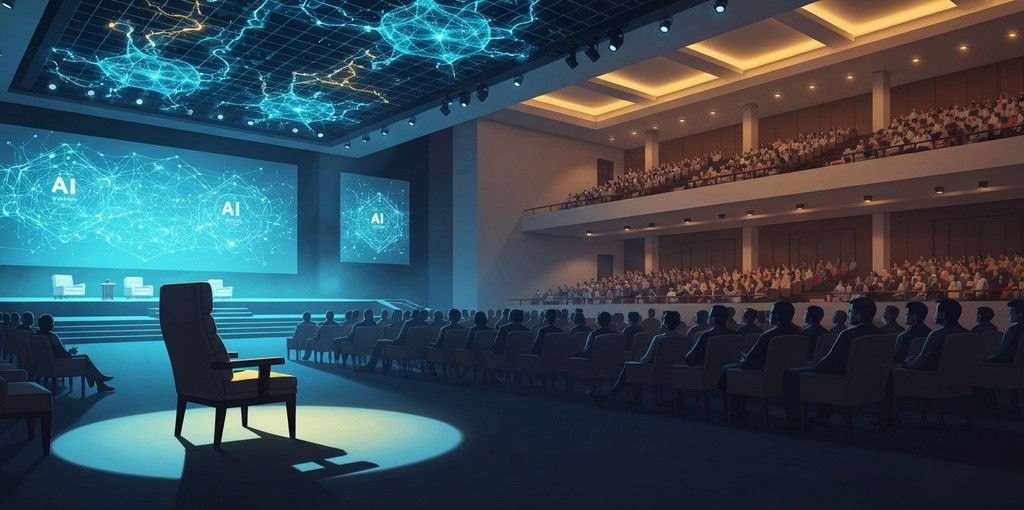
Jensen Huang's chair will be empty. The question is how much that matters.
The Man and the Machine
To understand why Huang's absence registers as more than a scheduling footnote, you must understand what NVIDIA has become. The company does not merely make graphics processing units. It manufactures the substrate on which modern artificial intelligence runs. Every large language model, every generative AI system, every autonomous driving platform of consequence runs on NVIDIA hardware or on hardware designed to compete with NVIDIA hardware.
Huang is not a tech CEO in the conventional sense. He is the gatekeeper of computational capacity. In a world where AI capability is directly proportional to access to GPUs, the man who controls GPU supply controls the pace of AI development. Countries, not just companies, compete for NVIDIA allocations.
India is one of those countries. The government has been negotiating with NVIDIA for expanded GPU access, data centre investments, and AI research partnerships. Huang's presence at the summit would have been a signal -- to Indian industry, to competing nations, to NVIDIA's own partners -- that India occupied a priority position in NVIDIA's global strategy.
His absence sends the opposite signal. Or at least, it creates a vacuum where a signal should have been.
Unforeseen Circumstances and the Art of the Last-Minute Cancel
Corporate cancellations at major international events are rarely random. They are calculated, even when they are genuine. A CEO of Huang's stature does not commit to a head-of-state-level summit and withdraw twenty-four hours before the opening session without a reason that his board and his government relations team consider sufficient.
The stated reason -- "unforeseen circumstances" -- is the diplomatic equivalent of "no comment." It could mean anything from a health concern to a regulatory complication to a strategic recalculation about the optics of appearing at an Indian government event at a moment when NVIDIA faces antitrust scrutiny in multiple jurisdictions.
What it is not is an insult. Jay Puri, the designated replacement, is a senior executive with deep India connections and the authority to make commitments. NVIDIA's participation in the summit continues. The company's exhibition presence is intact. The substance of whatever NVIDIA planned to announce or negotiate will likely proceed through Puri's office.
But summits are not only about substance. They are about presence. They are about the photograph of a nation's leader shaking hands with the man whose company is worth more than the GDP of most attending countries. That photograph will not exist. And in the visual grammar of international events, absence is its own statement.
What the Summit Has Without Huang
The roster of confirmed attendees should dispel any notion that Jensen Huang's cancellation diminishes the summit to irrelevance.
Sam Altman's presence is, if anything, more consequential than Huang's would have been. OpenAI is not merely building AI models. It is building the interface through which billions of people will interact with artificial intelligence. Altman's engagement with India -- where OpenAI has been expanding operations and exploring partnerships with Indian technology companies -- has direct implications for how AI is deployed in the world's most populous democracy.
Sundar Pichai represents Google, whose Gemini AI platform competes directly with OpenAI and whose cloud infrastructure ambitions in India are enormous. Google's recent investments in Indian AI startups and its partnership with India's digital public infrastructure make Pichai's presence more operationally significant than a GPU manufacturer's CEO, however powerful that manufacturer may be.
Bill Gates brings philanthropic capital, public health expertise, and a network of relationships across Indian government and civil society that no technology CEO can match. His Foundation's work on AI applications for agriculture, healthcare, and education in developing countries aligns precisely with India's stated AI priorities.
And Antonio Guterres, the UN Secretary-General, provides the multilateral legitimacy that India has been cultivating as a leader of the Global South's technology agenda. His participation frames the summit as a global governance event, not merely a technology trade show.
India's AI Summit in Context
The summit is organised around what the government has branded "Three Sutras" -- People, Planet, and Progress -- and "Seven Chakras," covering themes from AI governance to inclusive development. The framing is deliberately distinct from the techno-utopian vocabulary that dominates American and European AI discourse. India is positioning itself not as a competitor to Silicon Valley's AI dominance but as the architect of an alternative model: AI as a tool for development, not merely for profit.
This is strategically astute. India cannot compete with the United States or China in raw AI compute. It lacks the chip fabrication infrastructure, the venture capital concentration, and the frontier research density. What India has is scale -- 1.4 billion people whose interaction with AI will be fundamentally different from a San Francisco engineer's -- and governance ambition. The Digital Public Infrastructure model (Aadhaar, UPI, ONDC) has already demonstrated that India can build technology platforms at population scale. Applying that model to AI is the logical next step.
The AI Responsibility Pledge, which organisers plan to attempt as a Guinness World Record on February 16, is a characteristically Indian combination of the earnest and the theatrical. But beneath the record attempt lies a genuine policy objective: establishing India as the host nation for global AI governance norms, much as it has positioned itself as a climate diplomacy broker through the International Solar Alliance.
The GPU Question Persists
None of this changes the fundamental challenge that Huang's company -- present or absent -- represents. India's AI ambitions require computational infrastructure that India does not yet possess in sufficient quantity. The country's total installed GPU capacity is a fraction of what the United States deploys. Indian AI startups routinely train their models on cloud infrastructure hosted in other countries.
The government's AI Compute Mission, with plans for public AI infrastructure at scale, is a step towards addressing this deficit. But infrastructure takes time. NVIDIA's GPUs take purchase orders. And the relationship between India and NVIDIA -- which Huang's attendance would have publicly cemented -- remains a commercial negotiation, not a settled partnership.
Jay Puri can negotiate as effectively as Jensen Huang. What he cannot provide is the visual confirmation that India is at the top of NVIDIA's dance card. In a week when Huang could have stood beside India's Prime Minister and announced expanded investment, his absence will be interpreted -- fairly or unfairly -- as a signal about India's position in NVIDIA's hierarchy of priorities.
The Show Goes On
The India AI Summit will be the largest gathering of AI policymakers, executives, and researchers that any developing country has ever hosted. Its scale, its attendee list, and its agenda would be impressive for any nation. For a country that was building software for other people's platforms a generation ago, it is a remarkable assertion of technological ambition.
Jensen Huang's empty chair is a footnote in that story, not the headline. The summit's significance will be determined by the agreements signed, the frameworks established, and the partnerships announced over five days of intensive engagement. NVIDIA's GPUs matter. But the future of AI in India will be shaped by the 1.4 billion people who will use it, not by one man who declined to attend a conference.
Tomorrow, at Bharat Mandapam, the AI summit opens. The world's most powerful technology leaders will gather to discuss the most consequential technology of the century, in the world's most populous country. One chair will be empty.
The rest of the room will be full.
The views expressed are those of the author and do not necessarily reflect the editorial position of BarathVector.