By Ramachandran Rajeev Kumar — 2026-02-06
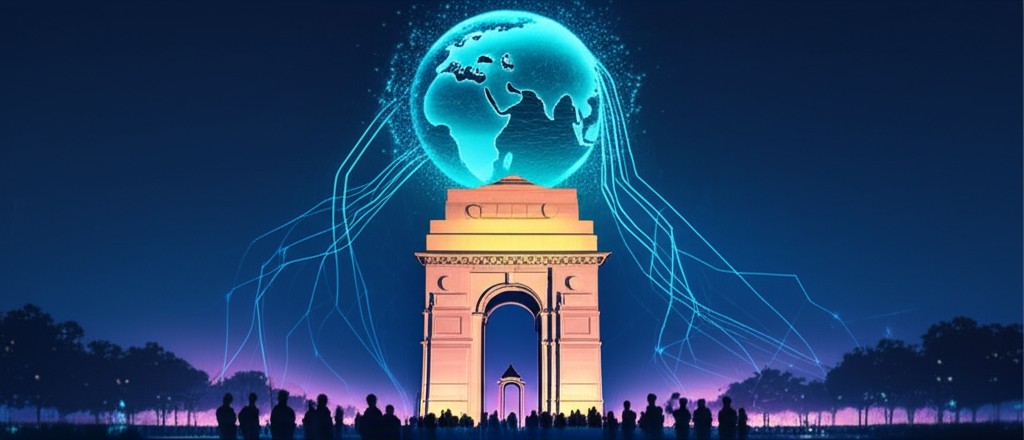
When the United Kingdom hosted the AI Safety Summit at Bletchley Park in November 2023, it chose Churchill's old haunt--where Turing and his colleagues cracked the Enigma code--as a symbolic reminder of Britain's place in computing history. When France hosted its AI Action Summit in February 2024, Macron leveraged Paris's reputation as the City of Light to illuminate AI's ethical dimensions. Now, as India prepares to host the first-ever AI Impact Summit in the Global South from February 16-20, 2026, New Delhi is making a different claim entirely: that the future of artificial intelligence should be written by those who have the most people, not the most processors.
The symbolism is deliberate. No developing nation has ever convened a gathering of this scale on artificial intelligence. India's Ministry of Electronics and Information Technology has invited representatives from over 80 countries, with a heavy emphasis on nations from Africa, Southeast Asia, and Latin America. The message is unmistakable: artificial intelligence governance has been dominated by a transatlantic elite and a Chinese techno-state for too long. India intends to speak for the rest.
Whether India can actually lead in AI--or whether this summit represents an aspirational photo opportunity--is the more interesting question.
The Digital Credentials
India's case for leadership rests on a genuine achievement: it has built some of the world's most successful digital public infrastructure. The Unified Payments Interface (UPI), India's real-time payment system, processed 131 billion transactions worth $2.4 trillion in 2025 alone, according to the National Payments Corporation of India. That's more than the combined volume of all card-based transactions in the United States. Aadhaar, India's biometric identity system, covers 1.4 billion people and has become the backbone of welfare delivery, tax collection, and financial inclusion. DigiLocker, a cloud-based document storage system, holds over 6.5 billion documents and has nearly eliminated the need for physical certificates in government dealings.
These are not trivial accomplishments. India demonstrated that digital infrastructure could be built at scale, cheaply, and with remarkable adoption rates. When Prime Minister Modi's government talks about "AI for development," it is pointing to this track record as proof of concept. If India could digitize payments and identity for a billion people, the argument goes, it can deploy AI-driven solutions for agriculture, healthcare, and education across the developing world.
But digital public infrastructure is not artificial intelligence. UPI is a rails system; AI is a reasoning system. Aadhaar is a database; large language models are probabilistic prediction engines. The skills required to build interoperable payment systems are fundamentally different from those required to train frontier AI models. And here, India faces a more sobering reality.
The Compute Conundrum
If there is one resource that separates AI leaders from AI aspirants, it is compute. Training a state-of-the-art large language model requires thousands of high-performance GPUs running in parallel for weeks or months. OpenAI's GPT-4 is estimated to have required over 25,000 NVIDIA A100 GPUs during training. Anthropic's Claude models, Google's Gemini, and Meta's Llama 3 all demanded similar--or greater--computational resources. China's DeepSeek and Moonshot AI have demonstrated that the country now has the infrastructure to train competitive models domestically, with DeepSeek's R1 model rivaling OpenAI's o1 in reasoning benchmarks despite US export controls on advanced chips.
India, by contrast, does not have a single AI lab with access to comparable compute infrastructure. The Indian government announced plans in 2024 to establish an AI compute infrastructure with 10,000 GPUs, a figure that would have been impressive in 2021 but is now dwarfed by the scale at which US and Chinese labs operate. For context, Meta alone operates over 600,000 NVIDIA H100 GPUs as of early 2026. India's proposed compute capacity is two orders of magnitude smaller than what frontier AI labs now consider table stakes.
This is not a problem that can be solved through clever engineering. Training frontier models is a capital-intensive, energy-intensive, and infrastructure-intensive endeavor. India's total AI-related R&D spending across government and private sector combined was estimated at $1.2 billion in 2025, according to NASSCOM. For comparison, OpenAI's compute costs alone for 2025 were estimated to exceed $5 billion. India is not playing in the same financial league.
The consequence is straightforward: India will not build a GPT-5 competitor. It will not train a model that can outperform Claude or Gemini Ultra. India will remain a consumer of frontier AI models developed elsewhere, not a producer.
The Brain Drain Paradox
India's second challenge is talent, though here the picture is more complicated. India produces more computer science graduates annually than any other country--roughly 1.5 million per year. Indian engineers dominate Silicon Valley: Sundar Pichai runs Google, Satya Nadella runs Microsoft, and Arvind Krishna runs IBM. Indian nationals hold leadership positions at Anthropic, OpenAI, and nearly every major AI lab in the United States.
But most of that talent does not stay in India. The country's brightest AI researchers leave for Stanford, MIT, Carnegie Mellon, and Berkeley, then join US-based labs where salaries for senior AI engineers routinely exceed $500,000 annually--sums that Indian institutions cannot match. India has no equivalent to DeepMind, no Anthropic, no OpenAI. The Indian Institute of Science in Bangalore and IIT Delhi have strong AI research groups, but they operate on academic budgets and cannot compete with the resources available at US and Chinese labs.
This creates a curious inversion: India has the talent pool to be an AI superpower, but the talent pool is largely employed by other superpowers. The AI Impact Summit will likely feature keynote speakers who are ethnically Indian but work for American companies. India's claim to speak for the Global South is undermined by the fact that its own top-tier talent has opted out of building in India.
The Regulatory Gambit
What India lacks in compute and retained talent, it hopes to compensate for through regulatory influence. The AI Impact Summit is explicitly framed around governance: how should AI be regulated? Who gets to set the rules? Should developing nations have different AI standards than wealthy nations?
India's position is that the existing AI governance conversation--dominated by the European Union's AI Act, the US executive orders on AI safety, and China's algorithmic recommendation regulations--reflects the priorities of rich countries. The EU worries about bias in hiring algorithms; India worries about AI-driven crop yield prediction for smallholder farmers. The US debates whether AI should be allowed to make autonomous weapons decisions; India debates whether AI can help reduce maternal mortality in rural clinics. The regulatory priorities are different, India argues, and the Global South should have a seat at the table.
This is a reasonable claim. The EU's AI Act, for instance, classifies AI systems by risk categories that make sense for European labor markets and consumer protection norms but may be poorly suited for contexts where the primary AI use cases involve informal economies, low-literacy populations, and minimal digital infrastructure. A regulatory framework designed for Paris may not work for Patna.
But regulatory influence without technological capability has limits. The EU's AI Act matters because European companies build AI systems and European markets are large enough to impose compliance costs on global firms. India's regulatory voice will carry weight only if Indian markets are large enough to force compliance--and even then, only if India can credibly threaten to block access to its market. Given India's dependence on foreign AI models, this is a delicate negotiation.
The US-China Shadow
India's AI ambitions unfold in the shadow of the US-China AI race, a reality made more complex by the recently finalized US-India trade deal. The agreement includes provisions for AI cooperation: the US committed to facilitate technology transfer in non-sensitive AI domains, ease export restrictions on certain semiconductor equipment, and support joint AI research initiatives. In exchange, India agreed to tighten intellectual property protections, reduce tariffs on US tech imports, and align its data localization policies more closely with US standards.
This is a strategic win for both sides. The US gains a counterweight to China in the AI domain, leveraging India's massive market and technical workforce. India gains access to US compute infrastructure, AI research partnerships, and--crucially--advanced semiconductor manufacturing expertise. But it also locks India into a Western-aligned AI ecosystem, which complicates India's claim to represent the non-aligned Global South.
China, meanwhile, has not been idle. DeepSeek's R1 model demonstrated that Chinese labs could match OpenAI's reasoning capabilities despite US chip export controls. Moonshot AI's Kimi model has become the dominant AI assistant in Chinese markets. Minimax's video generation models compete with OpenAI's Sora. China has built a parallel AI stack--models, chips, data centers--that operates independently of US supply chains. India has not.
The AI Impact Summit, then, is not occurring in a vacuum. It is occurring in a world where the US and China have already divided the AI landscape into competing spheres of influence. India's attempt to carve out a third path faces the structural problem that India depends on both for the foundational components of AI.
What India Can Actually Do
Strip away the aspirational rhetoric and India's realistic AI strategy becomes clearer. India will not build frontier models. It will not rival OpenAI or DeepMind. But it can deploy AI at scale in domains where the West has shown limited interest: precision agriculture, multilingual healthcare chatbots, logistics optimization for chaotic supply chains, climate resilience modeling for monsoon-dependent agriculture, and fraud detection in informal economies.
These are not trivial applications. India's agricultural sector employs 42% of the workforce and contributes 18% of GDP. AI-driven crop yield prediction, pest detection, and soil health monitoring could generate billions in economic value. India's healthcare system is chronically understaffed; AI-powered diagnostic tools and telemedicine platforms could extend care to underserved rural populations. India's logistics sector is notoriously inefficient; route optimization and predictive maintenance algorithms could reduce waste and emissions.
The private sector has already moved in this direction. Niramai uses AI-powered thermal imaging for early breast cancer detection in low-resource settings. Wadhwani AI focuses on maternal and newborn health, using machine learning to predict complications during pregnancy. CropIn builds AI-driven agritech solutions for smallholder farmers. These are not glamorous moonshot projects, but they are high-impact applications where AI can deliver measurable social and economic benefits.
India's AI strategy, in other words, should be application-driven rather than model-driven. Let OpenAI and Google compete to build the largest language models. India should compete to deploy AI where it matters most to the 2.8 billion people who live in the Global South--most of whom care far more about whether AI can help them get a fair price for their crops than whether it can pass a PhD-level physics exam.
The Philosophical Question
There is a deeper question embedded in India's AI ambitions, one that the summit may or may not address: should the Global South even want to replicate the AI development path taken by the US and China?
Frontier AI models are expensive, energy-intensive, and optimized for problems that matter to wealthy consumers: generating photorealistic images, automating white-collar knowledge work, and providing entertainment. These are not necessarily the priorities of developing nations. A model that can write a perfect McKinsey-style strategy deck is less useful in Lagos or Dhaka than a model that can predict the optimal planting date for sorghum or diagnose tuberculosis from a mobile phone photo.
India has an opportunity to define a different AI development paradigm--one focused on high-impact, low-resource applications rather than the frontier model race. This would require resisting the temptation to chase prestige benchmarks and instead prioritizing models that work in low-bandwidth, multilingual, and data-scarce environments.
Whether India--or any other Global South nation--has the political will to pursue this path is uncertain. The allure of the frontier model race is strong. Every nation wants its own "national champion" AI model, even if such models are expensive, duplicative, and poorly suited to local needs. But if India can articulate a compelling alternative vision--AI for impact rather than AI for its own sake--the AI Impact Summit will have served a purpose beyond the symbolic.
The Throne Is Still Empty
India's AI Impact Summit is an important moment, but it does not make India an AI superpower. India lacks the compute, the retained talent, and the R&D investment to compete with the US and China in frontier AI development. What it does have is a proven track record in digital infrastructure, a massive and underserved market, and a legitimate claim to represent the Global South's AI priorities.
The summit will succeed if it shifts the conversation from "How do we catch up to the US and China?" to "How do we deploy AI where it matters most?" The former is a losing game for developing nations. The latter is a race they can win.
Whether India can translate symbolic leadership into substantive leadership remains to be seen. Hosting a summit is easy. Building an AI ecosystem that works for 2.8 billion people is considerably harder. The algorithm throne is still empty. India is making a bid for it, but the coronation is far from certain.