By Ramachandran Rajeev Kumar — 2026-01-21
This article follows our coverage of India's BRICS bridge-building strategy and connects to the escalating US-India trade tensions.
India does not want to choose sides.
For three decades, New Delhi has practiced what diplomats call "multi-alignment"—maintaining robust partnerships with Washington, Moscow, Brussels, and yes, Beijing, without becoming a client state of any. This strategic ambiguity has served India well, allowing it to buy Russian weapons while conducting exercises with American forces, to negotiate an EU free trade deal while chairing BRICS.
But strategic ambiguity requires willing partners. It requires a United States that tolerates India's independent streak as the price of partnership. It requires patience, nuance, and a recognition that the world's largest democracy cannot be bullied into compliance.
The 500% tariff bill moving through Congress suggests Washington has forgotten all of this.
And that changes everything about BRICS.
The Essential Tightrope
India's BRICS chairmanship in 2026 is not a choice. It is an inheritance.
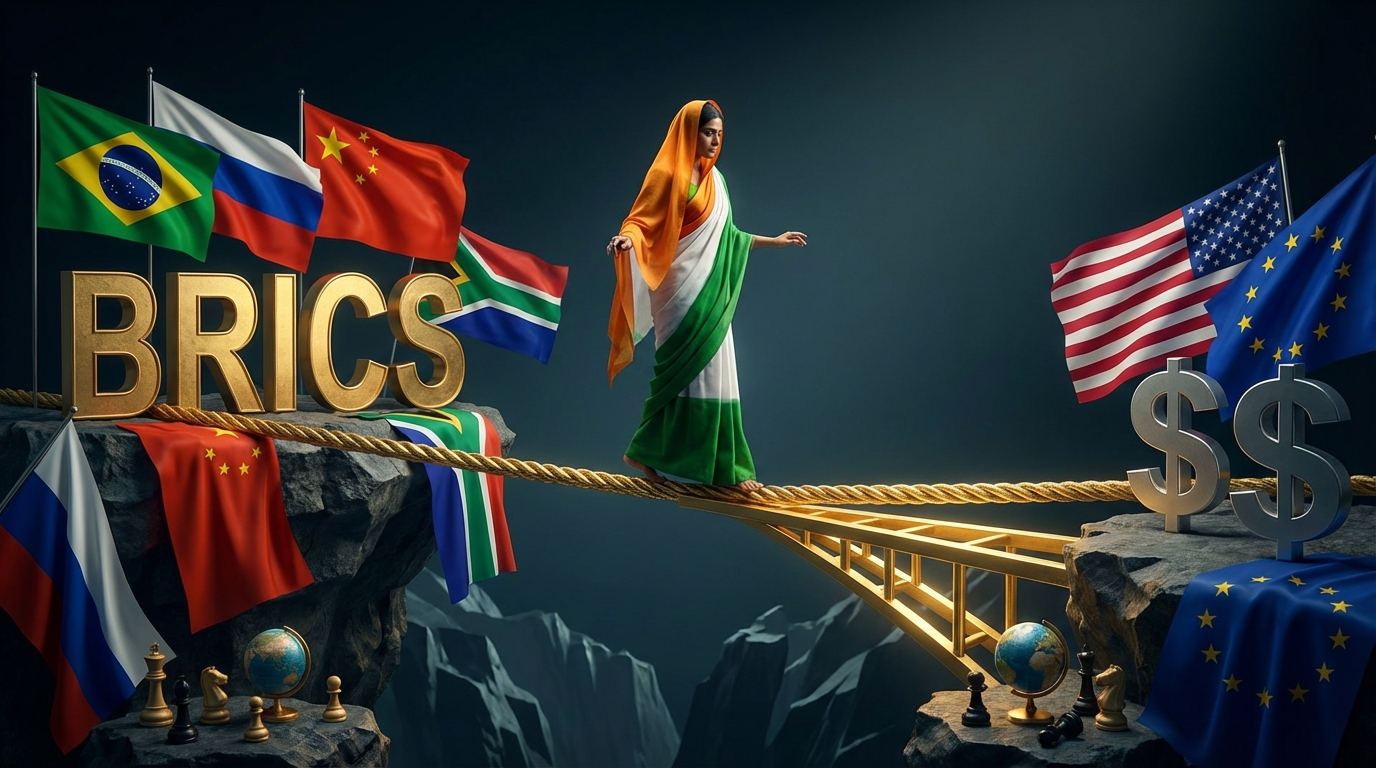
The bloc exists. India is a founding member. The chair rotates automatically. New Delhi cannot skip its turn without signaling a rupture it does not want. So India walks the tightrope—leading a group that includes Russia and China while trying to maintain credibility with the West.
External Affairs Minister S. Jaishankar has framed India's approach carefully. The theme for India's presidency—"Building for Resilience, Innovation, Cooperation and Sustainability"—is deliberately anodyne. There is no mention of de-dollarization, no anti-Western rhetoric, no challenge to American hegemony. India wants BRICS to be about development cooperation, not geopolitical confrontation.
This is the bridge-builder strategy: keep BRICS useful without making it threatening. Expand trade among members without creating a rival currency bloc. Coordinate on climate and health without forming a military alliance. Reform global institutions without tearing them down.
It is a delicate dance. And it assumes that Washington will meet India halfway—that America will recognize BRICS participation as pragmatic engagement, not hostile alignment.
The 500% tariff bill suggests otherwise.
The Insurance Policy Activates
Let us be clear about what BRICS represents for India: it is not a first choice. It is an insurance policy.
India would prefer a world where it could trade freely with America, access Western technology, and participate in the Quad without facing economic coercion. India would prefer that its multi-alignment strategy be respected as the sovereign choice of a major democracy.
But insurance policies exist precisely because preferred outcomes are not guaranteed.
If the Graham-Blumenthal bill passes—if India faces 500% tariffs on all exports to the United States because it refuses to sever energy ties with Russia—then the strategic calculus shifts fundamentally. At that point, the costs of Western alignment exceed the costs of Eastern pivot. At that point, BRICS stops being a hedge and becomes a lifeline.
Consider the arithmetic.
India exports $86 billion in goods to the United States annually. At 500% tariffs, that trade effectively goes to zero. No Indian pharmaceutical, no IT service, no textile shipment can survive a six-fold price increase. Millions of jobs disappear. Export-oriented industries collapse. The rupee craters.
Now consider the alternative.
BRICS members collectively represent over $60 trillion in GDP (purchasing power parity)—larger than the G7. They include the world's largest energy exporters (Russia, Saudi Arabia, UAE, Iran), the world's manufacturing superpower (China), and fast-growing markets across Africa, Asia, and Latin America. Intra-BRICS trade has grown at 9.2% annually since 2008, reaching nearly $700 billion.
If America slams the door, BRICS offers another room.
What a Full Pivot Looks Like
India swinging fully into the BRICS camp would not happen overnight. It would unfold in stages, each triggered by American escalation, each deepening India's integration with the non-Western world.
Stage One: Trade Diversification
The immediate response to 500% tariffs would be emergency trade redirection. Indian exporters would pivot to BRICS markets—pharmaceuticals to Russia and Brazil, IT services to South Africa and UAE, textiles to the Gulf states. The India-EU FTA, already at 20 of 24 chapters complete, would accelerate. Bilateral deals with Indonesia, Saudi Arabia, and Egypt would fast-track.
This is survivable. Painful, but survivable.
Stage Two: Currency Arrangements
The next stage is more consequential. If dollar-based trade becomes weaponized against India, rupee-based alternatives become necessary.
India already conducts some trade with Russia in rupees and rubles. BRICS has discussed (though not implemented) a common payment mechanism to reduce dollar dependence. A sanctioned India would have strong incentives to build these systems rapidly—not out of ideological opposition to the dollar, but out of practical necessity.
De-dollarization, which India has resisted to preserve Western ties, becomes attractive when Western ties no longer offer protection.
Stage Three: Security Realignment
The deepest shift would come in defense and security.
India currently balances Russian equipment with American technology—SU-30s alongside P-8 Poseidons, S-400s alongside future Predator drones. This hybrid approach requires functioning relationships with both Moscow and Washington.
A hostile America would freeze defense cooperation. The GE F414 engine deal would die. Predator sales would halt. Intelligence sharing would cease. Joint exercises would end.
India would respond by deepening ties with Russia (which has never weaponized defense sales) and accelerating indigenous programs. The Quad—already strained by American unilateralism—would become irrelevant. Indo-Pacific strategy would proceed without India as a willing partner.
Stage Four: Institutional Alignment
The final stage is institutional. A fully pivoted India would use its voice in the G20, UN, and WTO to align with BRICS positions rather than bridging BRICS and Western views. It would support BRICS expansion, BRICS development bank capitalization, and BRICS reform proposals for global governance.
India would not become anti-Western. But it would stop being the West's bridge to the rest. It would become part of the rest, advocating for rest interests, building rest institutions.
This is not India's preference. But it is India's fallback.
The Numbers Behind the Pivot
BRICS is no longer a Goldman Sachs acronym. It is an economic reality.
GDP (PPP): BRICS members now account for over 41% of global GDP in purchasing power terms—larger than the G7's 29%. This gap widens every year as BRICS economies grow faster than Western ones.
Population: Half the world's population lives in BRICS countries. The consumer markets of the future are in Mumbai, Shanghai, Jakarta, and São Paulo—not in aging, shrinking Western societies.
Commodities: BRICS includes the world's largest oil producers (Russia, Saudi Arabia, UAE, Iran), the largest food exporters (Brazil, Russia), and critical mineral suppliers. An India embedded in BRICS would have secure access to energy and resources regardless of Western sanctions.
Trade Growth: Intra-BRICS trade has grown from $169 billion in 2008 to nearly $700 billion today. This is still a fraction of global trade, but the trajectory is clear. BRICS members are building commercial relationships independent of Western intermediation.
Financial Infrastructure: The BRICS New Development Bank has $100 billion in authorized capital and $50 billion subscribed. The Contingent Reserve Arrangement provides emergency liquidity. These are nascent institutions, but they offer alternatives to IMF conditionality and World Bank priorities.
India, as BRICS chair, sits at the center of this emerging architecture. If America makes Western participation impossible, India has somewhere else to go.
What America Loses
Washington seems not to have considered what happens if India actually pivots.
The Quad dies. The Quadrilateral Security Dialogue—America's flagship Indo-Pacific initiative—is meaningless without India. Australia and Japan cannot balance China alone. American strategy for the region collapses.
China wins without fighting. Beijing has spent two decades trying to pull India into its orbit. America would accomplish in one legislative session what China could not achieve in twenty years of diplomacy.
The Global South follows India. Across Africa, Southeast Asia, and Latin America, nations watch how America treats India—a democracy, a market economy, a country that has bent over backward to maintain ties with Washington. If India is sanctioned for buying oil, every developing nation will conclude that American partnership is a trap. BRICS membership will surge.
De-dollarization accelerates. The dollar's dominance rests on network effects—everyone uses dollars because everyone else uses dollars. A BRICS that includes India, conducting trade in alternative currencies, reaches critical mass. The dollar doesn't collapse, but its monopoly cracks.
A generation of diplomacy burns. Twenty years of patient relationship-building—the nuclear deal, the defense framework, the technology initiatives, the people-to-people ties—would be sacrificed for a tariff bill that won't even accomplish its stated goal of ending Russian oil sales.
This is not strategy. This is self-harm disguised as strength.
Xi Jinping Comes to India
There is a bitter irony in the current moment.
In August 2025, Prime Minister Modi traveled to China for the first time in seven years. He met Xi Jinping on the sidelines of the SCO summit and invited the Chinese president to India for the 2026 BRICS summit. Xi accepted.
If Xi visits India—if the leader of India's greatest strategic rival walks through New Delhi as a guest while America threatens 500% tariffs—the symbolism will be devastating.
It will signal that China, despite the border tensions, despite the trade competition, despite the strategic rivalry, treats India with more respect than America does. It will suggest that BRICS membership offers dignity that Western partnership denies.
Modi and Xi have agreed that their countries are "development partners, not rivals." They have committed to resolving border disputes through dialogue. They have discussed resuming direct flights and facilitating visas.
None of this means India trusts China. The LAC remains contested. The competition continues. India's wariness of Beijing is deep and justified.
But if America forces a choice, India may conclude that a wary partnership with China is preferable to a hostile relationship with the United States. That is a catastrophic outcome for American interests—and Washington is engineering it.
The Tightrope Holds, For Now
India has not pivoted. The tightrope still stretches between East and West, and New Delhi still walks it carefully.
The BRICS presidency proceeds with bridge-builder rhetoric. Trade negotiations with Europe continue. Defense cooperation with France deepens. The Quad survives, barely.
But the rope is fraying.
Every tariff escalation, every visa restriction, every dismissive comment from American officials weakens the strands. The 500% bill, if passed, would cut the rope entirely.
India would not fall. India would land—on the BRICS side.
And once landed, it would not easily climb back.
The Choice America Faces
This is not complicated. America faces a binary choice:
Option A: Treat India as a partner. Accept that a major democracy will make sovereign decisions—including energy purchases—that Washington dislikes. Negotiate rather than coerce. Preserve the relationship that anchors American strategy in Asia.
Option B: Treat India as a vassal. Impose punitive tariffs for disobedience. Demand compliance without offering partnership. Watch as India pivots to BRICS, the Quad collapses, and China's influence expands unchecked.
The Graham-Blumenthal bill chooses Option B. It assumes India will capitulate rather than pivot. It assumes the BRICS alternative is not credible. It assumes America can bully its way to compliance.
Every one of these assumptions is wrong.
India will not capitulate. BRICS is credible. Bullying produces resistance, not submission.
The 500% tariff would be the most consequential foreign policy blunder since the Iraq War—a self-inflicted wound that damages American interests for generations.
The Insurance Waits
For now, BRICS remains India's insurance policy rather than its primary strategy.
India still wants the American relationship to work. It still sees value in Western technology, Western markets, Western institutions. It still hopes that cooler heads in Washington will prevail, that the tariff threats are negotiating tactics rather than genuine policy.
But insurance policies exist to be activated when needed.
If America passes the 500% bill, India will file the claim. The BRICS tightrope will become the BRICS bridge. And India will walk across it, leaving American strategy in ruins behind.
The choice, as always, is Washington's to make.
The BRICS summit will convene in India later this year. Whether America is watching as a concerned partner or a hostile adversary depends entirely on decisions made in the next few months.