By Ramachandran Rajeev Kumar — 2026-01-08
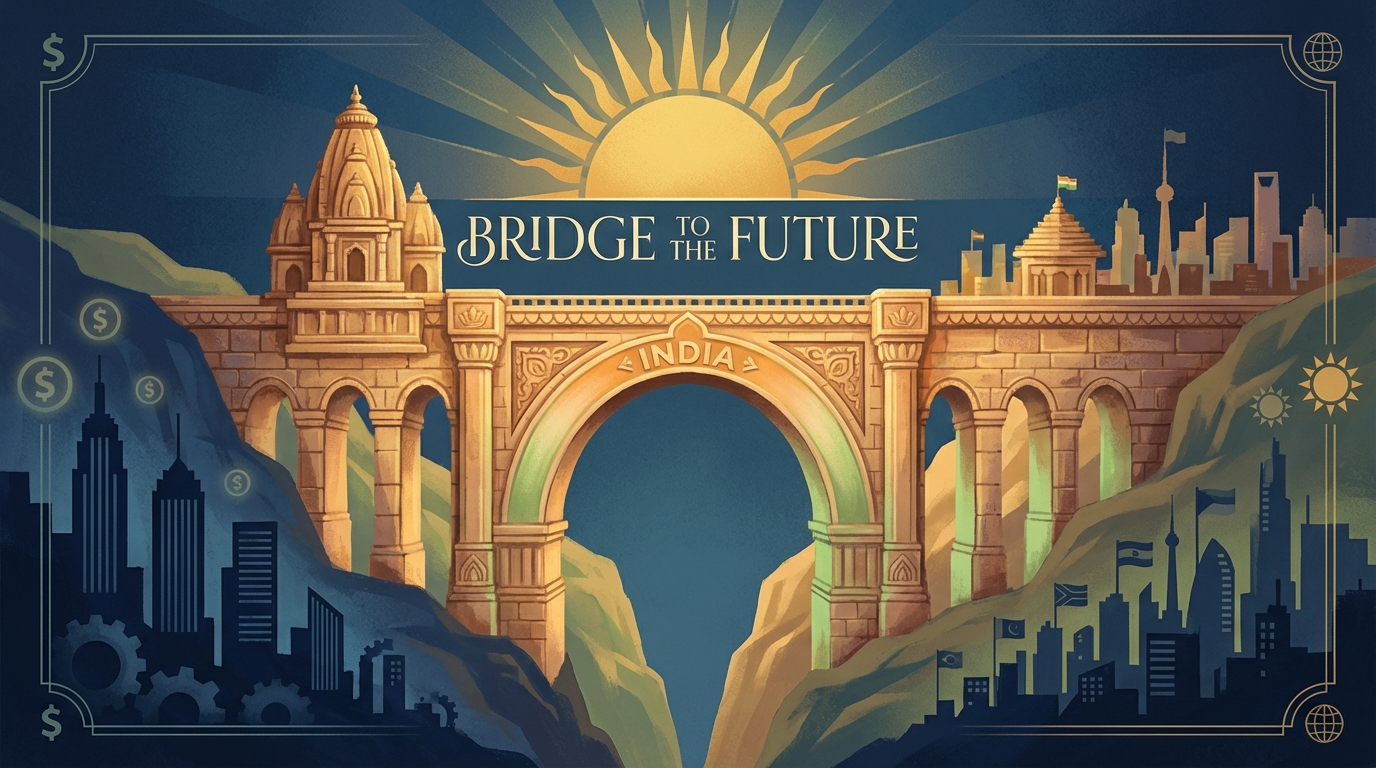
The Bridge Builder: Why India's BRICS Presidency Could Redefine the Bloc
As the West sees BRICS as a threat and the East sees it as salvation, India takes the chair with a radical idea: what if it could be neither—and both?
On January 1, 2026, India assumed the rotating chairmanship of BRICS, inheriting a bloc that has become one of the most watched—and most misunderstood—groupings in global politics.
To Washington, BRICS is a nascent anti-American alliance, a vehicle for Russia and China to challenge dollar hegemony and reshape the global order. To Moscow and Beijing, it represents the rise of the Rest, a counterweight to Western dominance that has defined international institutions since 1945. To the Global South, it offers hope—a seat at a table that isn't controlled by the G7.
India sees something different. And that difference might be exactly what BRICS needs.
The Problem with BRICS
Let's be honest: BRICS has an identity crisis.
The original grouping—Brazil, Russia, India, China, and South Africa—was coined by a Goldman Sachs economist in 2001 as an investment thesis, not a political alliance. These were fast-growing emerging markets with little in common beyond their growth rates. Two decades later, the bloc has expanded to eleven members (adding Saudi Arabia, Egypt, UAE, Ethiopia, Indonesia, and Iran) but still struggles to articulate what it actually stands for.
Is it an anti-Western bloc? Russia and China would like it to be. Is it a development forum? India and Brazil prefer that framing. Is it a currency union? Some members flirt with the idea; others run from it.
The expansion has only complicated matters. BRICS now includes Iran, which is under crippling Western sanctions and whose regime may not survive 2026, alongside Saudi Arabia and the UAE, which remain close American security partners. It includes Indonesia, a democracy that carefully balances between Washington and Beijing, and Ethiopia, which is emerging from civil war. The only thing these eleven nations clearly share is that they are not part of the G7.
This is not a coalition. It's a committee.
Enter India
Into this confusion steps India—and New Delhi brings something no other BRICS member can offer: credibility with both sides.
India is the only major BRICS economy that maintains robust strategic partnerships with both the West and the non-West simultaneously. It participates in the Quad with the United States, Japan, and Australia. It conducts joint military exercises with American forces. It is negotiating a landmark free trade agreement with the European Union. Its technology sector is deeply integrated with Silicon Valley.
At the same time, India has refused to condemn Russia's invasion of Ukraine, continues buying Russian oil at discounted rates, maintains a decades-old defense relationship with Moscow, and shares BRICS membership with China despite an unresolved border dispute.
This is not fence-sitting. It is strategic autonomy in action—and it positions India uniquely to bridge the bloc's internal contradictions.
The Modi Doctrine for BRICS
Prime Minister Narendra Modi has articulated a vision for India's BRICS presidency that deliberately sidesteps the controversies.
The theme—"Building Resilience and Innovation for Cooperation and Sustainability"—is built around four pillars: resilience, innovation, cooperation, and sustainability. Notice what's missing: currency. De-dollarization. Challenging Western hegemony. The confrontational rhetoric that has made BRICS a target of American ire is conspicuously absent.
Instead, India is pushing a development-first agenda centred on digital public infrastructure.
This is clever politics. India's success with digital systems—the Unified Payments Interface that processes billions of transactions, the Aadhaar identity system that covers 1.4 billion people, the CoWIN platform that managed the world's largest vaccination drive—gives it genuine expertise to share. Promoting "digital public goods" as a BRICS priority positions the bloc as a solutions provider rather than a grievance forum.
The agenda also emphasises climate-resilient infrastructure, renewable energy investment, and "just transition" strategies—issues where developing nations have legitimate concerns about Western-designed rules but where confrontation is unnecessary. India can champion the Global South's interests on climate finance without picking a fight with Washington.
The Currency Question
The elephant in the room—or rather, the dollar in the room—is de-dollarization.
President Trump has made his position clear. In late 2025, he threatened 100% tariffs on any BRICS nation that attempts to create a common currency or undermine the dollar's reserve status. "As a BRICS nation, they'll have a 100 percent tariff if they so much as even think about doing what they thought," he declared, in characteristically Trumpian syntax.
India's response has been a masterclass in diplomatic deflection.
Reserve Bank of India Governor Shaktikanta Das stated flatly: "De-dollarization is certainly not India's objective." External Affairs Minister S. Jaishankar echoed: "India has never been for de-dollarization. Right now there is no proposal to have a BRICS currency."
This is technically true. India has not endorsed a BRICS currency. But it's also somewhat disingenuous: 95% of India-Russia bilateral trade is already conducted in rupees and rubles, bypassing the dollar entirely. India has signed local currency trade agreements with multiple nations. The shift away from dollar dependence is happening—it's just happening quietly, bilaterally, and without the inflammatory rhetoric that invites American retaliation.
India's approach to BRICS currency discussions will likely follow the same pattern: support for local currency settlements as a practical matter, resistance to any formal "BRICS currency" that would provoke Trump, and careful framing of all initiatives as "trade facilitation" rather than "dollar alternatives."
This is the bridge-builder's art: achieving substance while avoiding symbolism.
Managing the Membership
India's other challenge is managing a bloc that now includes some genuinely difficult relationships.
China remains India's primary strategic competitor. The two nations fought a deadly border clash in 2020, and tensions along the Line of Actual Control remain high. Yet they must cooperate within BRICS, where China's economic weight gives it enormous influence.
Iran, a new BRICS member, is in the midst of an existential crisis. With protests spreading, the economy collapsing, and the regime in what its own foreign minister calls "survival mode," Tehran's participation in BRICS activities may be limited—or its government may not exist by the time the summit convenes.
Russia, under comprehensive Western sanctions and bogged down in Ukraine, views BRICS as a lifeline. Moscow will push for the bloc to take stronger anti-Western positions. India will need to resist without alienating a crucial energy supplier.
Saudi Arabia and the UAE, new members, bring financial muscle but also complicate the bloc's identity. Both remain American security partners. Their participation signals that BRICS is not an anti-Western alliance—but their priorities (energy markets, regional influence) don't always align with India's development agenda.
Herding these cats will require all of India's diplomatic skill.
What Success Looks Like
For India, a successful BRICS presidency would achieve several things.
First, it would consolidate the expanded membership. The bloc went from five to eleven members in 2024; making that expansion work—establishing procedures, building consensus, creating actual cooperation rather than just communiqués—is the immediate task.
Second, it would shift BRICS's image from "anti-Western bloc" to "development platform." If India can make digital infrastructure, climate finance, and institutional reform the headline issues, it changes the conversation about what BRICS represents.
Third, it would demonstrate that India can lead a major multilateral grouping without alienating Washington. The G20 presidency in 2023 was a success; replicating that with BRICS—a more politically charged forum—would cement India's reputation as a responsible rising power.
Fourth, it would create tangible deliverables. The BRICS New Development Bank could expand lending. The Contingent Reserve Arrangement could be strengthened. New initiatives on AI governance or digital trade could be launched. Summitry without substance is just tourism.
The Bridge India Is Building
The deeper significance of India's BRICS presidency lies in what it represents for the emerging global order.
The post-World War II system was built by the West, for the West. The institutions that govern trade, finance, and security—the UN Security Council, the IMF, the World Bank, the WTO—reflect a power distribution that no longer exists. The Global South wants reform. The West is reluctant to cede control.
BRICS, at its best, could be a vehicle for that reform—not by tearing down existing institutions but by demonstrating that alternatives are possible, that developing nations can cooperate effectively, that the "Rest" can lead.
India is uniquely positioned to make that case. It is large enough to matter, democratic enough to be credible, and connected enough to both sides to serve as translator.
The bridge India is building isn't between East and West—that framing is too simple. It's between the world that was and the world that's coming. Between institutions designed for 1945 and realities of 2026. Between the Global South's aspirations and the West's anxieties.
It's a bridge that someone needs to build. And right now, India is the only one with blueprints.
Ramachandran Rajeev Kumar is the Founder and Editor-in-Chief of BarathVector.