By Ramachandran Rajeev Kumar — 2026-05-01
The Fourth S-400 Unit Lands. Strategic Autonomy Is No Longer a Slogan.
Three US administrations tried to talk Delhi out of the deal. Three failed.
In October 2018, India signed a contract with Russia worth roughly five billion dollars for five regiments of the S-400 Triumf air defence system. The deal was controversial then. It was supposed to be unsustainable.
It was not.
The fourth of those five squadrons is scheduled to arrive in India this month. By the time the fifth lands, the system will form the most advanced layered air defence network in the Indo-Pacific outside of China and Russia themselves. And it will have been delivered through three US administrations — Trump's first, Biden's, Trump's second — each of which made some version of the same threat.
None of those threats was carried out. That is the story.
What the S-400 actually does
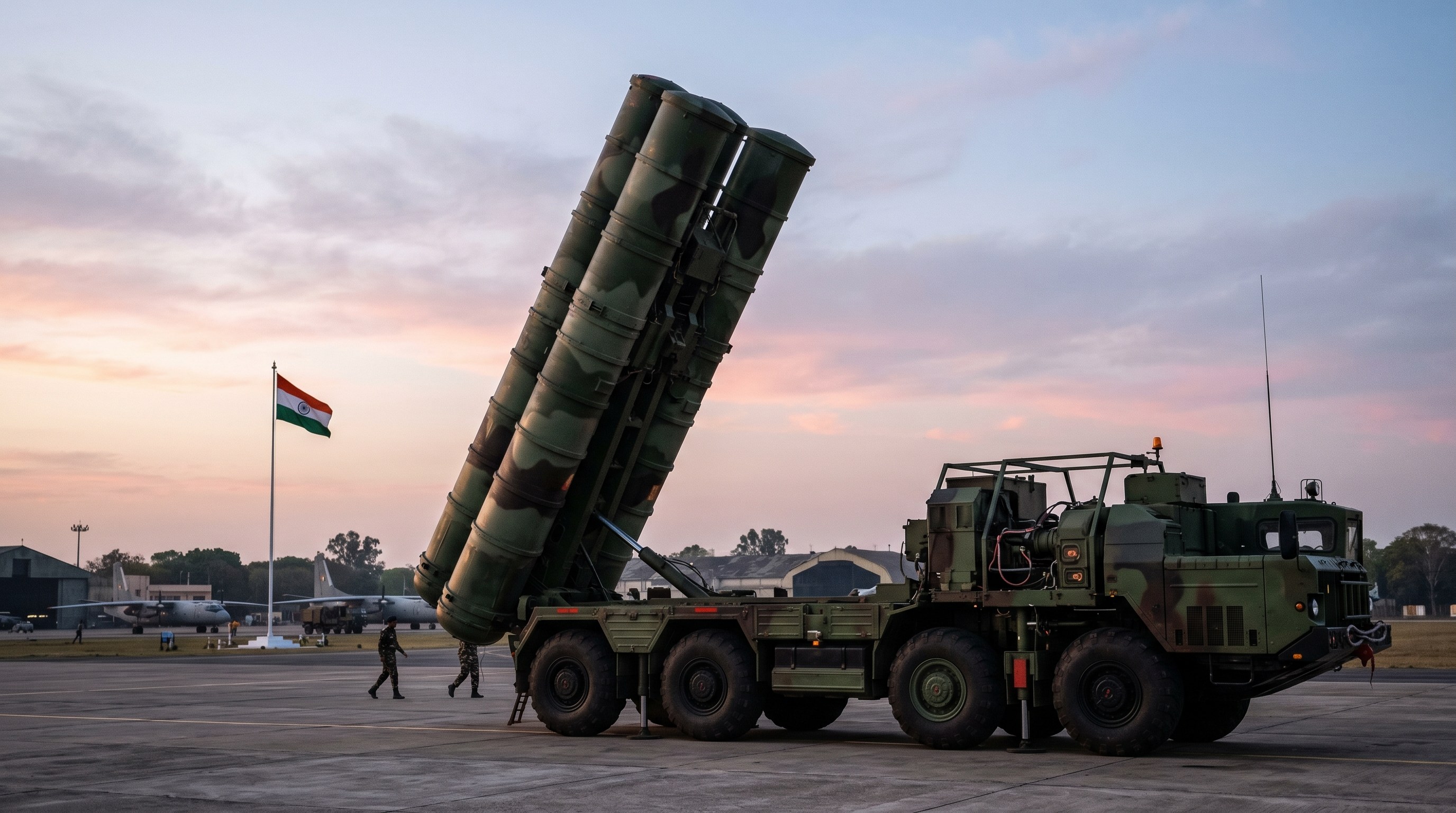
The S-400 is a long-range, integrated air defence system designed to engage aircraft, cruise missiles, and ballistic missiles at ranges up to four hundred kilometres and altitudes up to thirty kilometres. Each squadron consists of multiple launcher trucks, a phased-array engagement radar, an early-warning radar, and a command-and-control vehicle.
In Indian service, the squadrons have been positioned to cover the most operationally sensitive corners of the country: the northern sector facing Pakistan, the eastern sector facing China, and a strategic reserve. The fourth squadron, according to officials familiar with the deployment plan, is expected to anchor coverage along the central sector.
What this gives India is not just better air defence. It is a domestically deniable form of escalation control. A country that can shoot down hostile aircraft at four hundred kilometres has more options than a country that has to scramble fighters.
The CAATSA shadow
The Countering America's Adversaries Through Sanctions Act, passed by the US Congress in 2017, was designed to penalise countries that bought significant defence equipment from Russia. India was the headline test case. Senior US officials, on the record and off, said for years that India would face sanctions if the S-400 deal proceeded.
It proceeded. India took delivery of the first squadron in late 2021, the second in 2022, the third in 2023. No sanctions were imposed. No waiver was formally granted. Washington simply found ways to look elsewhere.
Why? Because the alternative — a sanctions package against the world's largest democracy at the moment when the United States needed a counterweight to China — was strategically inconceivable. Delhi understood this earlier than Washington did.
The S-400 deal is, in this sense, a teaching example. It demonstrated that the costs the United States threatens to impose on India are negotiable, conditional, and ultimately bounded by Washington's own strategic anxieties. That recognition has shaped every Indian negotiating position since.
The Trump tariff parallel
The same dynamic is playing out now in the trade lane. The Trump administration came in promising punishing tariffs on India, threatened five-hundred-percent secondary tariffs on countries buying Russian oil, and made a public spectacle of pressuring Delhi to cut purchases from Moscow.
What did India do? Negotiated. Quietly. Patiently. And in February 2026 landed a trade framework that capped India's tariff exposure at eighteen percent — better than Pakistan's nineteen, Vietnam's and Bangladesh's twenty. The deal was not perfect. Indian agriculture took the hardest blow. But the baseline arithmetic confirmed what the S-400 already showed: when India holds its line, Washington bends more often than it breaks.
The S-400 is the template. The trade deal is the instance.
What strategic autonomy actually means
Strategic autonomy is one of those phrases that gets repeated until it loses meaning. So here is what it operationally means in 2026:
- Buy weapons from whoever sells them best, even when that complicates your relationship with your largest trading partner
- Source energy from whoever sells it cheapest, even when that complicates your relationship with your largest security partner
- Negotiate with everyone, sign nothing exclusive, and never let any single country believe it has a veto over your foreign policy
- Take the diplomatic friction as a feature, not a bug — friction is the price of independence
The S-400 deal is what that doctrine looks like when you cash the cheque.
The fifth and final unit
The fifth and final S-400 squadron is expected to arrive in India in late 2026 or early 2027, according to defence officials. When it does, the system will be fully operational across all three priority sectors. India will have the deepest integrated air defence network of any non-nuclear-armed treaty ally outside the Russian and Chinese spheres.
That is the headline outcome.
The deeper outcome is harder to capture in a single sentence, but it sounds something like this: the country that signed the deal in 2018 was a country that had to justify its choices to Washington. The country that takes delivery in 2026 does not.
That is the change. Everything else is paperwork.
BarathVector covers India's defence and strategic posture across all theatres. Subscribe for the weekly briefing.