By Ramachandran Rajeev Kumar — 2026-01-11
This article follows up on our recent coverage of EU-India relations.
For nearly three years, India has endured a steady stream of European finger-wagging over its ties with Russia. From Brussels to Berlin, the message has been consistent: India must choose sides. India must condemn Moscow. India must stop buying Russian oil. India must align with the "rules-based international order."
Indian diplomats have smiled politely, made vague noises about dialogue and peace, and continued doing exactly what India's national interests require. This has frustrated European capitals to no end.
But in January 2026, something remarkable has happened. The very same European leaders who demanded India stand up to Russia have demonstrated that they cannot stand up to Donald Trump. And in doing so, they have forfeited whatever moral authority they once claimed.
The Greenland Farce
When Donald Trump returned to the White House, he wasted no time reviving his obsession with acquiring Greenland. But this time, he didn't merely float the idea over dinner. He refused to rule out military action. He suggested that Denmark - a NATO ally - might face economic coercion if it didn't cooperate.
The response from Europe? Muted concern. Diplomatic language. A few expressions of "confidence" that Trump was surely joking.
Denmark's Prime Minister Mette Frederiksen found herself pleading for European solidarity while EU leaders carefully avoided anything that might upset Washington. The European Commission issued statements that read like they were drafted by lawyers more concerned with not giving offense than defending sovereignty.
Compare this to the thundering denunciations Europe issued when Russia violated Ukrainian sovereignty. The sanctions packages. The weapons deliveries. The moral clarity about "never again" and the inviolability of borders.
Apparently, borders are sacred - unless an American president wants to redraw them.
The Venezuela Silence
If Greenland exposed European weakness on territorial sovereignty, Venezuela has exposed something worse: the utter collapse of European foreign policy independence.
Trump has made aggressive noises about Venezuela that would have triggered international outrage if any other leader had uttered them. He has threatened action to secure American interests in the region with the casual confidence of someone who knows no one will stop him.
And Europe? The continent that lectures the Global South about respecting international law and multilateral institutions has said almost nothing. France, which still maintains territorial possessions across the globe, has been silent. Germany, which never misses an opportunity to invoke "the lessons of history," has found no lessons applicable here.
The message could not be clearer: European principles apply to others, not to Washington.
The Hypocrisy Laid Bare
Let us be precise about what Europe demanded of India regarding Russia:
- That India condemn Russia's actions in Ukraine
- That India stop purchasing Russian oil at discounted prices
- That India distance itself from a decades-old strategic partnership
- That India accept higher energy costs to demonstrate solidarity with European values
- That India, in essence, sacrifice its national interests on the altar of Western unity
India refused. Indian diplomats made clear that India's foreign policy would be determined in New Delhi, not in Brussels. External Affairs Minister S. Jaishankar became an international figure precisely because he articulated what many in the Global South felt but dared not say: the West's rules-based order often looks like rules for thee but not for me.
At the time, European commentators dismissed this as cynical whataboutism. India was trying to deflect, they said. India was making false equivalences.
Well, here we are. Trump is openly discussing acquiring the territory of a European NATO ally, and threatening sovereign nations in Latin America. And Europe's response has been to look at its shoes and mumble about the importance of transatlantic dialogue.
Who is making false equivalences now?
Strategic Autonomy: India Understood, Europe Didn't
The irony is that Europe spent years talking about "strategic autonomy" - the idea that the EU should develop independent capabilities and not be entirely dependent on American security guarantees. Endless papers were written. Conferences were held. The phrase appeared in every major EU document.
India, meanwhile, simply practiced strategic autonomy without announcing it. India maintained ties with Russia because Russia provides weapons systems, energy security, and a diplomatic counterweight to China. India deepened ties with the United States because America offers technology, investment, and partnership on shared concerns about Beijing. India courted Europe because European markets and technology serve Indian development.
This is not hypocrisy. This is rational statecraft. Every major power in history has cultivated multiple relationships to avoid dependence on any single partner.
But when Trump demands that Europe choose between his agenda and its own principles, strategic autonomy suddenly evaporates. Europe's political leadership has demonstrated that when Washington raises its voice, Brussels folds.
What India Sees
From New Delhi, the lesson is unmistakable.
Europe cannot protect its own member from American territorial ambitions. Europe cannot articulate a coherent response to American threats against sovereign nations. Europe cannot practice the independence it preaches.
Why, then, should India take seriously European demands that India sacrifice its relationship with Russia? If Europe cannot say no to Trump on matters directly affecting European security, what credibility does Europe have to tell India how to manage its neighborhood?
The honest answer is: none.
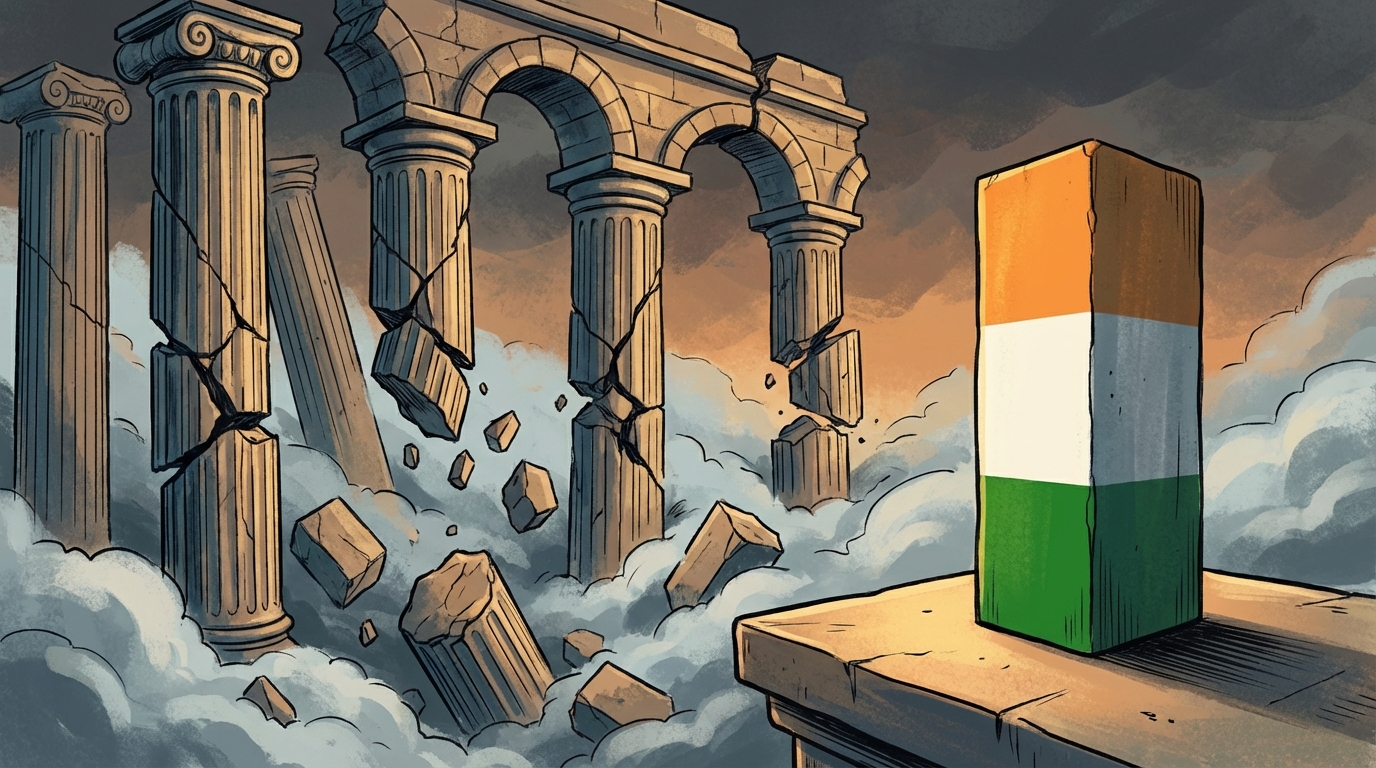
The Crumbling Architecture
India has been saying this for decades: the post-1945 international order is fragile, Western-centric, and increasingly unfit for purpose. For years, this was dismissed as the grievance politics of a rising power that wanted a bigger seat at the table.
It turns out India was simply describing reality.
Consider what January 2026 has revealed. The United Nations Security Council - the supposed guardian of international peace - is paralyzed not just by Russia-West rivalry, but by the fact that the world's most powerful democracy is now led by a president who openly mocks multilateralism. NATO, the most successful military alliance in history, cannot formulate a coherent response when its leading member threatens a fellow ally's territory.
The "rules-based international order" that Europe invokes so frequently? It was always a system where the rules were written by the powerful and applied to the weak. India pointed this out during the Iraq War, when Western nations invaded a sovereign country without UN authorization and faced no consequences. India pointed this out when Libya was destabilized in the name of humanitarian intervention. India has pointed this out every time the Security Council's permanent membership - frozen in the geopolitics of 1945 - blocked meaningful reform.
Now the contradictions are impossible to ignore. The system's biggest beneficiary is pulling it apart from within. And Europe, which styled itself as the guardian of multilateralism, can only watch.
India's push for a multipolar world, for reformed international institutions, for an order where Asian and African voices carry equal weight - this was never anti-Western resentment. It was clear-eyed analysis. The old order was built on American hegemony and European soft power. When American hegemony turns erratic and European soft power proves toothless, what remains?
The answer is exactly what India has been building: strategic relationships with multiple powers, economic resilience, military self-sufficiency, and the diplomatic flexibility to navigate a world where no one sets the rules.
The New Reality
None of this means India should turn its back on Europe. As we noted in our recent analysis, the EU remains a valuable partner for trade, technology, and diversification away from both American and Chinese dependence.
But the days when European capitals could lecture India about moral clarity in foreign policy are over. Europe has demonstrated that its principles bend when American pressure is applied. India need not apologize for having known this all along.
When von der Leyen and Costa take their seats at Republic Day in two weeks, they will be greeted warmly. India values the partnership. But the relationship has shifted.
India no longer looks at Europe as a mentor in international affairs. India looks at Europe as a partner that needs India as much as India needs Europe - perhaps more. The hectoring from 2022 and 2023 now looks not like principled leadership, but like the last gasp of a continent that still imagined it set the rules.
Trump has ended that illusion. And in a strange way, India should thank him for the clarity.
Strategic autonomy isn't what you talk about at conferences. It's what you do when powerful friends make uncomfortable demands. India does it. Europe, it turns out, does not.