By Ramachandran Rajeev Kumar — 2026-02-11
Beyond the Bandh: Why Indian Farmers Have More to Gain Than Fear
By Ramachandran Rajeev Kumar
This article builds on our earlier analysis of the India-US trade framework.
The calls for Bharat Bandh on February 12 over the India-US trade deal's agricultural provisions reveal something uncomfortable -- not about the deal, but about how easily complexity can be weaponised into panic.
Read the fine print. The India-US interim trade framework opens limited agricultural categories to competitive tariff rates. Soybean imports at reduced duties, Distiller's Dried Grains with Solubles (DDGS) at 1%, and selected dairy categories under negotiated quotas. The opposition has translated this into the claim that American farmers will destroy Indian agriculture.
That claim does not survive contact with data.
The Markets India Already Has
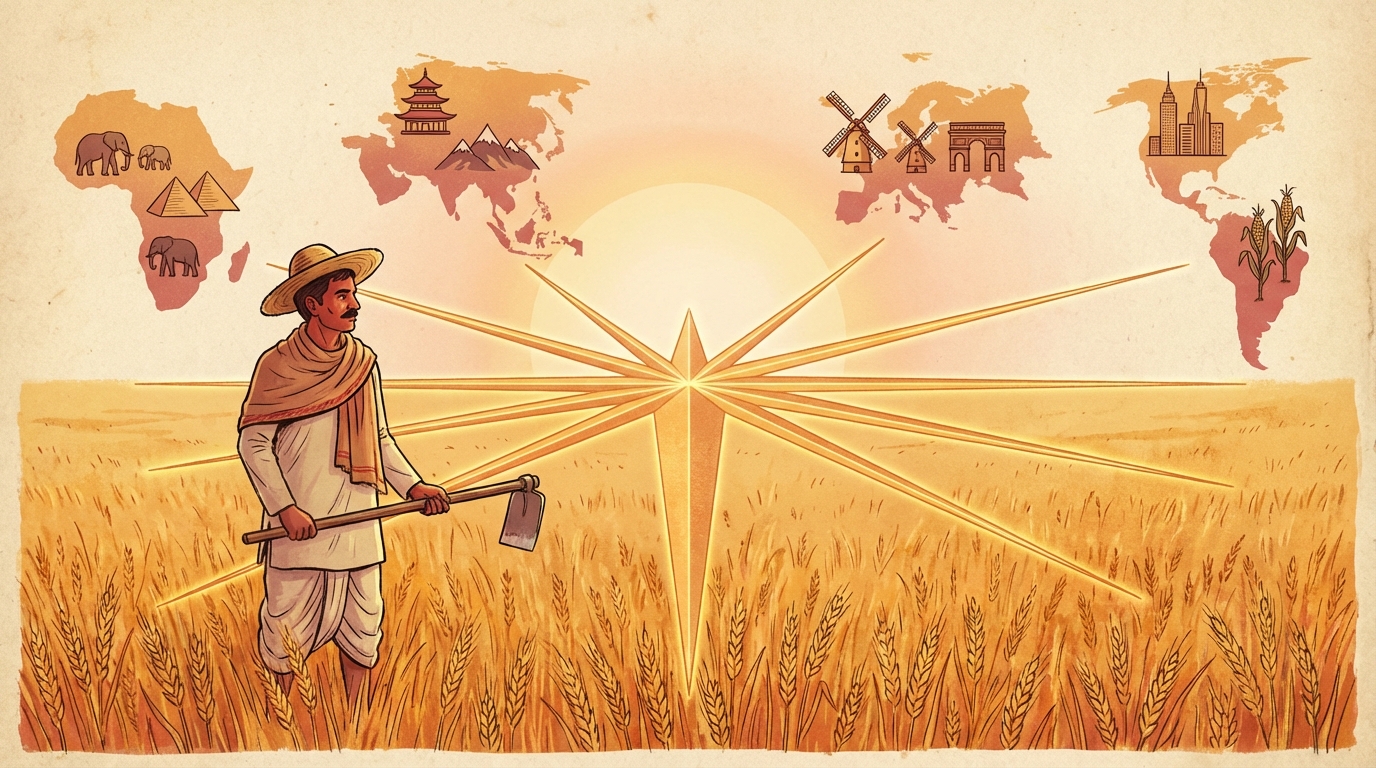
India has signed or operationalised Free Trade Agreements with ASEAN, Japan, South Korea, Australia, the UAE, and most recently the European Free Trade Association. Each of these opens markets for Indian agricultural products -- spices, basmati rice, organic produce, processed foods, marine products -- that Indian farmers could not access a decade ago.
India's reach into Africa and Southeast Asia is expanding simultaneously. India-Africa agricultural trade exceeded $15 billion in 2025, covering pulses, rice, spices, and processed foods. The India-Mauritius CECPA, the India-UAE CEPA, and the emerging India-UK FTA all carry agricultural chapters that widen market access.
The result is visible in the numbers. India's agricultural exports crossed $53 billion in 2025-26, up from $41 billion two years prior. Basmati rice alone accounts for over $5.2 billion. Spice exports exceed $4 billion. Marine products contribute $8.1 billion. These are Indian farmers selling to the world -- not despite trade deals, but because of them.
The US market, specifically, absorbs $4.2 billion in Indian agricultural products at zero or minimal tariff. Mangoes, shrimp, organic cereals, specialty rice, ground spices -- these flow freely westward. The trade surplus in agricultural goods with the US is India's, not America's.
It is not as if US imports in select areas such as soybean are going to displace Indian farmers who now have a more expanded market than ever before in India's history.
The Soybean Question
The legitimate concern -- and there is one -- centres on soybean. India produces roughly 12 million tonnes annually, primarily in Madhya Pradesh, Maharashtra, and Rajasthan. US soybean, priced competitively due to scale farming and government subsidies, could undercut domestic producers if imported without safeguards.
But the deal includes volume caps. And India's soybean goes primarily into animal feed and edible oil production, where the real competition is not American soybean but Indonesian palm oil, which already dominates India's edible oil import basket at over $10 billion annually.
The soybean panic is real in sentiment but manageable in arithmetic. A well-designed import mechanism can convert it from a threat into a supplement.
The JV Solution: A Policy Proposal
What India needs is not a bandh but a structure.
Agricultural imports under the trade deal should flow through a tripartite Joint Venture: government agencies providing regulatory oversight, nationalised banks providing trade finance and price stabilisation, and farmer cooperatives providing last-mile distribution and market intelligence.
This accomplishes three things. First, it prevents middlemen from cornering cheap imports and reselling at domestic prices -- the classic arbitrage that enriches traders and impoverishes growers. Second, it gives farmer cooperatives direct access to imported inputs -- soybean meal for feed, DDGS for livestock -- at below-market rates. Third, it creates a price buffer that protects domestic production while allowing imports to supplement, not replace, Indian output.
The model exists. India's dairy cooperatives, led by Amul, manage precisely this kind of market intervention for decades with remarkable success. Extend the architecture to grain and oilseed imports and you have a system that converts trade exposure into rural advantage.
The Re-Export Opportunity
What the bandh advocates entirely miss is the value-addition chain. India imports crude commodities, processes them, and re-exports finished products at multiples of the input cost. This is already the pattern with gold (imported crude, exported jewellery), petroleum (imported crude, exported refined products), and cotton (imported fibre, exported garments).
Agricultural imports from the US can follow the same trajectory. Import soybean, extract oil and meal, export processed products to Africa and Southeast Asia where India already has trade agreements. Import DDGS, feed livestock, export dairy and meat products to the Middle East and ASEAN.
There is huge opportunity for re-export to third countries -- but only if the import mechanism is designed to facilitate value-addition rather than simple arbitrage.
The Opposition's Responsibility
India's opposition has every right -- indeed, an obligation -- to scrutinise trade agreements. But scrutiny is not the same as sabotage. Calling a Bharat Bandh over provisions that protect rice, wheat, dairy, and sugar while opening limited categories under volume caps is not responsible opposition. It is performative outrage designed for electoral consumption.
The constructive path is clear: examine the deal provision by provision, identify genuine vulnerabilities (soybean pricing, dairy quotas), propose structural safeguards (the JV mechanism, volume-based trigger tariffs, cooperative distribution channels), and negotiate improvements within the framework.
Derailing long-term benefits for short-term political optics is not statesmanship. It is irresponsibility dressed as concern for farmers.
The Century Ahead
India and the United States are not negotiating a trade deal in isolation. They are constructing the economic architecture for a century of partnership that is pivotal for global stability -- and for both nations.
The US needs India as a manufacturing alternative to China, as a democratic ally in the Indo-Pacific, and as a market for its agricultural surplus. India needs US technology, defence partnerships, energy cooperation, and market access for its goods and services. Neither gets what it wants by retreating into protectionism.
A bandh closes shops. It does not open markets. India's farmers deserve better than performative outrage -- they deserve structural protections, institutional mechanisms, and expanded access to the global markets their produce has proven it can compete in.
The deal is better than the panic suggests. The question is whether India's political class has the maturity to read the fine print rather than burn the document.
This article builds on our earlier analysis of the India-US trade framework.