By Ramachandran Rajeev Kumar — 2026-01-02
Zohran Mamdani and the Burden of Firsts: When Failure Isn't Just Yours
The cruel irony of identity politics in America
At midnight on New Year's Day 2026, in the elegant gloom of an abandoned subway station, Zohran Kwame Mamdani placed his hand on a Quran borrowed from the Schomburg Center for Research in Black Culture and became the 112th Mayor of New York City.
He is the first Muslim to hold the office. The first born on the African continent. The youngest since 1892. The first Democratic Socialist. The son of a Ugandan-Indian academic and an Academy Award-nominated Indian filmmaker.
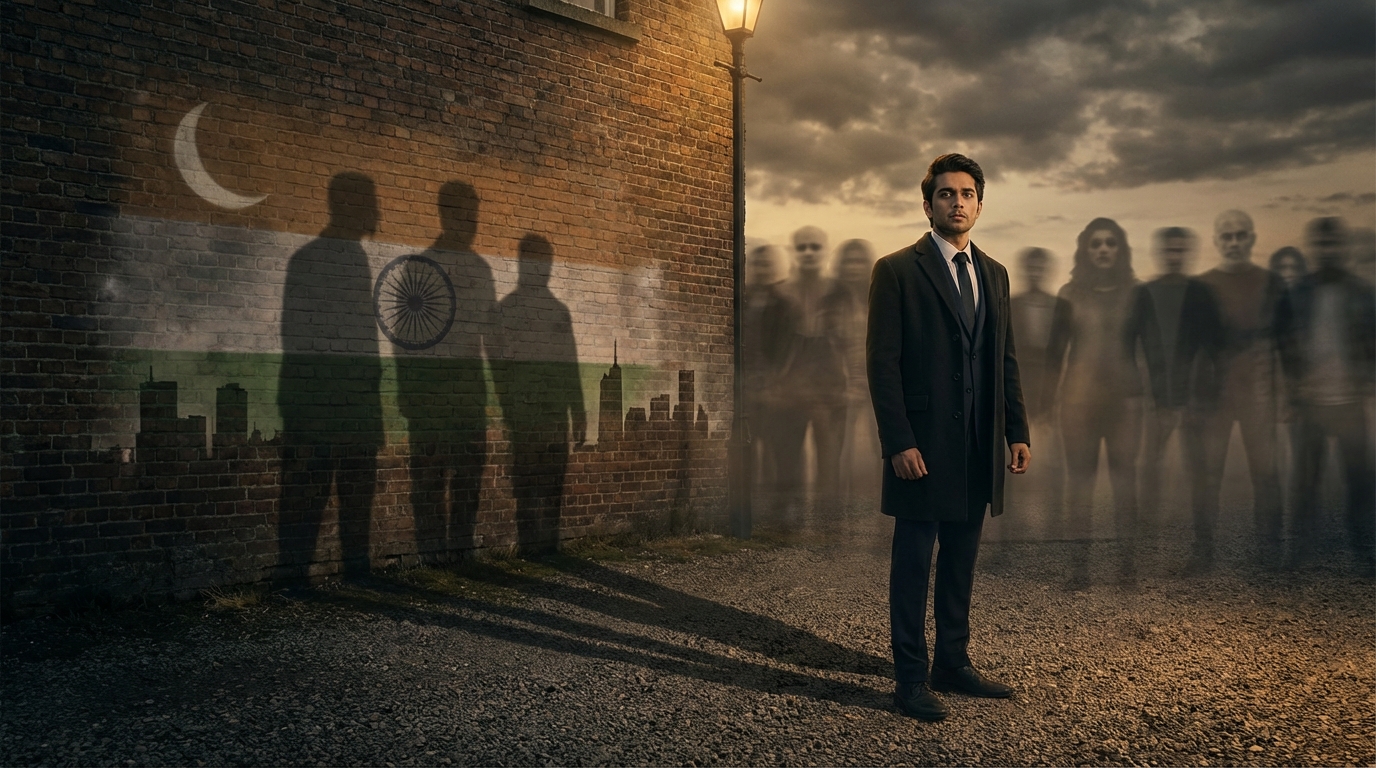
And whether he succeeds or fails, he will not be judged alone.
This is the burden of firsts - the invisible weight that every minority pioneer carries into positions of power. Their triumphs are personal achievements; their failures become indictments of entire communities.
Here is the cruel irony: Zohran Mamdani will be judged as a representative of India despite having no meaningful connection to the country, despite his politics being thoroughly American left-wing, and despite his open hostility toward India's democratically elected government.
The Man Behind the Symbols
To understand the politics at play, one must first understand the man.
Zohran Kwame Mamdani was born in Kampala, Uganda, in 1991. His father, Mahmood Mamdani, is one of Africa's most respected scholars - a third-generation East African of Gujarati Muslim descent who survived Idi Amin's 1972 expulsion of Asians from Uganda. His mother is Mira Nair, the filmmaker behind Salaam Bombay! and Monsoon Wedding.
The family moved to Cape Town when Zohran was five, where his father chaired African Studies at the university. Those years in post-apartheid South Africa shaped his politics profoundly. "It taught me what inequality looks like up close," he has said, "and that justice has to be more than an idea; it has to be material."
By nine, he was in New York, growing up near Columbia University in Morningside Heights. He attended the Bronx High School of Science, co-founded its cricket team, went to Bowdoin College in Maine, and emerged as a housing counselor helping immigrant families facing foreclosure in Queens.
He also had a hip-hop career. Stage name: Mr. Cardamom. Self-described as a "C-list rapper." Songs included an ode to chapati and a tribute to his grandmother featuring Madhur Jaffrey.
In 2020, he challenged a five-term Democratic incumbent and won a seat in the New York State Assembly. In 2021, he joined a 15-day hunger strike with taxi drivers crushed by the medallion debt crisis.
This is not a man who fits neatly into boxes. He is Ugandan by birth, South African by formative experience, American by citizenship, Muslim by faith, and Indian only by distant ancestry and parentage.
Yet in the algebra of identity politics, he will be reduced to two variables: Muslim and Indian-origin.
The India Problem
Let us be clear about something: Zohran Mamdani is not India's representative in America. He is not a friend of India. He is not someone Indians should celebrate.
Mamdani has called Prime Minister Narendra Modi a "war criminal" - a characterization that is not only factually wrong but deeply offensive to the hundreds of millions of Indians who have repeatedly elected Modi in free and fair elections. He has aligned himself with the far-left American position on Kashmir. He has shown no interest in India beyond using his ancestry as a political prop when convenient.
His politics are the politics of the American Democratic Socialists of America - a movement that has consistently taken positions hostile to India, supportive of Pakistan's narrative on Kashmir, and critical of India's democratic choices. This is not a man who represents Indian values, Indian interests, or the Indian diaspora's aspirations.
Indian right-wing media has labeled Mamdani "anti-India," and for once, they are not exaggerating. Some have called him a "jihadi mayor" - hyperbolic, perhaps, but the underlying concern is legitimate. This is a politician whose worldview places him closer to India's critics than to India itself.
The Burden He Didn't Earn
And yet - and here is the cruelty of identity politics - should Mamdani fail as mayor, the blame will fall on communities that want nothing to do with him.
Every American, save the indigenous peoples, descends from somewhere else. The Kennedys were Irish. The Bushes were English. Trump's grandfather was German. Obama's father was Kenyan.
This is unremarkable. Immigration is America's founding story.
But not all origins are treated equally. In the America of 2026 - where the word "socialist" still carries Cold War freight, where Muslim candidates face questions about dual loyalty - two markers on Zohran Mamdani stand out.
He is Muslim.
He is of Indian origin.
The first places him at the center of a civilizational fault line that has defined American foreign policy for a quarter century. The second links him, however unfairly, to a rising power whose relationship with America is complicated by trade wars, visa battles, and geopolitical competition.
If Mamdani delivers on his promises - if buses run free, rents stabilize, and New York becomes more affordable - he will be celebrated as a visionary mayor. His religion and ethnicity will be footnotes.
But if he fails - if the city's finances deteriorate, if crime rises, if his socialist agenda collapses under the weight of fiscal reality - the narrative will shift.
"The Muslim mayor couldn't govern."
"This is what happens when you elect a socialist."
"India sends its radicals to America."
The Injustice to India
This last critique is the most galling - because Mamdani has done nothing to earn India's association, and everything to reject it.
He grew up in Uganda and South Africa. He has spent his political career focused on New York housing policy and taxi drivers' rights. His signature issue is bus fares, not bilateral relations. He has never lived in India. He has never worked for India's interests. He has, in fact, actively worked against them by slandering India's elected leadership.
Yet should he fail, the naysayers will not distinguish between a Ugandan-American politician with left-wing American politics and the 1.4 billion people who happen to share fragments of his ancestry. His failure will become India's failure in the American imagination - proof, to those looking for proof, that the diaspora cannot be trusted with power.
This is the burden that Mamdani has placed on Indians - not by his success, but by his mere existence in the American political imagination. He claims the heritage when it suits him, rejects the politics when it doesn't, and leaves ordinary Indians to deal with the consequences.
The Muslim Dimension
The religious dimension is even more complex.
Mamdani is unapologetically Muslim. He took his oath on a Quran. He has refused to distance himself from pro-Palestinian advocacy even when it cost him politically. He won despite - or perhaps because of - his willingness to challenge the bipartisan consensus on Israel.
In a nation where Muslim candidates still face questions about dual loyalty, where mosque construction projects are protested, where "sharia law" is invoked as a boogeyman, his election was genuinely historic.
But history cuts both ways.
If Mamdani governs well, the needle moves slightly toward normalization. Muslims can be mayors. Muslims can be trusted with power.
If Mamdani governs poorly, the needle swings back - and perhaps further back than before, because the stakes were so high, the symbolism so prominent.
This burden, at least, Mamdani has chosen to carry. He has embraced his Muslim identity. He has made it central to his politics. The consequences, good or bad, are ones he has accepted.
The same cannot be said for his Indian burden - which he carries despite rejecting what India stands for today.
The Arithmetic of Identity Politics
The fundamental unfairness is this: Mamdani's white predecessors were judged as individuals.
When Bill de Blasio's progressive agenda stalled, no one blamed Italians. When Rudy Giuliani's reputation collapsed, no one questioned whether German-Americans could be trusted. When Eric Adams faced federal bribery charges, no one suggested that Black Americans were inherently corrupt.
But minorities do not have this luxury. They are always representatives, whether they choose to be or not. Their actions reflect on communities. Their failures validate stereotypes.
Mamdani knows this. In his victory speech, he quoted Jawaharlal Nehru - a choice that Indian media noted as "unmistakably Indian," even as Indian conservatives denounced him as anti-national. He cannot win on this front. Claim Indian heritage, and he is accused of inconsistency given his attacks on India's government. Reject it, and he is accused of self-hatred.
He is stuck in the amber of other people's expectations - including expectations he has done nothing to deserve.
What This Means for India
Indians watching from afar should understand several things clearly:
First, Mamdani is not our man. His success is not India's success. His vision of the world - DSA socialism, anti-Modi rhetoric, alignment with India's critics - is not India's vision. We should not celebrate him simply because his mother was born in Bhubaneswar and his grandmother cooked Indian food.
Second, his failure would nonetheless be weaponized against us. This is unfair, but fairness has never governed identity politics. Indians in America will face questions if Mamdani stumbles - questions about loyalty, about competence, about whether "those people" can be trusted. This is the tax that diaspora communities pay for pioneers they never chose.
Third, the solution is not to embrace Mamdani but to produce better alternatives. Indian-Americans who share Indian values, who respect India's democratic choices, who understand that criticizing an elected prime minister as a "war criminal" crosses a line - these are the representatives India needs in American public life. Not a man who happens to have an Indian surname while championing politics antithetical to Indian interests.
The Verdict
Zohran Mamdani is 34 years old. He once rapped under the name Mr. Cardamom. He starved himself for two weeks to help taxi drivers. He chose an abandoned subway station for his inauguration because he believes in public transit.
He is not a representative of India. He has made that clear through his words and his politics.
But in America's identity calculus, he will be counted as one nonetheless. His successes will be his own. His failures will be distributed across communities that never voted for him, never endorsed his worldview, and in India's case, have every reason to view his politics with suspicion.
This is the cruel arithmetic of representation in 2026. Mamdani carries burdens he didn't ask for - and has placed burdens on others who didn't ask to carry them either.
Whether he succeeds or fails, Indians should watch with clear eyes. He is not ours. But we may pay for him anyway.
The author is Founder & Editor-in-Chief of BarathVector.