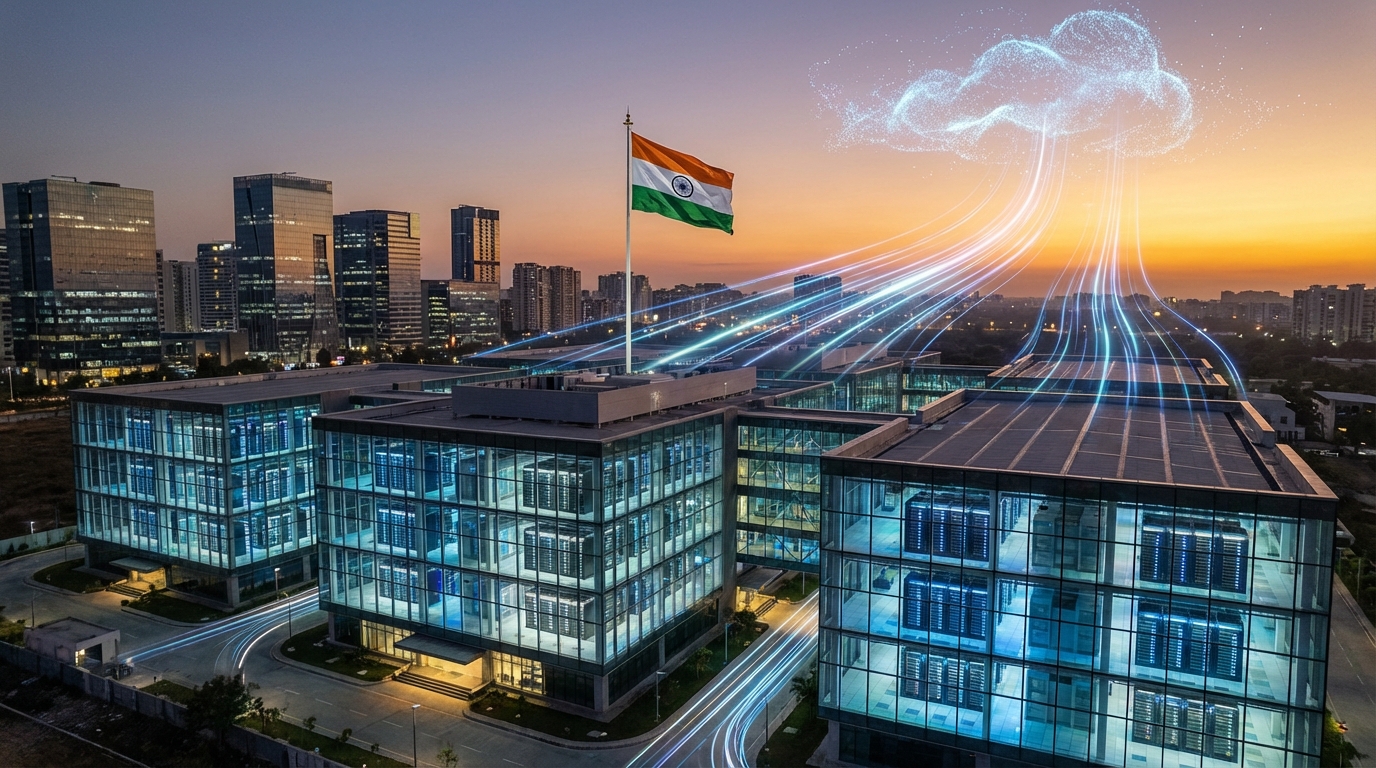
By Ramachandran Rajeev Kumar — 2026-02-06
The Boldest Fiscal Bet in Indian Technology History
On February 1, 2026, Finance Minister Nirmala Sitharaman did something that no Indian finance minister has done before. She offered foreign technology companies a tax rate of zero on cloud services revenues generated from Indian data centres and sold to global customers. Not for five years. Not for ten. For twenty-one years, through March 2047, the centenary of Indian independence.
The announcement landed with the subtlety of a sledgehammer in a room full of hyperscaler executives. Within the first four months preceding this budget, AWS, Microsoft Azure, and Google Cloud had already collectively pledged more than sixty-seven billion dollars toward Indian data centre projects. Google's partnership with AdaniConneX alone involves fifteen billion dollars for an AI hub in southern India. In under twenty-four hours last December, Microsoft and Amazon pledged over fifty billion dollars toward India's cloud and AI infrastructure.
The zero-tax policy did not create this momentum. It removed the last remaining friction.
What the Policy Actually Says
The mechanics are straightforward but strategically elegant.
Any notified foreign cloud company that operates from Indian data centres and sells services to global customers outside India will pay zero income tax on those revenues from April 2026 through March 2047. The exemption applies specifically to data centre services linked to India, meaning the compute must physically happen on Indian soil.
Three critical conditions keep the structure disciplined. First, sales to Indian domestic customers must be routed through a locally incorporated reseller and taxed under Indian law. The government is not giving away the domestic market. Second, where the Indian data centre is a related entity of the foreign cloud company, a safe harbour margin of fifteen percent applies, eliminating transfer pricing disputes before they begin. Third, the exemption is from income tax only. Property taxes, electricity duties, and local levies still apply.
This is not a blanket subsidy. It is a precisely engineered incentive that says: bring your global AI workloads to Indian soil, and we will not tax the global revenue those workloads generate.
Why This Changes the Calculation
The arithmetic that keeps hyperscaler CFOs awake at night is permanent establishment risk. When a company like Microsoft processes global Azure workloads through servers physically located in India, traditional tax law could argue that Microsoft has created a taxable presence in India, exposing the company's global cloud revenues to Indian taxation.
This single risk has historically driven cloud providers to route workloads through Singapore, Ireland, or the Middle East. India generates twenty percent of the world's data but stores ninety-five percent of it abroad. The zero-tax policy eliminates this risk entirely. For twenty-one years, a foreign cloud company's global income will not be taxed in India merely because it uses Indian data infrastructure.
Electronics and IT Minister Ashwini Vaishnaw has projected that this policy could attract investments worth two hundred billion dollars. That number sounds ambitious until you examine what has already been committed without the tax certainty.
The Infrastructure Reality Check
India's data centre power capacity reached 1.5 gigawatts by end of 2025, concentrated across seven cities. It is projected to exceed 1.7 gigawatts by end of 2026 and could expand more than fivefold to surpass 8 gigawatts by 2030. Maharashtra and Tamil Nadu have emerged as leading hubs.
But hardware infrastructure is only half the equation. The policy's real ambition is not to build server farms. It is to build an AI workforce.
Every hyperscale data centre that opens in India requires thousands of engineers for construction, operations, maintenance, and optimization. Every cloud workload that migrates to Indian soil needs local teams for monitoring, security, and compliance. Every AI model that trains on Indian compute creates demand for machine learning engineers, data scientists, and AI researchers who understand the local infrastructure stack.
The IndiaAI Mission, backed by ten thousand three hundred crore rupees, complements the tax holiday by providing subsidized compute access to Indian startups and researchers. When a twenty-year-old engineering student in Hyderabad can access the same GPU clusters that power global AI models, the innovation pipeline accelerates in ways no tax policy alone could achieve.
The Factory Floor Analogy
India's manufacturing story offers a precise template. When Foxconn, Samsung, and Tata Electronics built iPhone assembly lines in India, the initial argument was about cheap labour. The lasting impact was an entire ecosystem of component suppliers, quality engineers, logistics specialists, and design teams that now serves global electronics manufacturing.
The data centre play follows the same logic, but at a higher value tier. The factory floor is not assembling phones. It is assembling intelligence. The workers are not on assembly lines. They are training neural networks, optimizing inference pipelines, and managing petabytes of global data.
A semiconductor fabrication plant creates perhaps three thousand direct jobs. A hyperscale data centre campus creates comparable employment but with a multiplier effect that extends into software services, cybersecurity, edge computing, and AI application development. The talent pool India builds today for data centre operations becomes tomorrow's AI engineering workforce.
The Competition India Is Winning
Southeast Asia has been courting hyperscalers aggressively. Malaysia attracted investments from Microsoft and Google for data centres in Johor. Indonesia has been building capacity around Jakarta. The Middle East, particularly Saudi Arabia and the UAE, has invested billions in sovereign AI infrastructure.
India's advantage is not just tax policy. It is scale combined with talent combined with market proximity. India has the world's largest English-speaking engineering workforce. It produces 1.5 million engineering graduates annually. It has an existing services industry generating over two hundred billion dollars in IT exports. And now it has a twenty-one-year commitment that no incoming government can easily reverse without diplomatic consequences.
The centenary deadline is deliberate. By pegging the tax holiday to India's hundredth year of independence, the government has turned fiscal policy into national narrative. Reversing this commitment would not just change tax rates. It would symbolically retreat from a vision of technological sovereignty.
What Could Go Wrong
The policy is not without risks. Patchy power availability remains the most serious constraint. AI workloads are phenomenally energy-intensive, and India's electricity grid, while improving rapidly, still suffers from intermittent supply in many regions. High electricity costs in some states could offset the tax savings. Water scarcity is another concern, since data centre cooling systems consume enormous quantities of water, and several proposed hub locations face chronic water stress.
There is also the question of whether twenty-one years of zero tax creates a dependency. If global cloud companies build their India operations around the exemption, what happens in 2047? Will India have built enough institutional capability to compete on merit, or will it need to extend the holiday?
The BrahMos answer applies here too. The first decade is about building the factory floor. The second decade is about owning the technology. By 2047, the goal is not to still be offering tax holidays. It is to have built an AI ecosystem so deep and so capable that companies stay because leaving would cost more than any tax.
The Strategic Signal
India's zero-tax gambit sends a clear message to every technology company on the planet. We are not asking you to come here for cheap labour. We are not offering you a market of 1.4 billion consumers as bait. We are telling you that for the next twenty-one years, India will be the lowest-cost, highest-talent, zero-tax location to run your global AI workloads.
The policy makes India the factory floor of the artificial intelligence age. Not the factory floor that assembles products designed elsewhere, but the factory floor where intelligence itself is manufactured, trained, optimized, and distributed to the world.
The only question left is whether India's physical infrastructure can keep pace with its fiscal ambition. Given what sixty-seven billion dollars in committed hyperscaler investment can build, the answer is almost certainly yes.