By Ramachandran Rajeev Kumar — 2025-12-20
Beyond the Chatbot: Why AI's Next Revolution Won't Predict Words - It Will Understand Worlds
On December 19, 2025, one of the most influential figures in artificial intelligence made a bet that the future of AI isn't about predicting the next word. It's about understanding the next moment.
Yann LeCun, the Turing Award winner who spent 12 years building Meta's AI research empire, announced the launch of Advanced Machine Intelligence Labs (AMI Labs) - a startup seeking a $3.5 billion valuation before even launching a product. The company's mission: build "world models" that understand physics, maintain memory, and simulate cause-and-effect in ways that today's chatbots fundamentally cannot.
This isn't just another AI startup. It's a declaration that the Large Language Model era - the technology powering ChatGPT, Claude, and Gemini - has reached its philosophical limits.
The Hallucination Problem That Won't Go Away
Here's an uncomfortable truth that the AI industry has been dancing around: hallucinations aren't a bug to be fixed. They're a feature of how language models work.
Research published this year formally proved what many suspected - it is mathematically impossible to eliminate hallucinations from LLMs when used as general problem solvers. The models don't "know" that Paris is the capital of France. They've learned that those words frequently appear together. When the statistical patterns fail, the model confabulates - confidently, fluently, and often catastrophically wrong.
The numbers are sobering:
| Task Type | Hallucination Rate |
|---|---|
| Clinical medical cases | 80-90% |
| Search-related tasks | Up to 94% |
| Complex reasoning | Increases with complexity |
| Long-context tasks | Increases with length |
In October 2025, hallucinations including non-existent academic sources and a fabricated court quote were discovered in a A$440,000 report submitted to the Australian government - written by Deloitte using AI assistance. This wasn't a cheap chatbot; this was enterprise AI deployed by a Big Four consulting firm.
OpenAI's own research this year acknowledged the fundamental issue: language models hallucinate because standard training rewards guessing over acknowledging uncertainty. The incentive structure is broken at the foundation.
What World Models Actually Are
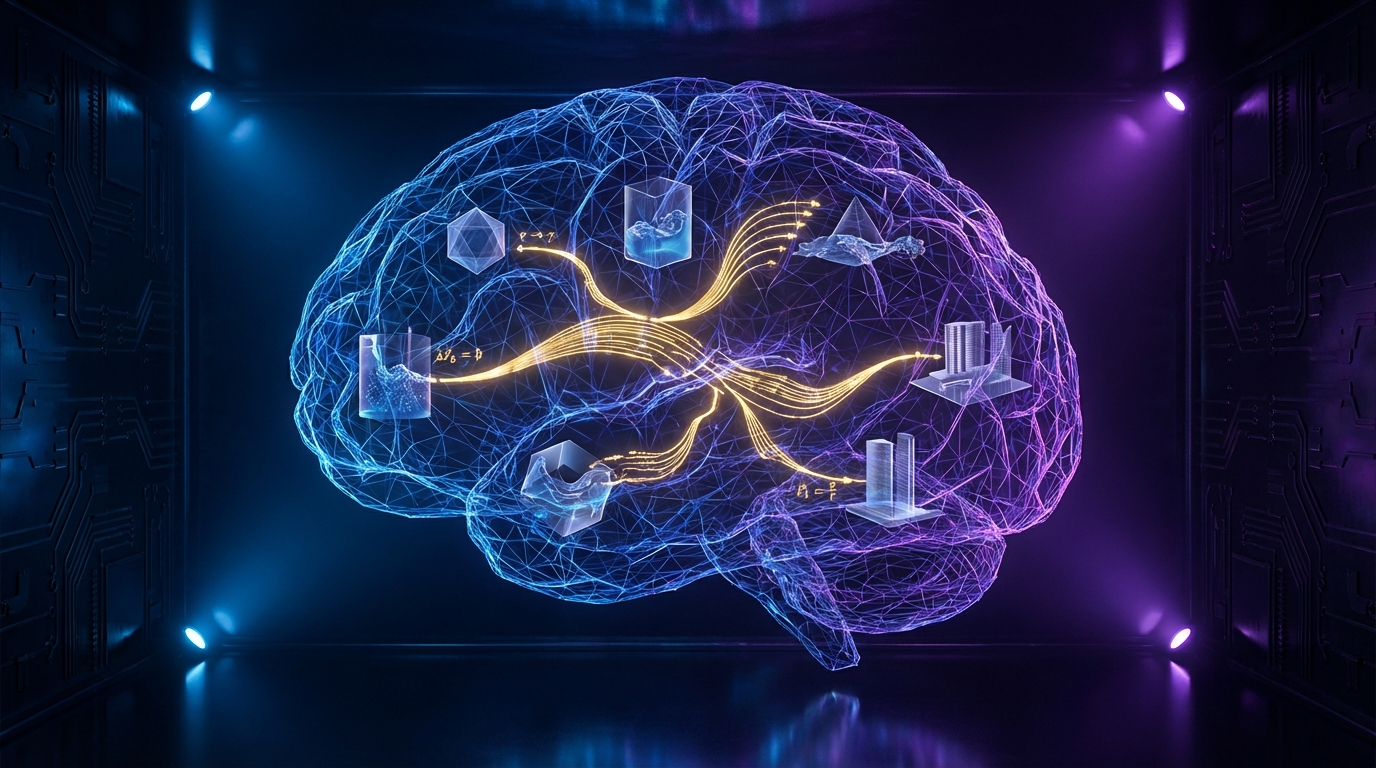
If LLMs are sophisticated autocomplete - predicting the next word based on patterns - world models are something categorically different. They're simulators.
A world model doesn't ask "what word comes next?" It asks "if I do X, what happens to the world?"
Think about how you catch a ball. You don't consciously calculate trajectories. Your brain runs a rapid simulation: the ball is here, moving at this speed, gravity pulls it down, my hand needs to be there in 0.8 seconds. You have a world model of physics running in your head.
LeCun's argument, refined over years at Meta, is that this is exactly what AI lacks - and exactly what it needs for genuine intelligence.
The technical architecture behind this is called JEPA - Joint Embedding Predictive Architecture. Unlike language models that predict raw data (words, pixels), JEPA models predict in an abstract representation space. They learn to understand the underlying structure of reality, not just its surface patterns.
V-JEPA 2: The Proof of Concept
Before launching AMI Labs, LeCun's team at Meta released V-JEPA 2 in June 2025 - the most advanced demonstration of world model capabilities to date.
The numbers are striking:
| Specification | V-JEPA 2 |
|---|---|
| Parameters | 1.2 billion |
| Training Data | 1 million+ hours of video, 1 million images |
| Video Understanding | 77.3% accuracy on Something-Something v2 |
| Robot Control | Zero-shot performance in new environments |
What makes V-JEPA 2 remarkable isn't its size - it's tiny compared to frontier language models. It's what it can do with that size.
Trained on video without human annotation, V-JEPA 2 learned how objects move, how people interact with things, how physical causality works. When deployed on robots in Meta's labs, it could perform tasks like reaching, picking up objects, and placing them in new locations - in environments it had never seen before.
This is the key insight: by learning a model of how the world works, AI can generalize to novel situations. Language models, by contrast, are fundamentally limited to recombining patterns they've seen before.
The AMI Labs Bet
AMI Labs isn't starting from scratch. The startup is partnering with Nabla, a French AI healthcare company, with an explicit goal: build "FDA-certifiable agentic AI systems for healthcare."
This partnership reveals the commercial logic behind world models. Healthcare is precisely the domain where hallucinations are unacceptable and where understanding physical causality matters enormously.
Imagine an AI assistant that doesn't just retrieve medical information, but actually understands:
- How drugs interact in the body
- What happens when conditions progress untreated
- Why certain symptoms indicate certain diagnoses
This requires simulation, not pattern matching. It requires a world model.
The $3.5 billion valuation - before launching a product - reflects investor belief that whoever cracks world models captures the next wave of AI value creation. Meta, Google DeepMind, and Fei-Fei Li's World Labs are all racing toward similar goals.
The Architecture of Understanding
V-JEPA 2's architecture offers clues to how world models might work at scale.
The Encoder: Takes raw video and outputs embeddings - compressed representations that capture what matters about the state of the world. Not the pixels, but the meaning.
The Predictor: Takes an embedding plus context about what to predict, and outputs predicted future embeddings. This is where simulation happens - the model imagines what comes next.
3D Rotary Position Embeddings: A technical innovation that allows the model to understand space and time simultaneously. Unlike static position encoding, 3D-RoPE dynamically represents where things are and when they are - critical for physical reasoning.
The training is self-supervised from video. No human labels required. The model learns physics by watching the world - the same way infants do.
Why This Matters Beyond Tech
The implications extend far beyond Silicon Valley valuations.
Robotics Finally Gets Brains
The robotics industry has been waiting decades for AI that can handle the real world. World models offer a path: train on video of humans doing tasks, develop an understanding of physics and objects, then deploy that understanding on physical robots.
V-JEPA 2's zero-shot robot control - performing tasks in environments never seen during training - is the proof point. If this scales, we're looking at a fundamental transformation of manufacturing, logistics, and service industries.
Healthcare Gets Safer AI
The Nabla partnership signals where world models might first reach commercial deployment. Medical AI that hallucinates kills people. Medical AI that actually understands physiology - how bodies work, how treatments interact, how diseases progress - could be transformative.
The FDA-certifiable angle is crucial. Regulators have been rightly skeptical of black-box AI in healthcare. World models, by explicitly representing causal relationships, may offer the interpretability that regulatory approval requires.
Autonomous Systems Get Real
Self-driving cars, delivery drones, industrial automation - all require AI that can predict what happens next in the physical world. Language models can describe a car crash. World models can simulate one and steer to avoid it.
The Skeptic's Case
Not everyone is convinced world models are the answer.
The scaling argument: Some researchers believe LLMs will eventually develop world-model-like capabilities through sheer scale. GPT-5 has fewer hallucinations than GPT-4, particularly when reasoning. Perhaps the path to understanding runs through even larger language models.
The hybrid argument: Others suggest the future is multimodal systems that combine language models with specialized world models - the best of both architectures. This is arguably what Meta is pursuing with its LLaMA + V-JEPA research.
The timeline argument: World models remain research projects. V-JEPA 2 can pick up objects in controlled lab settings. Deploying world models in the messy, unpredictable real world is a different challenge entirely. AMI Labs' $3.5 billion valuation prices in success that hasn't been demonstrated.
The Bottom Line
Yann LeCun's departure from Meta to build AMI Labs is the clearest signal yet that the AI field is approaching an inflection point.
The Large Language Model paradigm - predict the next token, scale up, hope understanding emerges - has delivered remarkable results. ChatGPT, Claude, Gemini have changed how hundreds of millions of people interact with information.
But they still hallucinate. They still fail at physical reasoning. They still can't reliably simulate cause and effect.
World models represent a different bet: that genuine intelligence requires not just learning patterns in data, but building internal simulators of reality. That AI needs to understand worlds, not just words.
Whether AMI Labs succeeds, whether the $3.5 billion valuation proves justified, whether world models can scale beyond lab demonstrations - these remain open questions.
But the direction is clear. The chatbot era was prologue. The simulation era is beginning.