By Ramachandran Rajeev Kumar — 2026-05-30
The War You Pay For at the Pump
Eleven days. Four hikes. Rs 102.12.
That is the journey Delhi petrol made in the second half of May 2026 — from Rs 99.51 a litre to past the three-figure psychological wall, in increments that arrived faster than most households could budget for. Diesel climbed in lockstep, from Rs 92.49 to Rs 95.20, a single Rs 2.71 jump on 25 May doing most of the damage. Cumulatively, both fuels are roughly Rs 7 a litre heavier than they were on 14 May.
No drone hit a Delhi refinery. No pipeline burst in Gujarat. The cause sits about 3,000 kilometres west, in a 33-kilometre-wide shipping channel between Iran and Oman. The West Asia crisis did not arrive in the Indian household as a headline. It arrived as a fuel receipt.
The plumbing of a price hike
India imports roughly 85% of the crude it burns. That single number is the entire story. When the Strait of Hormuz — the chokepoint through which a fifth of the world's oil moves — seizes up, India does not get a vote.
And it seized hard. Tanker loadings through the strait collapsed from over 20 million barrels a day in February to about 3.8 million by early April, with active traffic down nearly 80%. India had spent years de-risking exactly this scenario; petroleum ministry figures now put around 70% of crude imports on routes outside Hormuz. The diversification blunted the blow. It did not absorb it. The 30% that still threads the strait, plus the global price spike that a Hormuz scare sends through every barrel on earth, was enough.
There is a second multiplier the daily price board does not show you: the rupee. India buys oil in dollars. Through late May the rupee traded weak — touching 96.73 to the dollar on 21 May before recovering toward 94.87 by month-end. A softer rupee means every barrel costs more in domestic terms even when the dollar price holds. Crude shock and currency shock compounded, and the household paid for both.
Why the dam broke all at once
Here is the part that explains the speed. For 76 days before 15 May, retail fuel prices in India did not move. State-run oil marketing companies held the line while international crude climbed, swallowing losses reported at around Rs 1,000 crore a day. That freeze was a political and commercial decision — and like all dams, it held until it didn't.
When the OMCs finally began passing costs through, they were not adjusting for a single bad week. They were releasing eleven weeks of suppressed pain in four sharp instalments. The commuter who woke up on 26 May to a Rs 102 board was not seeing the cost of one day's war. He was seeing the bill for a quarter of it, presented at once.
This matters for how we read what comes next, because the underlying barrel has already turned. Brent fell to about $91 by 29 May — down roughly 17% over the month, its steepest fall since 2020 — on reports of a preliminary US-Iran understanding to ease Hormuz shipping. The supply panic is deflating. Whether the pump price deflates with it, or whether the OMCs quietly rebuild the margin they bled through during the freeze, is the question every Indian motorist should be asking and few are positioned to answer.
The household does the arithmetic
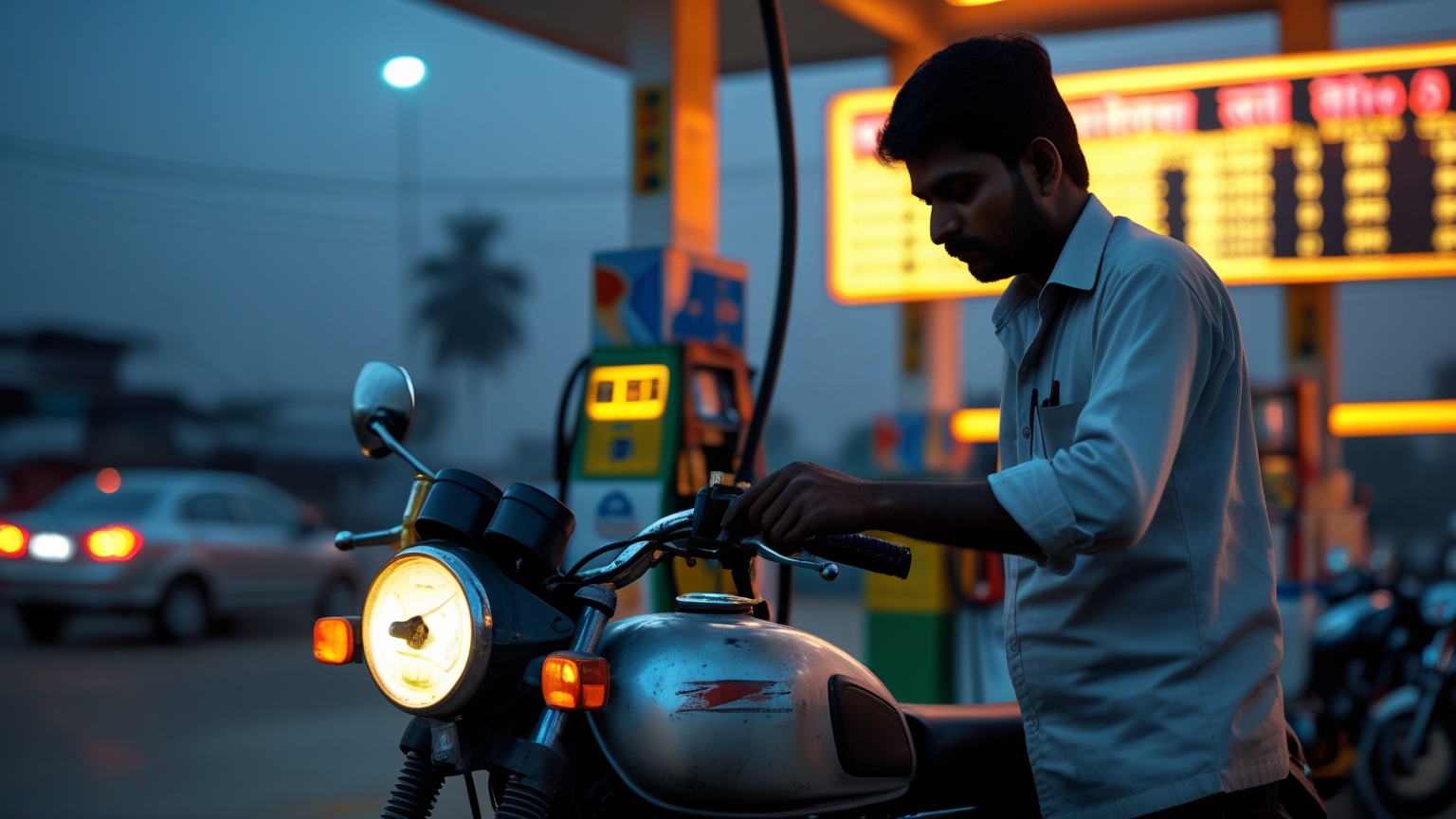
Strip away the geopolitics and the number that lands is small and relentless. Take a two-wheeler commuter filling 12 litres a fortnight. A Rs 7 rise on petrol is about Rs 84 a tank — call it Rs 170 a month, Rs 2,000 a year. For a software engineer in Bengaluru, that is a rounding error. For a delivery rider on a thin per-order margin, it is a meaningful slice of take-home pay, paid first and budgeted around later.
But the petrol number is the one you can see. The diesel number is the one that follows you home invisibly.
Diesel is not a consumer fuel — it is the economy's bloodstream. It moves the truck that brings tomatoes to the mandi, runs the pump that irrigates the field, and powers the tractor at harvest. When diesel goes up Rs 2.71 in a day, that cost does not stay with the trucker. It cannot. Freight operators in Mumbai have already warned that logistics rates will rise. The cost walks from the highway into the wholesale market, from the market into the retail shop, and from the shop into a thali that is suddenly a few rupees dearer for reasons the diner will never trace back to a strait near Oman.
This is the cruelty of diesel inflation: it is regressive and it is silent. The household that spends the largest share of its income on food and transport absorbs the largest share of the shock — and never sees the line item.
The number that frames it all
On 20 May, the UN Department of Economic and Social Affairs cut India's 2026 growth forecast to 6.4%, down from the 6.6% it projected earlier, naming the West Asia crisis directly. UN DESA flagged the "dual" damage of an energy shock — it slows growth and raises inflation at the same time, narrowing the room a central bank has to respond.
Read that revision correctly. It is two-tenths of a percentage point. India remains, by some distance, the fastest-growing major economy on the planet — a step down from 7.5% in 2025, not a stall. The macro story is resilience, not crisis. The lazy reading is to treat 6.4% as alarm. The honest reading is that a war India did not start, in a region India does not control, shaved a measurable sliver off the prosperity of a billion-plus people — and the sliver was distributed most heavily onto the households least able to carry it.
What is actually within reach
The instinct in moments like this is to demand a fuel-tax cut, and there is a real case for one: central and state taxes make up a large share of the pump price, and a temporary trim is the fastest relief lever the government holds. But it is a sugar hit. It drains revenue that funds the very transfers — subsidised cooking gas, ration support — that protect the poorest from exactly this kind of shock.
The durable answer is the boring one, and India is already walking toward it: more crude bought outside Hormuz, deeper strategic reserves, and the long structural shift toward electrified two-wheelers and public transport that quietly shrinks the size of the next oil shock's bite. The household cannot reroute a tanker. But the household that switches a daily commute to an electric scooter or a Metro pass has done something no OMC margin can undo — it has reduced its own exposure to a war it will never be consulted about.
The receipt at the pump is a message from a part of the world most Indians will never visit. The useful response is not anger at the cashier. It is to read the message clearly — a distant chokepoint, an 85% import habit, a dam of suppressed prices that broke at once — and to spend the next quiet stretch building the kind of household, and the kind of country, that the next strait crisis cannot reach quite so easily.
The barrel is already falling. The question is whether the pump remembers.