By Ramachandran Rajeev Kumar — 2026-05-30
Washington Is A Partner, Not The Price-Setter
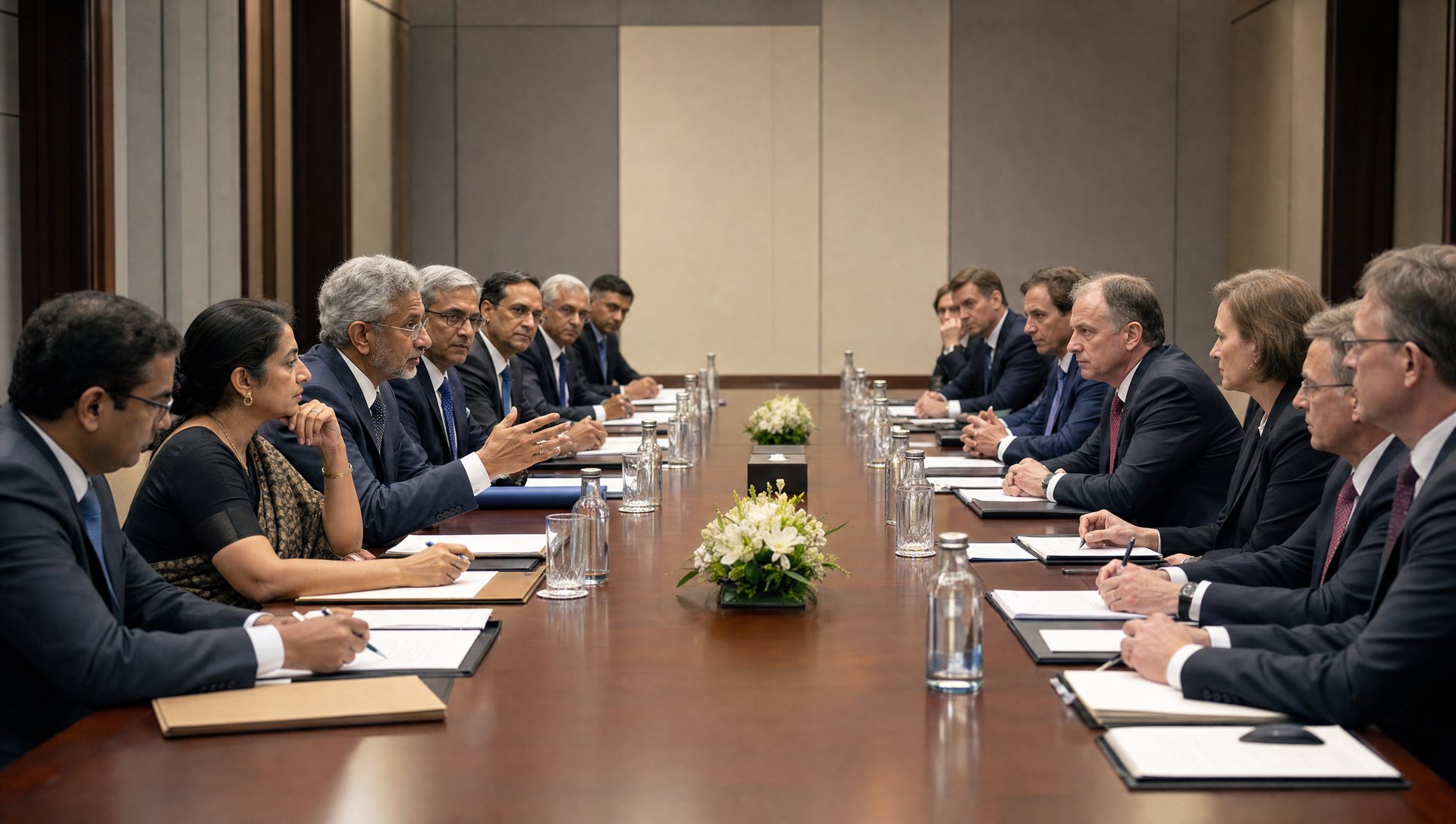
Marco Rubio's first official visit to India was not a courtesy call. It was a repair job.
The public language was warm. India and the United States remain strategically aligned. Trade, energy, defence, technology and maritime security are moving forward. The Quad has work to do. A broader bilateral trade agreement is still possible. Prime Minister Narendra Modi and President Donald Trump will continue their exchanges.
All of that matters.
But the real story is not warmth. The real story is price.
Washington has spent months reminding New Delhi that American friendship now comes with invoices: tariffs on Indian exports, pressure over Russian oil, demands on market access, technology conditions, export-control alignment, investment screening, digital trade rules and supply-chain preferences. India has spent the same period learning, again, that the United States is both an indispensable partner and an unreliable mood.
That does not mean India should pull away. It means India should grow up.
The United States is not an enemy. It is not a saviour. It is not a civilizational guardian of India's rise. It is a great power with interests, leverage, elections, industries and pressure groups. India should cooperate with Washington wherever interests align. It should buy technology, build defence depth, coordinate in the Indo-Pacific, negotiate trade access, secure energy options, develop critical minerals, and use American capital when useful.
But India should never let Washington define the cost of Indian friendship.
The Reset Is Necessary
The India-US relationship is too important to be left to hurt feelings.
The United States remains central to India's technology future, export markets, defence modernization, higher education pipeline, diaspora power, maritime cooperation and Indo-Pacific balancing. A serious India cannot pretend Washington is optional. Nor can Washington pretend India is just another market. India's scale, location, economy, military weight and China-facing geography make it one of the few countries that can alter the balance of the Indo-Pacific without formally joining an alliance.
Rubio's visit came at the right moment because the relationship had entered a trust deficit.
AP described ties as having fallen to their lowest point in more than two decades, strained largely by tariff policies and economic pressure. Washington had imposed steep tariffs on Indian exports, partly linked to New Delhi's purchases of Russian oil. Indian officials were angered, and rightly so. No serious country enjoys being told that strategic partnership means accepting unilateral punishment for energy choices made under its own economic conditions.
At the same time, both sides know the relationship cannot be allowed to drift.
That is why Rubio's meetings with Modi and Jaishankar covered the full board: defence, strategic technologies, trade and investment, energy security, connectivity, education, people-to-people ties, and regional questions including West Asia. That is why trade negotiators are following up. That is why the Quad meeting in New Delhi produced practical announcements on maritime surveillance, critical minerals, ports, undersea cables and energy security.
The reset is necessary.
The question is whether India treats it as partnership or submission.
Tariffs Are A Political Weapon
India should read the tariff episode without romance.
The February 2026 India-US joint statement on the interim trade framework laid out the bargain. India would eliminate or reduce tariffs on US industrial goods and a wide range of US food and agricultural products. The United States would apply an 18 percent reciprocal tariff rate on originating goods of India and remove tariffs on selected products subject to successful conclusion of the interim agreement.
That rate no longer stands as first written. On 20 February 2026, the US Supreme Court struck down the tariffs imposed under the International Emergency Economic Powers Act — the reciprocal rate among them — as an overreach of presidential power, and collection stopped within days. The episode only sharpens the lesson. India made real concessions under a framework whose central tariff bargain was unsettled within a fortnight, this time by Washington's own courts. A pressure applied by one branch of the American state can be undone by another, and India is left holding its commitments either way.
The broader bilateral trade agreement would continue.
There were useful elements in the framework: market access, rules of origin, non-tariff barrier discussions, technology trade, supply-chain resilience and a pathway toward a broader deal. There were also hard asks. India was expected to address US concerns on medical devices, ICT goods, food and agricultural products, standards, digital trade and economic-security alignment. India also stated an intention to purchase $500 billion of US energy products, aircraft and aircraft parts, precious metals, technology products and coking coal over five years.
That is not a small alignment.
India may decide much of it is worthwhile. It may need US energy, GPUs, aircraft, technology products and market access. It may benefit from lowering some barriers. It may use the agreement to protect vulnerable export sectors, reduce tariff uncertainty and attract investment.
But India should not mistake tariff relief for generosity.
Tariffs were used as leverage. Relief from leverage is not a gift. It is a negotiated outcome after pressure. The correct Indian response is neither outrage nor gratitude. It is memory.
If Washington can tariff today over Russian oil, it can tariff tomorrow over digital rules, climate standards, pharmaceuticals, data flows, defence procurement, tax disputes or China exposure. That is how great powers behave when domestic politics and strategic pressure converge.
India should negotiate. It should not internalize guilt.
Russian Oil Was The Warning
The Russian oil dispute revealed the basic asymmetry in the relationship.
India bought discounted Russian crude because energy security required it. After the Ukraine war, Western policy sought to restrict Moscow's revenue without crashing global oil markets. India's purchases helped keep barrels moving while saving Indian refiners and consumers money. This was not charity to Russia. It was Indian price management in a hostile energy environment.
Washington tolerated it when tolerance suited Washington. Then it became leverage.
That is the lesson. Not that India should forever buy Russian oil. Not that India should defy the United States for theatre. Not that Moscow is a reliable substitute for Washington. The lesson is that any single external pressure point can become a political weapon.
Energy security cannot depend on American waivers, Russian discounts, Iranian openings, Gulf calm or shipping luck. India needs a portfolio: Gulf stability, Russian optionality where useful, US LNG and crude where commercially sensible, strategic reserves, refinery flexibility, clean-energy buildout, fertilizer security and maritime protection.
The same principle applies beyond oil.
Technology security cannot depend only on US chips. Critical minerals cannot depend only on US-led supply chains. Defence readiness cannot depend only on Russian legacy platforms. Maritime stability cannot depend only on American naval presence. A mature India should welcome every useful partner while refusing dependence on any single one.
This is strategic autonomy in practice. Not slogans. Portfolio management.
The Friendship Must Be Useful
There is a lazy anti-Americanism in parts of Indian commentary that mistakes suspicion for strategy. It is not strategy.
The United States can help India in ways few countries can.
It can accelerate India's access to advanced defence systems, engines, sensors, space cooperation and maritime awareness. It can help build semiconductor, AI and critical-mineral ecosystems. It can provide capital and market depth for Indian manufacturing. It can absorb Indian services and talent. It can support India's role in the Indo-Pacific. It can help keep sea lanes open and coercion costly.
India should take all of that seriously.
The point is not to reduce cooperation. The point is to structure cooperation so that it increases Indian capacity rather than creating Indian dependency. A good deal makes India stronger after the deal. A bad deal makes India compliant during the deal.
This is the standard by which New Delhi should judge every line of the BTA.
Does it create Indian manufacturing capacity?
Does it protect India's policy space in agriculture, health, digital infrastructure and strategic sectors?
Does it give Indian exporters stable access, or only conditional relief?
Does it create technology transfer and domestic capability, or only import channels?
Does it reduce India's exposure to China, or merely make India dependent on US rules?
Does it strengthen Indian bargaining power with other partners, or narrow it?
Friendship that increases capacity is useful. Friendship that sets obedience tests is not.
Do Not Let China Define The Relationship Either
India must also avoid the opposite trap: allowing China to become the only reason Washington values India.
AP quoted Praveen Donthi of the International Crisis Group, warning that if the US changes its approach toward China, India's strategic value to Washington could shift. That is not paranoia. It is structural reality. The United States can swing from confrontation to accommodation with Beijing depending on administration, inflation, markets, business lobbies and crisis management. India cannot build its entire Washington strategy on being useful in someone else's China policy.
India's value must be broader.
India is a market. A manufacturing base. A technology workforce. A democratic scale power. A maritime state. A civilizational pole. A defence partner. A pharmaceutical producer. A space actor. A data society. A bridge to the Global South. A country whose choices shape energy, food, climate, migration, digital rules and industrial geography.
That is the relationship India should sell.
If India allows itself to be seen mainly as an anti-China asset, its leverage rises and falls with US-China temperature. If it builds a broader, interest-based partnership, the relationship becomes harder to downgrade.
New Delhi should cooperate with Washington on China where interests align. It should not become an instrument of Washington's China mood.
Trade Is Not Just Trade
The BTA talks are not only about tariffs.
They are about the structure of India's future economy. Medical devices, agricultural products, ICT goods, digital trade, standards, investment reviews, export controls, technology products, GPUs, aircraft parts and energy purchases are not isolated line items. They define who sets rules inside the Indian growth story.
India should enter these talks with confidence, not defensiveness.
Yes, India needs market access for textiles, leather, footwear, chemicals, machinery, gems, diamonds, pharmaceuticals and aircraft parts. Yes, exporters need relief from tariff uncertainty. Yes, the US market matters. But India also has leverage. It has demand. It has scale. It has labour. It has a fast-growing digital economy. It has geopolitical weight. It has alternatives in Europe, Japan, the Gulf, ASEAN, Africa and its own domestic market.
The goal should be balanced openness.
Open where competition improves Indian productivity. Protect where premature exposure destroys livelihoods without building capacity. Accept standards where they raise quality. Resist standards when they become disguised market exclusion. Buy US energy where it diversifies supply. Do not turn energy purchases into tribute. Import GPUs where necessary. Build domestic compute capacity at the same time.
Trade policy is industrial policy wearing a suit.
India should negotiate accordingly.
The Correct Posture
India's correct posture toward Washington is neither sentimental nor hostile.
It is disciplined cooperation.
On the Quad, cooperate hard. Maritime domain awareness, critical minerals, undersea cables, port resilience, energy security and humanitarian logistics are practical gains.
On defence, deepen where technology and interoperability strengthen Indian forces. Avoid arrangements that compromise independent use.
On technology, take access seriously. But link access to Indian capability, skilling, manufacturing, research and standards participation.
On trade, negotiate patiently. Do not sacrifice farm, digital or regulatory sovereignty for tariff relief dressed up as partnership.
On energy, diversify. Buy where commercial logic holds. Refuse moral lectures from countries that price their values differently when their own inflation rises.
On China, coordinate, but do not subcontract.
On Russia, reduce vulnerability without performative abandonment.
On the Global South, keep India's own voice. Washington will respect India more if India remains India.
The Price India Should Pay
Friendship has a price. The issue is not whether India pays one. The issue is who sets it.
India should pay the price of seriousness: regulatory reform, manufacturing competitiveness, cleaner contracts, stronger logistics, faster dispute resolution, better standards, deeper defence production, credible energy planning and real technology capacity.
India should not pay the price of obedience.
It should not accept tariff discipline as normal partnership. It should not let Russian oil become a permanent guilt lever. It should not sign digital trade rules that weaken domestic policy space. It should not accept export-control alignment that blocks its own technological options. It should not open sensitive sectors merely to prove goodwill. It should not pretend US domestic politics will remain friendly just because one meeting went well.
Rubio's visit was useful because it cleared the air. The relationship is moving again. The Quad has practical momentum. Critical minerals, maritime security, energy and trade are all live. A broader agreement may follow.
Good.
Now India must do the adult thing: cooperate without kneeling, bargain without sulking, diversify without drifting, and remember without becoming bitter.
Washington is a partner.
It is not the price-setter.
BarathVector covers India's foreign policy, trade, and strategic posture. Subscribe for the weekly briefing.