By Ramachandran Rajeev Kumar — 2026-01-07
Two Moves on the Chessboard: America Invaded Venezuela, India Invited China
By Ramachandran Rajeev Kumar
In the first week of 2026, the world's two largest democracies made their opening moves for the year.
America sent special forces to Caracas, captured a sitting president, killed at least 80 people including 32 Cubans, and declared it would "run Venezuela" until further notice.
India quietly rolled out a new e-Business visa for Chinese nationals, making it easier for executives from Beijing and Shanghai to visit Mumbai and Chennai for manufacturing partnerships.
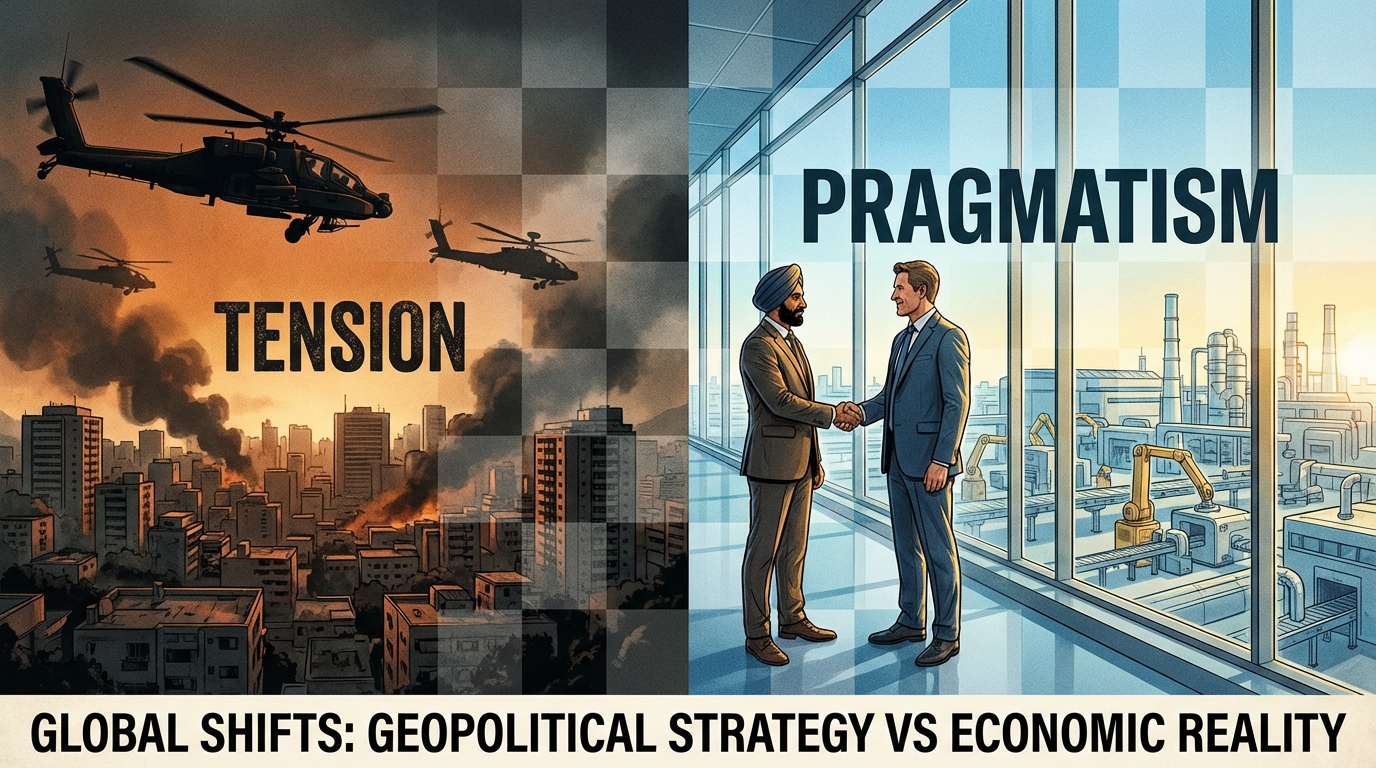
One democracy chose regime change. The other chose economic pragmatism.
Both moves were entirely predictable. Both reveal priorities that could not be more different. And both will shape the geopolitical landscape of 2026 in ways that neither Washington nor Delhi fully appreciates.
The Don-roe Doctrine in Action
At 2 a.m. on January 3rd, explosions lit up Caracas. "Operation Absolute Resolve" had begun.
Within hours, U.S. forces had breached Venezuelan air defenses, stormed Fuerte Tiuna military complex, and captured President Nicolás Maduro and his wife Cilia Flores. By morning, the couple was on a plane to New York to face narcoterrorism charges in a Manhattan federal court.
President Trump, in characteristic fashion, announced the operation as "extraordinary"—something "unlike anything since World War II." He was not wrong about its audacity. The United States had just conducted a military operation to arrest a sitting head of state, without a declaration of war, without Congressional authorization, and without informing allies.
Secretary of State Marco Rubio, briefing a stunned Congress days later, was blunt about American intentions: "We are going to take between 30 and 50 million barrels of oil. We're going to sell it in the marketplace at market rates."
He added, with the confidence of a man who believes history is on his side: "This is the Western Hemisphere. This is where we live. And we're not going to allow the Western Hemisphere to be a base of operations for adversaries."
The message was clear. The Monroe Doctrine—that 200-year-old assertion of American hegemony over the Americas—was back. Trump himself has rebranded it the "Don-roe Doctrine," a linguistic flourish that manages to be both self-aggrandizing and historically accurate.
But the implications extend far beyond Venezuela.
In recent weeks, Trump has threatened to annex Greenland, suggested Canada should become the "51st state," predicted the governments of Cuba and Colombia would "fall," and hinted at military options for the Panama Canal. The Venezuela operation was not an isolated incident. It was a proof of concept.
Meanwhile, in New Delhi
While Washington was planning regime change in Caracas, New Delhi was processing paperwork.
Effective January 1, 2026, India introduced the e-B-4 visa—a new "Production Investment Business Visa" specifically designed for Chinese nationals. The visa can be applied for online, processed in 45-50 days, and permits stays of up to six months.
The eligible activities read like a manufacturing playbook: installation and commissioning of equipment, quality checks, essential maintenance, IT and ERP systems, training, supply chain development, vendor empanelment, plant design, and visits by senior management.
This is not a tourism visa. This is an invitation for Chinese industrial expertise to help build Indian factories.
The timing is instructive. Just months after the Galwan Valley disengagement—where Indian and Chinese troops finally pulled back from eyeball-to-eyeball confrontation after four years—Delhi is actively facilitating Chinese business travel. The same India that banned 300+ Chinese apps after the 2020 border clash. The same India that scrutinized every Chinese investment with suspicion. That India now wants Chinese engineers visiting its production lines.
What changed?
The Art of Reading the Room
India has been learning to read America.
As we wrote in December, Trump's tariff tantrums have achieved what decades of Soviet diplomacy could not: they have made Indians question whether America is a reliable partner. The 50% duties, the trade war rhetoric, the transactional "what have you done for me lately" approach to alliances—all of it has registered in New Delhi.
The Venezuela operation confirms what Indian strategists suspected: this American administration is not interested in rules, norms, or multilateral frameworks. It is interested in power projection and resource extraction. "We're going to run the country," Trump said of Venezuela. "We're going to take 30-50 million barrels of oil," Rubio added.
India is watching and drawing conclusions.
If America can invade Venezuela without Congressional approval, what stops it from demanding similar compliance from allies? If the "Don-roe Doctrine" applies to the Western Hemisphere, what doctrine applies to the Indo-Pacific? And if American foreign policy is now explicitly about seizing oil and controlling resources, what does that mean for India's carefully cultivated "strategic partnership"?
The e-visa for Chinese businessmen is India's answer: hedge.
Tactical Convenience, Not Romance
Let us be clear about what this is—and what it is not.
India is not falling into China's embrace. The border dispute remains unresolved. The memories of Galwan are fresh. The strategic competition is real. China still occupies territory India claims. China still arms Pakistan. China still blocks India's UN Security Council membership.
But India is also not naive enough to put all its eggs in America's basket.
The e-B-4 visa is about economics, not geopolitics. India wants to become a manufacturing powerhouse. Chinese companies have expertise, capital, and supply chain networks that India needs. With Trump threatening tariffs on everyone including allies, diversifying economic partnerships is simple prudence.
As we noted in our December analysis of India-China relations: "This is tactical convenience, not genuine reconciliation. Both sides are driven by economic necessity."
Nothing has changed that assessment. If anything, the Venezuela operation reinforces it. When your primary ally is busy invading countries to seize oil, you make alternative arrangements.
The Diverging Worldviews
The contrast between America's Venezuela operation and India's e-visa rollout is not merely tactical. It reveals fundamentally different worldviews about how to exercise power in the 21st century.
America's approach: Military force, regime change, resource extraction, unilateral action, "we run the show."
India's approach: Economic engagement, visa facilitation, manufacturing partnerships, multilateral hedging, "we'll work with everyone."
One is the worldview of a declining hegemon trying to reassert dominance through raw power. The other is the worldview of a rising power trying to grow its economy without making unnecessary enemies.
Neither approach is inherently right or wrong. But they are increasingly incompatible.
The Indo-Pacific alliance that Washington has been building—with India as a cornerstone—assumes shared values and shared interests. The Quad, the defense agreements, the technology partnerships—all of it rests on the premise that India and America see the world similarly.
Venezuela and the e-visa suggest otherwise.
America sees a world where you either dominate or get dominated. India sees a world where you trade with everyone and align with no one completely. America wants India to be a partner in containing China. India wants to contain China while also doing business with China.
These positions are not irreconcilable. But they require more diplomatic finesse than "we're going to take their oil."
What India Is Actually Doing
Strip away the geopolitical abstractions, and India's strategy is remarkably simple.
With America: Maintain the defense partnership. Buy the weapons. Participate in the Quad. Talk about shared values. But don't get locked into commitments that limit flexibility.
With China: Resolve the border where possible. Facilitate economic engagement where beneficial. Keep strategic competition contained. Don't let American pressure dictate the relationship.
With Russia: Preserve the traditional partnership. Buy the oil at discount. Keep the defense supply chain open. Ignore Western complaints about sanctions.
With everyone else: Sign FTAs. Expand trade. Welcome investment. Build manufacturing capacity. Grow the economy.
This is multi-alignment—the foreign policy of a country that has learned, over decades, that great powers come and go, but geography and economics are permanent.
The e-visa for Chinese businessmen fits perfectly into this framework. It's not about loving China. It's about building Indian factories. If Chinese engineers can help commission a plant faster, why not invite them?
The Week Ahead
As this article goes to press, Congress is preparing for a full briefing on Venezuela. Democrats are calling the operation "regime change" and accusing the administration of lying to lawmakers. Republicans are largely supportive but nervous about the "run the country" rhetoric.
Meanwhile, Venezuela's interim president, Delcy Rodriguez, has declared a state of emergency and ordered the arrest of anyone who supported the U.S. operation. The country is in chaos. Oil production—the prize Trump and Rubio want—has plummeted.
In New Delhi, the Ministry of External Affairs has issued no statement on Venezuela. India will likely abstain from any UN resolution, as it usually does when great powers clash. The e-visa system is processing applications. Chinese executives are booking flights to Chennai and Bangalore.
Two democracies. Two moves on the chessboard. One chose to capture a king. The other chose to trade pawns.
The game continues.
The Bottom Line
The Venezuela invasion and the India-China e-visa are not unrelated events. They are two sides of the same coin—responses to a world where the old rules no longer apply and every nation must chart its own course.
America has chosen the path of military assertion. Whether it leads to renewed hegemony or costly overreach, only time will tell. The early signs—80 dead, oil production disrupted, regional allies alarmed—are not encouraging.
India has chosen the path of economic pragmatism. Whether it can sustain multi-alignment in an increasingly polarized world, only time will tell. The early signs—manufacturing growing, relationships diversifying, strategic autonomy preserved—are cautiously positive.
What is clear is that these two democracies are no longer moving in the same direction.
The chessboard has been reset. The pieces are moving. And India, for once, seems to be playing its own game rather than someone else's.
The author believes that great powers should be studied, not worshipped—and that India's interests are best served by keeping all options open.