By Ramachandran Rajeev Kumar — 2026-04-14
The Deal on Probation: How the February 18% Tariff Agreement Is Cracking
The February 2 deal between Washington and New Delhi was engineered for a world without a Hormuz war. That world ended on February 28. Everything since has been improvisation.
By Ramachandran Rajeev Kumar
In Tiruppur, the knitwear capital of Tamil Nadu, a small exporter named Sekar Muthusamy keeps two notebooks. The first is a ledger: cotton pricing, dye lots, loom hours, shipment dates. The second is newer, opened in January 2026, and has only two columns. On the left, tariff rates announced by Washington. On the right, the date they changed.
The February 2 column was a good day. Muthusamy remembers his forwarding agent calling from Chennai that afternoon. Tariffs on Indian apparel to the United States had been cut from an effective 50 per cent under the IEEPA surcharge to 18 per cent under a newly announced reciprocal framework. An order book that had gone silent in December filled up within three weeks. By the first week of March, Muthusamy had rehired four tailors he had let go in November.
Then on April 9, the same forwarding agent called again. A review of tariff line HS 6110.20 had been opened by the United States Trade Representative. The context was a Section 301 investigation reopened on March 11, which Muthusamy had not followed because no one in his WhatsApp group of exporters had thought to forward it. The call was short. Shipments already in transit would clear at 18 per cent. The shipment being stitched that morning might not.
Muthusamy closed the second notebook and opened the first. He had four weeks of cotton already dyed.
This is what a trade agreement on probation looks like in the place where it is actually paid for. Not in Raisina Hill or K Street, but in a small unit on the outskirts of Tiruppur where the cost of a broken promise is absorbed, first, by the workers who will not be rehired again.
What the February 2 deal actually was
The headline was the kind that reads like victory on both sides of the Pacific. President Donald Trump and Prime Minister Narendra Modi jointly announced a bilateral trade framework that cut the effective US tariff on Indian goods from 50 per cent to 18 per cent, subject to India's alignment on energy procurement and a basket of reciprocal concessions.
The mechanics underneath the rhetoric were more specific. The 50 per cent figure was itself a composite: a 25 per cent reciprocal rate applied under the International Emergency Economic Powers Act, stacked with an additional 25 per cent punitive surcharge that the Trump administration had imposed the previous year as pressure on India to stop importing Russian crude. The February 2 framework did two things. It reduced the reciprocal IEEPA rate from 25 per cent to 18 per cent. And it removed the 25 per cent Russian-oil punitive tariff entirely, conditional on Delhi's commitment to wind down Russian crude purchases.
In return, India committed to zero tariffs on an unusually long list of US industrial and agricultural baskets -- machine tools, medical devices, almonds, pistachios, blueberries, LNG, aerospace components -- and to expanded procurement of American defence equipment and energy. The specific procurement floors were left deliberately vague in the public text, which analysts at the time read as a face-saving device for Modi at home.
The White House fact sheet released on February 2 called it "historic". Al Jazeera, reporting the same afternoon, put the word in scare quotes. CNBC and CNN led with the tariff math. Thompson Hine's SmarTrade bulletin, which trade lawyers actually read, flagged the deal as "an interim framework with unresolved sectoral exposures" and noted that the reciprocal IEEPA rate could be adjusted upward by executive action without congressional approval.
The political chemistry held for 26 days. Then on February 28, the US and Israeli coalition launched operations against Iranian nuclear and command infrastructure, and the premise of the deal changed under everybody's feet.
The Hormuz disruption
India imports roughly 85 per cent of its crude oil. Of that, in the six months before February 28, close to 38 per cent came from Russia, a share built up after 2022 when Russian barrels became available at discounts that Indian refiners, operating on thin margins, could not responsibly refuse. Another 14 per cent came from Gulf producers whose tanker routes transit the Strait of Hormuz.
On February 28, both lanes seized at once. Russian cargoes already on water when the Hormuz war began were caught in insurance and compliance limbo as Western reinsurers reassessed exposure. Gulf transits slowed as tanker operators demanded war-risk premiums that pushed spot freight rates to levels not seen since the 1980s tanker war.
Washington responded on March 6 with a US Treasury Office of Foreign Assets Control general licence, granting a 30-day emergency waiver that allowed Indian refiners to take delivery of Russian cargoes already in transit. The waiver was framed as narrow and temporary. It is understood to have been extended administratively since, without public announcement, with the current window running into mid-May.
The second adjustment was not negotiated at all. Since March 20, Iranian oil has been landing at Indian ports for the first time in seven years -- roughly 2 million barrels across five cargoes, according to tracking data reported by CNBC on April 6. Delhi's official position is that these are emergency spot purchases through Dubai-based intermediaries, not a restoration of the Iran-India crude relationship that the 2019 sanctions had terminated. The position is technically true and substantively beside the point. What matters is that the barrels are moving.
The February 2 framework assumed a world in which India could, over a defined runway, substitute Russian crude with Gulf and American barrels. A Hormuz war broke that assumption on day 26. India did not choose to break the Russian-oil clause of the deal. Physics broke it. The Treasury waiver is Washington's tacit acknowledgement that the clause was never survivable under the conditions that now prevail.
March 11: USTR reopens Section 301
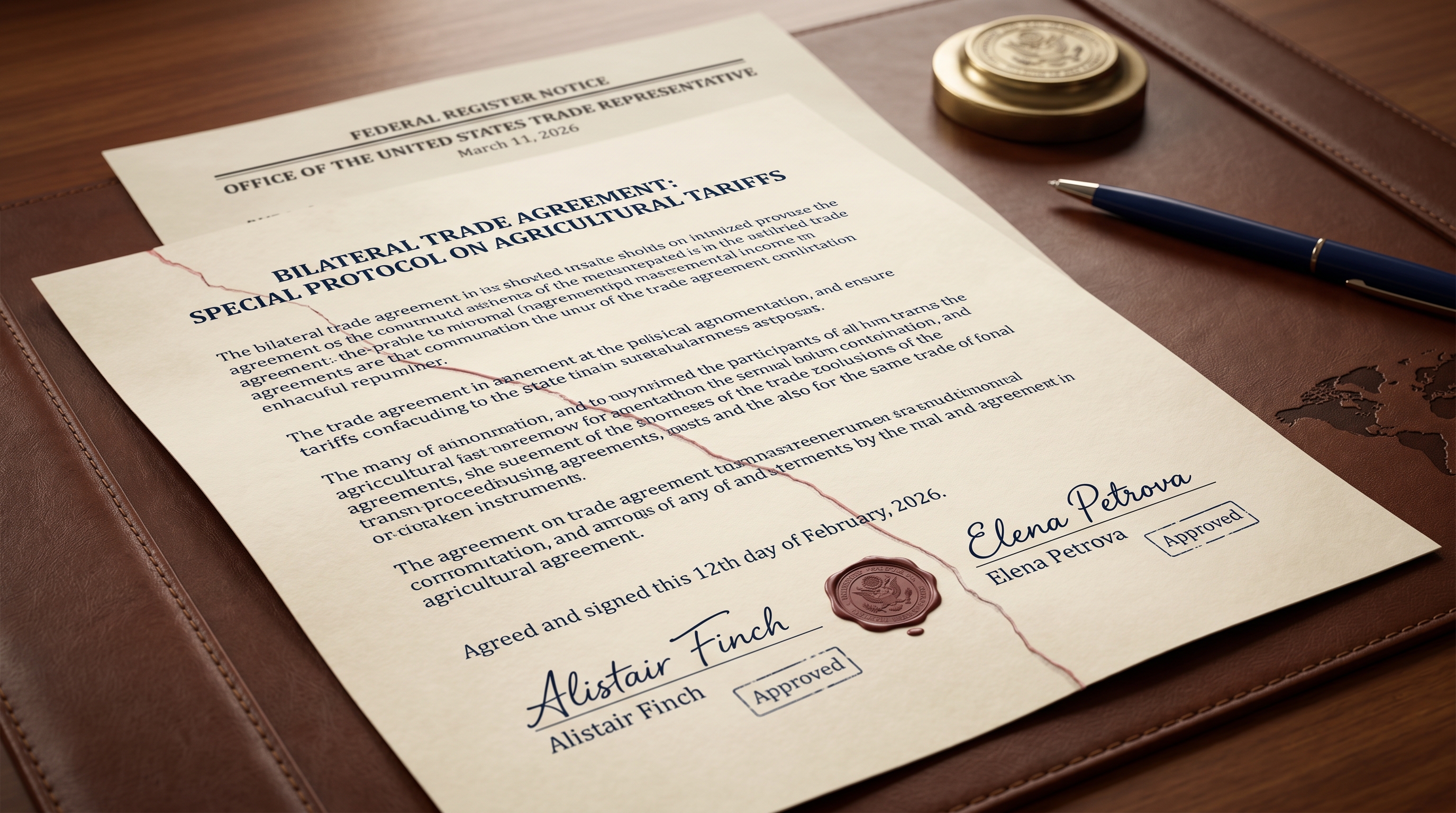
Eleven days after the Hormuz war began, and while the Treasury waiver was still fresh, the United States Trade Representative issued a Federal Register notice reopening a Section 301 investigation that had been dormant since 2020. The notice listed India alongside several other trading partners whose digital services taxes, tariff structures, data-localisation requirements and intellectual property regimes were flagged for review.
Section 301 of the Trade Act of 1974 is the statutory instrument that gives the USTR authority to investigate and retaliate against foreign practices deemed "unjustifiable, unreasonable or discriminatory". It is the same authority used against Chinese technology practices in 2018. Its investigation window runs 12 months, with the option to extend by six. Its enforcement toolkit includes unilateral tariff impositions that bypass the reciprocal framework agreed in February.
The Trade Compliance Resource Hub tracker, updated April 8, indicates the reopened probe is prioritising three areas against India: the 6 per cent equalisation levy on digital services (which India formally withdrew in 2024 but which the USTR appears to treat as re-emergent under a new name), the tariff schedule on agricultural imports that survived the February deal, and data-localisation requirements under the Digital Personal Data Protection framework.
What makes the March 11 notice consequential is its timing. Section 301 investigations have their own procedural calendar. They do not wait for trade negotiations to fail. They run in parallel, generating evidence and producing findings that can be converted into tariff action at presidential discretion. By reopening the investigation eleven days into a war that had already strained the February deal's energy clause, the USTR was not breaking the deal. It was building the paper trail that would allow the deal to be reversed cleanly if Washington decided to reverse it.
The door that February 2 opened has been kept on a hinge. The March 11 notice is the hinge.
Three scenarios for the next 60 days
The deal is not dead. It is on probation. What New Delhi offers Washington in the window between now and the middle of June decides whether the 18 per cent tariff is a floor or a ceiling.
Scenario one: Re-negotiation (probability 35 per cent). India tables a strategic-goods basket designed to compensate Washington for the Russian-oil clause that physics has broken. The elements are visible in April conversations in South Block and were flagged, in outline, by Indian officials to the Financial Times last week. US LNG procurement scaled up to replace a measurable share of the lost Russian barrels -- perhaps 8 to 12 million tonnes per annum over three years, landing at Dahej and Mundra. Defence co-production expanded beyond the existing jet-engine agreement to include next-generation propulsion and munitions. A formal framework for reducing data-localisation friction on US digital services firms, narrow enough to protect the Indian fintech stack. The prize for India is closure of the Section 301 probe and a written understanding that the 18 per cent rate is the floor through at least 2027.
Scenario two: Tariff snapback (probability 30 per cent). Section 301 findings land between late May and mid-June. The USTR recommends a return to the 25 per cent reciprocal IEEPA rate, plus targeted sectoral surcharges on textiles, pharmaceuticals and IT services. Trump signs the order on a Friday afternoon. India retaliates the following Monday with duties on US agricultural imports, almonds and pistachios first, because the political map of California is legible in New Delhi, and freezes the defence procurement track. The bilateral relationship enters a cold patch that lasts 18 to 30 months and forces Indian exporters, particularly in textiles and generic pharmaceuticals, to accelerate diversification toward the EU and ASEAN.
Scenario three: Cold peace (probability 35 per cent). Both capitals allow the deal to run on ambiguity. The Treasury waiver for Russian cargoes is renewed monthly without public announcement. Iranian oil is absorbed into Indian refining on the quiet Dubai route, with Washington choosing not to see it. The Section 301 investigation stays procedurally open but produces no findings before the end of the year. Trump's attention moves to the Middle East, to Taiwan, to the next domestic crisis. The February 2 framework holds, formally, while both sides walk around its contradictions. The 18 per cent rate survives by being forgotten.
The third scenario is the most likely in the short run and the least sustainable in the long run. Trade policy that survives by being forgotten is trade policy that can be reversed on a tweet.
What India actually needs
A trade doctrine, not a deal of the week.
The difference is not rhetorical. A doctrine names the national interest with enough specificity that it can survive three administrations, not one. It identifies the structural dependencies, chief among them energy, semiconductors, defence technology and skilled-worker mobility, and commits to reducing the most dangerous of them on a decadal timeline rather than a quarterly one. It selects a named negotiator with genuine authority, not a rotating cast of commerce secretaries and ambassadors, to hold the trade file through the political cycle in Washington. It publishes its own scoring of every reciprocal concession, so the domestic debate is informed rather than performative.
The February 2 deal was a negotiated instrument. What India needs is a negotiated position -- a clear statement of what Delhi will trade, what it will not, and at what price. The Russian-oil clause was always the weakest part of the February framework, because it asked India to accept the energy strategy of a supplier Washington can neither replace nor protect. The next framework must not repeat that error. Energy alignment between Delhi and Washington, if it is to be durable, must be tied to the Hormuz realities rather than to the American political calendar.
That is the doctrine question. The Tiruppur question is different, and more immediate. Sekar Muthusamy, with four weeks of dyed cotton on the cutting tables, needs to know by the first week of May whether his August shipment clears at 18 per cent or at something higher. He is not the only one waiting.
Sixty days. A deal on probation. A doctrine that does not yet exist. The clock is not ours to stop.
Continues the editorial arc of BarathVector's "The Art of the Deal, Unmade", published 10 April.