By Ramachandran Rajeev Kumar — 2025-12-11
The Greatest Loss America Doesn't Yet Understand
The headlines focus on tariffs—50% duties, trade deficits, economic retaliation. But the real damage Trump has inflicted on American interests runs far deeper than any trade metric can capture.
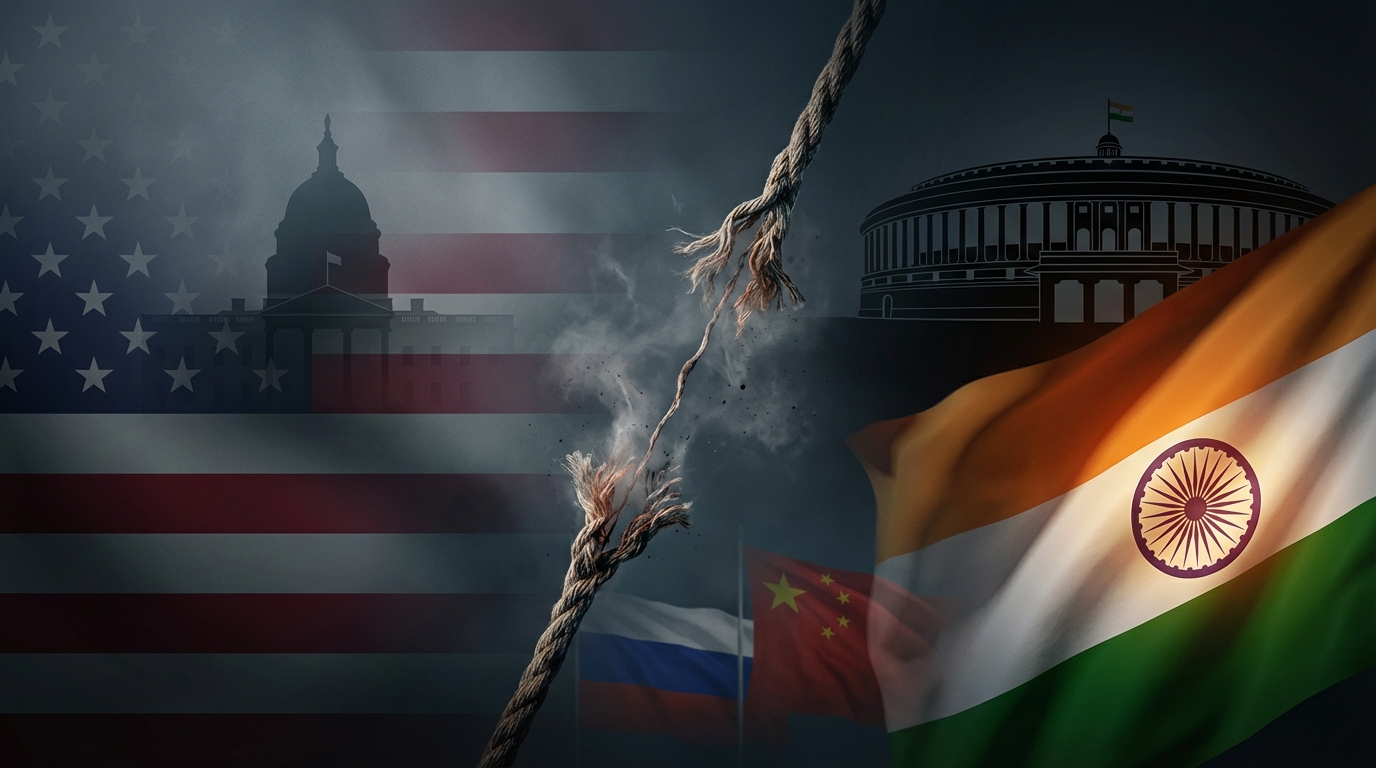
For the first time in two decades, Indians are questioning whether America is a reliable partner. For the first time since the Cold War, Russians are being welcomed as friends. And for the first time since 1962, there is serious discussion about resetting relations with China.
Trump didn't just damage a strategic partnership. He shattered something far more valuable: the goodwill of 1.4 billion people who had genuinely embraced American values and American leadership.
The consequences may be irreversible.
The Transformation America Forgot It Achieved
To understand what has been lost, one must appreciate what was built.
Until the turn of this century, Indians viewed Americans with deep suspicion and Russians with abiding trust. The Cold War alignment, American support for Pakistan, the USS Enterprise incident of 1971—these weren't distant history but living memory for Indian policymakers.
Then something remarkable happened.
Two decades of patient diplomacy by successive American administrations, combined with India's economic liberalization and the rise of an Indian diaspora in America, fundamentally transformed Indian public opinion. By 2020, the United States had achieved something unprecedented: the wholehearted support of the Indian public for American leadership.
This wasn't merely strategic alignment between governments. It was a genuine shift in how ordinary Indians saw America.
Several factors drove this transformation:
- The China threat: As Chinese aggression on the border intensified—Doklam, Galwan—Indians saw America as the natural counterweight
- Chinese support for Pakistan: Beijing's all-weather friendship with Islamabad made it India's adversary by extension
- Russia's economic decline: Moscow could no longer offer the economic and technological partnerships Indians needed
- The American Dream: Millions of Indians succeeded spectacularly in America—CEOs of Google, Microsoft, IBM; astronauts, Nobel laureates, professors. America became aspirational
- Shared democratic values: Indians genuinely believed they shared something fundamental with America
Trump in particular was seen as a pro-India president. His embrace of Modi, his tough stance on China, his apparent warmth toward the Indian community—all of this built extraordinary goodwill. Before the 2024 election, Trump enjoyed greater support among Indians (within and outside India) than perhaps any American leader in history.
This support base was strategically irrelevant for American domestic politics. But it was enormously consequential for American interests globally.
And Trump has destroyed it.
Operation Sindoor: The Breaking Point
The Pahalgam attack in early 2025 and India's subsequent military response—Operation Sindoor—became the crucible that tested the US-India relationship. And America failed the test spectacularly.
What followed revealed the hollowness of the "strategic partnership":
The fabricated mediation claim: Trump publicly claimed he had mediated the ceasefire between India and Pakistan. India swiftly and publicly rejected this, stating there was no American role in military negotiations. Trump had lied for self-aggrandizement.
Pakistan hyphenation: After decades of American acknowledgment that India and Pakistan are fundamentally different—one a chaotic democracy, the other a military-dominated terror sponsor—Trump reverted to treating them as equivalent irritants. Pakistan faces 19% tariffs; India faces 50%. The message was unmistakable.
Praising Pakistan: In a stunning reversal of decades of American policy, Trump spoke warmly of Pakistan while belittling India as "the tariff king" and a "dead economy" that does "very little business" with the US.
The non-existent call: Trump claimed he had spoken with Modi to use tariffs as leverage for peace. No such call occurred. He lied about a conversation with the leader of the world's largest democracy.
Indians watched all of this. All 1.4 billion of them.
And they drew conclusions.
The Rally Around Modi
The Indian response has been unlike anything in recent memory. Across political lines—BJP supporters and opposition alike—Indians have rallied around Modi's firm stance.
This isn't merely nationalist sentiment. It's the recognition that Trump's behavior represents something deeper: a fundamental American contempt for Indian interests, Indian autonomy, and Indian dignity.
Modi's response has been calibrated but unmistakable:
- Accepting Xi Jinping's invitation to the SCO summit in Tianjin—his first China visit in seven years
- An hour-long ride in Putin's limousine, sending a clear message of defiance
- Refusing to make concessions despite the 50% tariff
- Asserting that India's energy policy and strategic autonomy are non-negotiable
Old American suspicions have resurfaced with a vengeance. The pro-Western leaning has halted. Neutrality—with perhaps more weight toward Russia—has become the new consensus.
Trump achieved what decades of Soviet diplomacy could not.
The Olive Branch from Russia
Russia, despite its diminished economic status, has eagerly seized the opportunity Trump created.
Putin's outreach to Modi isn't merely transactional. It carries the weight of history—the 1971 friendship treaty, decades of defense cooperation, the veto that protected India at the UN. When Indians say "a friend in need is a friend indeed," they're thinking of Russia, not America.
The contrast with American behavior is stark. Russia has never publicly belittled India. Never hyphenated it with Pakistan. Never demanded India abandon its strategic autonomy.
India's response has been heartfelt. The invitation to Putin, the reduction in friction over Ukraine, the revitalization of defense partnerships—all signal a fundamental recalibration.
The China Factor: An Unexpected Shift
Perhaps the most consequential long-term impact of Trump's blunder is the emerging rethink on China.
For decades, Indian strategic thinking assumed American friendship as the bulwark against Chinese aggression. The Quad, the Indo-Pacific strategy, the defense agreements—all were built on this assumption.
Trump has demonstrated that this assumption was dangerously naïve.
A significant faction in Indian strategic circles now supports finding a middle ground with China rather than relying on American partnership. The logic is compelling:
India and China are old civilizations that coexisted as neighbors for millennia. The 1962 war—when a trusted brother put a dagger in India's back—created deep wounds. But wounds heal.
If China genuinely desires rapprochement, the path is clear:
- Stop promoting Pakistan as a counterweight to India
- Settle border disputes in good faith
- Understand and accommodate Indian aspirations for growth
- Respect Indian strategic space
In return, China would gain something America is now forfeiting: assurance that India won't be used as an American proxy.
This potential reset offers mutual benefits. India doesn't seek to meddle in other nations' affairs. China doesn't need to waste resources worrying about encirclement if India is genuinely neutral.
Yes, civilizational and political differences exist. But India and China coexisted for centuries without interference or destabilization. That equilibrium can be restored—if both sides choose it.
Trump has made that choice increasingly attractive for India.
The Historical Consequences: Dedollarization Accelerates
The Trumpians may dismiss Indian sentiment as irrelevant to American interests. This is catastrophically shortsighted.
India, as a leader of the Global South and BRICS, was actually preventing accelerated momentum toward dedollarization. Indian central bankers and policymakers, pro-Western in orientation, consistently argued for maintaining dollar-based systems.
That brake has now been released.
Trump's tariffs have directly triggered:
- India-Russia non-dollar transactions: Trade increasingly settled in rupees and rubles
- Partial SWIFT breakaway: Alternative payment systems now being seriously implemented
- RIC and BRICS acceleration: China is actively courting an economic architecture independent of dollar hegemony, and India—previously reluctant—is now receptive
The trust deficit between China and India, while real, is not insurmountable. Both nations understand that American reliability is now questionable. Both see opportunity in economic cooperation that bypasses American-controlled financial infrastructure.
This is the true historical consequence of Trump's India policy: accelerating the very dedollarization that threatens American economic hegemony.
The President Who Lost India
Congressional Democrats are already asking whether Trump will be remembered as "the President who lost India." The question answers itself.
What took four American administrations and two decades to build—genuine pro-American sentiment among the world's largest democracy—Trump has demolished in months.
The strategic partnership will limp along. Too many institutional ties exist to collapse entirely. Trade will eventually normalize. Defense cooperation will continue at some level.
But the enthusiasm is gone. The trust is gone. The assumption that America is a reliable partner—gone.
Indians will now pursue "multialignment" not as a strategic choice but as a survival necessity. America remains important, but as a "more erratic and occasionally troublesome" partner—not the natural ally Indians once believed it to be.
An Irreversible Strategic Wound
Perhaps a future American administration can repair some of this damage. Perhaps sustained, respectful engagement over years can rebuild trust.
But some changes are irreversible:
- The acceleration of dedollarization cannot be unwound
- The India-Russia rapprochement has its own momentum now
- The rethink on China will proceed regardless of American wishes
- A generation of Indians has learned that American friendship is conditional and unreliable
Trump may not understand what he has lost. His transactional worldview cannot comprehend the value of goodwill, the strategic importance of being genuinely liked by 1.4 billion people.
But history will record this as one of the great self-inflicted wounds of American foreign policy.
The President who lost India.
This analysis represents BarathVector's editorial perspective. We believe Trump's actions have fundamentally altered India's strategic orientation, with consequences that will outlast his administration and reshape the global order.