By Ramachandran Rajeev Kumar — 2026-01-09
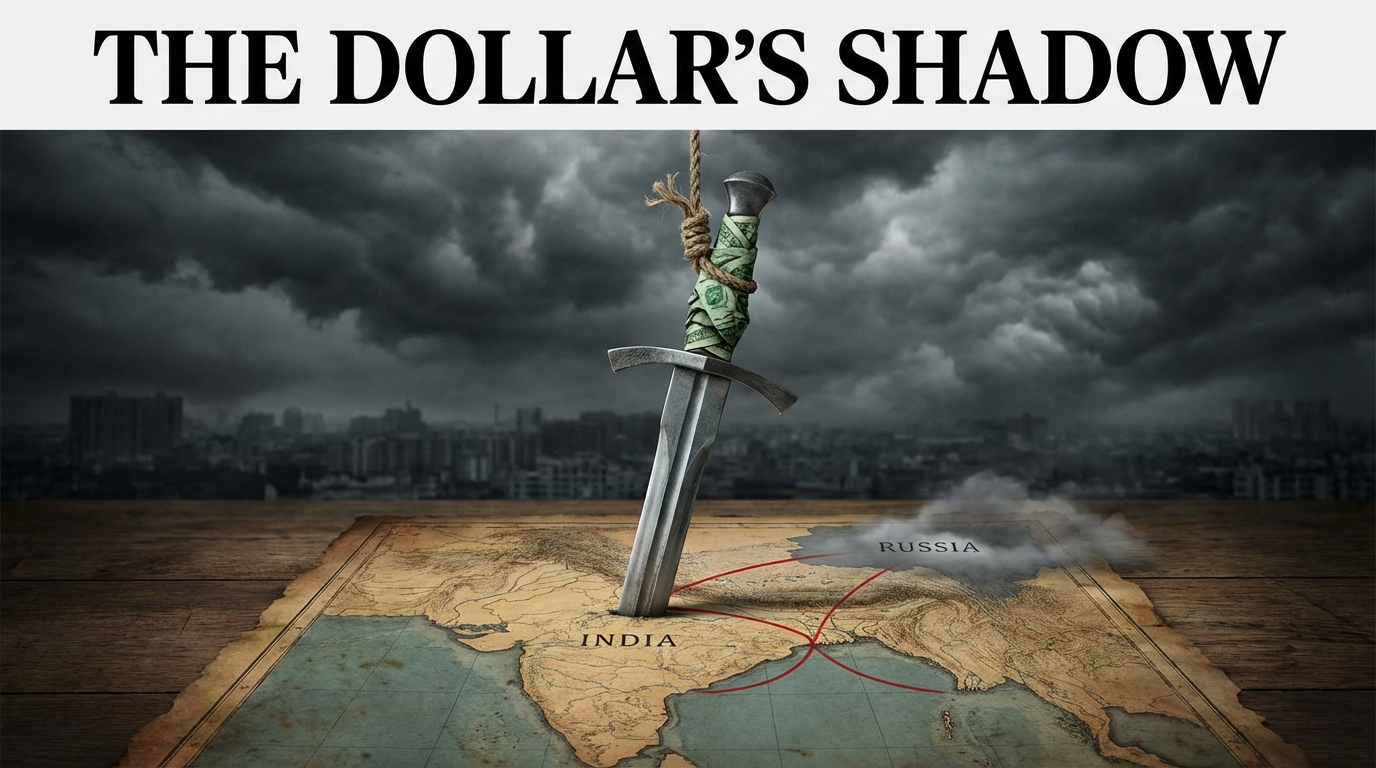
The 500% Sword: Trump's Russia Bill Could Devastate India's Economy
With 84 senators backing a bill that could impose 500% tariffs on India, New Delhi faces its most serious economic threat from Washington in decades.
On Wednesday evening, Senator Lindsey Graham announced that President Donald Trump had "greenlit" the Sanctioning Russia Act of 2025—a bipartisan bill that could impose tariffs of up to 500% on any country that continues to purchase Russian oil, natural gas, or uranium.
India is squarely in the crosshairs.
The bill, co-authored by Graham and Democratic Senator Richard Blumenthal, has an extraordinary 84 co-sponsors in the 100-member Senate. A companion House bill led by Representative Brian Fitzpatrick has over 150 supporters. A vote could come as early as next week.
If enacted, this wouldn't just be another trade skirmish. It would be an economic nuclear option aimed at one of America's most important strategic partners.
What the Bill Actually Says
The Sanctioning Russia Act of 2025 (S.1241) gives the president sweeping authority to impose secondary sanctions on any country that "knowingly engages" in trade involving Russian-origin petroleum products, natural gas, or uranium.
The key provision: tariffs of "not less than" 500% on all goods from offending countries.
Note the language carefully: all goods. Not just energy-related products. Everything.
For India, this means pharmaceuticals, textiles, engineering goods, IT-enabled services, gems and jewellery—the entire $80 billion annual export basket to the United States would become effectively unsellable. A 500% tariff isn't a trade barrier; it's a trade guillotine.
India's Russian Energy Entanglement
India's predicament stems from decisions made after February 2022, when Russia invaded Ukraine and Western sanctions sent global oil prices soaring.
Facing an energy crisis, India pivoted hard toward discounted Russian crude. By 2023, Russia had become India's largest oil supplier, displacing traditional partners like Iraq and Saudi Arabia. At its peak, Russian oil accounted for over 35% of India's crude imports—up from less than 2% before the war.
The economics were compelling. Russian Urals crude traded at $15-20 per barrel below Brent benchmarks. For a country that imports 85% of its oil needs, the savings were substantial—estimated at $5-7 billion annually.
But those savings came with geopolitical strings attached. And now, Washington is pulling.
The Escalation Ladder
The current threat didn't emerge overnight. It represents the culmination of steadily escalating pressure.
In August 2025, the United States imposed 25% tariffs on Indian goods—ostensibly over trade practices, but widely understood as punishment for continued Russian oil purchases. By late 2025, those tariffs had doubled to 50%.
Indian refiners, reading the writing on the wall, began reducing Russian purchases. Reliance Industries, India's largest buyer of Russian crude, announced in January 2026 that it had received no Russian deliveries for weeks and expected none in the current month.
But for the bill's sponsors, this isn't enough. They want complete severance—and they're willing to use economic coercion to achieve it.
The Strategic Contradiction
Here lies the fundamental tension in American policy: India is simultaneously one of Washington's most valued strategic partners and a target of its most aggressive economic threats.
India is a founding member of the Quad. It conducts joint military exercises with American forces. It has signed foundational defence agreements that would have been unthinkable a generation ago. It is Washington's preferred counterweight to Chinese expansion in the Indo-Pacific.
Yet the same administration that celebrates the US-India strategic partnership is preparing legislation that could devastate the Indian economy.
Senator Graham, announcing Trump's support for the bill, framed it as pressure on Putin: "The goal is to give President Trump the tools he needs to end the war in Ukraine on terms favourable to the free world."
India might be forgiven for wondering whether it's being treated as a strategic partner or a pawn.
New Delhi's Limited Options
India's room for manoeuvre is constrained.
Complete abandonment of Russian energy would be economically painful and strategically unwise. Russia remains a crucial defence partner—the source of India's aircraft carriers, submarines, and a significant portion of its military hardware. The relationship predates the current crisis by decades.
Yet defying American sanctions carries enormous risks. The United States is India's largest export market. American technology, investment, and diplomatic support underpin India's economic modernisation and strategic ambitions.
External Affairs Minister S. Jaishankar has repeatedly emphasised India's strategic autonomy—the principle that New Delhi will make decisions based on its own interests, not great-power preferences. That autonomy is now being tested as never before.
The Collateral Damage
Beyond the bilateral relationship, a 500% tariff would send shockwaves through the global economy.
India is the world's pharmacy, supplying 20% of global generic medicine exports. American hospitals, pharmacies, and patients depend on Indian-manufactured drugs. Disrupting this supply chain would raise healthcare costs across the United States.
India's IT services industry—the backbone of digital transformation for countless American corporations—would face existential pressure. The tens of thousands of Indian engineers, developers, and consultants who keep American businesses running would become casualties of a dispute over Russian oil.
The irony is sharp: in seeking to punish Russia, Washington may end up punishing American consumers, businesses, and patients.
What Happens Next
The Sanctioning Russia Act faces several hurdles before becoming law. Senate floor time is limited, with a government funding package and the Martin Luther King Jr. Day recess complicating scheduling. Even with 84 co-sponsors, procedural obstacles could delay a vote.
More importantly, the bill gives the president discretionary authority. Even if passed, Trump could choose not to impose the maximum 500% tariff, using the threat as leverage rather than the reality.
This may be the calculation in New Delhi: that the bill is a negotiating tactic, not a final policy. That Washington wants to pressure India into further reducing Russian imports without actually destroying the bilateral relationship.
But calculations can be wrong. And the consequences of miscalculation—for both countries—would be severe.
The Larger Question
The 500% tariff threat crystallises a question that has haunted Indian foreign policy since the Cold War: Can a nation truly maintain strategic autonomy in a world of competing great powers?
India has long prided itself on non-alignment, on the ability to maintain productive relationships with adversaries simultaneously. It buys Russian weapons while participating in American military exercises. It imports Chinese goods while confronting Chinese troops on its border. It balances, hedges, and navigates.
The Sanctioning Russia Act suggests that this space for manoeuvre is shrinking. That in a world of great-power competition, neutrality may become increasingly untenable. That partners will be forced to choose sides.
Whether India can preserve its strategic autonomy—or whether it will be forced into the American camp through economic coercion—may be the defining foreign policy question of the next decade.
The answer will shape not just India's future, but the future of the global order itself.
Ramachandran Rajeev Kumar is the Founder and Editor-in-Chief of BarathVector.