By Ramachandran Rajeev Kumar — 2026-05-03
Tamil Nadu's counting day: three roads, three probabilities, one highest-ever turnout
The state has handed counting officers an 85.1% turnout and a question Delhi has not had to think about in a generation.
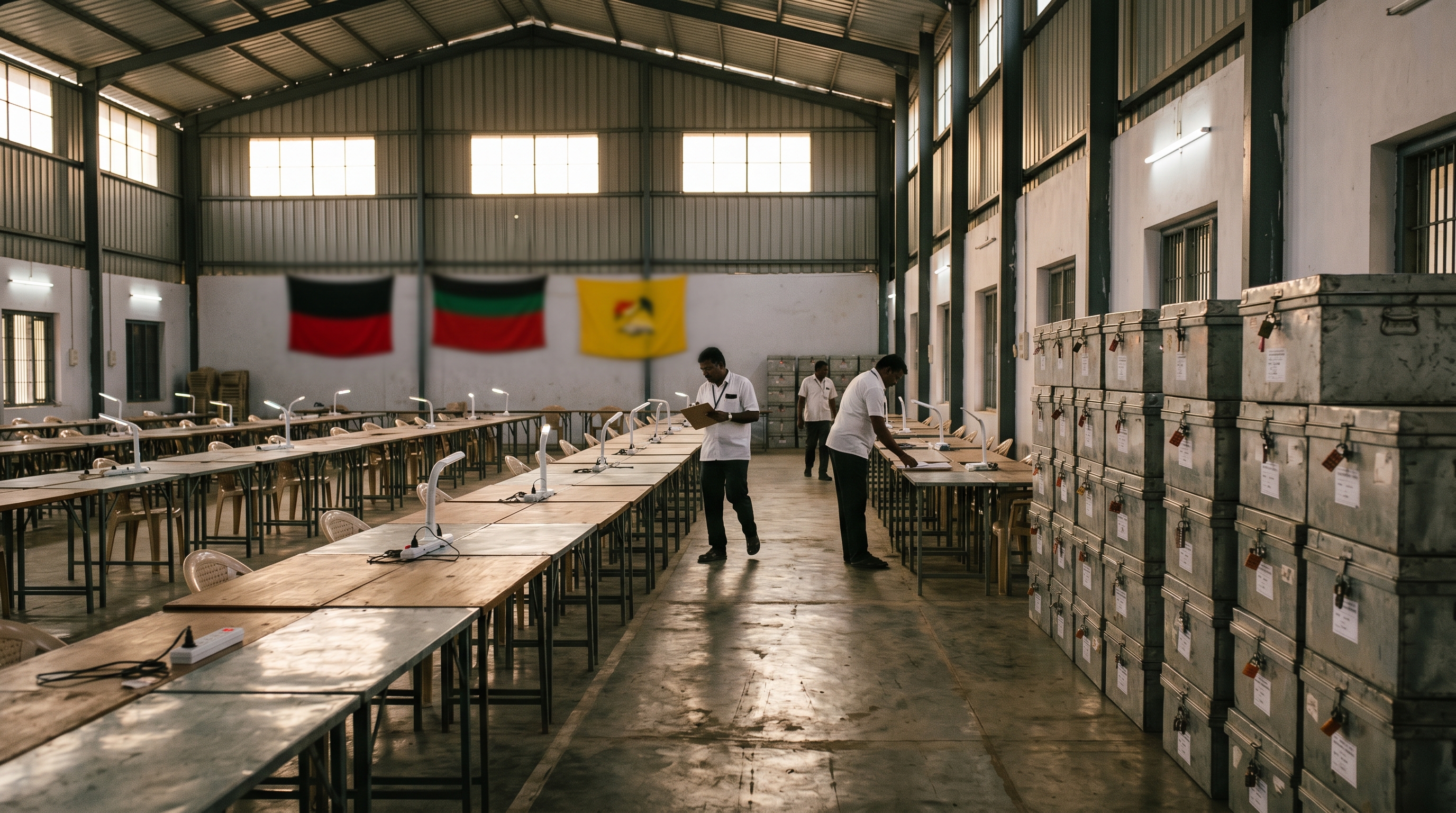
The Election Commission of India begins counting Tamil Nadu's 234 assembly constituencies at 8 a.m. on Sunday. Polling closed ten days ago. Turnout, at 85.1%, was the highest ever recorded for a Tamil Nadu assembly election. By 4 p.m. on counting day the trend will have stabilised. By 6 p.m. the government-formation question will be live.
Three scenarios are in play. They are not equally likely. The probabilities below are indicative bands rather than predictions — they are how the data, the campaign signals, and the historical baselines combine when read carefully and without flinching.
The three roads
Road 1. A clean DMK-SPA second term. Stalin returns to office. The Secular Progressive Alliance crosses 130 of 234 seats on its own, with the DMK accounting for the bulk of the count and the smaller alliance partners — Congress, CPI, CPI(M), VCK, MDMK — taking the rest. Stalin becomes the first DMK chief minister, going back to Annadurai, to be returned for a second consecutive term on his own watch. The federal posture sharpens. The Centre adjusts.
Road 2. A fragmented verdict. No single alliance crosses 118 — the bare majority. The DMK-SPA finishes ahead but in plurality, not majority. The AIADMK-BJP alliance finishes second. The Tamilaga Vettri Kazhagam, contesting under Joseph C Vijay in its first general election, finishes with a contingent — anywhere between fifteen and forty seats — large enough to deny either Dravidian alliance an unaided floor. Coalition arithmetic Tamil Nadu has not seen since 1971 begins on Monday morning.
Road 3. A clean AIADMK-BJP win. The alliance crosses 118 on its own. E Palaniswami returns as chief minister. The DMK enters its first opposition stretch in a decade. The BJP claims a southern bridgehead its national strategy has assumed for three years. The state's federal posture inverts.
A fourth theoretical road — a clean TVK majority on its own — exists in the manifestos of optimistic political columnists. It does not exist in any serious reading of the on-ground campaign. Vijay did not contest in a way calibrated to win 118 seats outright. He contested in a way calibrated to deny others 118 seats.
The probabilities, with their working shown
These are bands, not point estimates. They reflect the spread of plausible outcomes once the noise of pre-poll surveys, exit polls and turnout-pattern analysis is reconciled with the campaign's strategic geography.
| Outcome | Probability band | Direction of risk |
|---|---|---|
| Road 1 — DMK-SPA clean majority | 55-65% | Modal scenario. Risk to the upside if turnout in southern districts skewed pro-incumbent. |
| Road 2 — Fragmented / hung verdict | 25-35% | Probability rises with every additional seat the TVK is judged competitive in. |
| Road 3 — AIADMK-BJP clean majority | 5-10% | Requires anti-incumbency wave the campaign did not surface. Possible but not signalled. |
| Road 4 — TVK clean majority | <2% | Architecturally implausible in this election cycle. |
Two notes on the working.
The DMK-SPA modal range — 55-65% — is anchored to three things. First, an incumbent government with a delivered manifesto stack (the family-assistance floor, language-pillar manoeuvres, federal-share advocacy) and no major scandal cycle in the final eighteen months. Second, an alliance partner roster that did not fracture under campaign pressure. Third, a turnout pattern in which 85% is, on the historical evidence of Tamil Nadu, more often a vote of preservation than a vote of overthrow. None of these guarantee a clean majority. Together they make it the modal outcome.
The fragmented-verdict band — 25-35% — is the one that has moved most in the past month. A pre-Vijay-entry version of this election would have placed the band closer to 10-15%. The TVK debut adds, on the conservative end, a fifteen-seat bloc and, on the aggressive end, a forty-seat bloc. Either is enough to perforate the DMK-SPA majority if the underlying DMK swing is even mildly negative. The probability rises with the TVK's seat-share, not with its vote-share — those two numbers diverge sharply in first-past-the-post systems.
The AIADMK-BJP clean-majority band — 5-10% — is not zero. There are paths to 118. They require the BJP's inclusion in the alliance to be a net positive in caste-bloc consolidation rather than a net negative, which the campaign data has not clearly shown. They require Edappadi K Palaniswami to have re-anchored AIADMK identity post-OPS reconciliation, which he has done partly but not completely. They require the TVK to draw more from the DMK base than from the AIADMK base — the inverse of the most common reading. None of these conditions are individually impossible. All of them simultaneously are unlikely, which is what the band reflects.
How to read the trend by the hour
The first hour of counting (8 a.m. to 9 a.m.) is postal-ballot heavy and historically pro-incumbent. Treat that lead, in either direction, as 30% indicative.
The second to fourth hours (9 a.m. to noon) carry the bulk of the EVM trends. By 11 a.m. the swing direction is usually clear. By noon the seat range has narrowed to within 15-20 of the final tally.
The afternoon stabilisation (noon to 3 p.m.) is the period when narrow leads either consolidate or collapse. If a single alliance is hovering around 118 at 1 p.m., the next two hours decide whether it crosses or not.
By 4 p.m. the result is, for practical purposes, declared. The ECI's formal declaration follows in the early evening. Government-formation conversations, in any of the three scenarios, begin between 5 p.m. and 6 p.m.
The most informative single moment of the day is not the final tally. It is the noon read of two specific numbers — the TVK seat-count and the BJP seat-count within the AIADMK-BJP alliance. Those two numbers, more than any other, tell us which of the three roads we are on.
What each road does to the next five years
Each of the three plausible outcomes reorders the same set of variables — federal posture, caste consolidation, opposition geometry, 2029 Lok Sabha trajectory — but reorders them differently.
Under Road 1, Stalin governs to be remembered, not to win again. The federal axis sharpens. The DMK consolidates the Dravidian model as a self-renewing institution rather than a one-leader phenomenon. The AIADMK enters a structural crisis. The BJP postpones its southern build. The TVK either folds or repositions as a 2031 vehicle.
Under Road 2, every legislative agenda becomes a negotiation. Stalin's federal posture softens, because his floor is contingent. The TVK, if it holds the swing bloc, gets a kingmaker decade. The AIADMK and BJP face the question of whether to remain in alliance now that the alliance has not delivered. Delhi's Tamil Nadu calculations multiply.
Under Road 3, Edappadi K Palaniswami becomes chief minister. The DMK enters its first opposition stretch since 2011. The BJP gains its largest southern foothold. The Stalin-Modi federal stand-off inverts into a Palaniswami-Modi accommodation. The Dravidian binary survives, but the DMK loses control of its own brand for the first time in fifteen years.
The state will choose one of these three reorderings tomorrow. The choice will be made by 4 p.m.
The number that will not change
One number is fixed regardless of which road tomorrow takes.
85.1% of eligible Tamil Nadu voters cast a ballot. That is the highest assembly turnout the state has recorded. It is higher than the previous high. It is higher than the general elections of 2024 and 2019. It is higher, by a meaningful margin, than the Tamil Nadu turnout of any ten-year window the Election Commission has on file.
A turnout that high is not a generic civic-engagement signal. It is a specific message. It means that voters who do not normally turn out came out — and historically, that pool skews against the incumbent. It also means that voters who do normally turn out came out at higher rates — and that pool skews toward whichever side is the more organised on the day. The two effects partially cancel. What does not cancel is the underlying fact that Tamil Nadu wanted, in larger numbers than ever recorded, to make this decision in person.
Whichever road the state takes tomorrow, it took the road deliberately. That is the part that does not depend on the count.
The count itself begins at 8 a.m.
BarathVector will publish the result analysis within an hour of the ECI declaration.