By Ramachandran Rajeev Kumar — 2025-12-28
The Village That Argued About the Well
An Editorial Fable
By Ramachandran Rajeev Kumar
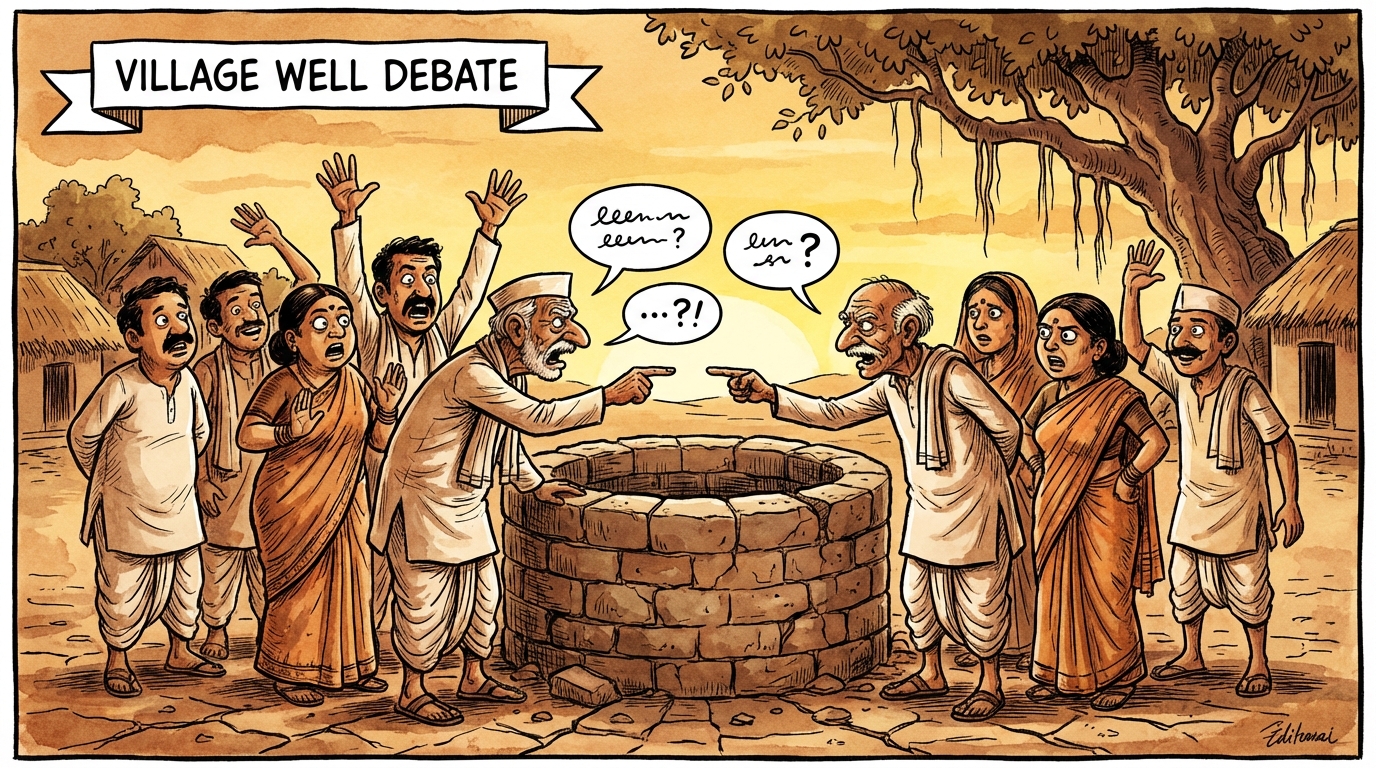
While they debated, the water level dropped another inch
In a village at the edge of the great plains, there was a well.
The well had served the village for generations. Grandmothers remembered drawing water from it as young brides. Grandfathers recalled the monsoons when it overflowed. The well was the village's heart, its lifeline, its pride.
But the well was running dry.
Each month, the water level dropped. The rope needed more length. The bucket came up lighter. By summer, the villagers could hear the echo of their own voices when they peered into the darkness below.
Something had to be done. Everyone agreed on this.
And so the village gathered to decide what to do.
The First Meeting
The headman, a portly gentleman who had held the position for thirty years, called the village to the banyan tree.
"The well is drying," he announced. "We must act."
"Indeed!" cried the villagers.
"But first," said the headman, "we must determine whose ancestors built this well. Credit must be given where credit is due."
This seemed reasonable to everyone.
The elders were consulted. Old documents were retrieved from termite-eaten trunks. Oral histories were recorded. Three families claimed their great-great-grandfathers had dug the original well. Two other families insisted the location had been chosen by their forebears. A sixth family produced a faded deed suggesting they had donated the rope.
The debate over ancestral credit consumed six village meetings.
The water level dropped three more inches.
The Second Meeting
Having failed to agree on who built the well, the villagers moved to the question of why it was drying.
"The farmers are using too much water for irrigation," said the merchants.
"The merchants are selling our water to the neighboring village," said the farmers.
"The young people are wasteful," said the elders.
"The elders built poor drainage that let the water seep away," said the young people.
"It is the neighboring village's fault," said everyone. "They have dug deeper wells and are stealing our groundwater."
A delegation was sent to confront the neighboring village. The neighboring village sent a counter-delegation claiming the original village was to blame. Both delegations returned with nothing but louder grievances.
The debate over blame consumed twelve village meetings.
The water level dropped six more inches.
The Third Meeting
Finally, a practical young woman named Lakshmi stood up.
"Respectfully," she said, "while we argue about the past, the well continues to dry. Can we not simply repair it?"
There was a moment of silence.
"She speaks sense," murmured several villagers.
"Very well," said the headman. "How shall we repair it?"
Lakshmi had a plan. The well needed to be deepened. The walls needed reinforcement. A rainwater harvesting system could be built to recharge the aquifer. She had consulted with engineers from the district town. The cost would be significant but manageable if the village pooled resources.
"An excellent plan!" said the villagers.
"But who will pay?" asked the headman.
The Fourth Meeting
The question of payment opened new wounds.
"The wealthy families should pay more," said the poor families.
"We already pay more in everything," said the wealthy families. "The burden should be shared equally."
"Those who use more water should pay more," suggested Lakshmi.
"But how will we measure usage?" asked everyone. "Who will be the measurer? Can the measurer be trusted? What if the measurer is corrupt?"
"We need a committee to select the measurer," said someone.
"We need a committee to oversee the committee," said someone else.
The formation of committees consumed eight village meetings.
The water level dropped four more inches.
The Fifth Meeting
With committees formed, the question became implementation.
"We should hire workers from our village to dig," said some.
"Our village workers are lazy," said others. "We should hire from outside."
"Outsiders will steal our jobs!" protested the village workers.
"If outsiders do the work, they will learn our well's secrets and share them with enemies."
"What enemies? We are a peaceful village."
"Exactly what an enemy would say."
The debate over labour policy consumed ten village meetings.
The water level dropped five more inches.
The Sixth Meeting
Summer arrived. The well was now barely yielding water. The villagers had to walk to a distant river for their daily needs. Children missed school. Farms wilted. The old and sick suffered most.
The village gathered again, now in crisis.
"We must act immediately!" cried the headman.
"Yes, but we still haven't resolved the payment structure," said the treasurer.
"Or the labor source," said the workers' representative.
"Or the question of ancestral credit," said the descendants of the maybe-builders.
"Or the blame for the crisis," said everyone, pointing at each other.
Lakshmi stood again. "The well is almost dry. If we do not act today, there will be nothing left to argue about."
"She is being dramatic," said the headman. "We have process. We have committees. We cannot abandon due deliberation simply because of urgency."
"The urgency IS the deliberation!" said Lakshmi.
"That makes no sense," said the headman. "Sit down."
Lakshmi sat down.
The Seventh Meeting
By monsoon's end, the well was empty.
The village gathered one last time at the banyan tree. The mood was somber.
"Well," said the headman, "this is unfortunate."
"Whose fault is it?" asked someone.
"Clearly, it is the fault of those who opposed my proposals," said another.
"No, it is the fault of those who proposed unworkable solutions," said a third.
"It is the fault of the previous generation," said the young.
"It is the fault of the current generation," said the old.
The neighboring village, they all agreed, was definitely to blame.
The Epilogue
Years later, a traveler passed through what remained of the village.
He found a few families still there, drawing water from a river an hour's walk away. The fields were fallow. The young had migrated to cities. The old waited to die.
"What happened to your village?" the traveler asked an ancient woman.
"We had a well," she said. "It ran dry."
"Could it not have been repaired?"
The woman laughed, though there was no joy in it.
"Oh, we tried. We held meetings. Many meetings. We formed committees. We debated credit and blame and payment and process. We were very thorough."
"And then?"
"And then the well dried up."
"While you were still deliberating?"
"We never stopped deliberating," she said. "We are deliberating still. Just yesterday, my nephew and his cousin argued for three hours about whose grandfather was more responsible for the well's failure."
The traveler looked at the dry stone circle where the well had once been. Weeds grew through the cracks. The bucket and rope had rotted away.
"What lesson did the village learn?" he asked.
The old woman considered this.
"We learned," she said slowly, "that we were very good at arguing. World-class arguers, we were. Champions of debate. Masters of deliberation."
"And the lesson about the well?"
The old woman looked at him with ancient eyes.
"What well?" she said.
The Moral
The well doesn't care who built it. The well doesn't care who's to blame. The well doesn't care about process, committees, or ancestral credit. The well only knows whether it has water or not.
And when the well runs dry, all the arguments in the world won't bring back a single drop.
This fable is fictional. Any resemblance to nations, parliaments, or climate conferences is purely coincidental and entirely deliberate.