By Ramachandran Rajeev Kumar — 2025-12-27
The Union Paradox: When Worker Protection Derails Work Itself
By Ramachandran Rajeev Kumar
There is a cruel irony at the heart of India's labour story.
For decades, we built an elaborate fortress of worker protections. Laws that made it nearly impossible to fire anyone. Regulations that required government permission to lay off workers. Mandates that turned every factory into a bureaucratic maze.
The intention was noble: protect the worker from exploitation.
The result was perverse: we protected workers right out of their jobs.
The Numbers Don't Lie
Here is the uncomfortable truth that labour unions refuse to confront.
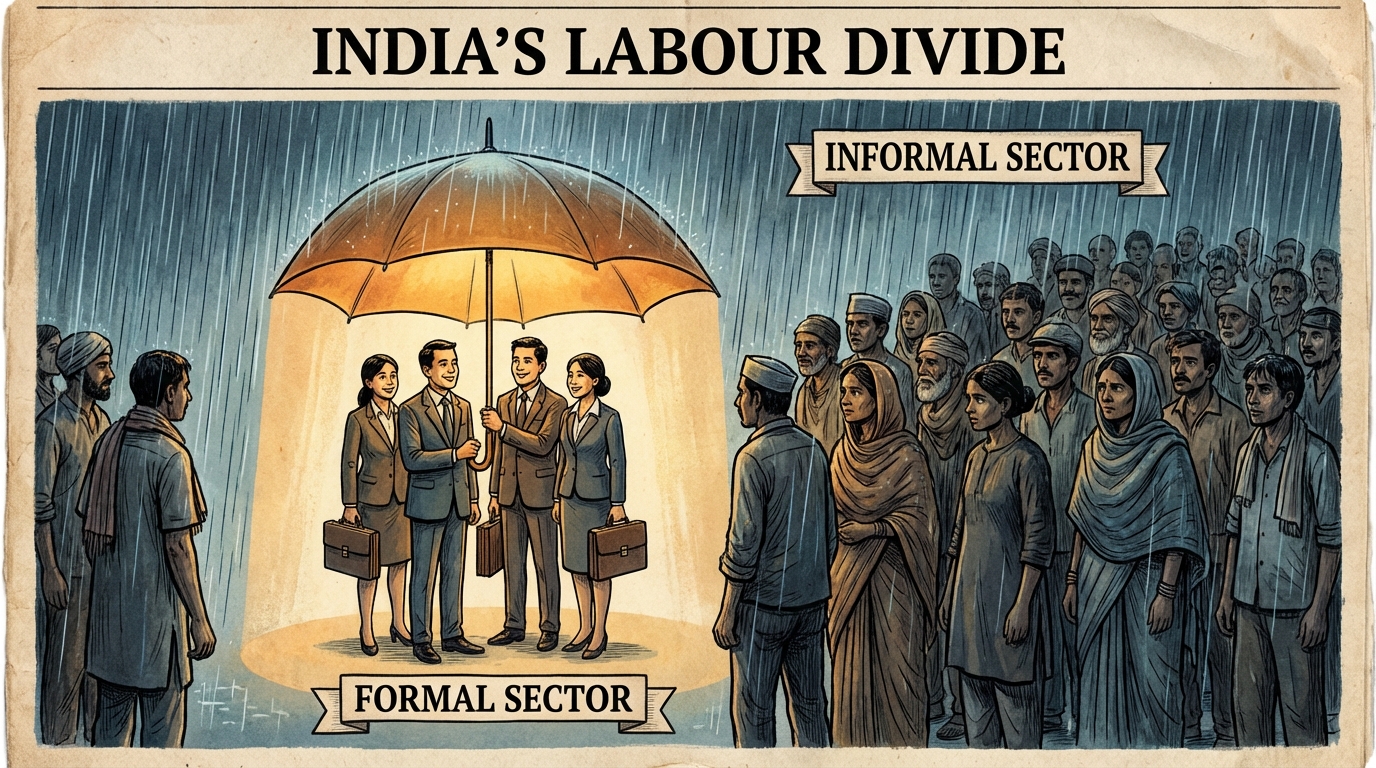
90% of India's workforce operates in the informal economy. Over 400 million workers labor without written contracts, without provident funds, without health insurance, without any of the protections that unions spent decades fighting for.
The formal sector, with all its elaborate protections, employs barely 10% of workers.
So who exactly did those protections protect?
A small aristocracy of labour. Government employees. Public sector workers. Employees of large corporations who could afford the compliance burden. Meanwhile, the overwhelming majority of Indian workers, the street vendors, the construction laborers, the domestic workers, the agricultural hands, they work without a safety net of any kind.
The laws designed to protect workers created a system that excluded most workers from protection.
This is the union paradox.
How We Lost Manufacturing to Smaller Nations
While Indian unions were fighting to preserve rigid labour laws, something was happening in the global economy that should have served as a wake-up call.
Bangladesh and Vietnam were eating our lunch.
According to the World Bank, India's share in global exports of apparel, leather, textiles, and footwear peaked at 4.5% in 2013. By 2022, it had declined to 3.5%. In the same period, Bangladesh reached 5.1% and Vietnam hit 5.9%.
Let that sink in. Bangladesh, a country we helped liberate in 1971, now exports more garments than we do. Vietnam, with one-fourteenth of our population, has become the poster child of the China+1 strategy, attracting $37 billion in FDI in 2023 alone.
Why?
Ask any manufacturer who considered setting up in India and then chose Vietnam instead. The answer is almost always the same: labour flexibility.
In Vietnam, if your orders drop, you can adjust your workforce. In India, if you hire 100 workers, you are married to those 100 workers for life. Government permission is required for layoffs. Inspector raj awaits any attempt at restructuring. The compliance burden is so heavy that many businesses simply choose to stay small.
The result: 80% of India's non-farm workforce is employed in firms with fewer than 10 workers. Even among registered manufacturing firms, the median size is around 20 workers.
We created laws that made it rational to stay small. Staying small meant staying unproductive. Staying unproductive meant we couldn't compete with Vietnam and Bangladesh.
The workers those laws were meant to protect? Many of them don't have jobs at all.
The Informal Economy Trap
Here is where the paradox becomes truly tragic.
Over 94% of the 27.69 crore informal sector workers registered on the e-Shram portal earn Rs 10,000 or less per month. That's approximately $120. These workers have no EPF, no ESI, no pension, no paid leave, no maternity benefits.
Meanwhile, the 10% in the formal sector enjoy all these benefits plus job security so strong that termination is virtually impossible.
This isn't worker protection. This is worker apartheid.
The formal sector worker can underperform for years and still keep their job. The informal sector worker can be dismissed without notice, without compensation, without recourse. The law protects one class while abandoning the other.
And the unions? They primarily represent the protected class. The voice of the 90% is largely absent from labour negotiations.
When nine central trade unions burned copies of the new labour codes in November 2025, calling them "anti-worker," one has to ask: which workers are they defending? The privileged 10%, or the vulnerable 90%?
The November 2025 Reform
On November 21, 2025, India finally implemented the four labour codes that had been pending since 2019-2020. These codes consolidated 29 colonial-era labour laws into four streamlined frameworks covering wages, industrial relations, social security, and occupational safety.
The most controversial change: raising the threshold from 100 to 300 workers for requiring government permission to lay off workers.
Unions called this a disaster. But consider the alternative.
Under the old regime, any factory with more than 100 workers was essentially frozen. You couldn't respond to market changes. You couldn't restructure during downturns. You couldn't modernize if it meant workforce reduction. The rational response was to never grow beyond 99 workers, or to outsource everything to contract labour who had no protections at all.
The new threshold gives medium-sized enterprises room to grow. It allows factories to respond to demand fluctuations. It creates space for the kind of industrial scaling that Vietnam and Bangladesh have achieved.
Will some workers be laid off? Perhaps. But will more workers be hired in the first place? Almost certainly.
You cannot protect jobs that don't exist.
A New Social Contract for the Gig Age
The most forward-looking aspect of the new labour codes is the recognition of gig and platform workers.
For the first time, Indian law now defines "aggregator," "gig worker," and "platform worker" and brings them under social security coverage. Platforms like Uber, Swiggy, and Zomato must now contribute 1-2% of annual turnover toward a Social Security Fund for these workers.
This is the future of work. The International Labour Organization projects that India's gig economy will employ 23.5 million workers by 2029-30. These are not traditional factory workers who need protection from arbitrary dismissal. They are flexible workers who need portable benefits that follow them from gig to gig.
The old union model, built around permanent employment at a single factory, is obsolete for this workforce. What they need is:
- Portable social security that travels with the worker, not the job
- Skills training that keeps them employable across platforms
- Minimum earning guarantees rather than minimum wage rates
- Health coverage that isn't tied to a specific employer
Denmark's "flexicurity" model offers a template: high flexibility for employers to hire and fire, combined with robust social safety nets and active labour market policies that help workers transition between jobs.
India's new codes move in this direction, but implementation remains patchy. States still need to notify their rules. The ecosystem of training and transition support is underdeveloped. But the direction is right.
The Uncomfortable Questions Unions Won't Ask
If labour unions are truly worker advocates, they should be asking themselves some hard questions:
Why did you let 90% of workers fall outside the protection regime? For decades, unions focused on the organized sector while the informal economy mushroomed. Where were the campaigns to organize domestic workers, construction laborers, street vendors?
Why did you oppose every reform that might create more jobs? Flexibility isn't inherently anti-worker. In a growing economy, flexibility means more hiring. The countries that created the most manufacturing jobs in the last two decades, China, Vietnam, Bangladesh, all had more flexible labour markets than India.
Why do you represent only the labor aristocracy? Government employees and public sector workers are already the best-protected workers in India. Their unions are among the most powerful. Yet they consume most of the union energy and political capital. Where are the unions for gig workers? For informal workers?
Why do you treat every job as permanent and immutable? In a changing economy, industries rise and fall. Skills become obsolete. The goal should not be to freeze every existing job in place, but to ensure that workers can navigate transitions safely. This requires portable benefits, retraining programs, and income support during transitions, not litigation against every restructuring.
The Path Forward
India stands at a crossroads.
We can continue with the old model: rigid protection for a privileged few, informality for the masses, and manufacturing jobs flowing to our competitors.
Or we can build a new social contract.
This contract would recognize that:
Flexibility and security are not opposites. Denmark proves that you can have easy hiring and firing alongside strong social safety nets. The goal is to protect workers, not specific jobs.
Formal sector expansion requires formal sector flexibility. The only way to bring the 90% into the formal economy is to make formal employment attractive to employers. This means reducing compliance burden, streamlining inspections, and allowing reasonable workforce adjustments.
Universal social security matters more than job security. In the gig economy, workers will have many employers over their careers. Benefits should be portable and universal, not tied to specific employers.
Skills are the ultimate protection. A worker with in-demand skills will always find employment. Investment in vocational training, continuous learning, and skill certification is more protective than any regulation.
Growth creates more jobs than regulation preserves. If rigid laws kept Vietnam-level manufacturing from coming to India, those laws cost far more jobs than they saved.
The Union That India Needs
India needs a new kind of worker movement. Not one that fights to preserve the privileges of the few, but one that fights for the inclusion of the many.
This movement would organize the unorganized. It would demand universal social security. It would push for skill development. It would advocate for portable benefits. It would recognize that in a globalized economy, worker welfare depends on economic competitiveness, not just legal protection.
The old unions can reform and lead this movement. Or they can become increasingly irrelevant as the economy moves on without them.
The labour codes of 2025 are not perfect. Implementation will face challenges. Some provisions may need adjustment. But the direction, toward flexibility with security, toward inclusion of gig workers, toward modernization of colonial-era laws, is correct.
The real question is whether India's labour movement will evolve to serve all workers, or continue to serve only those who already have the most.
The paradox must end. Protection that excludes is not protection at all.
The opinions expressed in this article are those of the author.