By Ramachandran Rajeev Kumar — 2026-02-17
In January 2026, Capital Economics quietly updated its Global Fracturing map -- the analytical framework that sorts the world's economies into US-aligned, China-aligned, and unaligned categories. India, which had spent the previous two years drifting into the "US-leaning" column on the strength of Quad enthusiasm and defence partnership expansion, was moved back to "unaligned."
The reclassification was not a demotion. It was a diagnosis. And for anyone paying attention to what New Delhi has been doing over the past twelve months, it was overdue.
The Pendulum Stops
India's tilt toward Washington was never ideological. It was transactional: defence technology transfers, intelligence sharing, semiconductor supply chain access, and the implicit understanding that the US and India shared a strategic interest in managing China's rise. The Quad -- India, the US, Japan, and Australia -- was the institutional expression of that convergence.
Then Donald Trump returned to office and applied a 50 percent tariff on Indian goods. Twenty-five percent as a "reciprocal" measure, plus an additional twenty-five percent for India's continued purchase of Russian crude. Indian exports to the United States fell 37 percent between May and September 2025, dropping from 8.8 billion to 5.5 billion dollars in four months. The Quad summit, which India was meant to host, was effectively shelved when Trump cancelled his visit. He then described his meeting with Xi Jinping as a "G-2" summit, which told New Delhi everything it needed to know about where India stood in Washington's mental hierarchy.
The pendulum that had been swinging toward over-dependence on America did not just slow down. It stopped.
The Galvanisation
What happened next will be studied in trade policy courses for decades. India, having been jolted awake from whatever comfortable assumptions it had been building about American partnership, did something it had failed to do for the previous fifteen years: it signed trade deals. Fast.
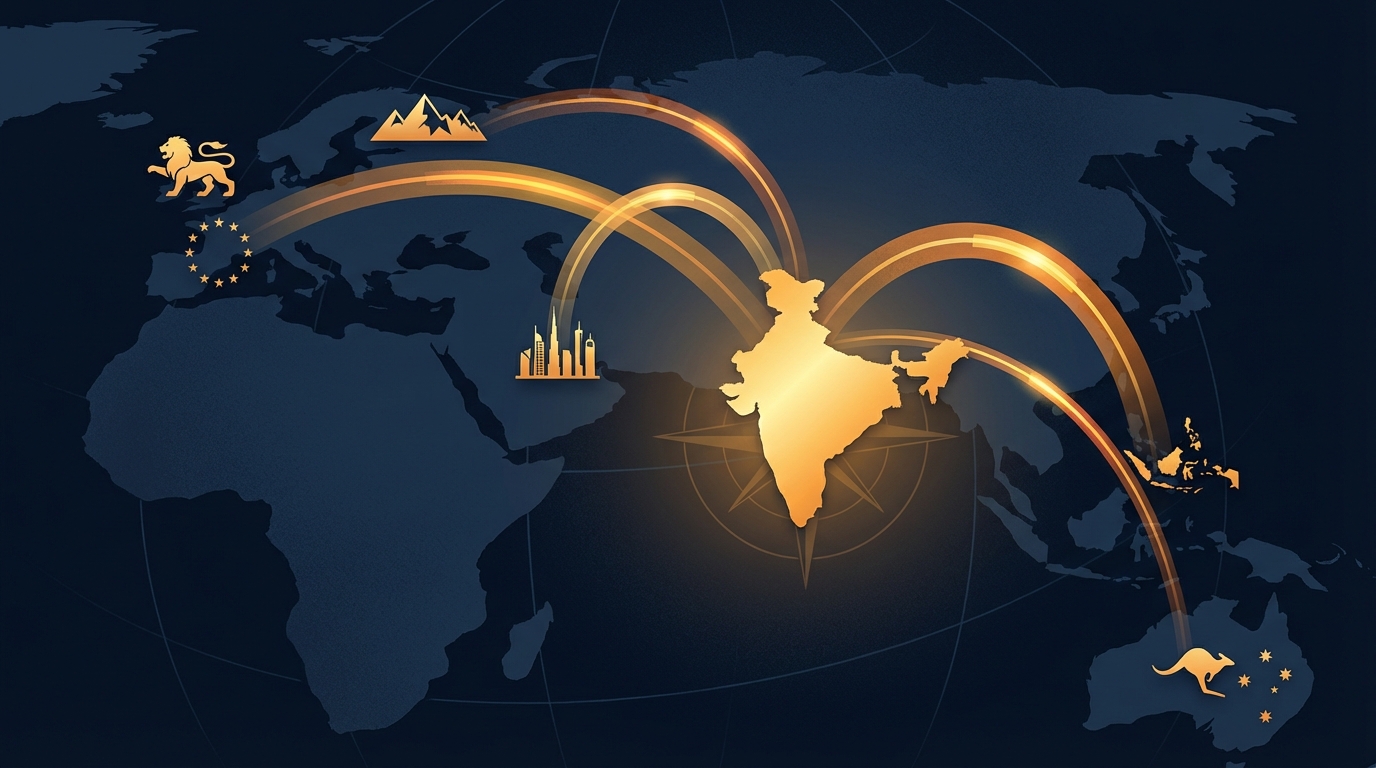
The numbers are staggering. Since 2021, India has finalised seven trade pacts -- with Mauritius, Australia, the UAE, the UK, EFTA, Oman, and New Zealand. But the centrepiece landed on January 27, 2026, when India and the European Union concluded a Free Trade Agreement that the World Economic Forum called "the mother of all deals." Two billion people. Twenty-five percent of global GDP. India's 22nd FTA and the largest ever concluded by either side.
Under the deal, India agreed to reduce car tariffs from 110 percent to 10 percent over five years, granting quota access for 250,000 EU vehicles annually. In return, the EU granted immediate zero-duty access for Indian textiles, leather, footwear, gems, and jewellery -- labour-intensive sectors where tariffs of up to 10 percent were eliminated upon entry into force. India secured commercially meaningful access across 144 EU service subsectors, including IT, financial services, education, and tourism. The EU's Carbon Border Adjustment Mechanism remains intact, but Brussels committed 590 million dollars to help India decarbonise its heavy industry.
India's trade with FTA partners has grown 92 percent since 2021. That is not a statistic. That is a structural reorientation of the world's fifth-largest economy.
Thank You, Mr. Trump
Here is the uncomfortable truth that no diplomat will say publicly but every trade negotiator in South Block understands: India owes Donald Trump a debt of gratitude.
For years, India's FTA machinery was stuck. The EU deal had been under negotiation since 2007 -- seventeen years of false starts, agricultural red lines, and institutional inertia. The UK deal languished. The EFTA deal was a backburner item. India was content to rely on bilateral chemistry and WTO rules, secure in the belief that the American umbrella would hold.
Trump shattered that belief in the space of one tariff announcement. And the shattering was precisely what India needed.
The flurry of FTA completions in 2025-2026 was not coincidental. It was panic transformed into strategy. When Washington proved unreliable, New Delhi stopped treating trade diversification as a long-term aspiration and started treating it as an urgent national security imperative. The EU, stung by its own Trump experience and desperate to diversify away from dependence on both the US and China, met India halfway. The UK, post-Brexit and searching for relevance, signed eagerly. Canada reopened negotiations. The EFTA deal -- with its historic 100 billion dollar investment pledge from Switzerland, Norway, Iceland, and Liechtenstein -- was implemented by October 2025.
None of this would have happened at this pace without the Trump shock. India needed someone to demonstrate, unmistakably, that strategic over-dependence on any single power is a vulnerability, not a strategy. Trump obliged.
The Unaligned Advantage
Capital Economics noted that India's shift was "the most notable" movement on their fracturing map, adding that a realignment toward China rather than the US would represent a "material shift in the geopolitical balance." This is correct, but it understates India's actual position.
India is not tilting toward China. It is tilting toward itself.
The BRICS chairmanship in 2026 gives India a platform to shape the non-Western order without becoming a Chinese satellite. New Delhi has been careful to push for consensus-based BRICS expansion and local currency trade settlement -- not yuan-based mechanisms -- effectively preventing the grouping from becoming an instrument of Beijing's geopolitical agenda.
Meanwhile, the trade architecture India has built in the past twelve months means it is no longer dependent on any single market or any single relationship. The EU deal alone covers exports worth 75.85 billion dollars in potential accelerated growth. Add the UK, EFTA, Australia, UAE, and ASEAN, and India has constructed a web of commercial relationships that no single partner's tariff tantrum can unravel.
This is what genuine strategic autonomy looks like. Not the performative non-alignment of the Cold War, where India chose neither side and paid the price in economic isolation. This is a transactional, diversified, hard-nosed version of independence -- where India trades with everyone, allies with no one permanently, and leverages its 1.4 billion consumers as the ultimate negotiating chip.
The New Doctrine
India's foreign policy establishment has always talked about strategic autonomy. For decades, the phrase was a polished way of saying India could not decide. That era is over.
The combination of Trump's tariffs, the EU mega-deal, the BRICS chair, the EFTA investment pledge, and the resumed engagement with China through the SCO has produced something new: a country that is unaligned not by default but by design. India is not sitting on the fence. It is building the fence, charging admission to both sides, and using the proceeds to fund its own infrastructure.
Capital Economics moved India from "US-leaning" to "unaligned." A more accurate label would be "strategically omni-aligned" -- present in every room, committed to none, and useful to all. It is a posture that requires enormous diplomatic skill, and for the first time in its independent history, India appears to have both the economic weight and the institutional confidence to sustain it.
The unaligned republic is not lost. It has arrived.