By Ramachandran Rajeev Kumar — 2026-02-10
The Three Sisters and the Glass Screen
An Editorial Fable
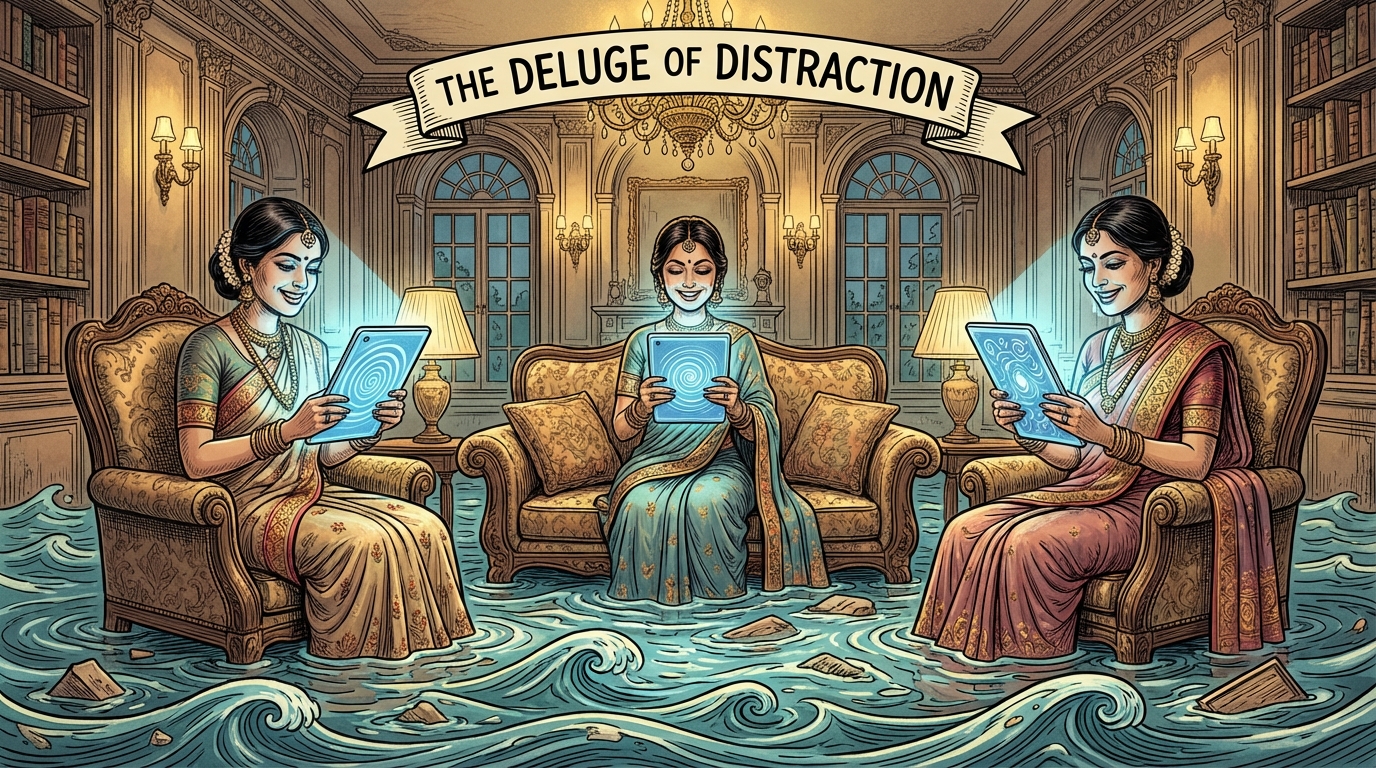
Three sisters, three screens, and a house that nobody is watching
Once, in a house that was very old and very large, there lived three sisters.
The eldest was called Democracy. She was proud and argumentative, fond of loud debates, and convinced that her voice was the most important sound in any room. She had once been the envy of the neighbourhood -- disciplined, principled, a keeper of rules that others admired even when they could not follow them. But in recent years, Democracy had discovered the glass screen.
Now she spent her mornings reading what people said about her, and her afternoons saying things about people who said things about her. She had 97 crore followers, and each one had an opinion, and Democracy found that she could not stop reading them. She had forgotten what she thought about anything because she was too busy tracking what everyone else thought about everything.
The middle sister was called Economy. She was clever and ambitious, always counting, always planning, always chasing a number that was slightly larger than the last number. She had built remarkable things -- bridges and highways and factories and a space programme that made the neighbours gasp. But Economy, too, had found the glass screen.
She now spent her days watching charts that went up and charts that went down, and she had developed an addiction to notifications. Every ping told her that something had changed -- a market had moved, a currency had shifted, a startup had raised money. Economy refreshed her screen every eleven seconds, because the world moved fast and she was terrified of being the last to know. She had not looked out the window in three years.
The youngest sister was called Culture. She was dreamy and creative, the keeper of songs and stories, the one who remembered the family's history when the others were too busy to care. Culture had been the soul of the house -- the one who knew which festivals to celebrate, which languages to preserve, which stories to tell the children so they would know where they came from.
But Culture had found the glass screen too. And on the glass screen, she discovered that the whole world wanted short stories -- fifteen seconds, no more. So Culture learned to dance in fifteen-second bursts, to compress ancient epics into slides, and to measure her worth in likes. She had 61% of her children spending more than three hours a day watching her perform, and she called this engagement.
None of the sisters noticed the water.
It had started as a trickle -- a thin stream running under the front door. The kind of thing you might notice if you looked down, but the sisters never looked down because their screens were at eye level.
The water rose past the floor tiles. It reached the hem of Democracy's sari, but Democracy was arguing about an algorithm and did not feel the cold. It lapped at Economy's ankles, but Economy was watching a real-time dashboard of GDP projections and thought the dampness was just humidity. It soaked Culture's manuscripts, but Culture was uploading a reel and assumed the smudged ink was a filter effect.
The children of the house noticed. They always do.
"The water is rising," said a child to Democracy.
"File a petition," said Democracy, without looking up. "There is a process."
"The water is rising," said a child to Economy.
"Is there an app for that?" said Economy. "Check the store. There should be a drainage solution with a freemium model."
"The water is rising," said a child to Culture.
"Make a video about it," said Culture. "Use a trending sound. Maybe it will go viral."
The children looked at each other. They were fifteen years old, and between them they had six glass screens and twenty-three social media accounts, but even they could see that the water was now waist-deep and the house was flooding.
Here is the thing about water: it does not care about your engagement metrics.
The Economic Survey of 2025-26 -- a document that Democracy is responsible for commissioning, Economy is responsible for interpreting, and Culture is responsible for communicating -- flagged digital addiction as a national public health challenge. It noted that the children of the house were spending their formative years not learning to think, create, or build, but scrolling through an infinite feed designed by engineers whose explicit goal is to make scrolling irresistible.
The Survey proposed age-based access limits. It proposed that nobody under sixteen should be permitted to maintain a social media account. It proposed, in the careful language of policy documents, that the three sisters should perhaps look up from their screens and notice the water.
The sisters read the Survey -- on their screens, naturally -- and each had a response.
Democracy said it was a free speech issue and formed a committee.
Economy said it was a market issue and commissioned a report on the monetisation of attention.
Culture said it was already making a documentary about it and could they please share the hashtag.
The water continued to rise.
In the old stories -- the ones Culture used to tell before she discovered reels -- there was usually a wise elder who arrived at this point in the narrative to deliver a warning. The elder would say something about how a house divided against itself cannot stand, or how those who do not look where they are walking will eventually fall.
But the wise elders had also found the glass screen. They were on WhatsApp groups, forwarding messages about the water to each other, arguing about whether the water was really rising or whether the floor was sinking, and sharing photographs of houses that had flooded worse.
So the warning will have to come from the children. It usually does.
The question is whether the three sisters will hear it over the sound of their own scrolling.
The house, incidentally, is still very old and very large. It has survived floods before. But it has never before faced a flood in which every member of the household was too distracted to pick up a bucket.
The water is patient. The screen is bright. And the sisters are still scrolling.
The author is Founder & Editor-in-Chief of BarathVector.