By Ramachandran Rajeev Kumar — 2026-01-16
By Ramachandran Rajeev Kumar
The Numbers That Tell Two Stories
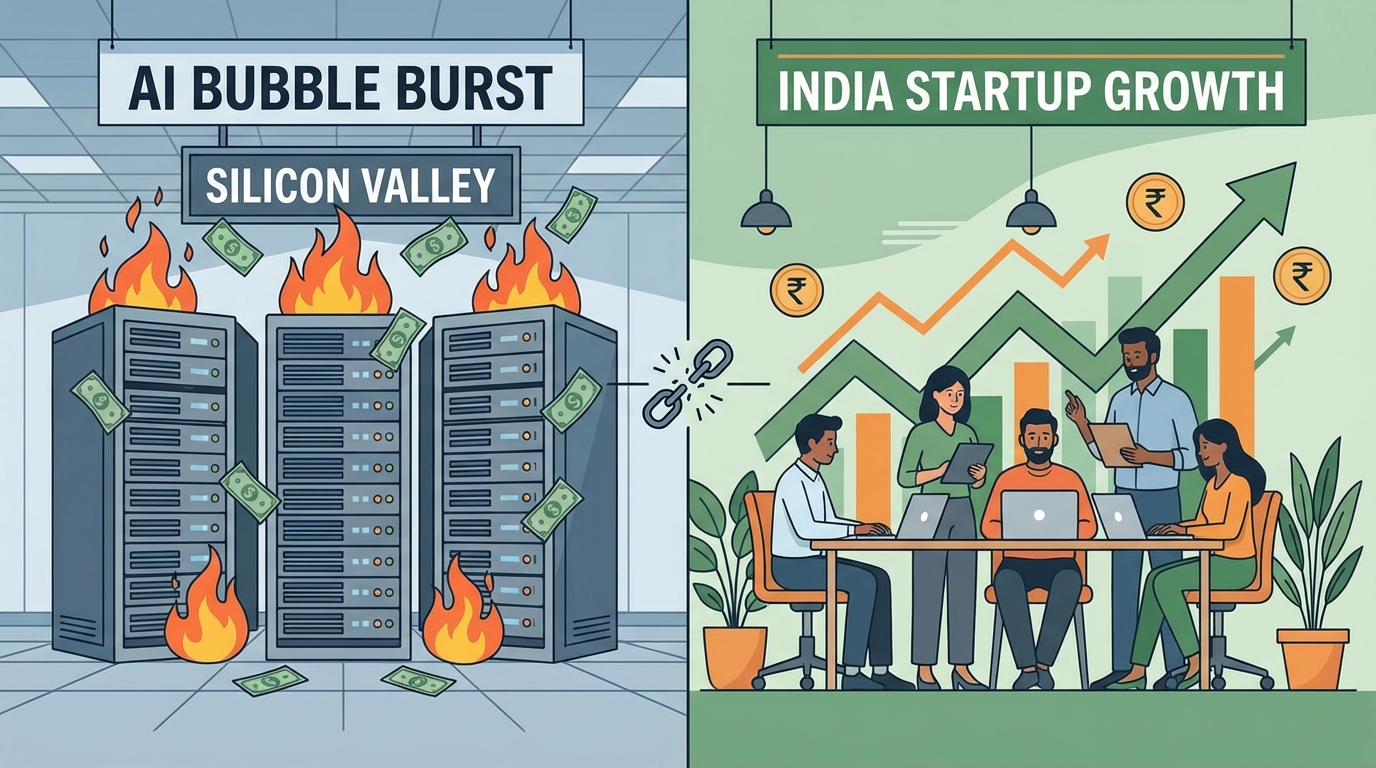
Silicon Valley, 2025: AI startups raise $121 billion across 765 rounds—a 141% surge. Microsoft commits $80 billion to AI data centers. Meta pledges $72 billion to AI infrastructure. Goldman Sachs CEO warns: "AI valuations could push beyond sustainable fundamentals."
India, 2025: Startups raise $10.5 billion, down 17% from 2024. Deals plummet 39% to 1,518. AI startups get just $643 million—a modest 4.1% increase. Yet 6 new unicorns emerge, most of them profitable.
The question: Is India's "startup winter" actually smarter than Silicon Valley's "AI summer"?
The answer: Yes. Here's why.
The Funding Decline That Wasn't a Failure
The Numbers
India's startup ecosystem raised $10.5 billion in 2025, down from ~$12.7 billion in 2024. Headlines screamed "Startup Winter." Founders panicked. Investors tightened purse strings.
But look closer:
| Stage | 2025 Funding | Change |
|---|---|---|
| Seed | $1.1 billion | -30% |
| Early-stage | $3.9 billion | +7% |
| Late-stage | $5.5 billion | -26% |
Early-stage funding grew. Why?
Because investors stopped funding hype and started funding fundamentals.
The Shift
Neha Singh, co-founder of Tracxn, explains:
"Capital deployment focus has increased towards early-stage startups who can demonstrate stronger product–market fit, revenue visibility, and unit economics."
Translation: Investors are writing bigger checks to fewer companies—but those companies have real businesses.
Seed-stage funding fell 30% because investors cut speculative bets. Late-stage funding fell 26% because scale-at-all-costs no longer flies. Early-stage grew because founders with traction are getting rewarded.
This isn't a winter. It's a maturation.
The Profitability Revolution
The Old Model (2020-2022)
Raise big → Burn fast → Grow user base → Worry about profits later
Outcome: Unicorns valued at $10 billion with zero revenue. Layoffs when funding dried up. Down rounds. Shutdowns.
The New Model (2025)
Unit economics → Burn rate control → Profitability → Then scale
Outcome: Over one-third of Indian startups chose profitability and runway extension over fundraising in 2025.
The 2025 Unicorns: Profitable, Not Just Valuable
India added 6 new unicorns in 2025: Juspay, Netradyne, Porter, Drools, Jumbotail, Dhan.
What makes them different?
Porter (logistics):
- Turned profitable in FY25: ₹55.2 crore PAT (vs ₹95.7 crore loss in FY24)
- Revenue jumped 58% to ₹4,306.2 crore
- Profit-first logistics, not burn-fueled expansion
Dhan (trading platform):
- PAT of ₹400 crore in FY25 (more than double ₹177 crore in FY24)
- Revenue surged 2.4x to ₹900 crore
- Profitable from year 1
Drools (pet care):
- Profitable for the last two years
- Bootstrapped mindset, even with VC money
Compare to Silicon Valley 2025:
- 765 AI funding rounds, $121 billion deployed
- How many profitable? Less than 10% of non-tech firms actively using AI as of mid-2025
- Revenue? Most AI startups still figuring out monetization
- AGI timeline? "5 years away" (said every year since 2018)
India's 2025 unicorns: Profitable now. Silicon Valley's 2025 AI darlings: Profitable... someday... maybe.
The AI Funding Gap—And Why It's a Good Thing
The Staggering Difference
- India AI funding (2025): $643 million, 100 deals
- US AI funding (2025): $121 billion, 765 rounds
Ratio: US received 188 times more AI funding than India.
Surface reading: India is losing the AI race.
Deeper truth: India is avoiding the AI bubble.
Silicon Valley's AI Spending Frenzy
$80 billion (Microsoft) + $72 billion (Meta) = $152 billion on AI data centers and infrastructure in one year.
For what?
- Foundational models that cost $100M+ to train
- AGI dreams that remain 5-10 years away
- Enterprise adoption rates still below 10%
Goldman Sachs CEO David Solomon: "AI's rapid acceleration could push valuations beyond sustainable fundamentals."
JP Morgan's Jamie Dimon: "I'm far more worried than others" about an AI-driven market boom mirroring the dot-com crash.
The risk: When the bubble bursts, thousands of AI startups with no revenue will implode.
India's AI Strategy: Applications, Not Models
India's $643M AI funding favored application-led businesses over capital-intensive model development.
Translation: India isn't trying to build GPT-5. India is building:
- AI-powered logistics (Porter)
- AI trading tools (Dhan)
- Consumer apps using existing LLMs
- B2B automation using OpenAI/Anthropic APIs
Why this works:
- Lower capital requirements: No need for $100M model training
- Faster time-to-revenue: Applications solve real problems today
- Sustainable margins: Not competing with OpenAI; partnering with them
An Accel partner noted: "India doesn't yet have an AI-first company generating $40–$50 million of revenue in a year's time frame. But we have dozens generating $5–$10 million—profitably."
India's approach: Make money on AI applications. Let Silicon Valley lose money on AI infrastructure.
The Unit Economics Revolution
The Investor Shift
Due diligence now emphasizes unit economics and profitability over growth charts.
What changed?
| Old Questions (2021) | New Questions (2025) |
|---|---|
| How fast can you grow? | What's your gross margin? |
| How many users? | What's CAC vs LTV? |
| When will you raise Series B? | When will you break even? |
| Can you 10x in 2 years? | Can you sustain 18-24 months runway? |
Result: Founders no longer need to burn capital aggressively to grow.
The Burn Rate Reality Check
Startups are now advised: Maintain 18–24 months of cash runway to avoid desperate fundraising that triggers down rounds.
Why?
Because capital discipline is now a competitive advantage, not a weakness.
When everyone was burning money (2021), profitability was boring. When funding dries up (2023-2025), profitability is survival.
What India Is Doing Differently (And Better)
1. Consumer-First, Not AI-First
AI deals accounted for 30–40% of India's 2025 funding. The other 60–70%? Consumer-facing companies.
Examples:
- Quick commerce (Zepto, Blinkit)
- D2C brands (Mamaearth, boAt)
- Fintech (Razorpay, CRED)
- SaaS (Freshworks, Zoho)
Why this matters: India is solving India's problems, not copying Silicon Valley's obsessions.
Silicon Valley asks: "How do we build AGI?" India asks: "How do we deliver groceries in 10 minutes?"
Both are technology problems. One has revenue today. The other might have revenue in 2030.
2. The "Third Way"
India is positioning itself as the leader of a third way—an alternative to the Silicon Valley-centric and Beijing-centric models.
Silicon Valley model: Raise billions → Build infrastructure → Worry about customers later Beijing model: State-directed capital → Build national champions → Profits optional India model: Sustainable unit economics → Profitability first → Scale second
As of December 2025, India's Semiconductor Mission approved 10 major semiconductor units across six states, representing $19 billion in investment—for long-term infrastructure, not speculative bubbles.
3. Government Support Without Distortion
New Delhi announced a $1.15 billion Fund of Funds in January 2025 to expand capital access, followed by a $12 billion Research, Development, and Innovation scheme focused on emerging technologies.
But: Government didn't dictate which startups get funded. It created capital pools and let VCs allocate.
Result: Support without distorting market incentives. Capital available, but only for startups with fundamentals.
The Sectors That Thrived (And Why)
Fintech: The Quiet Winner
Dhan (trading), Razorpay (payments), CRED (credit) all grew in 2025—profitably.
Why fintech works in India:
- 1.4 billion people, most underbanked
- UPI infrastructure (13 billion transactions/month)
- Digital-first consumers (post-COVID shift)
- Regulatory clarity (RBI sandbox, account aggregator framework)
Unit economics: Fintech can make ₹10–50 per transaction. At India's scale, that's billions in revenue.
Quick Commerce: The Burn That Paid Off
Zepto, Blinkit, Swiggy Instamart—all grew 2-3x in 2025. Still burning cash, but justified burn (building network effects, not just user acquisition).
Why it works: Urban density in India makes 10-minute delivery economically viable. Try that in suburban America.
SaaS: The Global Play
Freshworks, Zoho, Chargebee—India's SaaS unicorns serve global customers, not just Indian ones.
Unit economics: SaaS has 80%+ gross margins. Once you hit product-market fit, profitability is almost automatic.
The Silicon Valley Bubble—Waiting to Pop
The Warning Signs
- $121 billion deployed into AI, but less than 10% enterprise adoption
Less than 10% of non-tech firms actively use AI as of mid-2025. Where's the revenue?
- Valuations disconnected from fundamentals
AI startups valued at $1 billion+ with $5 million in revenue. 200x revenue multiples. In what universe is that sustainable?
- Infrastructure spending ahead of demand
Microsoft's $80 billion bet assumes AGI arrives soon and everyone needs massive compute. What if it doesn't? What if GPT-4 is "good enough" for 90% of use cases?
- Founder expectations vs investor returns
Every AI founder thinks they're building the next OpenAI. Most are building features, not companies. When that reality hits, valuations crash.
The India Advantage: Avoiding the Crash
India's $643M AI funding means:
- Fewer AI startups will fail
- Less capital destroyed when bubble pops
- Focus on applications means revenue today, not promises of AGI tomorrow
When the AI bubble bursts (and it will), India's pragmatic approach will look prescient.
What India Must Do Now
1. Double Down on Profitability
The shift toward unit economics is working. Don't reverse course when funding returns.
Metric to watch: Not unicorns created, but profitable unicorns created.
2. Build AI Applications, Not Models
Let OpenAI, Anthropic, Google spend billions on foundational models. India should:
- Use those models via APIs
- Build vertical-specific applications (healthcare AI, logistics AI, fintech AI)
- Monetize faster, with lower capital requirements
3. Export SaaS Globally
India's SaaS companies (Freshworks, Zoho, Chargebee) prove Indian founders can build for global markets.
Opportunity: $1 trillion global SaaS market, India has <2% share. 10x growth possible.
4. Keep Government Role Limited
The $1.15B Fund of Funds works because it's catalytic, not directive. Government provides capital, VCs allocate it.
Don't: Create state-backed "national AI champions" that burn billions without accountability (see: China's semiconductor subsidies, 90% failure rate).
5. Celebrate Profitability, Not Valuation
Porter's ₹55 crore profit is more impressive than a $10 billion valuation with zero revenue.
Culture shift needed: From "How much did you raise?" to "When did you break even?"
The Paradox Resolved
Is India's "startup winter" actually smarter than Silicon Valley's "AI summer"?
Yes.
Here's the scorecard:
| Metric | Silicon Valley (2025) | India (2025) | Winner |
|---|---|---|---|
| AI Funding | $121B | $643M | SV (quantity) |
| Profitable Unicorns | Few | 6 out of 6 new ones | India |
| Bubble Risk | High (CEO warnings) | Low (disciplined capital) | India |
| Unit Economics Focus | Low (growth > profit) | High (profit first) | India |
| Sustainable Model | Questionable | Proven | India |
| Revenue Today | Minimal (most AI startups) | Strong (fintech, SaaS, commerce) | India |
The paradox: India raised less money, funded fewer AI startups, and created a healthier ecosystem.
The lesson: More capital ≠ Better outcomes.
Sometimes, a "winter" that forces discipline produces stronger companies than a "summer" that funds hype.
The 2026 Prediction
Silicon Valley
- AI bubble will show cracks (mass layoffs, down rounds, shutdowns)
- Investors will demand profitability (finally)
- Capital will shift from foundational models to applications (India's playbook)
India
- Funding will stabilize at $12-15B (slightly up from 2025)
- More profitable unicorns will emerge
- Global SaaS expansion will accelerate
- India will remain the "boring but profitable" alternative to Silicon Valley hype
The verdict: When historians look back at 2025, they'll see:
- Silicon Valley: The year VCs poured $121B into AI and got... unclear returns
- India: The year founders chose profitability over hype and built real businesses
India's "winter" was actually a spring—planting seeds for sustainable growth.
Silicon Valley's "summer" might have been autumn—the last harvest before a long, cold winter.
Sources:
- TechCrunch: India startup funding hits $11B in 2025
- CryptoRank: India Startup Funding 2025 - Selective Investment
- Inc42: Six Indian Startups That Became Unicorns In 2025
- Rukam Capital: India's Silent Unicorns - What They're Doing Differently in 2025
- The Quint: The AI Bubble Is Real — So Why Is Silicon Valley Still Spending Like Crazy?
- Medium: The massive AI bubble is about to Burst
- IMP News: India Isn't Chasing Silicon Valley—It's Building Something Different
- Token Ring: The Silicon Subcontinent - India as New Gravity Center for AI
- Startup Movers: Down Rounds 2025 - Indian Startups Can Survive Valuation Drops
Ramachandran Rajeev Kumar is the founder of BarathVector. Agree? Disagree? The debate continues in the comments.